
- Key Takeaways
- Part 1. What is a 12v 50ah lithium battery?
- Part 2. How much energy does a 12v 50ah lithium battery store?
- Part 3. What can a 12v 50ah lithium battery power?
- Part 4. Can a 12v 50ah lithium battery run a refrigerator?
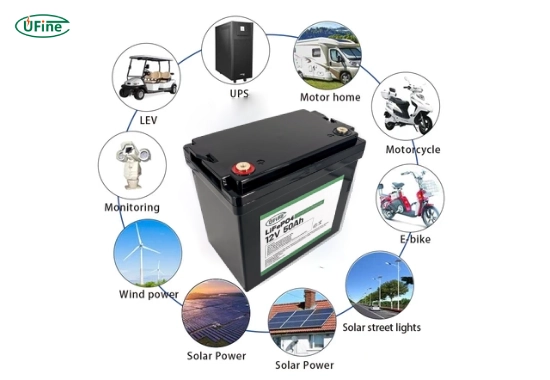
- Part 5. Best 12v 50ah lithium battery applications
- Part 6. How to size an inverter for a 12v 50ah lithium battery
- Part 7. How to charge a 12v 50ah lithium battery
- Part 8. Can you connect multiple 12v 50ah lithium batteries?
- Part 9. 12v 50ah lithium battery safety and buying checklist
- Part 10. FAQs about 12v 50ah lithium battery
A 12V 50Ah lithium battery can power LED lights, laptops, CPAP machines, routers, fans, portable refrigerators, and small water pumps. A typical 12V LiFePO4 battery stores about 600–640 watt-hours, but the usable energy is lower after discharge and conversion losses.
This guide explains what a 12 volt 50Ah lithium battery can run, how long it may last, and how to match the battery with an inverter, charger, solar panel, or DC load.
Key Takeaways
- A marketed 12V 50Ah battery stores about 600Wh. A 12.8V LiFePO4 version stores 640Wh.
- Practical usable energy is usually around 500–580Wh after system losses.
- A 10W LED light may run for over 50 hours, while a 100W AC device may run for about 5 hours.
- Battery capacity determines runtime, while the BMS current rating limits maximum output power.
- A 300–500W pure sine wave inverter is suitable for many small appliances.
- Refrigerator runtime depends on average energy consumption, not only compressor wattage.
- A LiFePO4-compatible charger and correctly sized cables, fuses, and connectors are required.
Part 1. What is a 12v 50ah lithium battery?
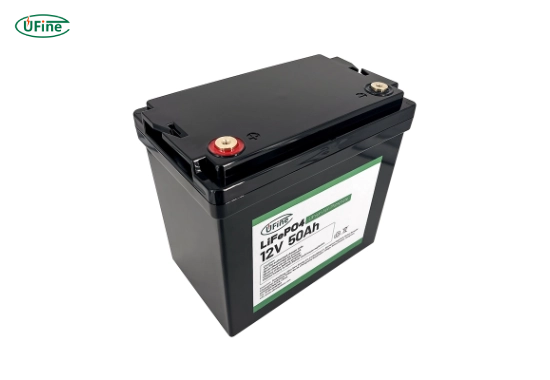
A 12V 50Ah lithium battery is a rechargeable battery pack for 12V electrical systems. Most batteries used in RV, marine, camping, solar, and backup applications use lithium iron phosphate, or LiFePO4, chemistry.
A standard 12V LiFePO4 battery normally contains four 3.2V cells connected in series. Its actual nominal voltage is therefore 12.8V, although it is commonly described as a 12V battery. Our 12V LiFePO4 battery technology guide explains this voltage structure in more detail.
The 50Ah rating means the battery can theoretically supply:
- 50 amps for 1 hour
- 10 amps for 5 hours
- 5 amps for 10 hours
- 1 amp for 50 hours
Actual runtime changes with the load, temperature, battery condition, discharge limit, and BMS settings.
The terms “12V 50Ah lithium battery” and “12V 50Ah lithium ion battery” are often used interchangeably. However, buyers should confirm the exact battery chemistry. LiFePO4, NMC, and other lithium-ion chemistries use different voltage ranges and charging profiles.
See our comparison of 12V lithium and lead-acid battery types for more information.
Part 2. How much energy does a 12v 50ah lithium battery store?
Amp-hours measure battery capacity, but watt-hours are more useful when calculating device runtime.
For a battery marketed as 12V:
12V × 50Ah = 600Wh
For a typical 12.8V LiFePO4 battery:
12.8V × 50Ah = 640Wh
The 600–640Wh value is theoretical. The full amount does not always reach the connected device because of:
- Battery discharge limits
- Inverter conversion losses
- DC converter and cable losses
- Low temperatures
- High discharge currents
A healthy 12.8V 50Ah lithium battery may provide approximately 540–580Wh to efficient DC devices. AC devices may receive around 480–530Wh after inverter losses.
Part 3. What can a 12v 50ah lithium battery power?
Use this formula to estimate the runtime of a DC device:
Runtime = Battery watt-hours × usable capacity ÷ device wattage
For an AC appliance, include inverter efficiency:
Runtime = Battery watt-hours × usable capacity × inverter efficiency ÷ device wattage
The following estimates use a 12.8V 50Ah battery with 640Wh of theoretical energy and include normal operating losses.
| Device | Typical Power | Connection | Estimated Runtime |
|---|---|---|---|
| LED light | 10W | DC | 50–58 hours |
| Wi-Fi router | 12W | DC | 40–48 hours |
| Portable fan | 25W | DC | 20–23 hours |
| CPAP without heated humidifier | 30–40W | DC or AC | 11–17 hours |
| Laptop | 60W | AC inverter | 8–9 hours |
| 12V compressor refrigerator | 35–50W average | DC | 10–16 hours |
| 24-inch LED TV | 80W | AC inverter | 6–6.5 hours |
| Small water pump | 60W | DC | 8–10 hours |
| Small AC appliance | 100W | AC inverter | 4.8–5.3 hours |
| Medium AC load | 300W | AC inverter | 1.5–1.7 hours |
Note: These are planning estimates. Check the actual wattage or daily watt-hour consumption of the connected equipment.
Factors that affect 12V 50Ah battery runtime
- Actual power: Device labels may show maximum rather than average power.
- Duty cycle: Refrigerators and pumps switch on and off instead of running continuously.
- Inverter efficiency: AC conversion normally reduces available energy.
- Temperature and battery condition: Cold weather and battery aging can reduce usable capacity.
Part 4. Can a 12v 50ah lithium battery run a refrigerator?
Yes. A 12V 50Ah lithium battery can run many portable refrigerators and small compressor coolers. However, runtime should be calculated from average energy use rather than rated compressor power.
12V portable refrigerator runtime
A portable compressor refrigerator may draw 40–60W while the compressor is running. The compressor switches off after reaching the set temperature, so average consumption is often lower.
A 12 volt 50Ah battery may run an efficient portable refrigerator for about 10–20 hours. Runtime may be shorter in hot weather or when the refrigerator is opened often.
Household refrigerator runtime
A household refrigerator requires an inverter and may have a high startup surge. Check the appliance label for daily energy use in Wh or kWh.
For example, a refrigerator using 450Wh per day may run for about one day if the battery provides around 500Wh of usable AC energy. A larger refrigerator may drain the battery within several hours.
A 50Ah lithium battery is therefore suitable for short refrigerator backup. Continuous use normally requires solar charging or additional battery capacity.
Part 5. Best 12v 50ah lithium battery applications
| Application | Typical Equipment | Suitability | Main Limitation |
|---|---|---|---|
| Camping | Lights, phones, fans, laptop, portable fridge | Very suitable | Limited capacity for heating devices |
| RV or camper van | Lighting, roof fan, fridge, water pump | Suitable for small systems | Not suitable for air conditioners |
| Solar storage | Lights, router, cameras, sensors | Suitable for compact systems | Charging depends on solar conditions |
| Marine electronics | Fish finder, radio, navigation lights | Suitable | Requires protected marine installation |
| Trolling motor | Small 12V trolling motor | Suitable for limited use | High-speed operation drains it quickly |
| Emergency backup | Router, lighting, phone charging, CPAP | Suitable for essential loads | Not designed for whole-home backup |
| Remote monitoring | Cameras, sensors, communication devices | Very suitable | Standby power must be calculated |
| Field equipment | Test instruments, small pumps, tool chargers | Suitable if correctly sized | Check startup and peak current |
For solar applications, the battery stores energy produced during daylight hours for later use. The U.S. Department of Energy’s solar energy and storage overview explains how storage supports solar power when sunlight is unavailable.
For battery and panel selection, see our LiFePO4 solar battery sizing guide.
Part 6. How to size an inverter for a 12v 50ah lithium battery
A pure sine wave inverter rated at 300–500W is suitable for many small devices. However, the inverter must match both the appliance power and the battery’s continuous discharge current.
Battery capacity and output power are not the same. A 50Ah rating describes stored capacity, while the BMS current rating limits how much current the battery can supply.
For example, a 500W AC load with an inverter operating at 88% efficiency requires approximately:
500W ÷ 12.8V ÷ 0.88 = 44A
The battery, BMS, cables, fuse, terminals, and connectors must safely support this current.
Before choosing an inverter, check:
- Continuous appliance wattage
- Motor or compressor startup surge
- BMS continuous and peak current
- Inverter conversion efficiency
- Cable and terminal current ratings
- Fuse or circuit-breaker rating
A high-wattage inverter does not increase battery capacity. It only allows the system to support a larger load if the battery and BMS are correctly rated.
Part 7. How to charge a 12v 50ah lithium battery
Use a charger designed for LiFePO4 batteries. A typical four-cell LiFePO4 pack uses a CC/CV charging profile with a maximum charging voltage of up to 14.6V.
The final voltage and current must follow the battery datasheet. Our LiFePO4 charging voltage and current guide explains the correct settings.
Charge a 12V 50Ah battery with an AC charger
| Charger Current | Approximate Charging Time |
|---|---|
| 10A | 5–6 hours |
| 20A | 2.5–3 hours |
The battery must support the selected charging current.
Charge a 12V 50Ah battery with solar panels
Use a solar charge controller with a LiFePO4-compatible charging profile. A 100–200W panel is practical for many portable systems, but charging time depends on sunlight, weather, panel angle, and controller efficiency.
Charge a 12V 50Ah battery from a vehicle
Use a lithium-compatible DC-DC charger between the alternator and the battery. Do not connect the battery directly to the alternator unless the complete charging system is designed for it.
Charge a 12V 50Ah battery in cold weather
Most standard LiFePO4 batteries should not be charged below 0°C. Use a battery with low-temperature charging protection or an internal heating system when operating in freezing conditions.
Part 8. Can you connect multiple 12v 50ah lithium batteries?
Multiple batteries can be connected in parallel to increase capacity or in series to increase voltage, but the manufacturer must approve the configuration.
| Connection | Result with Two Batteries | Purpose |
|---|---|---|
| Parallel | 12V 100Ah | Increase runtime |
| Series | 24V 50Ah | Increase system voltage |
Use matched batteries, balance their state of charge, install correctly sized protection and cables, and follow the manufacturer’s series and parallel limits.
After changing the system voltage, confirm that the charger, inverter, controller, and connected equipment remain compatible.
Part 9. 12v 50ah lithium battery safety and buying checklist
LiFePO4 has good thermal stability, but battery safety still depends on cell quality, BMS design, charging control, wiring, enclosure, and installation.
A properly designed lithium battery management system monitors cell voltage, pack current, temperature, state of charge, and cell balance. It also protects against overcharge, over-discharge, short circuits, overcurrent, and overheating.
Check these specifications before choosing a 12 volt 50Ah lithium ion battery:
- Battery chemistry: Confirm LiFePO4 or another lithium-ion chemistry.
- Nominal and usable capacity: Check voltage, watt-hours, and permitted depth of discharge.
- Continuous and peak current: Match the BMS to the normal load and startup surge.
- Charging limits: Check maximum current, voltage, and low-temperature protection.
- Mechanical design: Confirm dimensions, terminals, enclosure, vibration, and water protection.
- Expansion support: Confirm the permitted series and parallel configuration.
- Required documents: Check the safety, transport, and market certifications needed for the application.
For stationary energy storage, standards such as UL 1973 cover battery systems, while UL 9540 applies to complete energy storage systems. The UL energy storage testing and certification guide explains how these standards relate to batteries, inverters, and complete systems.
Equipment manufacturers may also require a custom voltage, enclosure, terminal, communication interface, BMS, discharge rate, or temperature range. Ufine provides custom 12V LiFePO4 battery solutions for application-specific projects.
Part 10. FAQs about 12v 50ah lithium battery
How long will a 12V 50Ah lithium battery run a 100W device?
It can run a 100W AC device for about 5 hours after normal inverter and system losses.
Can a 12V 50Ah lithium battery run a refrigerator overnight?
Yes. It can run many efficient 12V portable refrigerators overnight, depending on temperature and daily energy use.
What inverter size is suitable for a 12V 50Ah lithium battery?
A 300–500W pure sine wave inverter is suitable for many small devices if the BMS supports the required current.
How long does it take to charge a 12V 50Ah lithium battery?
A 10A LiFePO4 charger normally takes about 5–6 hours. A 20A charger may take about 2.5–3 hours.
Is a 12V 50Ah lithium battery better than lead-acid?
LiFePO4 is usually lighter, provides more usable capacity, and lasts more cycles. Lead-acid normally has a lower initial cost.
Related Tags:

More Articles

JST vs Molex: The Right Battery Connector Choice
JST or Molex for your battery? Learn how connector selection affects current, voltage drop, reliability, and device performance.
Custom Battery Pricing: Costs Manufacturers Don’t Mention
A low battery quote may not be the final cost. Discover common hidden expenses that affect custom lithium battery projects.
Battery Wire Length: Hidden Cause of Power Loss
A longer battery wire can cause voltage drop, power loss, and unstable operation. Learn how wire length affects battery performance.
How Device Sleep Modes Affect Battery Life
Think sleep mode extends battery life? Learn why devices still drain power and how firmware, hardware, and batteries affect runtime.
LiPo Battery and PCB Design: Clearance, Insulation, and Placement
Learn how to optimize LiPo battery PCB clearance, insulation, placement, wiring, and thermal design—and avoid common integration mistakes.


