
- Key Takeaways
- Part 1. What does it mean to charge a lifepo4 battery with a power supply?
- Part 2. Power supply vs regular battery charger (Important)
- Part 3. Lifepo4 battery charging voltage requirements with power supply
- Part 4. Lifepo4 battery charging current settings (0.2C–0.5C guide)
- Part 5. Step-by-step: How to charge lifepo4 with a power supply
- Part 6. Lifepo4 charging profile explained (CC/CV charging method)
- Part 7. Lifepo4 battery charging safety guidelines with power supply
- Part 8. How to balance lifepo4 battery cells during charging
- Part 9. Charging lifepo4 batteries in series vs parallel with power supply
- Part 10. Common applications for charging lifepo4 batteries with power supply
- Part 11. FAQs: Charging a lifepo4 battery with a power supply
Lithium Iron Phosphate (LiFePO4) batteries are widely used in solar storage, RVs, marine systems, and industrial equipment. They are stable and long-lasting—but only if charged correctly.
This guide explains how to charge a LiFePO4 battery with a power supply, including voltage and current settings, step-by-step setup, and key safety rules. It also answers a common question: can you charge a lithium iron phosphate battery with a regular battery charger?
Key Takeaways
- LiFePO4 batteries require precise CC/CV charging, not random voltage sources.
- Set voltage to 3.65V per cell (14.6V for 12V systems) to avoid damage.
- Recommended current is 0.2C–0.5C for safe and efficient charging.
- A bench power supply works, but requires manual monitoring.
- Do not float charge LiFePO4 like lead-acid batteries.
- Always use a BMS or external protection system.
Part 1. What does it mean to charge a lifepo4 battery with a power supply?
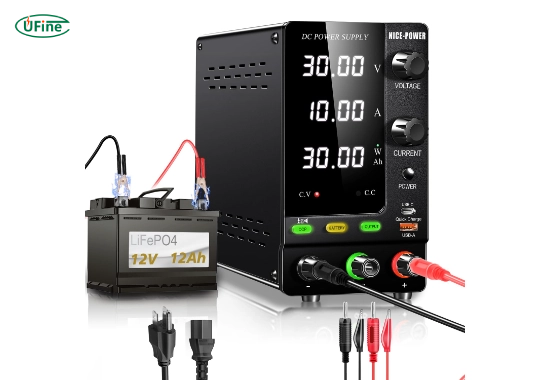
Charging a LiFePO4 battery with a power supply means using an adjustable DC power supply instead of a dedicated lithium charger.
This method is common in:
- DIY battery projects
- Lab testing / engineering validation
- Emergency charging scenarios
- Custom battery pack development
Unlike standard chargers, a power supply gives full control over voltage and current, but also requires correct setup.
Part 2. Power supply vs regular battery charger (Important)
Many users ask: Can you charge a lithium iron phosphate battery with a regular battery charger?
Short answer: Not recommended.
| Charger Type | Suitable for LiFePO4? | Reason |
|---|---|---|
| Lead-acid charger | ❌ No | Uses float charging, wrong voltage profile |
| Li-ion charger (generic) | ⚠️ Risky | Different voltage curve |
| LiFePO4 charger | ✅ Yes | Correct CC/CV profile |
| Adjustable power supply | ✅ Yes (manual) | Requires correct setup |
👉 A power supply works only if you manually configure correct parameters.
Part 3. Lifepo4 battery charging voltage requirements with power supply
LiFePO4 cells have strict voltage limits:
- Nominal voltage: 3.2V per cell
- Max charging voltage: 3.65V per cell
Common Battery Pack Voltages
| Battery System | Cells (Series) | Max Charge Voltage |
|---|---|---|
| 12V LiFePO4 | 4S | 14.6V |
| 24V LiFePO4 | 8S | 29.2V |
| 48V LiFePO4 | 16S | 58.4V |
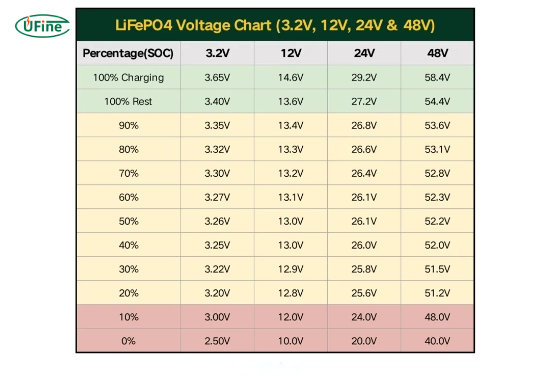
👉 For detailed voltage states, see: LiFePO4 Voltage Chart Guide
Practical Rules
- Set power supply to exact pack voltage (e.g., 14.6V)
- Never exceed 3.65V per cell
- Use a multimeter to verify output before connecting
Part 4. Lifepo4 battery charging current settings (0.2C–0.5C guide)
Charging current defines how fast the battery charges.
Recommended Range
- 0.2C (slow, longest lifespan)
- 0.5C (balanced speed and safety)
Example
100Ah battery →
- 20A (0.2C) → safer
- 50A (0.5C) → faster
Engineering Insight
- Lower current = less heat + longer cycle life
- Higher current = faster charging but more stress
👉 Never exceed manufacturer limits.
Part 5. Step-by-step: How to charge lifepo4 with a power supply
Follow this exact sequence:
Check Battery Specifications
Confirm voltage and max current. Verify BMS presence.
Connect Properly
Use low-resistance cables. Ensure correct polarity.
Set Voltage (CV Mode)
Example: 14.6V for 12V battery.
Set Current Limit (CC Mode)
Example: 0.2C–0.5C.
Start Charging
Current stays constant initially. Voltage gradually rises.
Monitor in Real Time
Watch voltage, current, temperature.
Stop Charging
When current drops near 0.05C–0.1C. Do NOT leave connected indefinitely.
Part 6. Lifepo4 charging profile explained (CC/CV charging method)
LiFePO4 charging follows a two-stage profile:
- Constant Current (CC) – Battery charges at fixed current. Voltage increases gradually.
- Constant Voltage (CV) – Voltage stays fixed (e.g., 14.6V). Current slowly drops.
👉 Unlike lead-acid, no float stage is needed.
Part 7. Lifepo4 battery charging safety guidelines with power supply
- Avoid overvoltage → main failure cause
- Do not exceed current limits
- Always use a BMS (Battery Management System)
- Ensure proper ventilation
- Never charge unattended in DIY setups
- Double-check wiring before power-on
For safety standards, refer to: UL Battery Safety Standards
Part 8. How to balance lifepo4 battery cells during charging
In multi-cell packs, imbalance can reduce lifespan.
Solutions
- Built-in BMS balancing
- External battery balancer
- Periodic full charge cycles
👉 Balancing ensures all cells stay near equal voltage.
Part 9. Charging lifepo4 batteries in series vs parallel with power supply
Series Charging
- Set voltage = total pack voltage
- Example: 4S → 14.6V
Parallel Charging
- Ensure same state of charge (SOC) before connecting
- Use equal-length cables for uniform current flow
Part 10. Common applications for charging lifepo4 batteries with power supply
| Application | Why Use Power Supply |
|---|---|
| Lab testing | Precise control |
| Battery R&D | Adjustable parameters |
| DIY solar storage | Flexible charging |
| Emergency charging | Backup solution |
Part 11. FAQs: Charging a lifepo4 battery with a power supply
How to charge a LiFePO4 battery with a power supply safely?
Set correct voltage (3.65V per cell) and current (0.2C–0.5C), use CC/CV mode, and monitor continuously.
Can you charge a LiFePO4 battery with a regular charger?
No. Most regular chargers (especially lead-acid) use incorrect voltage and float charging, which can damage LiFePO4 batteries.
What voltage should I use to charge a 12V LiFePO4 battery?
Set the power supply to 14.6V for a standard 4-cell (12V) LiFePO4 battery.
How long does it take to charge a LiFePO4 battery?
It depends on current. Example: 100Ah battery at 20A ≈ 5 hours.
Is it safe to leave a LiFePO4 battery connected to a power supply?
No. Disconnect after full charge. LiFePO4 does not require float charging and prolonged connection can cause stress.
Related Tags:

More Articles

JST vs Molex: The Right Battery Connector Choice
JST or Molex for your battery? Learn how connector selection affects current, voltage drop, reliability, and device performance.
Custom Battery Pricing: Costs Manufacturers Don’t Mention
A low battery quote may not be the final cost. Discover common hidden expenses that affect custom lithium battery projects.
Battery Wire Length: Hidden Cause of Power Loss
A longer battery wire can cause voltage drop, power loss, and unstable operation. Learn how wire length affects battery performance.
How Device Sleep Modes Affect Battery Life
Think sleep mode extends battery life? Learn why devices still drain power and how firmware, hardware, and batteries affect runtime.
LiPo Battery and PCB Design: Clearance, Insulation, and Placement
Learn how to optimize LiPo battery PCB clearance, insulation, placement, wiring, and thermal design—and avoid common integration mistakes.


