- Part 1. What is power consumption?
- Part 2. How to calculate power consumption
- Part 3. Calculating power consumption from battery specifications
- Part 4. How to calculate battery runtime
- Part 5. Measuring the actual power consumption of a device
- Part 6. Factors that affect power consumption
- Part 7. Ways to reduce power consumption and extend battery life
- Part 8. Choosing the right battery for your power requirements
- Conclusion
- FAQs
According to the International Energy Agency (IEA), global electricity demand is forecast to grow by 3.6% in 2026, following approximately 3% growth in 2025. This rising demand highlights the importance of using electricity efficiently, from large industrial systems to the small electronic devices we use every day.
The good news is that calculating power consumption does not require advanced electrical engineering knowledge. With a few basic formulas and some information about your device, you can estimate how much power it uses and how long its battery may last.
Part 1. What is power consumption?

Power consumption refers to the amount of electrical power a device uses while operating. It is usually measured in watts (W). A device that consumes more watts requires more power at that moment, while a device that uses fewer watts generally needs less energy to perform its function over the same period.
Three units are particularly important when evaluating battery-powered electronics:
-
Watt (W): Measures the rate at which a device consumes power.
-
Watt-hour (Wh): Measures the amount of energy consumed or stored over time.
-
Milliamp-hour (mAh): Measures battery capacity in terms of current delivered over time.
These units are related, but they are not interchangeable. For example, a battery rated at 2,000mAh does not tell you exactly how much energy it stores unless you also know its voltage.
Understanding the difference matters when designing products such as Bluetooth accessories, smart home sensors, portable medical electronics, and wearable devices. You need to know both how much power the device requires and how much energy its battery can supply.
Part 2. How to calculate power consumption
The simplest way to calculate electrical power is to multiply voltage by current.
Power consumption formula:
Power (W) = Voltage (V) × Current (A)
Voltage represents the electrical potential supplied to a device, while current describes the amount of electrical charge flowing through it. Multiplying these values gives the power consumed under the measured operating conditions.
For example, imagine a portable electronic device operating at 5V and drawing 0.4A of current.
Power = 5V × 0.4A = 2W
This means the device consumes approximately 2 watts while operating at that voltage and current.
If your current reading is in milliamps (mA), convert it to amps (A) before calculating power. Simply divide the current by 1,000.
For example, 250mA equals 0.25A. If a device operates at 3.7V and draws 250mA, its power consumption is:
Power = 3.7V × 0.25A = 0.925W
Once you know the power consumption, you can calculate energy usage over a period of time.
Energy consumption formula:
Energy (Wh) = Power (W) × Operating time (h)
If the same 0.925W device operates continuously for 4 hours, it consumes:
Energy = 0.925W × 4h = 3.7Wh
Keep in mind that this calculation assumes relatively stable power consumption. If the device switches between sleep, idle, and active modes, you should use its average power consumption for a more realistic estimate.
Part 3. Calculating power consumption from battery specifications
Battery specifications are useful when estimating how much energy a portable device can access. However, battery capacity alone does not directly indicate power consumption.
To convert battery capacity from mAh to Wh, use this formula:
Battery energy (Wh) = Voltage (V) × Capacity (Ah)
First, convert the capacity from milliamp-hours to amp-hours by dividing by 1,000.
For example, consider a lithium polymer battery rated at 3.7V and 2,000mAh.
Capacity = 2,000 ÷ 1,000 = 2Ah
Battery energy = 3.7V × 2Ah = 7.4Wh
The battery therefore has a nominal energy capacity of 7.4Wh. This does not mean it continuously supplies 7.4W. Its actual power output depends on the connected device’s current demand, the battery’s voltage under load, and its discharge capabilities.
The following examples illustrate how voltage and current affect power consumption.
| Operating voltage | Current draw | Power consumption |
|---|---|---|
| 3.7V | 100mA | 0.37W |
| 3.7V | 500mA | 1.85W |
| 5V | 500mA | 2.5W |
| 5V | 1,000mA | 5W |
| 12V | 500mA | 6W |
As the table shows, higher voltage or higher current can increase power consumption. When comparing devices, make sure the voltage and current values represent the same operating condition.
For battery-powered products, also distinguish between nominal voltage and fully charged voltage. A typical single-cell lithium polymer battery has a nominal voltage of 3.7V and a full-charge voltage of 4.2V, although specifications vary by battery chemistry and design. Always follow the battery manufacturer’s stated voltage limits.
Part 4. How to calculate battery runtime
Knowing power consumption is especially useful when you need to estimate how long a battery-powered device can operate between charges.
A straightforward estimate is:
Battery runtime (hours) = Battery energy (Wh) ÷ Average device power (W)
Suppose a device uses a 3.7V, 2,000mAh lithium polymer battery. As calculated earlier, the battery stores a nominal 7.4Wh of energy.
If the device consumes an average of 1.48W, its theoretical runtime is:
Runtime = 7.4Wh ÷ 1.48W = 5 hours
In practice, the device may operate for less than five hours. Some energy is lost through voltage conversion, and the battery may not deliver its full rated capacity under every operating condition.
A more practical estimate accounts for usable battery energy and system efficiency:
Estimated runtime = (Battery energy × Usable capacity factor × Conversion efficiency) ÷ Average power consumption
For example, assume 90% of the battery’s rated energy is usable and the power system operates at 90% efficiency.
Runtime = (7.4Wh × 0.9 × 0.9) ÷ 1.48W ≈ 4.05 hours
These factors are illustrative rather than universal. Actual results depend on battery characteristics, cutoff voltage, temperature, load profile, and circuit design.
If you are designing a device that must operate for a full day, calculate runtime using realistic average power consumption rather than the maximum power rating alone. For products with intermittent wireless communication or frequent processor activity, this distinction can make a substantial difference.
Part 5. Measuring the actual power consumption of a device
Calculations provide a useful starting point, but measuring your device directly can give you a more accurate picture of its real-world power consumption.
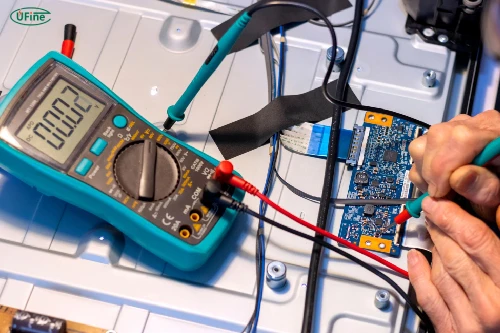
A multimeter is a common tool for measuring voltage and current. Measure voltage across the appropriate terminals and current using the meter’s correct current-measurement configuration. Always follow the instrument’s instructions, and never connect a meter in current mode directly across a battery, as this can cause a short circuit.
For USB-powered electronics, a USB power meter can make the process easier. It can display voltage, current, and sometimes accumulated energy without requiring you to modify the device’s wiring.
Remember that power consumption often changes with operating conditions. A wearable device may draw very little current while its screen is off but consume substantially more when the display, sensors, and wireless connection are active.
For a realistic estimate, measure the device in different operating modes and calculate its average consumption over a representative period. This approach is particularly useful for products that spend most of their time in standby mode.
Part 6. Factors that affect power consumption
Several factors determine how much power an electronic device requires.
Operating conditions: A processor performing intensive calculations generally consumes more power than one in an idle state. Similarly, a display’s brightness and refresh rate can influence a device’s energy requirements.
Wireless communication: Bluetooth, Wi-Fi, cellular connectivity, and frequent data transmission can increase power consumption. The effect depends on signal strength, transmission frequency, hardware design, and communication protocols.
Standby operation: Devices can continue consuming power even when they appear inactive. Lawrence Berkeley National Laboratory estimates that standby power typically accounts for around 5–10% of residential electricity use in developed countries. The figure varies by household and device.
Temperature and battery condition: Temperature affects battery performance, while aging can reduce the amount of energy a battery can store. A battery that has lost capacity may therefore provide shorter runtime even if the device’s power consumption remains unchanged.
Power conversion efficiency: Electronic devices often require a different voltage from the battery’s output. Voltage regulators and other conversion circuits consume some energy during this process. More efficient circuits can reduce these losses and extend operating time.
Part 7. Ways to reduce power consumption and extend battery life
Reducing power consumption starts with understanding where the energy goes. Once you identify the components or operating modes that use the most power, you can make targeted improvements.
For example, developers can configure processors to enter low-power modes when processing is unnecessary. Displays can dim or switch off automatically, and wireless modules can transmit data less frequently when real-time communication is not essential.
Component selection also matters. Efficient sensors, processors, and voltage regulators can reduce energy demand without sacrificing essential functionality.
For battery-powered products, choose a battery that matches the device’s voltage and current requirements. Avoid selecting capacity based on runtime alone: the battery must also support the device’s peak current demand and fit within its available space and weight limits.
A properly designed battery management system can provide important protections, including overcharge and over-discharge protection where appropriate. However, it does not automatically make an inefficient device energy-efficient. Battery selection and circuit optimization should work together.
Part 8. Choosing the right battery for your power requirements
Once you know your device’s average power consumption and target runtime, you can estimate the battery energy required.
For example, if a portable device consumes an average of 0.8W and needs to operate for 10 hours, its theoretical energy requirement is:
Required energy = 0.8W × 10h = 8Wh
If you assume that only 80% of the battery’s rated energy will be available for the intended application, the minimum nominal battery energy becomes:
Required battery energy = 8Wh ÷ 0.8 = 10Wh
The 80% figure is an illustrative design allowance, not a universal battery specification. Your actual design should account for conversion losses, cutoff voltage, temperature, aging, and safety margins.
For a compact consumer electronic product, a lithium polymer battery may be a suitable option because its form factor can be adapted to different enclosure designs. When comparing custom battery options, consider:
-
Voltage: Ensure the battery voltage range is compatible with the device’s power circuit.
-
Capacity: Calculate the energy needed to achieve the desired runtime.
-
Discharge capability: Confirm that the battery can supply both continuous and peak current safely.
-
Size and weight: Check the available installation space and product weight requirements.
-
Protection and certification: Specify suitable protection features and verify the certifications required for your target market.
Working with a battery manufacturer early in product development can help you balance capacity, dimensions, discharge performance, and operating life.
Conclusion
Calculating power consumption is a practical way to understand how electronic devices use energy and how to improve their battery life. By multiplying voltage by current, converting battery capacity into watt-hours, and estimating runtime, you can make more informed decisions during product design and battery selection.
For compact consumer electronics, the best results come from combining accurate power measurements with efficient circuit design and a battery that meets the device’s voltage, capacity, discharge, and space requirements. These calculations provide a solid starting point for building products that operate reliably and use energy efficiently.
FAQs
1. What is the difference between watts and watt-hours?
Watts measure the rate of power consumption, while watt-hours measure energy consumed or stored over time.
2. How do you calculate power consumption from voltage and current?
Convert current to amps if necessary, then multiply it by voltage. For example, 3.7V × 0.5A = 1.85W.
3. How do you calculate battery capacity in mAh?
Battery capacity in mAh is normally provided by the manufacturer or determined through appropriate battery testing. To convert mAh to Wh, multiply the capacity in Ah by the nominal voltage.
4. Does higher battery capacity increase power consumption?
No. Higher capacity means the battery can generally store more energy. The device’s power requirements determine how quickly that energy is used.
5. Why does actual battery life differ from calculated runtime?
Conversion losses, temperature, battery aging, peak loads, and variations in device activity can all affect actual runtime.
6. How can I reduce the power consumption of a battery-powered device?
Optimize processor activity, display settings, wireless communication, standby operation, and power conversion efficiency.
Related Tags:

More Articles

How to Reduce Power Consumption in Battery-Powered Devices?
Discover practical ways to reduce power consumption, eliminate hidden energy waste, and extend battery life in portable electronic devices
Buck vs. Boost vs. Buck-Boost Converter: Which Is Best for Battery?
Not sure which converter your battery-powered device needs? Compare Buck, Boost, and Buck-Boost designs and discover what affects voltage stability and runtime.
How to Match 18650 Cells for a Reliable Battery Pack?
Building an 18650 battery pack? Learn how to compare cell capacity, voltage, and internal resistance to avoid mismatches and improve reliability.
Why Do 18650 Battery Packs Get Hot During Discharge?
Is your 18650 battery pack overheating under load? Learn what causes excess heat, how to spot dangerous symptoms, and what to do next.
18650 Battery BMS: How to Get the Specs Right
Learn how to choose a BMS for an 18650 battery pack. Compare voltage, current ratings, protection features, and balancing before you buy.