- Key takeaways
- Part 1. What does a battery for car audio do?
- Part 2. Why a stock car battery may not be enough
- Part 3. Starter battery vs. deep-cycle battery for car audio
- Part 4. Lead-acid vs. lithium battery for car audio
- Part 5. How lithium batteries improve car audio performance
- Part 6. How to size a battery for a car sound system
- Part 7. Should you add a secondary car audio battery?
- Part 8. Can a lithium battery replace the starter battery?
- Part 9. How to choose the best lithium battery for car audio
- Part 10. Best battery for car audio by application
- Part 11. Car audio lithium battery brand comparison
- Part 12. Charging a lithium battery for car audio
- Part 13. Car audio battery wiring and fuse safety
- Part 14. Common car audio lithium battery myths
- Part 15. How to extend car audio battery life
- Part 16. Car audio battery selection checklist
- Part 17. FAQs about batteries for car audio
The best battery for car audio depends on system power, alternator output, and playtime needs, delivering high current and reducing voltage drop during peak demand.
For high-power setups, lithium batteries offer more stable voltage, lighter weight, faster charging, and higher usable capacity than AGM or lead-acid, but must match system requirements.
Key takeaways
- The alternator provides continuous power while the engine runs. The battery supports power peaks and engine-off playback.
- Choose a car audio battery based on system voltage, amplifier current, alternator output, temperature, and required playtime.
- Do not size the battery by amplifier watts or Ah alone. Check usable capacity, continuous discharge current, pulse current, and BMS limits.
- LiFePO4 is suitable for most daily car audio systems, while LTO is better for competition systems that need extreme burst current.
- Do not directly connect lithium and lead-acid batteries unless approved. Use correctly rated cables, fuses, grounds, and battery restraints.
Part 1. What does a battery for car audio do?
A battery for car audio stores energy, supports bass peaks, and helps keep amplifier voltage stable. It also powers the sound system when the engine is off.
- Stores energy: Powers amplifiers, subwoofers, and audio equipment when the alternator is not running.
- Supports peak loads: Supplies extra current during hard bass hits.
- Limits voltage drop: Helps keep voltage within the amplifier’s safe range.
A battery does not create more amplifier power. It only helps the amplifier receive enough current at a stable voltage. If the alternator cannot support the average load, the battery will still discharge while the engine is running.
| Component | Main Function | What It Cannot Replace |
|---|---|---|
| High-output alternator | Supplies continuous current while the engine runs | Energy storage for engine-off use |
| Car audio battery | Stores energy and supports short power peaks | An undersized alternator during long playback |
| Big Three wiring upgrade | Reduces resistance in charging and ground paths | Extra power generation or battery capacity |
| Supercapacitor bank | Supports very short current peaks | Long playtime or sustained power demand |
A reliable car sound system needs the right balance of alternator output, battery capacity, wiring, protection, and heat control.
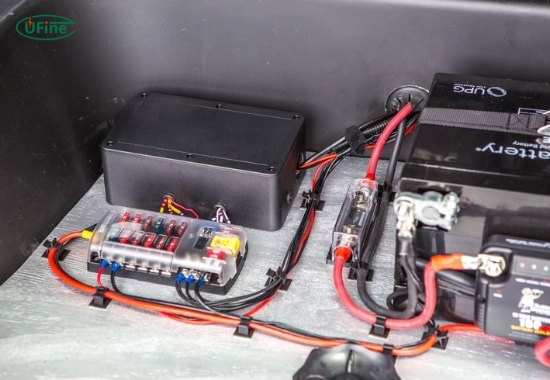
Part 2. Why a stock car battery may not be enough
Most factory batteries are designed to start the engine and support standard vehicle electronics. They may not handle the repeated current demand of large amplifiers.
Common warning signs include:
- Headlights dim during bass hits
- Voltage drops at the amplifier
- The amplifier enters protection mode
- The sound becomes distorted at high volume
- The engine cranks slowly after engine-off playback
- The starter battery fails more often than expected
- Cables, terminals, or fuse holders become hot
These signs do not always mean the battery is too small. Weak grounds, thin cables, loose terminals, a failing alternator, poor gain settings, or low speaker impedance can cause similar problems.
How to find the cause of voltage drop
| Test Result | Likely Cause | Recommended Action |
|---|---|---|
| Front battery voltage is normal, but amplifier voltage is low | High resistance in the cable or connection | Check cable size, terminals, fuse holders, grounds, and cable length |
| Voltage is low at both the battery and amplifier | Alternator output may be too low | Test alternator output at idle and normal driving RPM |
| Voltage is stable while driving, but engine-off runtime is short | Battery capacity is too low | Increase usable battery capacity |
| The amplifier clips while voltage remains stable | Incorrect gain, signal, impedance, or amplifier size | Check amplifier and speaker settings |
| A terminal or fuse holder becomes hot | Loose or high-resistance connection | Stop using the system and repair the connection |
Measure voltage at the amplifier while the system is under load. Battery voltage alone may not show losses in a long cable run.
Part 3. Starter battery vs. deep-cycle battery for car audio
A starter battery delivers high current for a few seconds to start the engine. It is not designed for frequent deep discharge.
A deep cycle battery for car audio supplies energy for longer periods. It can usually handle deeper discharge and repeated engine-off use.
Some batteries support both starting and deep cycling. Others are designed only as secondary batteries. Check the intended use before replacing the factory starter battery.
Part 4. Lead-acid vs. lithium battery for car audio
The main options are flooded lead-acid, AGM, LiFePO4, and lithium titanate oxide, or LTO.
| Feature | Flooded Lead-Acid | AGM | LiFePO4 | LTO |
|---|---|---|---|---|
| Initial cost | Low | Medium | Medium to high | High |
| Weight | High | High | Low | Low to medium |
| Voltage stability | Fair | Good | Very good | Excellent |
| Charge acceptance | Slow | Moderate | Fast with proper control | Very fast with proper control |
| Usable capacity | Limited | Moderate | High | High |
| Typical cycle life | Low to moderate | Moderate | High | Very high |
| High-current performance | Moderate | Good | Very good with high-rate cells | Excellent |
| Best use | Basic systems | Daily audio upgrades | High-power daily systems | Competition and burst-power systems |
Performance depends on cell design, internal resistance, temperature, battery age, and discharge current. Do not compare batteries by chemistry or Ah rating alone.
LiFePO4 battery for car audio
LiFePO4 is a practical choice for many daily car audio systems. A common 12V-class pack uses four cells in series and has a nominal voltage of about 12.8V.
Key benefits include:
- Stable voltage under load
- Low weight
- High usable capacity
- Long cycle life
- Good thermal stability
- Strong output when high-rate cells are used
Not every LiFePO4 battery is suitable for car audio. A battery built for solar storage may have a low-current BMS. It may shut down when an amplifier draws a large current.
Review the available 12V LiFePO4 battery configurations when comparing capacity, voltage, pack size, and custom options.
LTO battery for car audio
LTO batteries are common in competition-level systems. They have low internal resistance and strong pulse-current performance.
LTO is useful when the system needs:
- Very high burst current
- Fast voltage recovery
- Frequent high-rate charging
- Long cycle life
- Strong performance under repeated loads
LTO costs more and stores less energy per unit of weight than many LiFePO4 batteries. Pack voltage also changes with the number of cells in series. The alternator and charger must match the exact pack design.
AGM battery for car audio
AGM is still a good battery for car audio when the system is moderate or the budget is limited. It is also easier to use with many factory charging systems.
AGM batteries are widely available and simple to install. However, they are heavier and provide less usable energy per kilogram than lithium batteries.
Repurposed car audio lithium cells
Some advanced installers build battery banks from used automotive modules, including Ford C-Max cells.
These cells may provide high current at a lower cost. However, the builder must check:
- Cell chemistry and voltage limits
- Capacity and state of health
- Internal resistance and cell matching
- Busbar and terminal current ratings
- Compression requirements
- Cell balancing
- Fuses and overcurrent protection
- Insulation and enclosure design
- Temperature monitoring
Used car audio lithium cells are not plug-and-play products. They may have different aging histories and capacity levels. They should only be used by experienced builders with proper test equipment.
Part 5. How lithium batteries improve car audio performance
A suitable lithium battery can improve a car audio system in five main ways:
- Less voltage sag: Low internal resistance helps support bass peaks.
- More usable energy: More of the rated capacity can often be used.
- Lower weight: Lithium is much lighter than a similar lead-acid setup.
- Faster charging: Lithium cells can accept high charge current when the system is designed for it.
- More stable amplifier output: Stable voltage reduces early clipping and protection shutdowns.
No battery provides zero voltage drop. Every cell, cable, fuse, busbar, and terminal adds resistance.
A better battery also does not directly improve sound quality. It helps the amplifier work within its voltage range. Speaker design, enclosure tuning, gain settings, and source quality still affect the final sound.
Part 6. How to size a battery for a car sound system
Do not use a fixed Ah value for every 1,000 watts. Systems with the same RMS power can have very different energy needs.
Battery sizing should include:
- Total amplifier RMS power
- Amplifier efficiency
- System voltage
- Average listening level
- Alternator output at idle and driving RPM
- Normal vehicle electrical load
- Required engine-off playtime
- Battery discharge-current limit
- Allowed depth of discharge
Estimate amplifier current
Use this formula:
DC Current = Amplifier RMS Power ÷ (System Voltage × Amplifier Efficiency)
For a 2,000W amplifier at 13.8V and 80% efficiency:
2,000 ÷ (13.8 × 0.80) = 181A
This is an estimate at high output. Normal music does not remain at full RMS power. However, the battery, BMS, cables, fuses, and terminals must still support the expected peak load.
Calculate alternator reserve
The alternator’s label rating is not the full amount available to the audio system. The vehicle also uses power for lighting, cooling fans, fuel pumps, air conditioning, and control systems.
Use this simplified formula:
Battery Support Current = Audio Current + Vehicle Load − Usable Alternator Output
Alternator output may be much lower at idle. High temperature can also reduce output. If battery support current stays positive, the battery will discharge during playback.
Calculate engine-off playtime
Use the average current during normal listening:
Required Capacity = Average Current × Playtime ÷ Usable Depth of Discharge
For example, a system that averages 50A for 30 minutes needs:
50A × 0.5 hour ÷ 0.80 = 31.25Ah
Add extra capacity for cold weather, battery aging, cable loss, BMS reserve, and other vehicle loads.
Starting points by system power
| Audio System | Main Check | Possible Upgrade |
|---|---|---|
| Up to about 1,000W RMS | Battery condition, wiring, voltage drop, and alternator reserve | A healthy factory system may be enough |
| 1,000–2,000W RMS | Idle alternator output and amplifier voltage | Big Three wiring, stronger battery, or secondary battery |
| 2,000–5,000W RMS | Sustained alternator output and cable current rating | High-output alternator and high-rate lithium battery |
| Above 5,000W RMS | Current, heat, voltage design, and protection | Engineered charging and multi-battery system |
These ranges are only starting points. Amplifier efficiency, music duty cycle, alternator output, and playtime will change the final battery size.
Part 7. Should you add a secondary car audio battery?
A secondary battery is often placed close to the amplifiers. This shortens the high-current path and can reduce cable voltage drop.
It may provide:
- Better voltage at rear amplifiers
- More support during bass peaks
- Longer engine-off playtime
- Less cycling of the starter battery
- More flexible battery placement
A second battery does not reduce alternator load. The alternator must replace all energy used by both batteries.
Can you mix lithium and AGM batteries?
Do not connect AGM and lithium batteries directly in parallel unless both manufacturers approve the setup.
The two chemistries may have different resting voltages, charging profiles, resistance, temperature limits, and low-voltage cutoffs.
A DC-DC charger, isolator, contactor, or controlled relay may be needed. The correct design depends on the battery specifications and vehicle charging system.
Part 8. Can a lithium battery replace the starter battery?
Some lithium batteries support engine starting. Others are only designed for audio reserve power.
Before replacing the starter battery, check:
- Cranking-current rating
- Continuous and pulse-current limits
- Alternator charging voltage
- Cold-weather starting ability
- Low-temperature charging protection
- Under-hood temperature rating
- Vehicle battery sensor compatibility
- Battery size and terminal layout
- Battery registration or coding requirements
Many modern vehicles use smart alternators and battery sensors. These systems may adjust charging based on the expected battery type. A DC-DC controller or other charging hardware may be required.
Part 9. How to choose the best lithium battery for car audio
The best lithium battery for car audio is not always the model with the highest Ah, CCA, or watt rating. Compare the following values.
1. Match the charging voltage
Measure vehicle voltage when the engine is cold, hot, idling, and driving. Compare these readings with the battery’s recommended and maximum charging voltage.
Do not assume every 12V LiFePO4 battery should charge at 14.6V. The correct voltage depends on the cells, BMS, balancing method, and target service life.
2. Check continuous discharge current
A peak-current rating may only apply for a few seconds. Car audio amplifiers can draw high current for longer periods.
Confirm:
- Cell continuous current
- Pack continuous current
- BMS continuous current
- Pulse-current rating and duration
- Busbar and terminal current ratings
Systems with repeated high-current demand may need a purpose-built high-rate discharge battery for high-power equipment.
3. Compare watt-hours and amp-hours
Amp-hours show capacity at a given voltage. They do not show total stored energy by themselves.
Energy in Wh = Nominal Voltage × Capacity in Ah
Watt-hours are useful when comparing 12V, 14V, and 16V car audio batteries.
4. Review the BMS limits
A battery management system can monitor voltage, current, temperature, and cell balance. It may also protect against overcharge, over-discharge, overcurrent, and short circuit.
A BMS built for low-current energy storage may not support a large amplifier. Its continuous and pulse-current limits must match the real system load.
Ufine’s guide to battery management system functions and protection limits explains the main role of a BMS. UL Research Institutes also describes how lithium-ion battery safety controls help manage abnormal voltage, current, and temperature.
5. Check the temperature range
Vehicle cabins and engine bays can become very hot. Cold weather can also limit lithium charging.
Many LiFePO4 cells should not charge below their specified temperature limit. Low-temperature cutoff or battery heating may be required.
Only install a battery under the hood if it is rated for heat, vibration, moisture, and contamination in that location.
6. Check the mechanical design
The installation should include:
- A secure battery mount
- A strong protective enclosure
- Insulated terminals
- Protection from sharp or moving parts
- Cable strain relief
- Suitable airflow or heat control
- Protection from water and conductive debris
7. Verify battery documents
Ask for the cell datasheet, battery specification, BMS limits, test reports, and transport documents.
UN 38.3 covers transport testing for lithium cells and batteries. It does not confirm that a battery is correctly sized for a car audio system. The test requirements are published in the United Nations Manual of Tests and Criteria, Section 38.3.
Part 10. Best battery for car audio by application
| Application | Recommended Direction | Main Selection Priority |
|---|---|---|
| Moderate daily sound system | AGM or compatible LiFePO4 | Charging compatibility and reliability |
| High-power daily system | High-rate LiFePO4 and adequate alternator output | Continuous current and usable energy |
| Long engine-off playback | High-capacity LiFePO4 deep-cycle battery | Watt-hours and cycle life |
| SPL competition | LTO or specialized high-power lithium bank | Low resistance and burst current |
| Cold-weather vehicle | Lithium battery with verified low-temperature protection | Charging cutoff, heating, and temperature range |
| Custom vehicle or OEM audio product | Engineered custom battery pack | Voltage, size, BMS, current, and test requirements |
| Low-cost basic upgrade | Quality AGM battery | Simple installation and local support |
Part 11. Car audio lithium battery brand comparison
No single brand is best for every system. Compare exact model specifications before making a final choice.
| Brand or Solution | Main Position | Best For | What to Confirm |
|---|---|---|---|
| Ufine Battery | Custom LiFePO4 and high-rate battery packs | OEMs, installers, distributors, and custom projects | Voltage, current, BMS, size, temperature range, and required documents |
| Limitless Lithium | Purpose-built car audio batteries | Retail audio builds and SPL systems | Chemistry, charging voltage, alternator compatibility, and current rating |
| XS Power Titan8 | LTO power and reserve modules | High-burst systems and competition builds | System voltage, power or reserve design, current rating, and mounting location |
| Repurposed C-Max cells | Used automotive cells for DIY banks | Experienced battery builders | Cell condition, matching, balancing, compression, enclosure, and protection |
Ufine provides custom lithium battery pack design for projects that need specific voltage, capacity, dimensions, wiring, BMS settings, or enclosure structures.
A finished battery with clear specifications and test documents is usually safer and easier to support than a DIY pack made from used cells.
Part 12. Charging a lithium battery for car audio
The charger and alternator must match the battery chemistry and pack voltage.
Alternator charging
Check:
- Maximum alternator voltage
- Alternator output at idle
- Output at high temperature
- Battery maximum charge current
- BMS charge-current limit
- Smart alternator behavior
A low-resistance lithium battery may draw more charge current than the alternator can safely supply. A DC-DC charger or current limiter may be needed.
External charging
Use a charger made for the battery chemistry and voltage. Avoid equalization or desulfation modes unless the lithium battery manufacturer allows them.
12V, 14V, and 16V systems
A higher system voltage can increase available amplifier power. However, every connected part must support that voltage. This includes amplifiers, vehicle electronics, alternators, relays, fans, lights, and signal processors.
See Ufine’s 16V battery voltage and charging guide for more details.
Part 13. Car audio battery wiring and fuse safety
High-power systems can carry hundreds of amps. A small amount of extra resistance can cause heat, voltage loss, or fire.
Use the correct cable
Select cable based on current, length, insulation temperature, installation area, and allowed voltage drop. Do not choose cable from amplifier wattage alone.
The SAE J1127 low-voltage battery cable standard covers battery cable used in surface-vehicle electrical systems up to 60V DC.
Fuse every positive power source
Install a fuse close to the positive terminal of each battery. If a cable connects front and rear batteries, both ends may need protection because either battery can feed a short circuit.
The fuse protects the cable. Its rating must stay below the cable’s safe current limit and above normal operating current.
Build a low-resistance ground path
Remove paint, rust, and dirt from ground points. Use properly crimped terminals and protect the joint from corrosion.
Very high-current systems may need a dedicated negative cable instead of relying only on the vehicle body.
Do not use the BMS as a fuse
A BMS does not replace external overcurrent protection. The battery and every major power cable still need suitable fuses.
Part 14. Common car audio lithium battery myths
| Myth | Reality |
|---|---|
| Lithium removes all voltage drop | Every battery and connection has resistance. Lithium can reduce voltage sag but cannot remove it. |
| More Ah always means more amplifier power | Ah measures capacity. Power also depends on current rating, resistance, voltage, and BMS limits. |
| A larger battery fixes a weak alternator | The battery will still discharge if the alternator cannot support the average load. |
| Any 12V lithium battery works in any car | Charging voltage, temperature, current, and vehicle electronics must match. |
| AGM and lithium can always be connected together | Direct parallel use may cause charging and balancing problems. |
| Peak current is the only current rating that matters | The battery must also support the required continuous current and pulse time. |
| A BMS removes the need for fuses | External cable and battery protection is still required. |
Part 15. How to extend car audio battery life
- Keep voltage within the manufacturer’s limits.
- Do not charge outside the approved temperature range.
- Avoid leaving the battery fully discharged.
- Use a charger made for the battery chemistry.
- Stay within continuous and pulse-current limits.
- Keep terminals clean and tight.
- Measure amplifier voltage under load.
- Check cable and fuse-holder temperature during testing.
- Secure the battery and cover exposed terminals.
- Monitor cell voltage when BMS data is available.
- Inspect the battery after a collision, water leak, or electrical fault.
- Stop using any battery that swells, leaks, overheats, or smells unusual.
Part 16. Car audio battery selection checklist
| Selection Item | Information to Confirm |
|---|---|
| System voltage | Vehicle charging voltage and amplifier voltage range |
| Amplifier load | Total RMS power, efficiency, impedance, and duty cycle |
| Current demand | Maximum, continuous, and average current |
| Alternator | Output at idle, driving RPM, and high temperature |
| Stored energy | Nominal voltage, Ah, Wh, and usable depth of discharge |
| Battery output | Continuous current, pulse current, and pulse duration |
| BMS | Charge limits, discharge limits, temperature sensing, balancing, and fault recovery |
| Environment | Temperature, vibration, moisture, dust, and mounting location |
| Charging method | Alternator, external charger, or DC-DC charger |
| Installation | Cable size, fuses, grounding, terminals, enclosure, and battery restraint |
| Documents | Datasheet, BMS specification, test reports, and UN 38.3 documents |
Part 17. FAQs about batteries for car audio
What is the best lithium battery for car audio?
A high-rate LiFePO4 battery is best for most daily car audio systems because it offers stable voltage, low weight, and long cycle life. LTO is better for competition systems that need extreme burst current.
How many Ah do I need for a 2,000W car audio system?
There is no fixed Ah requirement. Size the battery based on amplifier current, alternator output, and engine-off playtime; a 50A average load for 30 minutes requires about 31Ah at 80% usable capacity.
Can a stock alternator charge a lithium car audio battery?
Yes, if its charging voltage and current match the lithium battery and BMS limits. Vehicles with smart alternators may need a DC-DC charger or current limiter.
Can I use an AGM starter battery with a lithium secondary battery?
Do not connect AGM and lithium batteries directly in parallel unless the manufacturers approve it. A DC-DC charger or battery isolator is usually required.
Can I replace my car starter battery with lithium?
Yes, but the lithium battery must support engine starting and match the vehicle’s charging voltage, temperature range, terminal layout, and battery monitoring system.
Related Tags:

More Articles

Best 24V Lithium Battery: Top 10 Compared
Discover the top 24V lithium batteries. We compare capacity, price, cycle life, safety features, and the best options for different applications.
Top LFP Cell Manufacturers in China You Should Know
Looking for reliable LiFePO4 cells? Explore China's top LFP battery manufacturers, key technologies, production capabilities, and supplier selection tips.
Check If Your Charger Works: Simple Test Guide
Think your battery charger's broken? Quick tests can show you for sure. See if it’s the charger or the battery that's causing issues. Read more.
Best Camera Batteries: 7 Brands Compared & Tested
Looking for the best camera battery? Compare 7 top brands, including OEM and third-party options, to find the right battery for your camera.
What You Need to Know About Portable Fan Batteries
Discover the best portable electric fan battery, its types, lifespan, and maintenance tips. Learn how to choose the right one and keep it running longer.