- Part 1. What Is a 3.7V LiPo Battery Pack?
- Part 2. What Is a 3.7V Lithium-Ion Battery Pack?
- Part 3. 3.7V LiPo vs. Lithium-Ion Battery Pack: Key Differences
- Part 4. How to Choose the Right Capacity for Your 3.7V Battery Pack?
- Part 5. What Protection Does a 3.7V Battery Pack Need?
- Part 6. Why Do Connecting Wires and Connectors Matter?
- Part 7. How to Choose the Right Charger for a 3.7V Battery Pack?
- FAQs
When looking for a rechargeable battery, you may come across two common descriptions: a 3.7V LiPo battery pack and a 3.7V lithium-ion battery pack. Both use lithium-based rechargeable technology and can provide power to many of the same electronic devices. However, their construction, packaging, physical design, and application suitability can be quite different.
So, are they actually different batteries? Can you replace one with the other? And what should you consider when selecting a battery, including capacity, protection circuits, chargers, and connecting wires?
Let’s take a closer look.
Key takeaways
-
3.7V LiPo batteries are part of the broader lithium-ion battery family. The main differences are often related to cell construction, electrolyte design, and packaging.
-
LiPo batteries typically use pouch packaging, making them suitable for thin, lightweight, and customized electronic devices.
-
Both battery types commonly have a 3.7V nominal voltage and a 4.2V maximum charging voltage when using conventional 3.7V lithium-ion cell chemistry.
-
Battery protection matters. A suitable protection circuit helps prevent overcharging, over-discharging, and excessive current.
-
The charger, connector, and connecting wires must match the battery specifications and the electronic device.
-
Capacity should be selected according to actual power consumption, available installation space, and expected operating time.
Part 1. What Is a 3.7V LiPo Battery Pack?
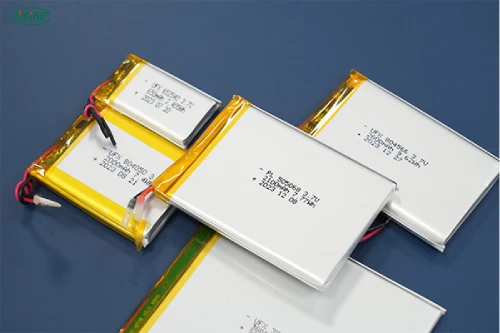
A 3.7V LiPo battery pack is a rechargeable lithium polymer battery pack with a nominal voltage of 3.7V. LiPo stands for lithium polymer, referring to the electrolyte and cell construction technology used in this battery family.
Unlike conventional cylindrical batteries, most small LiPo batteries use a soft aluminum-laminate pouch instead of a rigid metal can. This packaging allows manufacturers to produce batteries in different thicknesses, widths, lengths, and shapes.
For consumer electronics, this design offers an important advantage: the battery can fit into products with limited internal space.
For example, a thin LiPo battery may be used in:
-
Bluetooth headphones and wireless earbuds
-
Smartwatches and fitness trackers
-
Smart rings and wearable devices
-
Portable medical equipment
-
GPS trackers and IoT devices
-
Miniature cameras and handheld electronics
Another advantage is customization. Manufacturers can develop LiPo batteries with different capacities, dimensions, connectors, and discharge rates to match specific product requirements.
However, LiPo batteries are not automatically safer or more powerful than every other lithium-ion battery. Their actual performance depends on cell chemistry, design, manufacturing quality, and operating conditions.
Part 2. What Is a 3.7V Lithium-Ion Battery Pack?
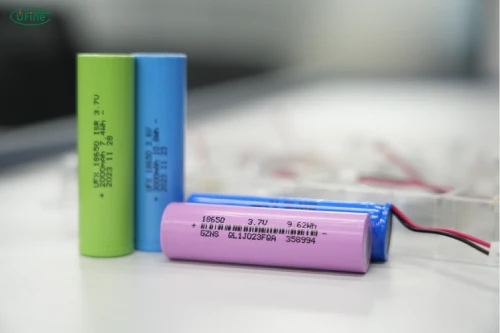
A 3.7V lithium-ion battery pack is a rechargeable battery pack that uses lithium-ion electrochemical technology and has a nominal voltage of approximately 3.7V per cell.
The term lithium-ion battery is broad. It covers several battery chemistries and physical designs, including cylindrical, prismatic, and pouch cells.
For example, common cylindrical lithium-ion batteries include the 18650 and 21700 formats. These batteries have rigid metal housings and standardized physical dimensions, making them convenient for products that can accommodate cylindrical cells.
Lithium-ion batteries are widely used in:
-
Flashlights and portable lighting
-
Power tools
-
Portable electronics
-
Battery-powered equipment
-
Rechargeable consumer devices
One important point is that LiPo batteries are also generally classified within the lithium-ion battery family. Therefore, comparing a LiPo battery with a lithium-ion battery is not always a comparison between two completely separate technologies.
In everyday product descriptions, however, lithium-ion often refers to conventional cylindrical or rigid-case cells, while LiPo usually refers to pouch-type cells.
This distinction is useful when comparing their physical designs and application requirements.
Part 3. 3.7V LiPo vs. Lithium-Ion Battery Pack: Key Differences
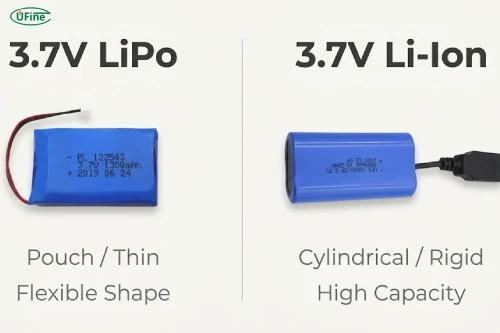
Although both battery types can have the same nominal voltage, they may differ significantly in their physical construction and practical applications.
Here are the main differences.
| Comparison | 3.7V LiPo Battery Pack | Conventional 3.7V Lithium-Ion Battery Pack |
|---|---|---|
| Common packaging | Soft aluminum pouch | Rigid cylindrical or prismatic case |
| Shape | Flat, thin, and customizable | Usually standardized formats |
| Weight and design | Suitable for compact product designs | Depends on cell format and housing |
| Installation | Flexible for limited spaces | Requires compatible mounting space |
| Capacity | Available in various customized capacities | Depends on cell size and chemistry |
| Typical applications | Wearables, earbuds, smart devices | Flashlights, tools, portable electronics |
| Customization | High flexibility in dimensions and shape | More limited with standard cell formats |
Battery structure and packaging
The most noticeable difference is the packaging.
A typical LiPo battery uses a flexible pouch structure. This makes it possible to manufacture ultra-thin batteries and custom-shaped cells for products where conventional cylindrical batteries would be difficult to install.
Conventional cylindrical lithium-ion batteries use rigid metal housings. They offer mechanical protection and standardized dimensions, which can simplify product design when the device is built around an established battery format.
Size, shape, and design flexibility
If your device has a narrow or irregular battery compartment, a LiPo battery may be a better choice.
For example, a smart ring or wireless earbud may require a very small battery with a specific thickness and footprint. A customized pouch cell can be designed around these spatial limitations.
By comparison, an 18650 battery has a fixed cylindrical form factor. It is suitable for devices designed to accommodate that shape but less convenient for extremely compact or thin products.
Capacity and energy density
Neither battery type automatically offers higher capacity or energy density.
Actual capacity depends on the cell’s chemistry, active materials, dimensions, electrode design, and manufacturing process.
A larger battery generally has more room for active materials, but simply choosing a higher mAh rating does not guarantee better performance. You also need to consider the battery’s physical size, discharge capability, and operating conditions.
Cost and manufacturing
Standard cylindrical lithium-ion cells can benefit from mature production processes and large manufacturing volumes.
LiPo batteries, on the other hand, offer more design flexibility but customized dimensions, connectors, and electrical specifications may affect production costs.
The best option depends on your product’s design, required performance, production quantity, and customization needs.
Can You Replace a 3.7V Lithium-Ion Battery with a 3.7V LiPo Battery?
In some cases, yes. However, matching the nominal voltage alone is not enough.
Before replacing one battery type with another, check several important specifications.
First, confirm that the replacement battery has the same cell configuration and compatible voltage limits. A typical 3.7V single-cell battery is not interchangeable with a 7.4V two-cell battery.
Second, compare the physical dimensions. Even if the voltage and capacity match, a battery that is too thick or too wide may not fit inside the device.
Third, check the capacity and discharge current. The replacement battery must provide sufficient energy and support the device’s peak power requirements.
Finally, check the protection circuit, charging system, connector, wire polarity, and temperature specifications.
For example, replacing an 18650 battery with a pouch-type LiPo battery may be possible in a redesigned product, but it is not necessarily a direct drop-in replacement.
The safest approach is to confirm the complete electrical and mechanical specifications with the battery manufacturer before making a substitution.
Part 4. How to Choose the Right Capacity for Your 3.7V Battery Pack?
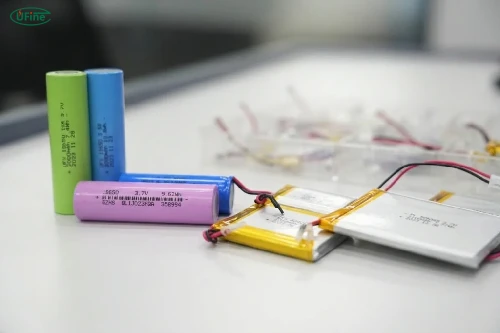
Battery capacity directly affects how long your electronic device can operate between charges.
Capacity is usually measured in milliamp-hours (mAh). A 3.7V 500mAh battery stores less energy than a 3.7V 1,000mAh battery, assuming comparable nominal voltage.
To estimate battery runtime, you first need to understand your device’s average current consumption.
A simplified formula is:
Estimated runtime (hours) = Battery capacity (mAh) ÷ Average current consumption (mA)
For example, suppose your electronic device consumes an average current of 100mA, and you select a 3.7V 1,000mAh battery.
1,000mAh ÷ 100mA = 10 hours.
This is an idealized estimate. Actual runtime may be shorter because of conversion losses, battery aging, temperature, discharge conditions, and the battery’s usable capacity.
Consider your device’s actual power consumption
Different electronic devices have different energy requirements.
A Bluetooth earbud may consume relatively little power during normal operation, while a portable medical instrument with a display, sensors, and wireless communication may require more energy.
Before selecting a battery, consider:
-
Average operating current
-
Peak current during startup or wireless transmission
-
Expected operating time between charges
-
Battery compartment dimensions
-
Available charging frequency
You should also check the battery’s discharge capability. A battery with sufficient capacity may still be unsuitable if it cannot safely deliver the current required by your device.
Part 5. What Protection Does a 3.7V Battery Pack Need?
Battery protection is an important consideration for both LiPo and conventional lithium-ion battery packs.
Lithium-based rechargeable batteries must operate within specified voltage, current, and temperature limits. If these limits are exceeded, battery performance may deteriorate, and safety risks can increase.
A battery protection circuit, commonly called a PCM (Protection Circuit Module), helps monitor and control the battery’s electrical conditions.
Typical protection functions include:
-
Overcharge protection: Stops charging when the cell voltage reaches its specified upper limit.
-
Over-discharge protection: Disconnects the load when the battery voltage falls below its permitted lower limit.
-
Overcurrent protection: Helps prevent excessive current during operation.
-
Short-circuit protection: Disconnects the battery when an external short circuit is detected.
Some battery packs also incorporate temperature monitoring through an NTC thermistor. This allows the charging or discharging system to respond to temperature conditions outside the permitted range.
It is worth noting that a PCM and a BMS are not necessarily the same thing. A PCM typically provides basic protection functions, while a BMS may offer more advanced monitoring and control, especially in multi-cell battery systems.
For a single-cell 3.7V LiPo battery used in a smartwatch, GPS tracker, or portable medical device, a properly designed protection circuit can help improve operating safety and reliability.
However, protection circuitry does not replace a suitable charger, correct battery design, or proper device-level safety controls.
Part 6. Why Do Connecting Wires and Connectors Matter?
Connecting wires and connectors may seem like minor components, but they directly affect how a battery pack works with your electronic device.
An unsuitable wire or connector can cause voltage drops, excessive resistance, overheating, or intermittent power connections.
When selecting connecting wires, consider the following factors.
Wire gauge: The wire must support the expected continuous and peak current. Thicker wires generally have lower resistance, but they also take up more installation space.
Wire length: Longer wires create more resistance and voltage drop. For compact consumer electronics, keeping the wire length appropriate can help improve power delivery.
Connector type: Common small battery connectors include JST-PH and JST-SH series connectors. However, connector selection should depend on the device’s PCB interface, dimensions, current requirements, and mechanical design.
Polarity: Positive and negative terminals must match the device’s electrical interface. Incorrect polarity can damage electronic components.
For small wearable products, connector size and wire flexibility may be especially important because the available installation space is limited.
When ordering a customized 3.7V LiPo battery pack, specify the required connector model, wire length, wire gauge, pin configuration, and polarity in advance.
Part 7. How to Choose the Right Charger for a 3.7V Battery Pack?
Using the correct charger is essential for battery performance and safety.
For a conventional single-cell 3.7V LiPo or lithium-ion battery with a 4.2V maximum charging voltage, the typical charging method is CC/CV (Constant Current/Constant Voltage).
During the constant-current stage, the charger supplies a controlled current. Once the battery reaches 4.2V, the charger maintains that voltage while the charging current gradually decreases.
When the current falls to the specified termination level, the charging process ends.
There are three important factors to consider when choosing a charger.
1. Charging voltage
The charger’s output voltage must match the battery’s specified maximum charging voltage. A typical 3.7V single-cell lithium-ion battery uses a 4.2V charging limit, but other lithium chemistries may require different values.
2. Charging current
Charging current should follow the battery manufacturer’s recommendations.
For example, a 1,000mAh battery charged at 0.5C has a nominal charging current of 500mA. At 1C, the current is 1,000mA.
However, not every battery supports 1C charging. Always check the specified maximum charging current.
3. Charging compatibility
A charger must support the correct battery chemistry, cell configuration, voltage, and charging termination method. Do not assume that every charger labeled 3.7V is compatible with every 3.7V battery.
You should also ensure that the charging circuit works properly with the battery’s protection system.
For reliable and customized 3.7V LiPo battery solutions, contact Ufine to find the right battery for your device.
FAQs
1. How can I tell if my battery pack is a LiPo or lithium-ion battery?
Check the battery label, model number, datasheet, and physical packaging. LiPo batteries commonly use flexible pouch packaging, while conventional lithium-ion cells often have cylindrical or rigid prismatic housings. However, packaging alone does not confirm the exact cell chemistry.
2. Does a 3.7V battery pack lose capacity over time?
Yes. Rechargeable lithium batteries gradually lose capacity through normal aging, even when properly maintained. High temperatures, frequent deep discharges, and demanding operating conditions can accelerate capacity degradation.
3. Does a higher mAh rating mean a better battery?
Not necessarily. A higher mAh rating generally means more stored charge and potentially longer operating time. However, battery size, weight, discharge capability, cycle life, and compatibility with the electronic device should also be considered.
4. What causes a 3.7V battery pack to swell?
Battery swelling can result from internal gas generation caused by chemical degradation, overcharging, excessive heat, or aging. A swollen lithium battery should not be charged, compressed, punctured, or reused. Disconnect it safely if possible and follow local battery disposal procedures.
5. Are all 3.7V LiPo battery packs rechargeable?
Most 3.7V LiPo battery packs are designed to be rechargeable, but you should always verify the manufacturer’s specifications. Never attempt to recharge a battery unless it is explicitly designed for rechargeable operation and used with a compatible charging system.
Related Tags:

More Articles
3 Cell Laptop Battery Life: What You Need to Know
How long does a 3 cell laptop battery last? Compare battery life, replacement prices, compatible models, and practical tips before buying a new one.
How to Build a 7.4V 18650 Battery Pack: Full Guide
Building a 7.4V 18650 battery pack? Discover the right cells, 2S configuration, BMS, wiring, and common mistakes to avoid.
18650 3S2P Battery Pack: Wiring, Parts & Safety Tips
Learn how to build an 18650 3S2P battery pack, choose the right cells, BMS, connectors, and wires, and avoid common assembly mistakes.
Solar Battery Bank: How Many Batteries Are Enough?
Find out how many batteries your solar system needs. Learn how to calculate battery capacity, compare battery types, and avoid costly sizing mistakes.
Swollen Laptop Battery? Don’t Ignore These Signs
Is your laptop case bulging? Find out why lithium batteries swell, what risks you should know, and how to handle a swollen battery safely.