- Part 1. Understand your daily energy consumption
- Part 2. Determine how much battery storage you need
- Part 3. Choose the right battery capacity
- Part 5. Understand series and parallel battery connections
- Part 6. What type of battery is best for a solar battery bank?
- Part 7. How long does a solar lithium battery bank last?
- Part 8. How to extend the lifespan of your solar battery bank
- FAQs
Choosing the right number of batteries for a solar battery bank isn’t as simple as picking a few 100Ah batteries and connecting them together. You need to consider how much electricity you use, how long you want backup power to last, battery capacity, system voltage, and the type of battery you choose.
Get the number wrong, and you could end up with a battery bank that runs out of power too quickly or costs far more than necessary.
In this guide, we’ll walk through how to calculate the number of batteries you need for a solar battery bank, compare different battery types, estimate battery lifespan, and explore practical ways to keep your batteries working efficiently for years.
Key takeaways
-
The number of batteries you need depends on daily energy consumption, desired backup time, battery capacity, and depth of discharge (DoD).
-
Battery energy capacity is calculated using voltage × amp-hours (Ah) ÷ 1,000.
-
Lithium batteries, particularly LiFePO4, are widely used for solar storage because of their long cycle life and high usable capacity.
-
A properly sized solar battery bank should account for inverter efficiency and other system losses.
-
Battery lifespan depends on chemistry, temperature, charging habits, and operating conditions.
-
Proper battery management and avoiding extreme temperatures can help extend service life.
Part 1. Understand your daily energy consumption
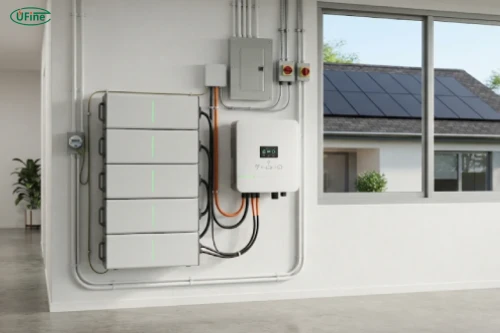
Before choosing batteries, you need to know how much electricity your home or equipment uses each day. This is the starting point for sizing any solar battery bank.
Electricity consumption is measured in kilowatt-hours (kWh). You can usually find this information on your electricity bill. If you’re designing an off-grid system, calculate the daily consumption of the appliances you plan to run.
For example, consider a small household with the following daily electricity needs:
|
Appliance |
Power |
Daily usage |
Energy consumption |
|---|---|---|---|
|
Refrigerator |
150W |
8 hours |
1.2 kWh |
|
LED lights |
60W |
5 hours |
0.3 kWh |
|
Television |
100W |
4 hours |
0.4 kWh |
|
Laptop |
65W |
5 hours |
0.325 kWh |
|
Fan |
50W |
8 hours |
0.4 kWh |
|
Total |
2.625 kWh |
In this example, the household needs approximately 2.63 kWh of electricity per day.
Remember that some appliances, especially refrigerators and air conditioners, don’t consume power continuously at their rated wattage. Their actual energy consumption depends on operating cycles, ambient temperature, and usage patterns.
If you want your solar battery bank to power your entire home, include all major appliances. If you only need emergency backup, focus on essential equipment instead.
Part 2. Determine how much battery storage you need
Once you know your daily electricity consumption, the next step is deciding how long you want your battery bank to provide power without sufficient solar generation.
This is your required backup time, also known as autonomy.
For example:
-
1 day of backup: Your batteries need to cover one full day’s electricity consumption.
-
2 days of backup: Your batteries need enough energy for two days without relying on solar charging.
-
3 days of backup: Your system needs a larger storage capacity for extended cloudy weather.
However, you shouldn’t calculate battery capacity based on electricity consumption alone. You also need to consider depth of discharge (DoD).
DoD refers to the percentage of a battery’s total capacity that has been used. If a battery has a 100Ah capacity and a 90% DoD, you can use approximately 90Ah before reaching its recommended discharge limit.
Here’s the basic formula:
Required battery capacity (kWh) = Daily energy consumption × Backup days ÷ (DoD × Inverter efficiency)
For example, suppose your household uses 5 kWh per day and you want one day of backup. You’re using a lithium battery with a recommended 90% DoD and an inverter with 95% efficiency.
Required battery capacity:
5 ÷ (0.90 × 0.95) = 5.85 kWh
This means you need approximately 5.85 kWh of nominal battery capacity.
The higher your daily electricity consumption or backup requirements, the larger your battery bank needs to be.
Part 3. Choose the right battery capacity
Solar batteries come in different voltage and capacity combinations. Two specifications you’ll frequently encounter are volts (V) and amp-hours (Ah).
Voltage indicates the electrical potential of a battery, while amp-hours describe how much electrical charge it can deliver over time.
To calculate the energy capacity in kilowatt-hours, use:
Battery capacity (kWh) = Voltage (V) × Capacity (Ah) ÷ 1,000
For example:
-
12V 100Ah battery = 1.2 kWh
-
24V 100Ah battery = 2.4 kWh
-
48V 100Ah battery = 4.8 kWh
Actual nominal voltage varies by chemistry. For example, a typical 12.8V LiFePO4 battery provides 1.28 kWh at 100Ah, while a 51.2V 100Ah battery provides 5.12 kWh.
Here’s a comparison using common LiFePO4 battery configurations:
|
Battery configuration |
Nominal capacity |
Energy storage |
|---|---|---|
|
12.8V 100Ah |
100Ah |
1.28 kWh |
|
12.8V 200Ah |
200Ah |
2.56 kWh |
|
25.6V 100Ah |
100Ah |
2.56 kWh |
|
25.6V 200Ah |
200Ah |
5.12 kWh |
|
51.2V 100Ah |
100Ah |
5.12 kWh |
|
51.2V 200Ah |
200Ah |
10.24 kWh |
When selecting a battery, don’t focus on Ah alone. A 100Ah battery at 48V stores four times as much nominal energy as a 100Ah battery at 12V.
Also, make sure the battery voltage matches your inverter and solar charge controller requirements.
Calculate how many batteries you need
Now you have the information needed to estimate the number of batteries.
The basic formula is:
Number of batteries = Required battery capacity (kWh) ÷ Individual battery capacity (kWh)
Always round up to the next whole battery.
Let’s look at practical example.
A typical household solar system
Imagine your home consumes 10 kWh daily and you want one day of backup. You choose 51.2V 100Ah LiFePO4 batteries, each providing 5.12 kWh.
Assuming 90% DoD and 95% inverter efficiency:
10 ÷ (0.90 × 0.95) = 11.70 kWh
11.70 ÷ 5.12 = 2.28
You need 3 batteries.
In a real installation, you may need additional capacity for temperature-related performance changes, battery aging, and other system losses.
Part 5. Understand series and parallel battery connections
Buying the right number of batteries is only half the job. You also need to understand how they’re connected.
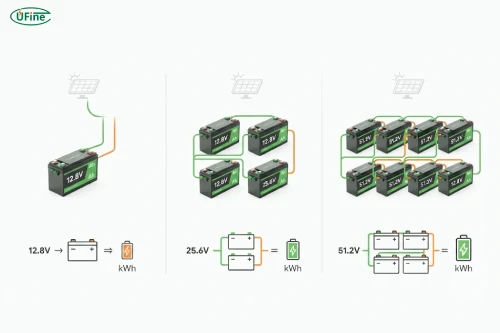
Solar battery banks generally use two connection methods: series and parallel.
Series connection: Increasing voltage
When batteries are connected in series, their voltages add together, while their amp-hour capacity remains the same.
For example, connecting four 12.8V 100Ah batteries in series creates a 51.2V 100Ah battery bank with 5.12 kWh of nominal energy.
Parallel connection: Increasing capacity
When batteries are connected in parallel, their voltage stays the same, but their amp-hour capacities add together.
For example, connecting two 12.8V 100Ah batteries in parallel creates a 12.8V 200Ah battery bank with 2.56 kWh of nominal energy.
Some solar installations use a combination of series and parallel connections to achieve the required voltage and storage capacity.
Before connecting multiple batteries, check the manufacturer’s requirements for compatible models, voltage, current limits, wiring, and battery management systems (BMS). Not every battery supports unrestricted series or parallel connections.
Part 6. What type of battery is best for a solar battery bank?
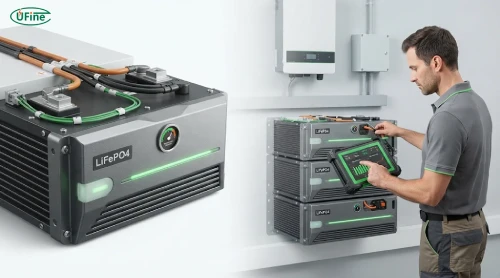
The battery chemistry you choose affects storage capacity, usable energy, lifespan, charging performance, and overall system cost.
Not all rechargeable batteries are equally suitable for solar energy storage. Here are four common options.
Lithium iron phosphate (LiFePO4 or LFP) batteries are among the most popular choices for stationary solar energy storage.
They offer good thermal stability, relatively long cycle life, and high usable capacity. They also support frequent charging and discharging, making them suitable for daily solar energy storage.
According to the IEA, LFP batteries accounted for approximately 90% of global battery storage deployments. Their cost and suitability for frequent cycling are major reasons for their growing adoption.
2. Lithium-ion NMC batteries
Nickel manganese cobalt (NMC) batteries offer higher energy density than LFP batteries. This means they can store more energy in a relatively compact and lightweight package.
They’re commonly used in electric vehicles and some residential energy storage products. However, their thermal management and protection requirements need careful consideration.
3. Lithium polymer (LiPo) batteries
Lithium polymer batteries use a polymer-based electrolyte system and are available in flexible pouch-style formats.
Their lightweight construction, customizable dimensions, and high energy density make them particularly useful for compact consumer electronics, portable equipment, and space-constrained applications.
However, conventional LiPo pouch batteries are not the default choice for large residential solar battery banks. Stationary solar installations generally favor purpose-built LFP battery systems with appropriate BMS and enclosure designs.
4. Lead-acid batteries
Lead-acid batteries are an older and often lower-cost battery technology.
They are relatively straightforward to use, but typically offer lower usable capacity, lower round-trip efficiency, and shorter practical service life than modern lithium storage systems. They also tend to be heavier for the same amount of usable energy.
For most new solar storage installations where long-term performance matters, lithium batteries are worth considering.
Part 7. How long does a solar lithium battery bank last?
A solar battery bank doesn’t last forever. Over time, repeated charging and discharging gradually reduce its ability to store energy.
Battery lifespan is generally measured in two ways:
-
Cycle life: The number of charge and discharge cycles a battery can complete before its capacity drops to a specified level.
-
Calendar life: How many years a battery can remain in service, regardless of how frequently it’s used.
Different battery chemistries have different expected lifespans.
|
Battery type |
Typical cycle life |
General lifespan considerations |
|---|---|---|
|
LiFePO4 |
3,000–6,000+ cycles |
Long cycle life and suitable for frequent cycling |
|
NMC lithium-ion |
1,000–3,000 cycles |
Depends on operating temperature and charging conditions |
|
Lithium polymer |
500–1,500 cycles |
Varies considerably by cell design and application |
|
Lead-acid |
500–1,500 cycles |
More sensitive to deep discharge and maintenance |
These are indicative industry ranges, not guaranteed specifications. Actual performance varies by manufacturer, cell design, DoD, temperature, charging rate, and end-of-life definition.
For example, a LiFePO4 battery rated for 4,000 cycles and completing one full equivalent cycle per day could theoretically reach 4,000 cycles in approximately 11 years.
However, this doesn’t mean the battery will suddenly stop working after that point. Cycle-life ratings generally refer to reaching a defined remaining-capacity threshold, often 80% of the original capacity.
In practice, a quality solar lithium battery bank may provide around 10–15 years of service, depending on its design and operating conditions. Some systems can last longer.
Temperature is particularly important. Excessive heat accelerates battery aging, while charging outside the manufacturer’s permitted temperature range can cause permanent damage.
When comparing solar batteries, look beyond the advertised cycle count. Check the warranty period, guaranteed remaining capacity, permitted DoD, and actual operating conditions covered by the manufacturer.
Part 8. How to extend the lifespan of your solar battery bank
Buying a high-quality battery is important, but how you operate it also makes a difference.
A few practical habits can help your solar battery bank maintain its capacity for longer.
Avoid unnecessary deep discharges
Although lithium batteries can support relatively high DoD, using the full rated capacity every day isn’t always necessary.
If your energy requirements allow it, maintaining a more moderate discharge range can reduce battery stress. Follow the recommended operating range provided by the battery manufacturer.
Keep the battery within its recommended temperature range
Heat is one of the biggest enemies of battery longevity.
Avoid installing batteries in direct sunlight, poorly ventilated spaces, or areas exposed to extreme temperatures. A suitable enclosure and thermal management system can help maintain stable operating conditions.
Use a compatible charging system
Your solar charge controller and inverter must support the battery’s chemistry, voltage, charging current, and protection requirements.
Incorrect charging parameters can accelerate degradation or create safety risks. For lithium battery banks, a properly configured BMS is essential for monitoring voltage, current, and temperature.
Avoid prolonged storage at extreme states of charge
If your solar battery bank will remain unused for an extended period, follow the manufacturer’s recommended storage state of charge and maintenance schedule.
Leaving a battery fully discharged for too long can cause problems, while storing it at a high state of charge in a hot environment can accelerate aging.
Monitor battery performance regularly
Keep an eye on battery temperature, charging behavior, voltage, and available capacity.
If one battery in a multi-battery bank behaves differently from the others, investigate the issue rather than continuing to operate the system without checking it.
Small maintenance and monitoring habits can help you identify problems early and avoid unnecessary battery replacements.
FAQs
1. Can I mix different battery brands in one solar battery bank?
It’s generally not recommended. Different battery brands may have different voltage characteristics, internal resistance, BMS settings, and charging requirements. Mixing incompatible batteries can cause uneven charging and discharging.
2. Does a larger solar battery bank generate more electricity?
No. Batteries store electricity rather than generate it. A larger battery bank provides more storage capacity, but the amount of electricity generated depends on your solar panels, sunlight exposure, and system performance.
3. Can solar batteries charge during cloudy weather?
Yes. Solar panels can still generate electricity during cloudy conditions, although their output is usually lower than on sunny days. If solar generation is insufficient, your battery bank may discharge to supply the remaining energy demand.
4. Is a 48V solar battery bank better than a 12V system?
For many larger residential and off-grid installations, 48V systems are more practical because they can deliver the same power with lower current than 12V systems. This can reduce cable losses and simplify high-power system design. However, the best voltage depends on your inverter and application.
5. Do solar batteries lose capacity when not in use?
Yes. Rechargeable batteries experience self-discharge and gradual calendar aging even when they’re not actively used. The rate depends on battery chemistry, storage temperature, and state of charge.
6. Can I use a portable power station as part of a solar battery bank?
Some portable power stations support solar charging and additional battery expansion. However, compatibility depends on the manufacturer’s design, supported voltage, charging input, and expansion interfaces. They should not be connected directly to a conventional battery bank unless explicitly supported.
7. How much space is needed for a solar battery bank?
The required installation space depends on the number, dimensions, and configuration of the batteries. You also need to consider ventilation, maintenance access, electrical clearances, and the manufacturer’s installation requirements.
Related Tags:

More Articles

How to Build a 7.4V 18650 Battery Pack: Full Guide
Building a 7.4V 18650 battery pack? Discover the right cells, 2S configuration, BMS, wiring, and common mistakes to avoid.
18650 3S2P Battery Pack: Wiring, Parts & Safety Tips
Learn how to build an 18650 3S2P battery pack, choose the right cells, BMS, connectors, and wires, and avoid common assembly mistakes.
Swollen Laptop Battery? Don’t Ignore These Signs
Is your laptop case bulging? Find out why lithium batteries swell, what risks you should know, and how to handle a swollen battery safely.
200 Amp Lithium Battery: Better Than Lead-Acid?
Is a 200Ah lithium battery worth the extra cost? Compare runtime, lifespan, usable power, and long-term savings before you buy.
Where to Find Reliable LiPo Battery Suppliers for OEM Projects
Looking for LiPo battery suppliers? Discover where to find reliable manufacturers and how to avoid costly sourcing mistakes.