- Part 1. What is a 200 amp lithium battery?
- Part 2. What is a 200 amp lead-acid battery?
- Part 3. Lithium vs. lead-acid battery: Key differences
- Part 5. How to calculate the runtime of a 200 amp lithium battery
- Part 6. Popular battery brands and price comparison
- Part 7. Which battery should you choose?
- FAQs
With lithium batteries becoming more widely available, you may be wondering whether a 200 amp lithium battery is worth the higher upfront cost compared with a traditional lead-acid battery.
Both battery types can provide reliable power, but they differ significantly in weight, usable capacity, charging efficiency, lifespan, and long-term cost.
Let’s compare them to help you decide which option makes more sense for your power needs.
Key takeaways
-
Lithium batteries last longer: A 200Ah LiFePO4 battery can offer thousands of charge cycles, while many comparable AGM batteries have a significantly shorter cycle life.
-
More usable energy: Lithium batteries generally support deeper discharge without sacrificing as much cycle life.
-
Faster charging: Lithium batteries typically accept higher charging currents and recharge more efficiently.
-
Lead-acid costs less upfront: However, its shorter lifespan and lower usable capacity can increase long-term costs.
-
Choose based on your application: Lithium is often better for frequent cycling, while lead-acid can work well for occasional backup power and budget-conscious installations.
Part 1. What is a 200 amp lithium battery?
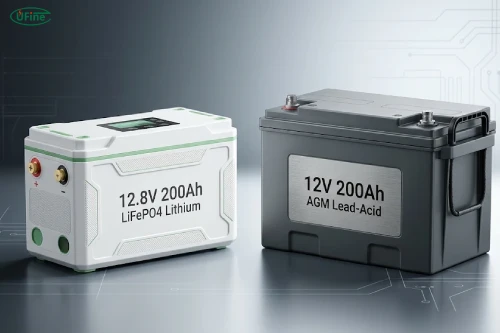
First, let’s clarify an important specification. A 200 amp lithium battery and a 200Ah lithium battery do not necessarily mean the same thing.
-
200A (amperes): Refers to the electrical current a battery can deliver or handle under specified conditions.
-
200Ah (amp-hours): Refers to its rated capacity, indicating how much electrical charge it can store and deliver over time.
For example, a 12.8V 200Ah LiFePO4 battery stores approximately 2,560Wh (2.56kWh) of nominal energy.
Lithium batteries are available in several chemistries, including lithium iron phosphate (LiFePO4) and lithium nickel manganese cobalt oxide (NMC). LiFePO4 is particularly common in deep-cycle applications because of its long cycle life and thermal stability.
A typical 200Ah lithium battery may be used in:
-
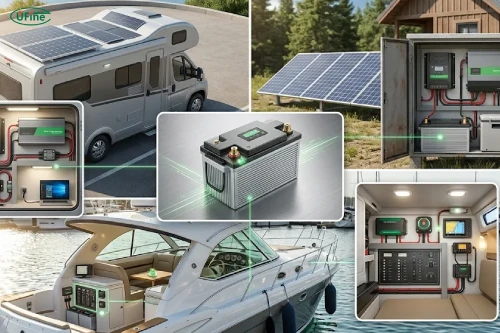
RV and marine power systems
-
Solar energy storage
-
Portable power stations
-
Emergency backup systems
-
Off-grid electrical installations
Part 2. What is a 200 amp lead-acid battery?
A 200Ah lead-acid battery stores energy through an electrochemical reaction between lead-based electrodes and a sulfuric acid electrolyte.
It is a mature battery technology that has been used in vehicles, backup power systems, and industrial equipment for decades.
There are three common types:
-
Flooded lead-acid: Uses liquid electrolyte and requires periodic maintenance, including checking electrolyte levels.
-
AGM (Absorbent Glass Mat): Uses an absorbent glass mat to hold the electrolyte. It is sealed and generally maintenance-free.
-
Gel battery: Uses a gel-like electrolyte and is designed for applications requiring controlled discharge and reliable operation.
Compared with lithium batteries, lead-acid batteries generally have a lower purchase price and well-established recycling infrastructure.
However, they are heavier, typically charge more slowly, and usually provide less usable capacity relative to their rated capacity.
Part 3. Lithium vs. lead-acid battery: Key differences
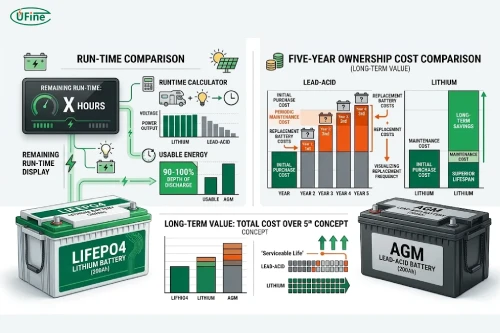
So, which battery performs better in everyday applications? Let’s look at the most important differences.
1. Energy density and weight
One of the biggest advantages of lithium batteries is their higher energy density.
A 12V 200Ah AGM battery can weigh around 58kg (127.9 lbs), while a comparable 200Ah LiFePO4 battery can weigh considerably less, depending on its design.
This difference matters when you’re installing batteries in an RV, boat, or portable power system.
A lighter battery is easier to transport and install, and it puts less additional weight on the vehicle or equipment.
2. Battery lifespan and cycle life
Battery lifespan is another major difference.
A typical deep-cycle AGM battery may provide around 300–500 cycles under specified discharge conditions. A quality LiFePO4 battery can offer several thousand cycles.
For example, Renogy specifies 5,000 cycles at 80% depth of discharge for its 12V 200Ah Core LiFePO4 battery.
This means lithium batteries can be a better investment for applications that require frequent charging and discharging.
3. Charging speed and efficiency
Lithium batteries generally accept higher charging currents and have better charging efficiency than lead-acid batteries.
For example, a lithium battery may recharge in a few hours with a properly sized charger, while a lead-acid battery can take significantly longer, particularly during the final absorption stage.
Lithium batteries also waste less energy during charging, making them useful for solar systems where available charging time and energy may be limited.
Remember that actual charging time depends on the charger output, battery condition, temperature, and battery management system (BMS).
4. Usable capacity and depth of discharge
Rated capacity does not always equal the energy you can actually use.
Depth of discharge (DoD) describes how much of a battery’s capacity has been consumed.
For a typical comparison, LiFePO4 batteries can often use around 80–100% of their rated capacity, depending on manufacturer recommendations. Lead-acid batteries are commonly limited to approximately 50% DoD when prioritizing cycle life.
This means a 200Ah lithium battery can provide substantially more usable energy than a 200Ah lead-acid battery.
5. Maintenance and safety
AGM and gel batteries require relatively little routine maintenance, while flooded lead-acid batteries need periodic electrolyte checks.
Lithium batteries usually require less routine maintenance and include a battery management system (BMS) to monitor important operating conditions.
A BMS can provide protection against overcharging, over-discharging, excessive current, and temperature-related issues.
However, lithium batteries are not maintenance-free in every respect. You still need to follow the manufacturer’s charging and storage instructions. For example, some LiFePO4 batteries prohibit charging below freezing unless they have an appropriate low-temperature protection or heating function.
200 amp lithium battery vs. lead-acid: Side-by-side comparison
Here is a quick comparison using typical 12V 200Ah battery specifications.
| Specification | LiFePO4 lithium | AGM lead-acid |
|---|---|---|
| Nominal voltage | 12.8V | 12V |
| Rated capacity | 200Ah | 200Ah |
| Nominal energy | 2,560Wh | 2,400Wh |
| Typical usable DoD | 80–100% | Around 50% |
| Typical cycle life | 2,000–5,000+ cycles | 300–500 cycles |
| Weight | Generally lighter | Around 58kg for the Renogy example |
| Charging speed | Faster | Slower |
| Maintenance | Low | Low for AGM |
| Initial price | Higher | Lower |
Note: These are representative figures, not universal specifications. Actual performance varies by manufacturer, model, temperature, discharge rate, and operating conditions.
Overall, lithium batteries offer more usable energy, a longer cycle life, and lower weight. Lead-acid batteries remain attractive when initial purchase price is the main consideration.
Part 5. How to calculate the runtime of a 200 amp lithium battery
Estimate battery runtime using our online calculator:
Knowing a battery’s capacity is useful, but how long will it actually power your devices?
You can estimate runtime using a simple formula:
Runtime (hours) = Usable battery energy (Wh) ÷ Device power consumption (W)
Let’s use a 12.8V 200Ah LiFePO4 battery as an example.
Step 1: Calculate nominal battery energy
12.8V × 200Ah = 2,560Wh
Step 2: Calculate usable energy
Assuming an 80% depth of discharge:
2,560Wh × 80% = 2,048Wh
Step 3: Account for inverter efficiency
If you’re using an inverter with 90% efficiency:
2,048Wh × 90% = 1,843Wh
Step 4: Calculate runtime
Suppose your connected devices consume 500W:
1,843Wh ÷ 500W = 3.69 hours
So, a 200Ah lithium battery could power a 500W load for approximately 3.7 hours under these assumptions.
Here are a few more examples:
| Device power consumption | Estimated runtime |
|---|---|
| 100W | 18.4 hours |
| 200W | 9.2 hours |
| 300W | 6.1 hours |
| 500W | 3.7 hours |
| 1,000W | 1.8 hours |
These figures are estimates. Actual runtime depends on inverter losses, battery temperature, discharge rate, wiring, and the battery’s actual available capacity.
Also, check the battery’s continuous discharge current and BMS rating. A 200Ah capacity does not automatically mean the battery can safely support every high-power appliance.
Part 6. Popular battery brands and price comparison
If you’re considering a 200Ah battery, several established brands offer lithium and lead-acid options.
Here are two examples from Renogy’s US product range:
| Brand and model | Battery type | Listed price (USD) |
|---|---|---|
| Renogy 12V 200Ah Core | LiFePO4 | $769.99 |
| Renogy 12V 200Ah Deep Cycle | AGM | $395.99 |
Prices are listed US retail prices observed in November 2026. Promotions, regional availability, shipping, and taxes may change the final price.
Other brands worth researching include Battle Born Batteries and Dakota Lithium for LiFePO4 products, as well as Trojan Battery for lead-acid deep-cycle solutions.
The initial price difference is noticeable, but purchase price alone doesn’t tell the whole story.
For example, if you frequently cycle your battery, a lithium battery’s longer lifespan and greater usable capacity may offset its higher upfront cost. On the other hand, if you only need occasional emergency backup power, a lower-cost lead-acid battery may be sufficient.
It’s also worth comparing warranty coverage, BMS features, charging compatibility, and replacement costs before making a decision.
Part 7. Which battery should you choose?
There is no single battery that works best for every situation. Your choice depends on how often you use it, how much power you need, and how much you’re willing to spend.
Choose a lithium battery if:
-
You need more usable energy from a compact battery.
-
Your system charges and discharges frequently.
-
You want a longer service life.
-
Battery weight is an important consideration.
-
You need faster charging and higher energy efficiency.
Choose a lead-acid battery if:
-
Your initial budget is limited.
-
You only need occasional backup power.
-
Weight and installation space are not major concerns.
-
You already have a compatible lead-acid charging system.
For RVs, solar storage, and off-grid applications with frequent daily cycling, LiFePO4 is often the more practical long-term choice. For less demanding applications, lead-acid can still be a reasonable option.
FAQs
1. Can I connect a lithium battery and a lead-acid battery in the same system?
Generally, it is not recommended to connect lithium and lead-acid batteries directly in parallel. Their charging characteristics, voltage behavior, and internal resistance differ, which can cause uneven current distribution and charging problems.
2. Does a 200Ah lithium battery need a special inverter?
Not necessarily. The inverter must match the battery’s nominal voltage and support its continuous and peak current requirements. You should also check the inverter’s low-voltage cutoff settings.
3. Does a 200Ah lithium battery lose capacity when it’s cold?
Yes. Low temperatures can temporarily reduce available battery capacity and power output. More importantly, many LiFePO4 batteries must not be charged below 0°C unless equipped with suitable low-temperature charging protection or heating.
4. Can I take a 200Ah lithium battery on an airplane?
Generally, no. A typical 12.8V 200Ah lithium battery contains approximately 2,560Wh, far exceeding standard passenger aircraft lithium battery limits. Airline and cargo transport rules should always be checked before shipping.
Related Tags:

More Articles

Swollen Laptop Battery? Don’t Ignore These Signs
Is your laptop case bulging? Find out why lithium batteries swell, what risks you should know, and how to handle a swollen battery safely.
Where to Find Reliable LiPo Battery Suppliers for OEM Projects
Looking for LiPo battery suppliers? Discover where to find reliable manufacturers and how to avoid costly sourcing mistakes.
Lithium Polymer vs. Lithium Ion Power Bank: What’s the Difference?
Are LiPo power banks really better? Discover the key differences in capacity, weight, lifespan, safety, and air travel before choosing one.
How to Choose the Right 2S Shorty LiPo Battery for Your RC Car?
Not sure which 2S Shorty LiPo to buy? Compare battery specs, popular brands, prices, and performance to find the right fit for your RC car.
What Happens If One Cell in a Battery Pack Goes Bad? How to Fix It
Found a faulty battery cell? Discover how to identify the problem, whether one cell can be replaced, and how to fix a battery pack safely.