Finding a reliable LiPo battery supplier is an important step in developing any product powered by rechargeable batteries. Whether you’re manufacturing wireless earbuds, smart wearables, portable medical devices, or other consumer electronics, the right supplier can help you get the battery specifications, quality, and production support your project needs.
However, finding a supplier is only the beginning. You also need to understand the difference between a battery manufacturer and a trading supplier, know where to search, and evaluate whether a potential partner can support your project from prototype development to mass production.
Key takeaways
-
Identify your battery specifications and OEM requirements before contacting suppliers.
-
Understand the difference between direct manufacturers, trading companies, and distributors.
-
China, South Korea, and Japan are major battery manufacturing hubs, while Europe and North America are developing additional production capacity.
-
A good LiPo battery supplier should offer reliable quality control, technical support, customization, and consistent production.
-
Always evaluate samples, certifications, production capabilities, and communication before placing a bulk order.
Part 1. Understand your OEM battery requirements
Before searching for LiPo battery suppliers, take some time to define what your product actually needs. A supplier cannot provide an accurate quotation or technical solution without understanding your battery requirements.
Start with the basic specifications:
-
Voltage and capacity: Determine the operating voltage and required capacity based on your device’s power consumption and expected runtime.
-
Battery dimensions: Measure the available internal space, including length, width, and thickness.
-
Discharge rate: Check the current your device requires during normal operation and peak usage.
-
Connector and wiring: Identify the connector type, cable length, and polarity requirements.
-
Operating temperature: Consider the temperature range in which your device will charge, discharge, and operate.
You should also consider whether your project needs a standard LiPo battery or a fully customized design.
For example, a wireless earbud manufacturer may need an ultra-small battery with a specific shape, while a portable medical device manufacturer may prioritize stable discharge performance and long cycle life.
Having these requirements ready makes supplier communication much easier and helps you avoid comparing quotations based on different specifications.
Discover how Ufine Battery manufactures and tests LiPo batteries to ensure consistent quality at every stage of production.
Part 2. Where to find LiPo battery suppliers
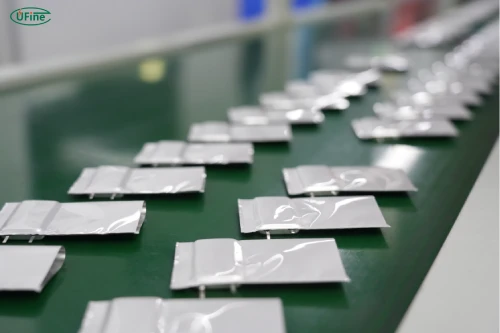
There are several ways to find LiPo battery suppliers, but the best sourcing channel depends on your project size, technical requirements, and preferred cooperation model.
1. Search directly for battery manufacturers
Searching for manufacturers is often the best starting point for OEM projects. Use terms such as “custom LiPo battery manufacturer,” “LiPo battery factory,” or “OEM lithium polymer battery supplier.”
A direct manufacturer can usually communicate with you about cell dimensions, capacity adjustments, battery structure, connectors, and production requirements.
You can explore company websites, product catalogs, factory information, and technical documentation before making contact.
2. Use B2B sourcing platforms
Platforms such as Alibaba and Global Sources allow you to discover battery suppliers from different countries and compare their product ranges.
They are useful for building an initial supplier list, but remember that not every company listed as a manufacturer owns its production facilities. Check the company’s business profile and manufacturing information before moving forward.
3. Attend battery and electronics trade shows
Industry exhibitions are another useful way to meet suppliers. Events such as The Battery Show and electronics manufacturing exhibitions bring together battery producers, component manufacturers, and technology providers.
Meeting suppliers in person gives you an opportunity to discuss technical requirements, examine samples, and understand their manufacturing capabilities.
4. Explore global battery manufacturing regions
Battery suppliers are distributed across several regions, and each market has different strengths. Understanding this distribution can help you narrow your search.
Global battery supplier distribution and manufacturing capabilities
|
Region |
Key manufacturing strengths |
What OEM buyers should know |
|---|---|---|
|
China |
Large-scale lithium-ion cell production, LiPo batteries, battery components, and customization |
A strong option for custom battery projects, flexible production volumes, and integrated supply chains |
|
South Korea |
Advanced lithium-ion battery technology and large-scale cell manufacturing |
Well-established battery industry with experience in high-performance battery applications |
|
Japan |
Battery materials, cell technology, and precision manufacturing |
Known for established quality systems and advanced battery engineering |
|
Europe |
Growing battery manufacturing capacity, research, and regional supply networks |
Worth considering when local sourcing and regional supply arrangements are important |
|
North America |
Expanding battery production, particularly for automotive and energy storage applications |
Local manufacturing options are developing, although supplier capabilities vary by product type |
The regional picture is supported by the IEA’s 2026 battery industry research. Its latest analysis shows that China remains the leading battery production hub, while South Korea and Japan continue to play important roles. Europe and North America are investing in additional manufacturing capacity, although their supply chains are still developing.
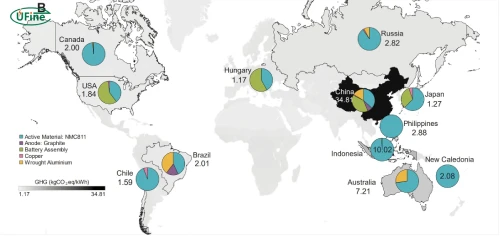
One important distinction: these figures mainly describe the broader lithium-ion battery industry, particularly EV-related cell production. They should not be interpreted as exact market shares for small-format LiPo pouch batteries used in consumer electronics.
For OEM projects involving custom-sized LiPo batteries, China is often a practical sourcing destination. Its established battery manufacturing ecosystem provides access to cell production, raw materials, connectors, protection circuits, and battery pack assembly. This can make it easier to coordinate customization and production under one supply chain.
However, location alone does not guarantee quality. A capable manufacturer in any region should still be evaluated based on its actual products, engineering experience, and quality management.
Ufine Battery provides custom LiPo battery solutions for OEM projects, from prototype development to mass production.
Contact Us TodayPart 3. LiPo battery manufacturer vs. supplier: what’s the difference?
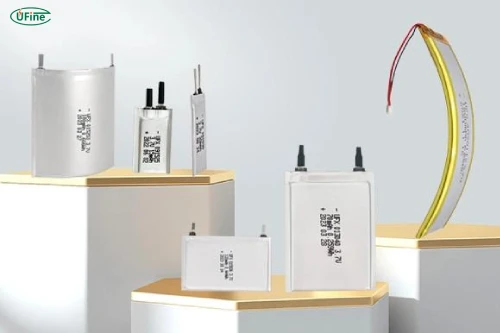
When searching online, you’ll often see the terms LiPo battery manufacturer and LiPo battery supplier used interchangeably. However, they don’t always describe the same type of business.
A manufacturer operates its own production facilities and is directly involved in making batteries. A supplier is a broader term that can refer to manufacturers, trading companies, or distributors that sell batteries to customers.
Understanding this difference helps you choose the right partner for your OEM project.
|
Business type |
Main role |
Potential advantages |
Possible limitations |
|---|---|---|---|
|
Battery manufacturer |
Produces battery cells or packs |
Direct technical communication, customization, production control |
May have specific MOQ or production requirements |
|
Trading company |
Sources batteries from factories and resells them |
Convenient sourcing and access to multiple products |
Less direct control over manufacturing and technical changes |
|
Distributor |
Supplies existing battery products |
Convenient purchasing and product availability |
Limited customization and product flexibility |
Why work directly with a manufacturer?
For OEM projects, working directly with a manufacturer can make a significant difference, especially when your battery needs are not standard.
Imagine you’re developing a compact wearable device. The battery needs to fit a curved internal space, deliver a specific capacity, and connect to your circuit board through a particular connector.
A direct manufacturer can discuss these requirements with its engineering team and assess whether the battery design can be adjusted. If changes are needed during development, you can communicate with the people responsible for production rather than relying entirely on an intermediary.
That doesn’t mean every trading company is unreliable. Some have established relationships with excellent factories and provide useful sourcing services. But if your project requires customized battery development, direct access to manufacturing and engineering capabilities is generally a major advantage.
Part 4. What makes a good LiPo battery supplier?
Finding a company that sells LiPo batteries is easy. Finding one that can consistently deliver the right battery for your product is much more important.
Here are several qualities worth paying attention to when evaluating potential suppliers.
1. Strong customization capabilities
A good supplier should be able to discuss more than standard battery models. OEM projects often involve specific requirements for battery dimensions, voltage, capacity, discharge rate, connectors, and protection circuits.
For consumer electronics, flexibility is particularly important because the battery needs to fit the product’s internal structure without compromising performance.
Ask whether the supplier can support custom battery shapes, thicknesses, and electrical specifications, and whether it has an engineering team to review your design.
2. Reliable quality control and testing
Battery quality affects product performance, user safety, and long-term maintenance costs.
A professional supplier should have established inspection and testing procedures throughout production. Depending on the battery design, these may include:
-
Capacity and voltage testing.
-
Internal resistance measurement.
-
Charge and discharge performance testing.
-
Cycle life testing.
-
Protection circuit and functional testing.
-
Appearance and dimensional inspection.
Don’t just ask whether the supplier performs quality inspections. Find out what is tested, when testing takes place, and whether test records are available.
3. Relevant certifications and compliance support
Depending on your target market and application, your battery may need to meet specific safety and transportation requirements.
For example, UN 38.3 testing is relevant to the transportation of lithium batteries. Other standards and certifications, such as IEC 62133-2 and UL 1642, may also be relevant depending on the battery type and end product.
Remember that certifications should match the actual battery model and configuration. A supplier’s general statement that its products are certified is not a substitute for checking the relevant documents.
4. Stable production capacity and delivery
A supplier may provide excellent samples but struggle when you move to mass production.
Before choosing a long-term partner, ask about its production capacity, manufacturing schedule, material sourcing, and ability to handle repeat orders.
It’s also worth discussing how the supplier manages production changes and component availability. Consistency between sample batches and mass-produced batteries is essential for OEM projects.
5. Responsive technical support
Battery development often involves multiple rounds of communication. You may need to adjust dimensions, review a protection circuit, change a connector, or investigate an unexpected performance issue.
A good supplier should be able to understand your technical questions and provide clear answers rather than simply sending a price quotation.
This is especially important when you’re developing a new product and need support from the early design stage through mass production.
Part 5. Common mistakes to avoid when sourcing LiPo batteries
Even if you’ve found several potential suppliers, rushing into a purchasing decision can create problems later.
Here are some common mistakes worth avoiding.
Choosing a supplier based on price alone
A low quotation may look attractive, but it doesn’t necessarily mean better value. Differences in battery materials, manufacturing processes, capacity consistency, and quality control can affect the final product.
Compare suppliers using the same technical specifications rather than looking at unit prices alone.
Skipping sample testing
Never assume that a battery will perform as expected just because its specifications look good on paper.
Request samples and test them in your actual device whenever possible. Check dimensions, capacity, charging behavior, discharge performance, and compatibility with your product.
Overlooking long-term supply capabilities
Your first order may only involve a small production run, but what happens when demand increases?
A supplier should be able to explain how it handles repeat orders, production planning, and changes in material availability. This helps reduce supply disruptions as your business grows.
Ignoring communication during development
If a supplier takes too long to answer technical questions or cannot clearly explain its production process, that may become a bigger problem during OEM development.
Good communication is not just about response speed. It’s also about whether the supplier understands your requirements and can provide practical solutions.
FAQs
1. How do I verify whether a LiPo battery supplier is a manufacturer?
Ask for factory information, production facility details, manufacturing process documentation, and relevant quality management certifications. You can also arrange a factory audit or video inspection to verify its production capabilities.
2. What is the typical MOQ for custom LiPo batteries?
MOQ varies depending on battery dimensions, specifications, materials, and customization requirements. Some manufacturers support low-MOQ orders for prototypes or small production runs, while larger customized orders may require higher quantities.
3. What certifications should I look for when sourcing LiPo batteries?
Commonly relevant standards and requirements include UN 38.3, IEC 62133-2, and UL 1642. The specific requirements depend on your product, target market, and transportation arrangements.
4. Can a LiPo battery manufacturer develop batteries based on product drawings?
Yes. Experienced manufacturers can review product drawings and available installation space to develop a battery solution that fits your device. They may also recommend adjustments to battery dimensions or specifications based on technical feasibility.
5. What is the difference between a LiPo battery sample and a production sample?
A prototype sample is generally used to evaluate the initial design and technical feasibility. A production sample is closer to the final mass-production version and helps verify materials, dimensions, performance, and manufacturing consistency before bulk production.
6. What should I consider when designing a custom LiPo battery pack?
Consider cell configuration, voltage, capacity, discharge current, protection circuit requirements, wiring, connectors, thermal management, and available installation space. These factors should be evaluated together to ensure compatibility with your electronic device.
Related Tags:

More Articles

200 Amp Lithium Battery: Better Than Lead-Acid?
Is a 200Ah lithium battery worth the extra cost? Compare runtime, lifespan, usable power, and long-term savings before you buy.
Lithium Polymer vs. Lithium Ion Power Bank: What’s the Difference?
Are LiPo power banks really better? Discover the key differences in capacity, weight, lifespan, safety, and air travel before choosing one.
How to Choose the Right 2S Shorty LiPo Battery for Your RC Car?
Not sure which 2S Shorty LiPo to buy? Compare battery specs, popular brands, prices, and performance to find the right fit for your RC car.
What Happens If One Cell in a Battery Pack Goes Bad? How to Fix It
Found a faulty battery cell? Discover how to identify the problem, whether one cell can be replaced, and how to fix a battery pack safely.
4S LiFePO4 BMS Wiring: Step-by-Step Connection Guide
Wiring a 4S LiFePO4 BMS for the first time? Discover the correct balance wire connections, terminal functions, and mistakes that could damage your BMS.