- Part 1. Check whether a 2S Shorty LiPo fits your RC car
- Part 2. Choose the right capacity: 4000mAh, 5000mAh, or 6000mAh?
- Part 3. Understand C-rating and discharge current
- Part 4. Check voltage compatibility with your ESC and motor
- Part 5. Consider battery weight and weight distribution
- Part 6. Match the battery to your driving style
- Part 7. Which 2S Shorty LiPo battery brands should you consider?
- Part 8. How much does a 2S Shorty LiPo battery cost?
- FAQs
Choosing a 2S Shorty LiPo battery for your RC car is not just about finding the highest capacity or C-rating. The wrong battery may not fit your chassis, deliver enough current, or work safely with your electronic speed controller (ESC).
So, whether you’re replacing an old battery or upgrading your RC racing setup, let’s look at the specifications that actually matter before you buy.
Key takeaways
-
Dimensions come first: A Shorty battery must fit your chassis, battery tray, and mounting system.
-
Capacity affects runtime: Higher mAh generally provides more energy, but often comes with additional weight and size.
-
C-rating determines current capability: Match the battery’s discharge capability to your motor and ESC requirements.
-
Voltage must be compatible: A standard 2S LiPo is rated at 7.4V nominal and 8.4V when fully charged.
-
Weight influences handling: A lighter battery can improve weight distribution and vehicle response.
-
Brand and price matter: Compare specifications, construction, warranty, and real-world performance rather than choosing based on marketing claims alone.
Part 1. Check whether a 2S Shorty LiPo fits your RC car
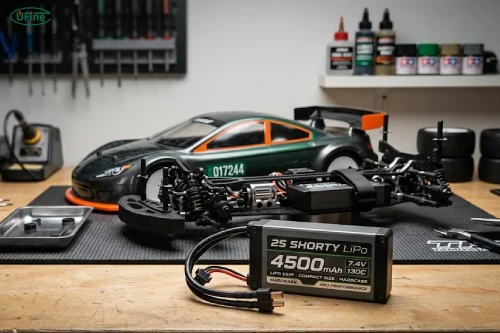
Before comparing battery brands or performance ratings, check the physical dimensions of your RC car’s battery compartment.
A Shorty LiPo battery is designed with a shorter form factor than many conventional stick-style or full-length hardcase batteries. This compact design is particularly useful in RC racing vehicles where chassis space and weight distribution are important.
However, the term “Shorty” does not describe one universal battery size. Different manufacturers offer different lengths, widths, and heights.
Measure the available space in your battery tray, including the clearance needed for wires, connectors, and mounting straps. Compare these measurements with the manufacturer’s battery specifications rather than relying on product photos.
Hardcase vs. softcase is another consideration. Hardcase batteries have a rigid protective enclosure, making them popular for RC cars exposed to vibration, impacts, and frequent battery changes. Softcase batteries are generally more flexible in shape and may be suitable for vehicles with specific mounting requirements, provided the battery is adequately protected.
Also check the connector. Common options include Deans/T-Plug, XT60, EC3, and 4mm or 5mm bullet connectors. A physically compatible battery may still require a suitable connector or properly made adapter.
Part 2. Choose the right capacity: 4000mAh, 5000mAh, or 6000mAh?
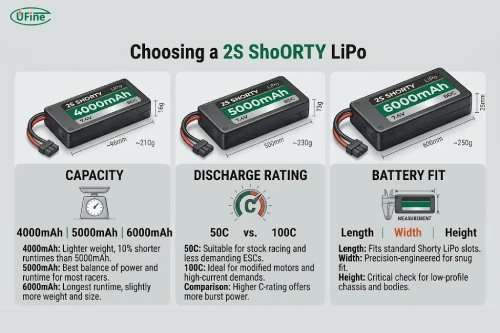
Battery capacity directly affects how much energy is available during a driving session. For many 1/10-scale RC applications, 4000mAh, 5000mAh, and 6000mAh are useful capacity options to compare.
But should you always choose 6000mAh?
Not necessarily.
A higher-capacity battery generally provides longer potential runtime, but it may also be heavier and larger. That additional weight can change acceleration, braking, and cornering characteristics.
| Battery capacity | Main advantage | Potential trade-off |
|---|---|---|
| 4000mAh | Lower weight and compact options | Shorter potential runtime |
| 5000mAh | Balanced capacity and weight | Moderate runtime |
| 6000mAh | More available energy | Greater weight and space requirements |
For example, if you mainly drive casually in a parking lot, a 5000mAh battery may provide a good balance between runtime and handling.
For longer sessions, a 6000mAh option may be more attractive, provided it fits your vehicle and doesn’t make it unnecessarily heavy.
Actual runtime also depends on motor efficiency, throttle habits, gearing, tire choice, terrain, and driving conditions. A battery rated at 6000mAh will not necessarily last 20% longer than a 5000mAh battery in every RC car.
Part 3. Understand C-rating and discharge current
If your RC car accelerates aggressively, runs a powerful brushless motor, or participates in competitive racing, discharge capability deserves particular attention.
The C-rating indicates how quickly a battery can theoretically deliver current relative to its capacity.
You can estimate the theoretical continuous discharge current using:
Maximum continuous current (A) = Capacity (Ah) × C-rating
For example:
-
4000mAh × 50C = 200A
-
5000mAh × 50C = 250A
-
5000mAh × 100C = 500A
These figures are theoretical ratings, not guaranteed real-world outputs.
Some manufacturers use different testing methods or marketing conventions when specifying C-ratings. Therefore, a 100C battery from one brand does not automatically outperform a 50C battery from another.
For a more meaningful comparison, look at internal resistance (IR), temperature under load, voltage sag, and independent performance testing where available.
You should also compare the battery’s discharge capability with the current demands of your ESC and motor. A battery’s theoretical current rating does not mean your electronics will draw that amount of current.
The goal is to find a battery that can comfortably support your setup without excessive voltage sag or overheating.
Part 4. Check voltage compatibility with your ESC and motor
A 2S Shorty LiPo contains two cells connected in series. Its standard nominal voltage is 7.4V, while its fully charged voltage reaches 8.4V.
This distinction matters because your ESC and motor must support the battery’s actual operating voltage.
Before purchasing, check the ESC manufacturer’s specifications for supported LiPo cell counts. A 2S-compatible ESC is generally designed to work with a standard 2S LiPo, but you should also verify the motor’s recommended voltage range.
Pay attention to low-voltage cutoff (LVC), too. This ESC protection feature helps prevent excessive battery discharge.
Hobbywing explains that LVC settings can vary between ESC models and that the cutoff voltage is typically configured on a per-cell basis. For a 2S battery, settings of 3.3V or 3.1V per cell correspond to 6.6V or 6.2V under the guidance discussed in its technical article.
One more thing: don’t confuse standard LiPo and LiHV batteries. Standard 2S LiPo batteries are typically labeled 7.4V nominal, while 2S LiHV batteries are commonly labeled 7.6V nominal and can charge to a higher voltage of 8.7V.
A LiHV battery should only be used when the ESC, motor, and charger explicitly support its voltage requirements.
Part 5. Consider battery weight and weight distribution
In RC racing, battery weight is not just a specification on the product label. It can change how your vehicle behaves on the track.
A heavier battery may increase overall vehicle weight and affect acceleration, braking, and cornering. Its position also influences the vehicle’s balance.
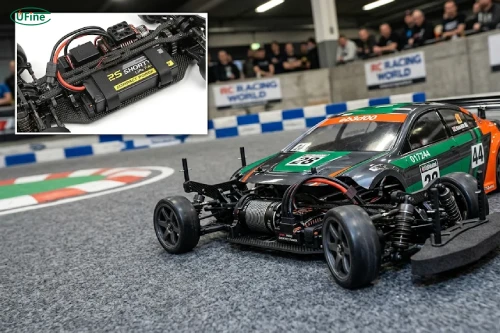
This is one reason Shorty batteries are popular among RC racers. Their compact form factor can provide more flexibility when positioning battery weight within the chassis.
For example, if your setup allows the battery to be moved forward or backward, you may be able to adjust the front-to-rear weight distribution to suit different track conditions.
For casual driving, a slightly heavier battery may be an acceptable trade-off for longer runtime. For competitive racing, however, you may prefer a lighter battery that provides sufficient capacity and discharge performance without adding unnecessary mass.
Don’t assume that every Shorty battery is automatically lighter than a standard pack. Compare the actual weight of each model before deciding.
Part 6. Match the battery to your driving style
The best 2S Shorty LiPo battery depends on how you use your RC car.
For casual driving, you probably don’t need the most expensive high-discharge racing battery. A reliable 4000–5000mAh battery with sufficient current capability may be more practical.
For competitive racing, weight, voltage stability, internal resistance, and consistent power delivery become more important.
For high-power brushless setups, focus on whether the battery can support the system’s current demand without excessive heating or voltage sag.
For longer driving sessions, higher capacity may be worthwhile, but only if your chassis can accommodate the battery.
In other words, there is no universally best combination of capacity and C-rating. Your vehicle’s electronics, physical layout, and driving requirements should determine the specifications.
Part 7. Which 2S Shorty LiPo battery brands should you consider?
Several brands offer batteries for RC cars and competitive racing. Their product ranges differ in capacity, discharge ratings, construction, and pricing.
Here are some established names worth comparing:
Gens ace
Gens ace offers a wide range of RC batteries, including standard 2S LiPo packs and Shorty hardcase models. Its Redline series targets users who need higher discharge performance for demanding RC applications.
Reedy
Reedy is well known in the RC racing community. Its Zappers battery range includes Shorty configurations designed for racing applications, with different capacities and low-profile options.
ProTek RC
ProTek RC offers several high-performance battery options, including Si-Graphene and HV Shorty models. Its products are worth considering if you prioritize racing-oriented specifications and low internal resistance.
R1 WURKS
R1 WURKS also offers Shorty LiPo batteries with different capacity and discharge configurations, including options aimed at competitive RC racing.
When comparing these brands, don’t focus only on the advertised C-rating. Look at the exact battery model, dimensions, weight, connector, voltage, warranty, and availability of technical specifications.
A well-matched battery from a mid-range product line may be a better purchase than an expensive racing model with specifications your RC car cannot fully use.
Part 8. How much does a 2S Shorty LiPo battery cost?
Price is another important factor, especially if you regularly participate in RC racing and need multiple batteries.
As of November 2026, US retailer listings show considerable price differences between standard Shorty packs and premium racing models.
Here are some examples of products and listed prices:
| Brand / model | Key specifications | Listed price (USD) |
|---|---|---|
| Gens ace Shorty | 4600mAh, 7.4V, 60C | $44.99 |
| Gens ace Redline 2.0 | 6000mAh, 7.6V, 140C | $88.99 |
| Reedy Zappers HV SG6 | 4000mAh, 7.6V, 135C | $72.99 |
| ProTek RC SG3 HV Shorty | 6000mAh, 7.6V, 150C | $74.99 |
| R1 WURKS Shorty | 6000mAh, 7.4V, 150C | $116.99 |
Prices are examples from US retailer listings, not official manufacturer MSRP. They may change with stock, promotions, and retailer policies.
As a general purchasing guide:
-
Around $35–$55: More affordable options for casual driving and general RC use.
-
Around $55–$90: Mid-range options with higher capacities or more advanced battery configurations.
-
Around $90–$120+: Premium racing-oriented models featuring specialized cell configurations, high discharge claims, or advanced construction.
Why do two batteries with similar capacities sometimes have very different prices?
Several factors contribute:
-
Cell quality and consistency: Cell matching and manufacturing quality can affect voltage stability and long-term performance.
-
Internal resistance: Lower internal resistance can help reduce voltage sag and heat generation under comparable loads.
-
Construction: Hardcase materials, connectors, wiring, and assembly quality influence overall product cost.
-
Testing and quality control: More rigorous production testing and quality assurance can add to manufacturing costs.
-
Brand positioning and support: Established brands may charge more for product development, warranties, and customer service.
A higher price doesn’t guarantee better performance in your particular vehicle. Compare actual specifications and choose a battery that meets your requirements without paying for features you won’t use.
FAQs
1. What is the best capacity for a 2S Shorty LiPo RC car battery?
For many 1/10-scale RC applications, 4000–6000mAh is a useful range to compare. The right capacity depends on your chassis dimensions, preferred runtime, and acceptable battery weight.
2. Can I use a regular 2S LiPo instead of a Shorty battery?
Yes, provided the battery fits your chassis and meets the voltage, discharge, weight, and connector requirements. The main difference is the physical form factor.
3. Can I use a 2S Shorty LiPo battery in both 2WD and 4WD RC cars?
Yes, a 2S Shorty LiPo can work in both 2WD and 4WD RC cars if the battery dimensions, voltage, connector, and discharge capability match the vehicle’s requirements. However, 4WD setups may have different power demands depending on the motor, gearing, and driving conditions.
4. Does a 2S Shorty LiPo battery lose performance over time?
Yes. Repeated charge and discharge cycles gradually increase internal resistance and reduce usable capacity. You may notice shorter runtime, greater voltage sag, or increased heating as the battery ages.
5. Can cold weather affect my 2S Shorty LiPo battery performance?
Yes. Low temperatures can increase internal resistance and temporarily reduce available capacity and discharge performance. Allow the battery to reach an appropriate operating temperature before use, and always follow the manufacturer’s temperature recommendations.
Related Tags:

More Articles

Where to Find Reliable LiPo Battery Suppliers for OEM Projects
Looking for LiPo battery suppliers? Discover where to find reliable manufacturers and how to avoid costly sourcing mistakes.
Lithium Polymer vs. Lithium Ion Power Bank: What’s the Difference?
Are LiPo power banks really better? Discover the key differences in capacity, weight, lifespan, safety, and air travel before choosing one.
What Happens If One Cell in a Battery Pack Goes Bad? How to Fix It
Found a faulty battery cell? Discover how to identify the problem, whether one cell can be replaced, and how to fix a battery pack safely.
4S LiFePO4 BMS Wiring: Step-by-Step Connection Guide
Wiring a 4S LiFePO4 BMS for the first time? Discover the correct balance wire connections, terminal functions, and mistakes that could damage your BMS.
Learn 24V Battery Management System
Need a 24V battery management system? Explore wiring diagrams, BMS current ratings, charging compatibility, battery protection, and troubleshooting tips.