- Part 1. What is a 24V battery management system?
- Part 2. How does a 24V BMS work?
- Part 3. Essential protection features of a 24V lithium battery BMS
- Part 4. 24V BMS wiring diagram and connection basics
- Part 5. 24V BMS vs. PCM: What's the difference?
- Part 6. 24V BMS current rating: How many amps do you need?
- Part 7. How to choose the right 24V battery management system
- FAQs
A 24V lithium battery pack needs more than the right voltage and capacity to operate safely and reliably. Its battery management system (BMS) also plays an essential role by monitoring individual cells, controlling charging and discharging, and protecting the battery against electrical and temperature-related problems.
If you’re designing a 24V lithium battery pack, choosing a replacement BMS, or troubleshooting a battery that won’t charge, understanding how the system works can help you avoid compatibility problems and make better technical decisions.
Key takeaways
-
A 24V BMS monitors battery voltage, current, and temperature to keep a lithium battery pack operating within safe limits.
-
A 24V lithium battery pack may use different series configurations depending on its chemistry. Always match the BMS to the actual cell count and voltage requirements.
-
Common BMS protections include overcharge, over-discharge, overcurrent, short circuit, and temperature protection.
-
BMS wiring typically involves battery-negative, output connections, and individual cell-balancing wires.
-
BMS current ratings must accommodate both continuous operating current and short-duration peak current.
-
A BMS and a PCM provide related battery protection functions, but their monitoring and management capabilities may differ.
Part 1. What is a 24V battery management system?
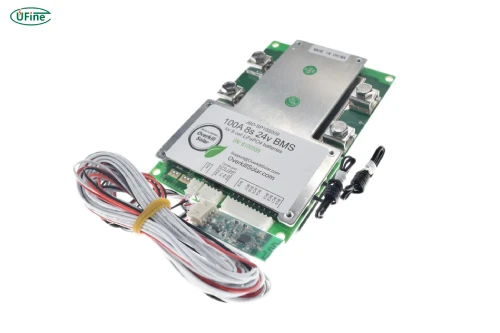
A 24V battery management system is an electronic circuit designed to monitor and protect a lithium battery pack with a nominal voltage in the 24V class. It acts as a control and protection unit between the battery cells, charger, and connected device.
Unlike a simple battery protection circuit that may only disconnect the battery when a fault occurs, a more advanced BMS can continuously monitor individual cell voltages, pack current, and temperature. Depending on its design, it may also estimate the battery’s state of charge (SOC), balance cells, and communicate operating information to the main device.
A typical 24V BMS performs four important functions:
-
Monitoring: Measures individual cell voltages, charging and discharging current, and battery temperature.
-
Protection: Disconnects charging or discharging when electrical or temperature limits are exceeded.
-
Cell balancing: Helps maintain similar voltage levels across cells connected in series.
-
Battery management: Provides operating information and, in advanced designs, supports communication with external controllers.
The BMS is particularly important in lithium polymer (LiPo) and lithium-ion battery packs because individual cells must remain within their specified operating limits. Even when the total pack voltage appears normal, one cell may already be overcharged or over-discharged.
How many cells does a 24V lithium battery have?
The term 24V describes a nominal voltage class rather than one universal battery configuration. The number of cells connected in series depends on the battery chemistry and the voltage characteristics of each cell.
For example:
|
Battery chemistry |
Series configuration |
Nominal voltage |
Full-charge voltage |
|---|---|---|---|
|
LiPo (3.7V per cell) |
6S |
22.2V |
25.2V |
|
LiPo (3.7V per cell) |
7S |
25.9V |
29.4V |
|
Li-ion (3.6V per cell) |
7S |
25.2V |
29.4V |
|
LiFePO4 (3.2V per cell) |
8S |
25.6V |
29.2V |
These examples use typical nominal and maximum charging voltages. Always confirm the cell manufacturer’s specifications before selecting a BMS.
For example, a 6S LiPo battery pack uses six cells connected in series. Its nominal voltage is 22.2V, but it is commonly used in applications described as 24V battery systems.
A 7S LiPo configuration has a higher nominal voltage of 25.9V. Therefore, you should never select a BMS based only on the product label saying “24V.” The actual series cell count and chemistry are much more important.
Part 2. How does a 24V BMS work?
A 24V BMS works by continuously collecting information from the battery pack and comparing it with predefined protection thresholds.
During normal operation, the BMS allows the battery to charge and discharge. When it detects an abnormal condition, it can control its charging or discharging MOSFETs to interrupt the corresponding current path.
The basic operating process includes three stages.
1. Monitoring battery conditions
The BMS measures the voltage of each cell connected in series. It also monitors the overall battery current and uses temperature sensors, commonly NTC thermistors, to detect overheating or excessively low temperatures.
These measurements help the system identify problems before they cause permanent battery damage.
2. Evaluating operating conditions
The BMS compares the collected data with configured limits.
For example, if one cell reaches its maximum permitted charging voltage, the BMS identifies an overvoltage condition. If the battery temperature exceeds its specified operating range, it may also trigger protection.
3. Controlling charging and discharging
If a fault occurs, the BMS can switch off the relevant MOSFETs to disconnect the charging source or connected load.
Once the fault condition disappears and the recovery requirements are satisfied, some BMS designs automatically restore operation. Others require a charger connection, reset signal, or specific recovery procedure.
This process helps prevent individual cells from operating outside their recommended limits.
Part 3. Essential protection features of a 24V lithium battery BMS
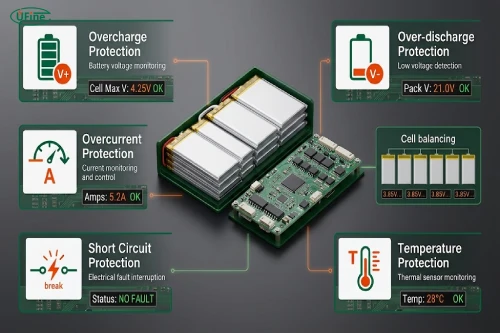
A reliable 24V BMS should provide protection appropriate to the battery chemistry, cell configuration, and application. The following are among the most important functions.
Overcharge protection
Overcharging occurs when a cell exceeds its maximum permitted charging voltage. It can accelerate cell degradation and create serious safety risks.
The BMS monitors individual cell voltages and stops or interrupts charging when a configured overvoltage threshold is reached.
Over-discharge protection
When a lithium battery is discharged below its recommended minimum voltage, its capacity and service life may be permanently affected.
The BMS monitors cell voltage during discharge and disconnects the load if a cell reaches its undervoltage threshold.
Overcurrent protection
If the connected device draws more current than the BMS can safely handle, excessive heat may build up in the cells, wiring, and protection components.
Overcurrent protection limits this risk by interrupting the discharge path when the configured current threshold is exceeded.
Short circuit protection
A short circuit can produce a sudden, extremely high current. The BMS detects this abnormal condition and rapidly disconnects the battery through its protection circuit.
Lithium batteries are sensitive to temperature changes. Excessive heat can accelerate degradation, while charging at excessively low temperatures can increase the risk of lithium plating in certain lithium-ion chemistries.
A BMS with temperature sensors can prevent charging or discharging when temperatures move outside the cell manufacturer’s permitted limits.
Cell balancing
Cells connected in series do not always have exactly the same capacity, internal resistance, or self-discharge characteristics.
Over time, their voltage levels may become uneven. Cell balancing helps reduce this difference so that one cell does not reach its voltage limit significantly earlier than the others.
There are two common balancing methods:
-
Passive balancing: Releases excess energy from higher-voltage cells as heat, usually through resistors.
-
Active balancing: Transfers energy between cells to reduce voltage differences more efficiently, although the circuit is generally more complex.
For most compact consumer electronics battery packs, passive balancing is a common and practical solution.
Part 4. 24V BMS wiring diagram and connection basics
Correct wiring is essential for a 24V battery management system. Incorrect balance-wire connections can damage the BMS or create dangerous electrical conditions.
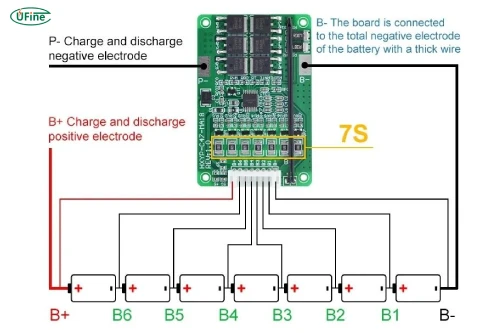
A typical BMS connection includes the battery negative terminal, charging and discharging connections, and individual cell-monitoring wires.
The following is a simplified conceptual diagram for a 4S battery pack. It illustrates the connection principle rather than a specific 24V wiring layout.
       Cell 1       Cell 2       Cell 3       Cell 4
     +-------+    +-------+    +-------+    +-------+
     |       |    |       |    |       |    |       |
     +-------+----+-------+----+-------+----+-------+
     B0      B1   B2      B3   B4

     Balance wire connections:
     B0 = Battery negative
     B1 = Cell 1 positive
     B2 = Cell 2 positive
     B3 = Cell 3 positive
     B4 = Cell 4 positive

                  4S BMS
             +----------------+
             | Cell monitoring|
             | Protection     |
             | Balancing      |
             +----------------+
                |          |
              P-           B+
                |          |
             Output     Battery
             negative   positive
For a typical common-port BMS, the main connections may include:
-
B-: Connects to the battery pack’s negative terminal.
-
B+: Connects to the battery pack’s positive terminal, often directly rather than through the BMS.
-
P-: Connects to the negative terminal of the external load and charger.
-
C-: Found on some separate-port designs and connects to the charger negative terminal.
-
Balance wires: Connect to the individual cell junctions in the correct sequence.
Not every BMS uses the same terminal arrangement. Some have separate charging and discharging ports, while others use a common port.
For an actual 24V battery pack, the balance-wire count must match the selected series configuration. A 7S battery, for example, requires monitoring connections for seven cells and their corresponding junction points.
Before connecting anything, check the manufacturer’s wiring diagram and verify each connection with a suitable meter. Never assume that two BMS boards with similar appearances have identical pin assignments.
Part 5. 24V BMS vs. PCM: What’s the difference?
BMS and PCM (Protection Circuit Module) are both used to protect lithium battery packs. However, they are not always designed with the same level of monitoring and management functionality.
A PCM generally focuses on essential battery protection, such as overcharge, over-discharge, and overcurrent protection. A more advanced BMS may provide additional functions, including cell balancing, temperature monitoring, battery status estimation, and communication.
|
Feature |
PCM |
Advanced BMS |
|---|---|---|
|
Overcharge protection |
Common |
Yes |
|
Over-discharge protection |
Common |
Yes |
|
Overcurrent protection |
Common |
Yes |
|
Short circuit protection |
Common |
Yes |
|
Cell voltage monitoring |
Basic or limited |
Individual cell monitoring |
|
Cell balancing |
Not always available |
Often available |
|
Temperature monitoring |
Design-dependent |
Common |
|
SOC estimation |
Usually limited |
Available in advanced designs |
|
Communication |
Usually limited |
May support UART, I2C, CAN, etc. |
The distinction is not absolute. Some PCMs include balancing and temperature protection, while some simpler BMS boards provide only basic protection.
For compact consumer electronics, a basic protection circuit may be sufficient when the battery design requires only essential safety functions.
For larger or more complex battery packs, an advanced BMS may be more appropriate because it provides greater visibility and control over battery operation.
Part 6. 24V BMS current rating: How many amps do you need?
The current rating is one of the most important factors when choosing a 24V BMS. Even if the battery voltage and cell configuration are correct, an undersized BMS may repeatedly disconnect the battery or overheat during operation.
To select an appropriate current rating, you first need to understand the power consumption of the connected device.
The basic relationship between voltage, power, and current is:
I = P/VWhere:
-
I = Current (A)
-
P = Power (W)
-
V = Voltage (V)
For example, suppose a 24V-class battery system powers a device rated at 240W.
Using a nominal voltage of 24V:
I = 240W/24V= 10AThe device requires approximately 10A under these assumed operating conditions.
However, this does not mean you should automatically choose a 10A BMS. You also need to consider startup current, peak loads, operating temperature, and the battery cells’ maximum discharge capability.
Continuous current vs. peak current
These two ratings describe different operating conditions.
-
Continuous discharge current: The maximum current the BMS can support continuously under its specified thermal and operating conditions.
-
Peak discharge current: The higher current the BMS can temporarily support for a limited period.
For example, a motor-driven device may normally consume 8A but briefly require 18A during startup. A BMS rated for 10A continuous and 20A peak may appear suitable, but only if its peak-current duration and thermal specifications match the actual application.
You should also check the battery cells themselves. A BMS with a 30A rating cannot make cells rated for only 10A safely deliver 30A.
A suitable design must consider the lowest current limit among the cells, BMS, connectors, wiring, and other electrical components.
Part 7. How to choose the right 24V battery management system
Selecting a 24V BMS involves more than matching the voltage printed on the battery. You need to consider the battery chemistry, series cell count, discharge requirements, charging specifications, and operating environment.
Here are five factors to consider.
1. Match the battery chemistry and cell count
Start by identifying whether your battery uses LiPo, conventional lithium-ion, or LiFePO4 cells. Each chemistry has different voltage limits and charging requirements.
The BMS must support the correct number of cells connected in series. A 7S LiPo battery, for example, needs a BMS designed for a compatible 7S configuration.
2. Select the appropriate current rating
Calculate the maximum continuous current required by your device, then consider startup and peak loads.
Make sure the BMS can handle these requirements without exceeding its thermal or electrical limits.
3. Check the protection functions
At a minimum, look for overcharge, over-discharge, overcurrent, and short circuit protection.
Temperature monitoring and cell balancing are also important, particularly for battery packs that undergo frequent charging and discharging.
4. Consider the battery’s physical dimensions
For compact consumer electronics, the size of the BMS can be just as important as its electrical specifications.
A large protection board may not fit inside a small handheld device, wearable product, or portable electronic enclosure. Consider PCB dimensions, connector placement, wiring layout, and heat dissipation during battery pack design.
5. Evaluate communication requirements
Some applications only need basic battery protection. Others require real-time battery information, including voltage, current, temperature, and state of charge.
If your device needs to communicate with the battery pack, consider a smart BMS with an appropriate interface, such as UART, I2C, or CAN, depending on system compatibility.
Ultimately, the right BMS is one that matches the battery cells and the actual operating requirements of your device.
FAQs
Q1. Can a 24V BMS work with a 36V battery?
No. A 24V BMS is designed for a specific cell configuration and voltage range. A 36V-class battery generally requires a different series-cell configuration and a compatible BMS. Always match the BMS to the actual battery specifications.
Q2. Can you connect two 24V batteries in parallel with one BMS?
Not automatically. Parallel battery packs require careful consideration of voltage matching, current sharing, protection coordination, and connection design. Each battery pack should have an appropriate protection strategy. Never connect independently protected packs in parallel without confirming that the BMS manufacturers permit this arrangement.
Q3. Does a 24V BMS consume power when the battery is not in use?
Yes, most BMS boards consume a small amount of standby current to monitor battery conditions. Smart BMS designs may consume more depending on their communication and monitoring functions. Over long storage periods, this standby consumption can gradually discharge the battery.
Q4. Can a 24V BMS be used with different battery capacities?
Yes, provided the battery chemistry, series configuration, voltage limits, and current requirements are compatible. For example, two 7S LiPo battery packs with different capacities may use the same BMS model if their electrical requirements fall within its specifications.
Q5. Is a 24V BMS compatible with different battery brands?
Not necessarily. Compatibility depends more on cell chemistry, series configuration, voltage thresholds, current ratings, and connection design than on the battery brand. Always check the technical specifications rather than assuming that batteries with the same nominal voltage are interchangeable.
Related Tags:

More Articles

What Happens If One Cell in a Battery Pack Goes Bad? How to Fix It
Found a faulty battery cell? Discover how to identify the problem, whether one cell can be replaced, and how to fix a battery pack safely.
4S LiFePO4 BMS Wiring: Step-by-Step Connection Guide
Wiring a 4S LiFePO4 BMS for the first time? Discover the correct balance wire connections, terminal functions, and mistakes that could damage your BMS.
How a Series BMS Manages and Protects Lithium Battery Cells
Learn how Series BMS works in lithium battery packs, including cell balancing methods, wiring connections, protection features, and common mistakes.
20S BMS Wiring Diagram: A Step-by-Step Connection Guide
Building a 20S battery pack? Discover how to connect BMS terminals, check balance wires, calculate discharge current, and choose the right protection system.
Can Power Bank Charge an Action Camera Battery?
Find out which power banks work with action cameras, whether you can record while charging, and what to use when your camera runs out of power.