- Part 1. What is a Series BMS and how does it work?
- Part 2. Series BMS vs. parallel BMS: What's the difference?
- Part 3. How to connect batteries in series with a BMS
- Part 4. How does a BMS protect a series lithium battery pack?
- Part 5. Why do series lithium batteries need cell balancing?
- Part 6. What happens if one cell fails in a series battery pack?
- Part 7. Active vs. passive balancing in Series BMS: Key differences
- Part 8. Common Series BMS wiring mistakes and how to avoid them
- Part 9. How to choose the right Series BMS for a LiPo battery pack
- FAQs
For devices that require higher operating voltages, connecting multiple lithium battery cells in series is a common solution. However, series-connected cells do not always charge and discharge at exactly the same rate. Even small differences in voltage, capacity, and internal resistance can affect the performance of the entire battery pack.
This is where a Series Battery Management System (BMS) comes in. It monitors individual cells, manages charging and discharging conditions, and helps protect the battery pack from electrical and temperature-related problems.
In this guide, you’ll learn how a Series BMS works, how it differs from a parallel configuration, how cell balancing works, and what to consider when selecting a BMS for a LiPo battery pack.
Key takeaways
-
A Series BMS monitors individual cells in a series-connected lithium battery pack.
-
Connecting cells in series increases total voltage, while the pack capacity in Ah remains the same when using matched cells.
-
A BMS provides protection against overcharging, over-discharging, overcurrent, short circuits, and excessive temperatures, depending on its design.
-
Cell balancing helps reduce differences in cell voltage and state of charge.
-
Active balancing transfers energy between cells, while passive balancing dissipates excess energy as heat.
-
Using cells with different capacities or conditions can reduce the usable performance of the entire battery pack.
-
The BMS must match the battery chemistry, series count, voltage, current, and protection requirements.
Part 1. What is a Series BMS and how does it work?
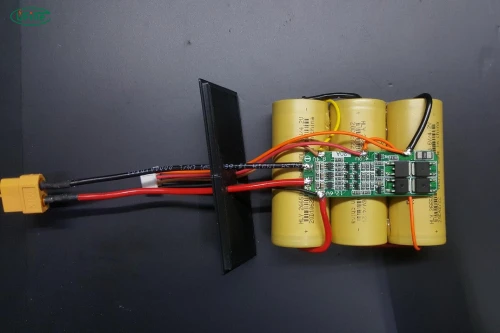
A Series BMS is a battery management system designed to monitor and protect lithium battery cells connected in series. It checks the condition of individual cells rather than relying only on the total battery pack voltage.
When batteries are connected in series, the positive terminal of one cell connects to the negative terminal of the next. This arrangement increases the overall voltage without increasing the Ah capacity of the pack.
For example, three 3.7V LiPo cells connected in series form a 3S battery pack with a nominal voltage of 11.1V.
A Series BMS monitors the voltage of each cell, along with other parameters such as charging and discharging current and temperature. If one cell reaches an unsafe operating limit, the BMS can interrupt charging or discharging through its protection circuitry.
How does a Series BMS monitor individual cells?
A Series BMS uses voltage-sensing connections attached to the battery cells or series groups. These connections allow the monitoring circuit to measure each cell’s voltage independently.
This is important because the total pack voltage does not tell you whether every cell is operating normally. For example, a 3S pack might have a normal-looking total voltage even though one cell is nearly fully charged and another is significantly lower.
By monitoring individual cells, the BMS can identify these differences and respond before they become more serious.
How does a Series BMS manage voltage and current?
The BMS continuously monitors the battery pack during operation. Depending on its design, it can disconnect the charging or discharging circuit when a cell exceeds its voltage limits, when the current becomes excessive, or when the temperature moves outside the permitted range.
A BMS also works with the charger and the device’s power system to keep the battery operating within its specified limits.
Common applications
Series BMS configurations are used in many rechargeable battery applications, including:
-
Portable medical equipment requiring higher operating voltages.
-
Handheld industrial instruments and inspection devices.
-
Portable gaming devices and electronic equipment.
-
Robotics and compact automation systems.
-
Multi-cell LiPo battery packs for customized consumer electronics.
Part 2. Series BMS vs. parallel BMS: What’s the difference?
Series and parallel connections serve different purposes. The main difference is how they affect battery voltage, capacity, and monitoring requirements.
In a series configuration, cell voltages add together. In a parallel configuration, voltage remains the same while capacity increases.
|
Feature |
Series connection |
Parallel connection |
|---|---|---|
|
Voltage |
Increases |
Remains the same |
|
Ah capacity |
Remains the same |
Increases |
|
Current capacity |
Limited by cell and pack design |
Can increase with suitable matched cells |
|
Cell monitoring |
Each series cell or group needs voltage monitoring |
Each parallel group is generally monitored as one voltage group |
|
Main purpose |
Achieve higher voltage |
Increase capacity and runtime |
It’s worth understanding that a BMS is not simply classified as a series BMS or parallel BMS in every product specification. The correct monitoring architecture depends on the battery pack’s actual configuration.
For example, a 3S2P battery pack contains three series groups, with two cells connected in parallel within each group. The BMS must support three series monitoring channels, while the parallel cells within each group operate at the same voltage.
When choosing a BMS, always check the manufacturer’s supported series and parallel configurations rather than relying on the product name alone.
Part 3. How to connect batteries in series with a BMS
Connecting lithium batteries in series requires careful wiring. Incorrect connections can damage the BMS, battery cells, or connected electronic equipment.
Before starting, make sure the cells have compatible chemistry, voltage ratings, and capacities. They should also have similar states of charge.
Components required
A typical series battery pack includes lithium battery cells, a compatible BMS, connecting wires, an appropriate charger, and suitable electrical connectors.
The BMS must support the number of cells connected in series. For example, a 3S battery pack requires a BMS designed for three series-connected cell groups.
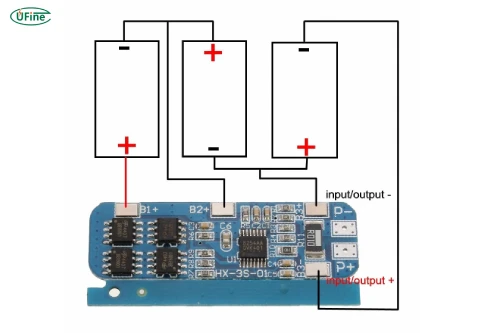
How does the wiring work?
In a series battery pack, the cells are connected positive-to-negative in sequence. The BMS balance wires connect to the individual cell junctions, allowing it to monitor each cell group.
For a typical 3S configuration, the monitoring connections reference the battery pack’s negative terminal and the junctions between the three cells.
The main positive and negative connections are then routed according to the BMS manufacturer’s designated terminals. Some BMS designs use a common charging and discharging port, while others have separate ports.
Example: 3S LiPo battery pack
Illustrative electrical configuration
|
Parameter |
Value |
|---|---|
|
Number of cells |
3 |
|
Nominal cell voltage |
3.7V |
|
Nominal pack voltage |
11.1V |
|
Full-charge pack voltage |
12.6V |
|
Typical cell chemistry |
Lithium polymer |
A standard 3S LiPo pack uses three 3.7V nominal cells, each with a maximum charging voltage of 4.2V.
Always follow the exact BMS wiring diagram. Check every balance-wire connection with a multimeter before connecting the BMS, and never assume that wire colors or connector positions are universal. Incorrect balance-wire sequencing can cause immediate damage.
Part 4. How does a BMS protect a series lithium battery pack?
A BMS provides several layers of protection to help prevent abnormal battery operation. The exact protection functions depend on the BMS model and its specifications.
Overcharge protection
Overcharging occurs when a lithium battery cell exceeds its permitted charging voltage. This can accelerate cell degradation and create serious safety risks.
A BMS monitors individual cell voltages and can stop charging when a cell reaches its overvoltage protection threshold.
Over-discharge protection
Over-discharging happens when a cell’s voltage falls below its specified minimum level. This may cause permanent capacity loss or internal damage.
A BMS can disconnect the discharge path when a cell reaches its undervoltage protection threshold.
Overcurrent and short-circuit protection
When a device draws more current than the battery pack can safely supply, the BMS may disconnect the circuit.
Short-circuit protection responds to sudden, excessive current caused by an unintended electrical connection. These functions help protect both the battery and the connected equipment.
Temperature protection
Battery performance is affected by temperature. Charging or discharging outside the cell manufacturer’s specified temperature range can accelerate degradation and create safety risks.
A BMS with temperature sensors can monitor operating conditions and interrupt charging or discharging when temperature limits are exceeded.
Part 5. Why do series lithium batteries need cell balancing?
Even when lithium battery cells are manufactured to the same specifications, small differences can develop over time.
Cells may have slightly different capacities, internal resistance, self-discharge rates, or initial states of charge. These differences can become more noticeable after repeated charging and discharging cycles.
In a series battery pack, the weakest cell can limit the usable capacity of the entire pack.
For example, imagine a 3S LiPo battery pack in which two cells have plenty of remaining charge, but the third reaches its discharge protection threshold first. The BMS may disconnect the entire pack even though the other two cells still contain usable energy.
Cell balancing helps reduce differences in cell voltage and state of charge, allowing the battery pack to operate more consistently.
It is particularly important in multi-cell lithium battery packs because a single cell reaching its voltage limit can affect the charging or discharging of the whole pack.\
Part 6. What happens if one cell fails in a series battery pack?
A single weak or damaged cell can affect the performance of the entire battery pack.
For example, if one cell has significantly lower capacity than the others, it may reach its discharge voltage limit earlier. The BMS can then disconnect the pack, reducing its usable runtime.
Common warning signs include:
-
Noticeably reduced battery runtime.
-
One cell consistently showing a lower voltage than the others.
-
Unexpected BMS protection shutdowns.
-
Abnormal temperature differences between cells.
-
Rapid voltage changes under load.
Can a BMS prevent individual cell failure?
A BMS can detect certain abnormal conditions and disconnect the battery to reduce further risk. However, it cannot repair a damaged cell or restore lost capacity.
If a cell shows persistent abnormal behavior, the battery pack should be inspected. Replacing only one cell is not always appropriate, especially when the remaining cells have different aging histories. A professionally matched replacement or a complete pack replacement may be necessary.
Can you connect lithium batteries in series with different capacities?
Technically, lithium battery cells with different capacities can be connected in series, but this is generally not recommended.
Consider two cells connected in series: one has a capacity of 2,000mAh, while the other has a capacity of 2,500mAh.
The smaller-capacity cell will generally reach its charging and discharging limits before the larger-capacity cell. As a result, the usable capacity of the entire pack is limited by the weaker cell.
Can a BMS solve this problem?
Not completely. A BMS can monitor cell voltages, provide protection, and balance cells within its capabilities. However, it cannot make a 2,000mAh cell behave like a 2,500mAh cell.
For a reliable battery pack, use cells with matching chemistry, capacity, voltage specifications, and similar internal resistance. Ideally, cells should also have similar manufacturing and aging histories.
This is particularly important when designing custom LiPo battery packs for consumer electronics, where consistent runtime and predictable performance matter.
Part 7. Active vs. passive balancing in Series BMS: Key differences
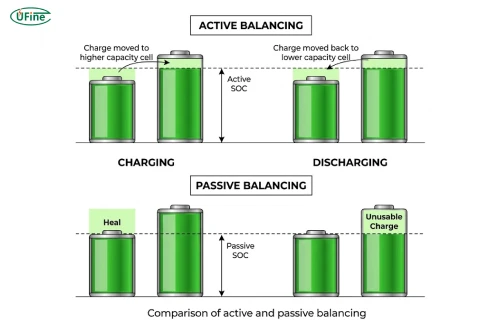
There are two common approaches to cell balancing: active balancing and passive balancing.
What is passive cell balancing?
Passive balancing removes excess energy from higher-voltage cells through resistors. The energy is converted into heat rather than transferred to other cells.
This approach has a relatively simple circuit design and is commonly used in cost-sensitive battery management systems.
What is active cell balancing?
Active balancing transfers energy from cells with higher states of charge to cells with lower states of charge.
Depending on the design, this process may use capacitors, inductors, or other energy-transfer circuits.
Instead of simply dissipating excess energy, active balancing redistributes it within the battery pack.
Active vs. passive balancing
|
Feature |
Passive balancing |
Active balancing |
|---|---|---|
|
Working principle |
Dissipates excess energy |
Transfers energy between cells |
|
Energy efficiency |
Lower |
Higher |
|
Circuit design |
Simpler |
More complex |
|
Heat generation |
Generates balancing heat |
Generally reduces balancing energy losses |
|
Cost |
Usually lower |
Usually higher |
|
Typical application |
Cost-sensitive battery packs |
Applications requiring more advanced balancing |
Which method should you choose?
For many compact consumer electronics, passive balancing may be sufficient when the cells are well matched and the battery pack has relatively straightforward operating requirements.
Active balancing may be worth considering for larger multi-cell packs where balancing efficiency and energy utilization are more important.
Texas Instruments provides additional technical information on cell-balancing methods in its battery cell-balancing application note (a technical reference worth consulting when designing a BMS).
Part 8. Common Series BMS wiring mistakes and how to avoid them
Incorrect BMS wiring is one of the most common causes of battery protection problems. Even a suitable BMS may not work properly if its connections are incorrect.
Here are several mistakes worth avoiding.
Connecting balance wires in the wrong order
Balance wires must follow the exact sequence specified by the BMS manufacturer. Incorrect connections can damage the monitoring circuit.
Using a BMS with the wrong series count
A 3S BMS is not interchangeable with a 4S BMS. The number of cell-monitoring channels must match the battery pack configuration.
Reversing positive and negative connections
Incorrect polarity can damage electronic components and create a short-circuit risk. Always verify terminal polarity before making connections.
Choosing an incorrect current rating
The BMS continuous discharge current should support the device’s actual operating requirements. Its peak current rating should also accommodate temporary startup or load surges.
Ignoring cell voltage differences
Cells should be checked and appropriately matched before assembly. Large voltage differences can cause uneven charging and balancing problems.
Before powering on a battery pack, verify the wiring, terminal polarity, individual cell voltages, and BMS specifications. If you’re unfamiliar with lithium battery assembly, have a qualified battery technician perform the work.
Part 9. How to choose the right Series BMS for a LiPo battery pack
Selecting a suitable BMS involves more than matching the number of cells. You also need to consider the electrical requirements and operating environment of your device.
1. Match the series cell count
Choose a BMS that supports the exact number of series-connected cells, such as 2S, 3S, or 4S.
2. Check the voltage specifications
Make sure the BMS supports the battery chemistry and its nominal and maximum charging voltages.
For standard 3.7V nominal LiPo cells, a 3S pack has an 11.1V nominal voltage and a 12.6V full-charge voltage.
3. Check continuous and peak current ratings
The BMS must handle the device’s normal operating current and temporary peak demands without triggering unnecessary protection.
4. Consider cell balancing
Check whether the BMS supports passive or active balancing and whether its balancing current is appropriate for your battery pack.
5. Check temperature protection
For portable electronics, temperature monitoring can help prevent charging or discharging under unsuitable conditions.
6. Consider the device’s physical requirements
Battery dimensions, weight, connectors, wire placement, and available installation space can all affect the final design.
For custom consumer electronics, it’s worth evaluating the battery and BMS together rather than selecting them independently. Their electrical specifications and physical configurations need to work as one system.
FAQs
Q1. Can a Series BMS Work with Different Lithium Battery Chemistries?
No. A Series BMS must be compatible with the battery chemistry used in the pack. Different lithium battery chemistries have different nominal voltages, charging limits, and operating requirements. Always check the BMS specifications before connecting it to a battery pack.
Q2. Can a Series BMS Disconnect the Battery During Normal Operation?
Yes. A BMS may disconnect the battery if it detects a condition that exceeds its programmed protection limits. However, incorrect BMS settings, unsuitable current ratings, or excessive voltage fluctuations can also cause unexpected shutdowns. Check the protection thresholds and operating requirements if this happens repeatedly.
Q3. What Is the Difference Between a BMS and a Battery Protection Circuit Module (PCM)?
A PCM generally provides basic battery protection functions, such as overcharge, over-discharge, and overcurrent protection. A BMS can offer additional capabilities, including cell monitoring, balancing, temperature monitoring, and communication functions. However, actual features vary by product, and the terms are sometimes used differently by manufacturers.
Related Tags:

More Articles

What Happens If One Cell in a Battery Pack Goes Bad? How to Fix It
Found a faulty battery cell? Discover how to identify the problem, whether one cell can be replaced, and how to fix a battery pack safely.
4S LiFePO4 BMS Wiring: Step-by-Step Connection Guide
Wiring a 4S LiFePO4 BMS for the first time? Discover the correct balance wire connections, terminal functions, and mistakes that could damage your BMS.
Learn 24V Battery Management System
Need a 24V battery management system? Explore wiring diagrams, BMS current ratings, charging compatibility, battery protection, and troubleshooting tips.
20S BMS Wiring Diagram: A Step-by-Step Connection Guide
Building a 20S battery pack? Discover how to connect BMS terminals, check balance wires, calculate discharge current, and choose the right protection system.
Can Power Bank Charge an Action Camera Battery?
Find out which power banks work with action cameras, whether you can record while charging, and what to use when your camera runs out of power.