- Key takeaways
- Part 1. Set robot battery pack acceptance criteria before testing
- Part 2. Robot battery pack validation checklist for OEM samples
- Part 3. Robot battery pack testing example for a loaded start
- Part 4. Approve the robot battery pack pilot lot before mass production
- Part 5. Robot battery pack testing FAQs
Test a robot battery pack under the loads, charging conditions, and installation constraints it will face in service. Set the pass limits before testing, then use pilot-lot units to verify that the production build can meet them.
Key takeaways
- Use the robot’s operating requirements to set measurable pass limits.
- Capture battery current, pack voltage, and regulator input voltage during the same loaded start.
- Link each test result to the exact sample build and repeat the critical checks on pilot-lot units.
Part 1. Set robot battery pack acceptance criteria before testing
Build the acceptance criteria from the robot’s requirements. Use the controller and regulator specifications to set the minimum loaded voltage. Use the work cycle and return-to-dock reserve to set the minimum usable energy in watt-hours (Wh). Use the approved charger and the robot’s schedule to set the charging requirements.
Record the configuration for each result so the supplier and OEM can reproduce the test.
| What to identify | What to record |
|---|---|
| Battery sample | Sample ID, pack drawing revision, cell model and configuration, protection board revision, and pack firmware if used |
| Harness and connector | Connector part number, pinout, polarity, wire gauge, and wire length |
| Robot and charger | Robot hardware and firmware revisions, battery compartment revision, charger model, and charger settings |
If a component, setting, or test condition changes, record it before comparing the new result with the previous test.
Part 2. Robot battery pack validation checklist for OEM samples
Use this checklist to assign bench tests and robot-level tests. Enter the project’s limits in the pass criteria before running the plan.
| Test item | Test condition | Measurement or record | Pass criterion |
|---|---|---|---|
| Loaded startup | Start from rest with the intended payload at the lowest planned state of charge (SOC). Test at the relevant pack temperatures and repeat the start as agreed. | Capture pack current, pack output voltage, and regulator input voltage on the same time base. Save the controller fault log. | The robot completes the start without a reset or unintended cutoff. Voltage at each specified point stays within its agreed limit. |
| Usable energy | Run the work cycle or replay its load profile. Include travel, handling, and waiting within the planned SOC window. | Log pack output voltage and current to calculate delivered Wh. Record when the robot requests a charge. | The pack completes the required work while preserving the specified energy reserve. |
| Dock charging | Use the approved charger or dock at the expected arrival SOC and pack temperature. Limit charging to the time available between jobs. | Record active charging time, pack voltage, current, and temperature. Measure recovered usable Wh in a follow-on discharge or work-cycle test. | Charging starts and stops as expected. The pack recovers the required usable Wh within the available window. |
| Protection and recovery | Run the protection checks relevant to the design under an agreed supplier or lab procedure. | Record the trip threshold, delay, recovery behavior, and any fault reported to the robot. | Protection and recovery match the approved pack specification and the robot’s expected response. |
| Pack and connector temperature | Repeat the most demanding expected work and charging pattern with the pack installed. | Measure temperature at the agreed points on the pack and connector. Log ambient temperature and any power reduction. | Temperatures stay within the specified limits. Any power reduction starts and clears as agreed. |
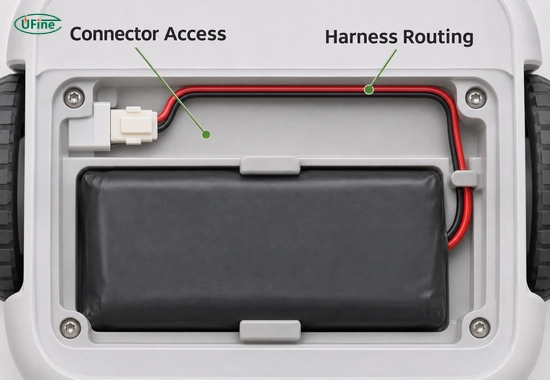
| Fit and service access | Install and remove the pack with the intended enclosure, harness, and nearby parts in place. | Check clearances, connector access, wire routing, and strain relief. Save installation photos. | The pack fits and can be removed using the approved method. The harness clears pinch points and moving parts. |
| Battery communication, if used | Check startup, charging, and the agreed communication fault scenarios. | Log SOC, fault flags, and any reported charge or discharge limits. Record how the robot responds. | The robot reads the data correctly and takes the specified action when messages are lost or faults are reported. |
For a dock-charged robot, estimate AMR battery capacity from the charging schedule to set the minimum usable Wh and return-to-dock reserve. For a humanoid robot, use the humanoid robot battery pack design guide to define checks for pack placement, weight distribution, and connector access.
Part 3. Robot battery pack testing example for a loaded start
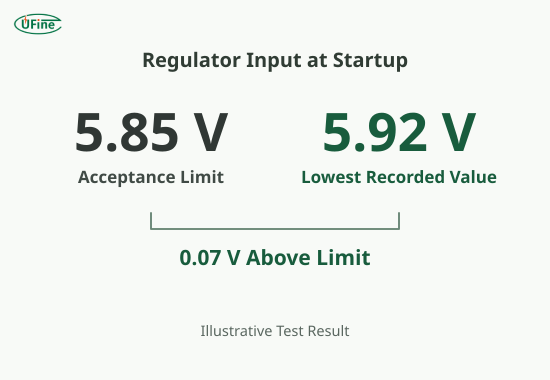
Consider a compact robot with a 2S lithium battery pack. Its regulator needs at least 5.60 V at the input during startup. The OEM adds 0.25 V of design margin and sets the sample acceptance limit at 5.85 V. These figures and readings are illustrative.
| Test record | Example result |
|---|---|
| Test condition | 25% starting SOC, pack at 23 °C, rated payload, three loaded starts |
| Peak pack current on the start with the lowest regulator input | 4.3 A |
| Minimum acceptable regulator input voltage | 5.85 V |
| Lowest regulator input across the three starts | 5.92 V |
| Robot behavior | No reset or unintended protection cutoff |
| Margin above the acceptance limit | 0.07 V |
The reading clears the acceptance limit by 0.07 V. If measurement uncertainty is close to that margin, review the setup before signing off. Save the raw voltage and current traces, including the pulse duration, and repeat the test at the other required temperatures, charge levels, and loads.
If the regulator input falls below the limit, compare it with the pack output at the same instant. A large drop at the pack calls for a review of the pack’s pulse performance. If the pack output holds up and the regulator input falls too low, check the harness, connector, switch, and board path. The same traces help you diagnose robot battery voltage sag during motor startup.
Part 4. Approve the robot battery pack pilot lot before mass production
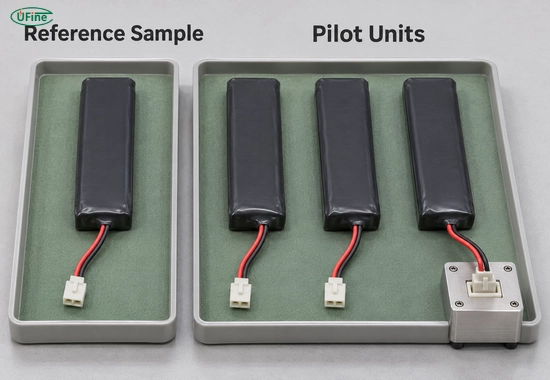
Sample approval applies to the tested build. Before approving the pilot lot, confirm that its units use the intended production materials, assembly process, and firmware. Agree on which checks run on every unit and which checks run on selected pilot samples.
| Release step | Evidence to review |
|---|---|
| Sample approval | Approved pack drawing, component list, and results linked to sample IDs. For each failed test, record the corrective action and retest result or the agreed disposition. |
| Pilot-lot approval | Build records and repeat results for checks sensitive to production variation, such as loaded startup, charger interaction, or connector fit. |
| Production checks | End-of-line limits and records for checks such as output voltage, polarity, connector fit, and communication where used. |
| Change control | A process for reviewing changes to cells, protection boards, firmware, harnesses, connectors, or enclosures and selecting the tests to repeat. |
Review transport and applicable product safety documentation as part of release. For lithium battery shipments, confirm that the documentation covers the battery design being shipped. The U.S. Pipeline and Hazardous Materials Safety Administration explains what a UN 38.3 lithium battery test summary contains.
Part 5. Robot battery pack testing FAQs
Which robot battery pack tests should the supplier run before sample approval?
The supplier should verify pack output, usable energy, charging, and protection against the approved specification. The OEM should verify loaded startup, fit, and fault response in the robot.
How many robot battery pack samples should an OEM test?
Set the sample count from the type of test, expected build variation, and consequences of failure. Use prototype samples to verify the design and pilot-lot units to check repeatability.
Can a robot battery pack pass a capacity test and still reset the robot?
Yes. A pack can deliver the required watt-hours while its voltage dips below the controller’s operating limit during a brief startup pulse. Test both usable energy and voltage under peak load.
Can an OEM approve a robot battery pack before the production enclosure is ready?
An OEM can approve the electrical results from an early sample. Before final release, verify fit, harness routing, and temperature in a representative production enclosure.
What does UN 38.3 cover in robot battery pack testing?
UN 38.3 covers lithium battery transport testing. Robot-level validation separately checks startup, charging, fit, and fault response.
Related Tags:

More Articles
How to Size an AMR Battery for Short Charging Stops
Size an AMR battery using route energy, actual charging time, and return-to-dock reserve. See how one missed charge changes the required capacity.
Why Does My Robot Reset When the Motors Start? Battery Voltage Sag Explained
Find out why your robot resets at motor startup. Compare battery voltage, wiring loss, and the logic supply to pinpoint the cause.
3.7V LiPo Battery Pack vs. 3.7V Lithium-Ion Battery Pack: What’s the Difference?
Choosing a 3.7V battery pack? Compare LiPo and lithium-ion batteries, and learn how to select the right capacity, charger, protection, and connectors.
3 Cell Laptop Battery Life: What You Need to Know
How long does a 3 cell laptop battery last? Compare battery life, replacement prices, compatible models, and practical tips before buying a new one.
How to Build a 7.4V 18650 Battery Pack: Full Guide
Building a 7.4V 18650 battery pack? Discover the right cells, 2S configuration, BMS, wiring, and common mistakes to avoid.