- Key takeaways
- Part 1. Measure AMR battery energy use across a shift
- Part 2. Calculate AMR opportunity charging in watt-hours
- Part 3. Size AMR battery capacity for a missed charging stop
- Part 4. Set the AMR return-to-dock reserve and validate the pack
- Part 5. AMR battery sizing and opportunity charging FAQs
Size an autonomous mobile robot (AMR) battery for the largest energy deficit during the shift, plus enough energy to reach an available charger. Include short charging stops in the calculation, then check what happens if the robot misses one.
Key takeaways
- Count charging time from when power starts flowing to the battery.
- Check the energy deficit before every charge and at the end of the shift.
- Test each missed-stop scenario and check whether the robot still has enough energy to reach a dock.
Part 1. Measure AMR battery energy use across a shift
Measure energy in watt-hours (Wh) at the battery output. Divide the shift into work blocks between planned charging stops. A block can contain one route or several jobs. Record what the robot does in each block and how much energy it uses.
| Part of the work cycle | What to measure |
|---|---|
| Travel and handling | Energy for driving, turning, lifting, and carrying the expected payload. Include ramps and longer routes that occur in normal operation. |
| Waiting | Energy used while the robot is stopped with its controller, sensors, and communications still powered. |
| Dock approach | Energy used to reach the charging station and align before charging starts. |
If queue time varies by shift, measure the robot’s standby power drain and use the expected waiting time. For example, 20 minutes at 15 W uses 5 Wh. If the route energy already includes waiting or docking, count that energy once.
Part 2. Calculate AMR opportunity charging in watt-hours
Opportunity charging uses gaps between tasks to top up the battery. Part of each stop may be spent aligning with the dock or waiting for charging to start. The Omron OL-series AMR charging documentation describes how the robot navigates to a station and charges autonomously.
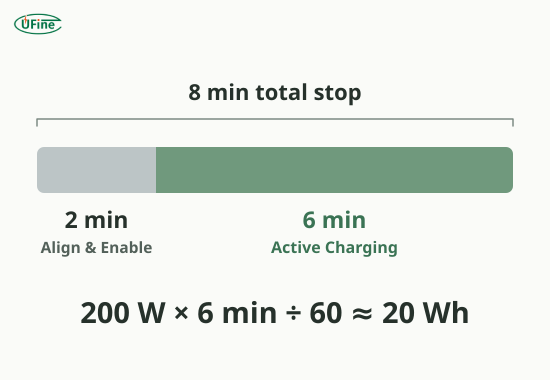
Estimated energy added per stop (Wh) = Average net power into the battery (W) × Active charging time (minutes) ÷ 60
If the schedule allows an 8-minute stop and alignment and charge enable take 2 minutes, the battery has 6 minutes to charge. At an average net battery charging power of 200 W, that adds about 20 Wh as a first estimate.
Use average power at the battery during the stop. The robot may use some charger output to run its electronics while docked. The battery can also accept less power at certain temperatures or charge levels. For packs that use constant-current/constant-voltage charging, TI’s lithium-ion charging profile shows how charging current falls during the constant-voltage phase.
Part 3. Size AMR battery capacity for a missed charging stop
Track the energy deficit relative to the planned starting charge level. Start at zero. Add the energy used in each work block, then subtract the energy recovered at the next stop. If the shift starts at the planned upper charge limit, cap each top-up at the amount needed to reach that limit. For a missed stop, enter 0 Wh of recovered energy.
Worked example for a compact AMR
Assume six work blocks at 35 Wh each and five planned charging stops at 20 Wh each. The third stop is missed in the second scenario. The robot performs the same work in both cases.
| Work block | Energy used | Planned top-up after block | Deficit before top-up or at shift end | Deficit if stop 3 is missed |
|---|---|---|---|---|
| 1 | 35 Wh | 20 Wh | 35 Wh | 35 Wh |
| 2 | 35 Wh | 20 Wh | 50 Wh | 50 Wh |
| 3 | 35 Wh | 20 Wh | 65 Wh | 65 Wh |
| 4 | 35 Wh | 20 Wh | 80 Wh | 100 Wh |
| 5 | 35 Wh | 20 Wh | 95 Wh | 115 Wh |
| 6 | 35 Wh | — | 110 Wh | 130 Wh |
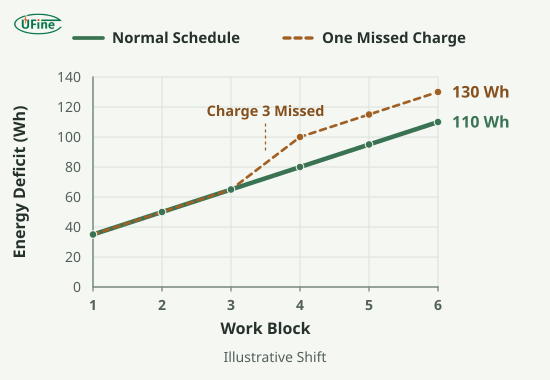
The missed stop raises the maximum energy deficit from 110 Wh to 130 Wh. Add 18 Wh for an extra trip to an available dock, including waiting and alignment. The robot now needs 148 Wh of usable energy within its planned operating range.
Assume the pack operates from 85% to 20% state of charge and retains 80% of its original energy at the planned replacement point. For a first-pass estimate, treat that 65-percentage-point charge window as 65% of the retained energy.
Minimum rated battery energy ≈ (130 Wh + 18 Wh) ÷ (0.65 × 0.80) ≈ 285 Wh
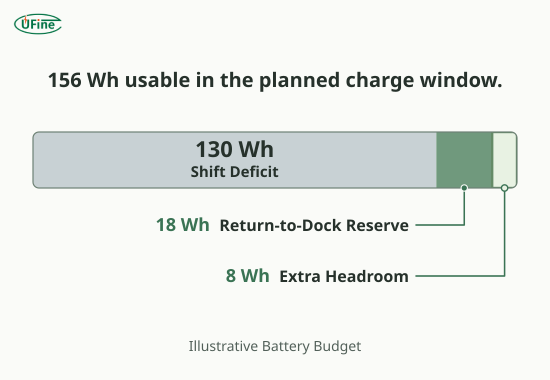
A 300 Wh pack is a candidate for sample testing. The estimate gives it 156 Wh within the planned charge window at the replacement point. After the missed-stop shift, 26 Wh remains above the lower operating limit. The 18 Wh dock trip leaves 8 Wh of additional headroom. In the same model, two missed stops would leave only 6 Wh for that trip.
If a missed stop also sends the robot to a farther charger or adds queue time, include that extra energy in the affected work block. Recalculate the shift before selecting a pack.
Part 4. Set the AMR return-to-dock reserve and validate the pack
Calculate the dock reserve in Wh using a realistic route from the farthest work point to an available charger. Include the payload the robot may still be carrying, expected waiting, and any docking retries. Use measured battery data to convert the reserve into a state-of-charge trigger above the lower operating limit.
| Sample validation check | What to verify |
|---|---|
| Usable energy in the charge window | Measure how many Wh the sample delivers between the planned upper and lower charge limits under the expected load and temperature. Use the result to check the sizing estimate. |
| Energy recovered during a short stop | Reproduce the actual docking window, arrival charge level, and battery temperature. Check how much usable energy the pack gains during the stop. |
| Loaded restart after a missed charge | Confirm that the robot can start, turn, or lift near its lower charge limit without pack voltage falling below the robot’s operating limit. |
| Back-to-back shifts | Confirm that the available charging time restores the planned starting charge level before the next shift. In the example, a normal shift ends with a 110 Wh deficit. |
When reviewing battery pack options for autonomous mobile robots, share the work-block energy table, active charging time, charger voltage and current limits, peak load, and available battery space. This gives the supplier the inputs to check the pack’s capacity and the energy it can recover between jobs.
Part 5. AMR battery sizing and opportunity charging FAQs
How much battery capacity does an AMR need for short charging stops?
Add the largest shift energy deficit to the return-to-dock reserve. Divide by the usable fraction of the charge window and the expected energy retention at the planned replacement point.
How do I convert AMR battery capacity from Wh to Ah?
Divide watt-hours by the pack’s nominal voltage. A 300 Wh battery at 24 V nominal is about 12.5 Ah.
Which missed charging stop matters most for AMR battery sizing?
Simulate each planned stop being missed once. Size the battery for the scenario that produces the largest energy deficit, including any extra travel or waiting.
What battery percentage should trigger an AMR to return to the dock?
Measure the energy needed to reach and enter an available dock. Use pack test data to set a charge trigger that leaves that energy above the lower operating limit, with margin for estimation error.
Can a faster charger reduce the AMR battery capacity requirement?
Yes, if the battery can accept enough extra energy before the shift reaches its lowest battery level. Verify the gain during the actual charging window.
Related Tags:

More Articles

Why Does My Robot Reset When the Motors Start? Battery Voltage Sag Explained
Find out why your robot resets at motor startup. Compare battery voltage, wiring loss, and the logic supply to pinpoint the cause.
3.7V LiPo Battery Pack vs. 3.7V Lithium-Ion Battery Pack: What’s the Difference?
Choosing a 3.7V battery pack? Compare LiPo and lithium-ion batteries, and learn how to select the right capacity, charger, protection, and connectors.
3 Cell Laptop Battery Life: What You Need to Know
How long does a 3 cell laptop battery last? Compare battery life, replacement prices, compatible models, and practical tips before buying a new one.
How to Build a 7.4V 18650 Battery Pack: Full Guide
Building a 7.4V 18650 battery pack? Discover the right cells, 2S configuration, BMS, wiring, and common mistakes to avoid.
18650 3S2P Battery Pack: Wiring, Parts & Safety Tips
Learn how to build an 18650 3S2P battery pack, choose the right cells, BMS, connectors, and wires, and avoid common assembly mistakes.