- Key takeaways
- Part 1. What is a zinc-air battery?
- Part 2. Main components of a zinc-air battery
- Part 3. Zinc-air battery diagram and working principle
- Part 4. Zinc-air battery advantages and disadvantages
- Part 5. Zinc-air battery applications
- Part 6. Zinc-air battery vs lithium-ion battery
- Part 7. Zinc-air battery challenges and limitations
- Part 8. Future of zinc-air batteries
- Part 9. FAQs about zinc-air batteries
Zinc-air batteries have attracted growing attention as an alternative energy storage technology. Unlike conventional batteries that store all reactants internally, zinc-air batteries use oxygen from the surrounding air as part of the electrochemical reaction. This unique design enables high energy density, low material costs, and a potentially lower environmental impact.
Today, zinc-air batteries are widely used in hearing aids and are being researched for renewable energy storage, medical devices, and next-generation electric mobility systems.
Key takeaways
- Zinc-air batteries generate electricity through the reaction between zinc and oxygen from the air.
- They offer higher theoretical energy density than many traditional battery chemistries.
- Zinc is abundant, low-cost, and less environmentally problematic than many battery materials.
- Most commercial zinc-air batteries are primary (non-rechargeable), though rechargeable versions are under development.
- Hearing aids remain the largest commercial application.
- Key challenges include limited rechargeability, air cathode degradation, moisture management, and zinc dendrite formation.
- The final discharge product is zinc oxide (ZnO), which is why zinc-air batteries are sometimes associated with the term zinc oxide battery.
Part 1. What is a zinc-air battery?
A zinc-air battery is an electrochemical energy storage device that produces electricity by oxidizing zinc and reducing oxygen from the atmosphere.
Unlike lithium-ion batteries, which contain both active materials internally, zinc-air batteries draw oxygen directly from the air through a porous cathode. This design reduces battery weight and increases the amount of energy that can be stored relative to battery size.
For a detailed comparison with lithium technology, see our guide on: Zinc-Air Battery vs Lithium-Ion Battery
Part 2. Main components of a zinc-air battery
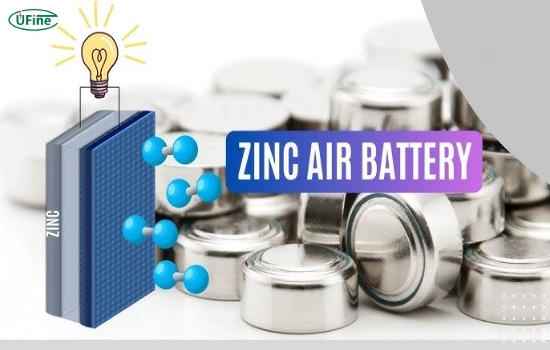
A zinc-air battery contains four primary components:
| Component | Function |
|---|---|
| Zinc Anode | Provides the active fuel material |
| Air Cathode | Allows oxygen from the atmosphere to enter and react |
| Electrolyte | Usually potassium hydroxide (KOH) solution for ion transport |
| Separator | Prevents internal short circuits while allowing ion movement |
Part 3. Zinc-air battery diagram and working principle
Many users search for a zinc air battery diagram to understand how the technology functions. The process is relatively simple compared with many advanced battery systems.
How do zinc-air batteries work?
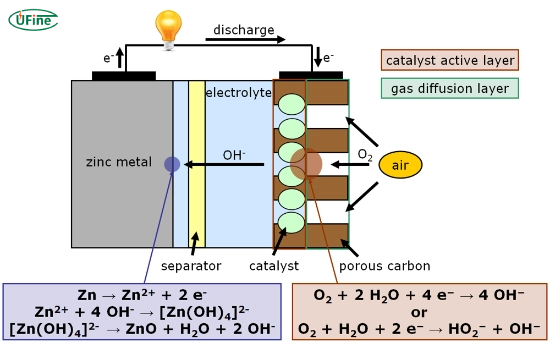
The battery generates electricity through two simultaneous reactions.
Zinc Oxidation at the Anode
At the anode, zinc releases electrons:
Zn → Zn²⁺ + 2e⁻
These electrons travel through the external circuit and power the connected device.
Oxygen Reduction at the Cathode
Oxygen from ambient air enters the porous cathode and reacts with water and electrons:
O₂ + 2H₂O + 4e⁻ → 4OH⁻
Hydroxide ions then move through the electrolyte.
Electrolyte Transport
The alkaline electrolyte carries hydroxide ions between the cathode and anode, maintaining charge balance and enabling continuous operation.
Formation of Zinc Oxide
The overall reaction becomes:
2Zn + O₂ → 2ZnO
The resulting zinc oxide (ZnO) is the discharged product.
Because zinc oxide is formed during discharge, some people refer to zinc-air technology as a zinc oxide battery system, although zinc-air battery is the more accurate industry term.
Part 4. Zinc-air battery advantages and disadvantages
One of the most common searches is “zinc air battery advantages and disadvantages.” Understanding both sides is essential before selecting this technology.
Advantages of zinc-air batteries
-
High Energy Density
- Because oxygen comes from the atmosphere, the battery does not need to store one of its reactants internally. This increases energy density and reduces weight.
-
Low Material Cost
- Zinc is abundant and relatively inexpensive compared with lithium, cobalt, and nickel.
-
Environmentally Friendly Chemistry
- Zinc is non-toxic and widely recyclable. The chemistry generally presents fewer environmental concerns than lead-acid systems.
-
Long Shelf Life
- Unactivated zinc-air batteries can remain in storage for extended periods with minimal self-discharge.
-
Lightweight Design
- The air cathode structure helps reduce overall battery mass, making zinc-air batteries attractive for portable devices.
Disadvantages of zinc-air batteries
-
Limited Rechargeability
- Most commercial zinc-air batteries are primary batteries designed for single use.
-
Air Cathode Degradation
- Exposure to carbon dioxide and contaminants in the air can gradually reduce cathode performance.
-
Moisture Sensitivity
- Performance depends heavily on maintaining proper humidity levels.
-
Zinc Dendrite Formation
- Rechargeable versions may develop zinc dendrites that reduce cycle life and create safety risks.
-
Lower Power Output
- Compared with lithium-ion batteries, zinc-air batteries often provide lower power density, making them less suitable for high-drain applications.
Part 5. Zinc-air battery applications
Although not as widespread as lithium-ion batteries, zinc-air batteries serve several important markets.
-
Hearing Aids
- Hearing aids are currently the largest commercial application. Zinc-air batteries offer long runtime, compact size, and stable voltage output.
-
Medical Devices
- Portable medical equipment benefits from the technology’s high energy density and reliability.
-
Renewable Energy Storage
- Researchers are exploring rechargeable zinc-air systems for solar and wind energy storage because of their potentially low cost at large scale.
-
Smart Sensors and IoT Devices
- Long-duration power delivery makes zinc-air batteries suitable for low-power remote monitoring systems.
-
Electric Vehicles
- Although not yet mainstream, several research projects are investigating zinc-air batteries as a future alternative for electric transportation due to their high theoretical energy density.
Part 6. Zinc-air battery vs lithium-ion battery
When selecting a battery chemistry, many engineers compare zinc-air batteries with lithium-ion batteries.
| Feature | Zinc-Air Battery | Lithium-Ion Battery |
|---|---|---|
| Energy Density | High | Very High |
| Power Density | Moderate | High |
| Rechargeability | Limited | Excellent |
| Cost of Raw Materials | Low | Higher |
| Weight | Light | Light |
| Environmental Impact | Lower | Moderate |
| Commercial Maturity | Limited | Very Mature |
| Typical Applications | Hearing aids, sensors | EVs, electronics, energy storage |
For custom rechargeable battery projects, lithium-ion remains the preferred solution in most commercial applications due to its proven cycle life and high power capability.
Part 7. Zinc-air battery challenges and limitations
Despite decades of research, several technical barriers continue to limit large-scale deployment.
-
Rechargeable Zinc-Air Technology
- Developing a truly rechargeable zinc-air battery remains one of the industry’s biggest challenges.
-
Air Electrode Stability
- The oxygen reduction and oxygen evolution reactions can degrade catalysts over time.
-
Carbon Dioxide Contamination
- Atmospheric CO₂ can react with alkaline electrolytes and reduce battery efficiency.
-
Water Management
- Maintaining the correct moisture balance is critical for long-term performance.
-
Manufacturing Scale
- Lithium-ion benefits from a mature global supply chain, while zinc-air production infrastructure remains comparatively limited.
Part 8. Future of zinc-air batteries
Researchers continue to improve zinc-air battery performance through:
- Advanced bifunctional catalysts
- Solid-state electrolytes
- Improved air cathode materials
- Better zinc electrode designs
- Rechargeable zinc-air architectures
Organizations such as the U.S. Department of Energy and the International Energy Agency continue to support research into alternative battery technologies that could complement lithium-ion systems in future energy storage markets.
Part 9. FAQs about zinc-air batteries
What makes zinc-air batteries unique?
Zinc-air batteries use oxygen from the surrounding atmosphere instead of storing all active materials internally. This allows higher energy density and lower battery weight.
How do zinc-air batteries work?
They generate electricity through zinc oxidation at the anode and oxygen reduction at the air cathode. The reaction ultimately produces zinc oxide while releasing electrical energy.
Are zinc-air batteries rechargeable?
Most commercial zinc-air batteries are non-rechargeable. However, rechargeable zinc-air technologies are actively being developed and tested.
What are the main advantages and disadvantages of zinc-air batteries?
Advantages include high energy density, low cost, lightweight design, and environmentally friendly materials. Disadvantages include limited rechargeability, air management challenges, and lower power density than lithium-ion batteries.
Are zinc-air batteries better than lithium-ion batteries?
It depends on the application. Zinc-air batteries can offer lower material costs and environmental benefits, while lithium-ion batteries provide superior rechargeability, power output, and commercial maturity.
Related Tags:

More Articles

Battery Calibration: Why Is Your Battery % Wrong?
Is your battery percentage inaccurate? Learn how battery calibration works, when you need it, and how to fix unexpected battery drops.
Battery Calibration Guide: Fix SOC Errors in Lithium Systems
SOC accuracy problems can reduce device reliability. Learn how battery calibration, BMS, and fuel gauge optimization improve lithium battery performance.
How Internal Resistance Limits LiPo Battery Performance
Your LiPo Battery may have enough capacity but still fail under load. Discover how Internal Resistance causes voltage sag, heat, and power loss.
What Engineers Can Learn From a Discharge Curve for LithiumBattery?
What can a discharge curve for lithium ion battery tell engineers? Learn how voltage, C-rate, temperature, and capacity affect real-world performance.