- Key takeaways
- Part 1. What is an inductor?
- Part 2. What does an inductor do?
- Part 3. How does an inductor work?
- Part 4. What is inductance?
- Part 5. What are the main types of inductors?
- Part 6. Inductor vs capacitor: what's the difference?
- Part 7. What are inductors used for?
- Part 8. Common applications of inductors
- Part 9. How is an inductor value calculated?
- Part 10. How to choose the right inductor?
- Part 11. Factors that affect inductor performance
- Part 12. Common misconceptions about inductors
- Part 13. FAQs about inductors
Inductors are one of the most important components in modern electronics. Although they are less visible than batteries, chips, or capacitors, they play a critical role in power conversion, signal filtering, energy storage, and electromagnetic interference (EMI) suppression.
From smartphones and laptops to EV chargers, solar inverters, and battery management systems (BMS), inductors help electronic devices operate efficiently and reliably.
In this guide, you’ll learn the inductor definition, what an inductor does, how an inductor works, the different types available, and how to choose the right inductor for a specific application.
Key takeaways
- An inductor is a passive electronic component that stores energy in a magnetic field.
- The primary purpose of an inductor is to resist sudden changes in current.
- Inductance is measured in Henries (H), with common units including mH and μH.
- Inductors are widely used in power supplies, DC-DC converters, filters, transformers, and RF circuits.
- Ferrite core, iron core, air core, and powder core inductors are the most common types.
- Unlike capacitors, inductors store energy magnetically rather than electrically.
- Selecting the right inductor requires evaluating inductance value, current rating, saturation current, frequency, and core material.
Part 1. What is an inductor?
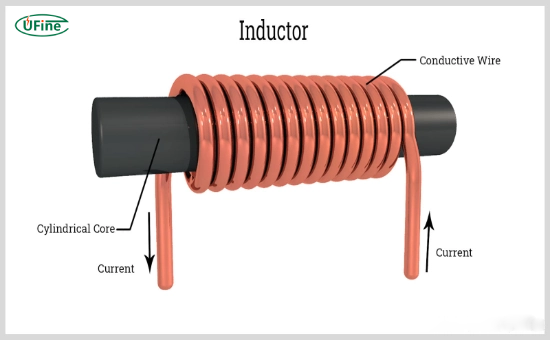
An inductor is a passive electronic component that stores energy in the form of a magnetic field when electric current flows through a conductor, usually a coil of wire.
In simple terms, an inductor acts like a temporary energy reservoir. It absorbs energy when current increases and releases energy when current decreases.
Inductor definition
A common inductor definition is: An inductor is a passive electrical component that opposes changes in current by generating a magnetic field and storing energy within that field.
Because of this characteristic, inductors are essential in circuits that require stable current flow, noise reduction, or efficient power conversion.
Part 2. What does an inductor do?
One of the most searched questions is: What does an inductor do?
The primary function of an inductor is to oppose sudden changes in current.
When current tries to increase rapidly, the inductor resists that increase. When current suddenly drops, the inductor releases stored energy to maintain current flow.
As a result, inductors are used to:
- Smooth current fluctuations
- Reduce electrical noise
- Store energy in switching power supplies
- Filter unwanted frequencies
- Suppress electromagnetic interference (EMI)
- Stabilize voltage conversion circuits
Without inductors, many electronic devices would experience unstable power delivery and excessive electrical noise.
Part 3. How does an inductor work?
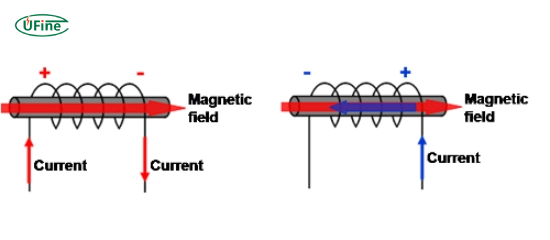
The operation of an inductor is based on Faraday’s Law of Electromagnetic Induction and Lenz’s Law.
Current Flows Through the Coil
As current passes through the wire coil, a magnetic field forms around it.
Magnetic Energy Is Stored
The growing magnetic field stores energy proportional to the current flowing through the coil.
The Inductor Resists Current Changes
If the current suddenly changes, the magnetic field reacts by generating an opposing voltage.
Stored Energy Is Released
When current decreases, the collapsing magnetic field releases stored energy back into the circuit.
This behavior allows inductors to smooth current flow and protect circuits from rapid electrical fluctuations.
Part 4. What is inductance?
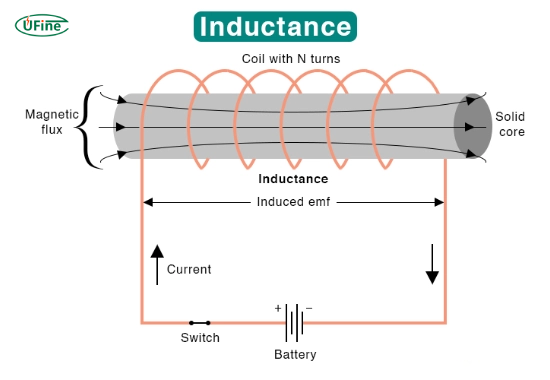
Inductance is the property that measures how effectively an inductor stores energy and resists changes in current.
Inductor units
The standard unit of inductance is the Henry (H).
Common inductor units include:
| Unit | Value |
|---|---|
| Henry (H) | 1 H |
| Millihenry (mH) | 0.001 H |
| Microhenry (μH) | 0.000001 H |
| Nanohenry (nH) | 0.000000001 H |
Many consumer electronics use inductors in the microhenry range, while industrial equipment and power systems often use millihenry or higher values.
Inductance formula
L = NΦ / I
Where:
- L = Inductance (H)
- N = Number of turns
- Φ = Magnetic flux
- I = Current
A higher inductance value generally means a greater ability to store magnetic energy and oppose current changes.
Part 5. What are the main types of inductors?
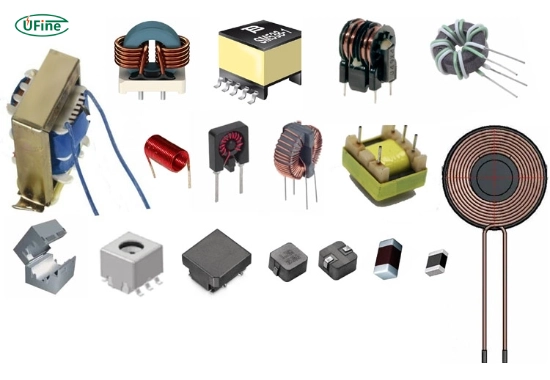
Different applications require different inductor designs.
Air core inductor
Air core inductors use no magnetic core material.
Advantages:
- Excellent high-frequency performance
- No core saturation losses
Applications:
- RF circuits
- Radio transmitters
- Wireless communication equipment
Iron core inductor
Iron core inductors provide high inductance values and strong magnetic coupling.
Advantages:
- High energy storage capability
- Suitable for power applications
Applications:
- Power transformers
- Industrial power supplies
Ferrite core inductor
Ferrite materials offer high magnetic permeability with low losses.
Advantages:
- Compact design
- Good high-frequency performance
Applications:
- Switching power supplies
- DC-DC converters
- EMI filters
Powder core inductor
Powdered iron cores reduce core losses while maintaining high current capability.
Applications:
- Automotive electronics
- Solar inverters
- High-current power conversion
Choke inductor
A choke is a specialized inductor designed to block high-frequency signals while allowing DC current to pass.
Applications:
- EMI suppression
- Noise filtering
- AC/DC power supplies
Part 6. Inductor vs capacitor: what’s the difference?
Both inductors and capacitors store energy, but they do so differently.
| Feature | Inductor | Capacitor |
|---|---|---|
| Energy Storage | Magnetic field | Electric field |
| Opposes | Changes in current | Changes in voltage |
| Unit | Henry (H) | Farad (F) |
| Main Use | Current smoothing | Voltage stabilization |
| Typical Applications | Power converters, filters | Timing circuits, filtering |
In many electronic circuits, inductors and capacitors work together to create LC filters and resonant circuits.
For a broader understanding of energy storage systems, you may also be interested in our guide on lithium battery technologies and battery system design.
Part 7. What are inductors used for?
Many people ask: What are inductors used for?
Inductors appear in nearly every modern electronic device.
1. Switching power supplies
Inductors are essential in:
- Buck converters
- Boost converters
- DC-DC converters
- AC-DC power supplies
They store and transfer energy efficiently during switching cycles.
2. Battery-powered devices
Inductors help regulate voltage in:
- Smartphones
- Tablets
- Laptops
- Power banks
- Battery management systems (BMS)
For example, modern lithium battery systems often integrate DC-DC conversion stages that rely heavily on inductors.
3. EMI and noise filtering
Inductors suppress unwanted electrical noise generated by:
- Switching circuits
- Motors
- Power converters
4. RF and communication circuits
Inductors are widely used in:
- Radios
- Wireless modules
- Bluetooth devices
- Cellular communication systems
5. Renewable energy systems
Applications include:
- Solar inverters
- Energy storage systems
- EV charging stations
- Industrial battery packs
Part 8. Common applications of inductors
| Application | Purpose |
|---|---|
| DC-DC Converter | Energy transfer and voltage regulation |
| Power Supply | Current smoothing |
| EMI Filter | Noise suppression |
| Transformer | Magnetic coupling |
| Radio Circuit | Frequency tuning |
| Solar Inverter | Energy conversion |
| EV Charger | Power regulation |
| Battery Management System | Voltage control |
Part 9. How is an inductor value calculated?
Engineers often estimate inductance using:
L = (μ × N² × A) / l
Where:
- L = Inductance (H)
- μ = Core permeability
- N = Number of turns
- A = Cross-sectional area
- l = Magnetic path length
Increasing the number of turns or using a core with higher permeability increases inductance.
For detailed electromagnetic theory, the educational resources from the IEEE and MIT provide excellent technical references.
Part 10. How to choose the right inductor?
Selecting the correct inductor depends on both electrical and mechanical requirements.
Inductance Value
Choose an inductance that meets circuit performance targets.
Rated Current
The inductor must safely carry the expected operating current.
Saturation Current
Exceeding saturation current can dramatically reduce inductance and cause circuit instability.
DC Resistance (DCR)
Lower DCR improves efficiency and reduces heat generation.
Operating Frequency
Different core materials perform better at different frequencies.
Physical Size
Ensure the component fits available PCB space and thermal requirements.
Part 11. Factors that affect inductor performance
Several variables influence real-world performance:
- Core Material: Different materials affect efficiency, losses, and saturation behavior.
- Temperature: Higher temperatures may alter inductance and increase losses.
- Frequency: At high frequencies, skin effect and core losses become significant.
- Magnetic Saturation: When the core reaches its magnetic limit, inductance decreases sharply.
- DC Resistance: Higher resistance generates more heat and reduces efficiency.
Part 12. Common misconceptions about inductors
“Inductors Store Energy Like Capacitors”
Not exactly. Capacitors store energy in an electric field, while inductors store energy in a magnetic field.
“Inductors Instantly Allow Current Changes”
False. The fundamental purpose of an inductor is to resist rapid current changes.
“All Inductors Are the Same”
Different core materials, winding methods, and current ratings create significant performance differences.
Part 13. FAQs about inductors
What is an inductor used for?
An inductor is used to store magnetic energy, smooth current flow, filter noise, suppress EMI, and regulate power in electronic circuits.
What does an inductor do in a power supply?
An inductor stores energy during switching cycles and releases it when needed, helping maintain stable voltage and current output.
What are inductor units?
Inductance is measured in Henries (H). Common units include millihenries (mH), microhenries (μH), and nanohenries (nH).
How does an inductor work?
An inductor creates a magnetic field when current flows through its coil. The magnetic field stores energy and generates an opposing voltage whenever current changes.
What is the difference between an inductor and a capacitor?
An inductor stores energy in a magnetic field and opposes changes in current, while a capacitor stores energy in an electric field and opposes changes in voltage.
Related Tags:

More Articles
Why Is My Battery Charge Slow?
Learn why batteries charge slowly due to charger, heat, aging, and system limits. Get quick fixes to improve lithium-ion charging speed and efficiency.
How Long Does a 6 Volt Deep Cycle Battery Last?
Learn how long a 6 volt deep cycle battery lasts in RV, solar, and marine use. Explore lifespan factors, battery types, and tips to extend service life.
What is a RoHS Battery? Meaning, Standards & Key Benefits
Learn what a RoHS battery is, key restricted substances, compliance rules, and benefits. Discover how to identify RoHS-compliant battery packs easily.
Diesel Batteries Guide: Function, Use and Importance
Diesel batteries deliver high cranking power for diesel trucks and RVs. Learn types, dual battery systems and how to choose the right battery.
What Is a Power Pack Battery and How Does It Work?
A power pack battery stores portable energy for backup, travel, and off-grid use. Learn its meaning, types, working principle, and how to choose one.