- Key Takeaways
- Part 1. Are tractor batteries 12 volt or 6 volt?
- Part 2. 6 volt battery vs 12 volt: Key tractor battery differences
- Part 3. Which tractors use a 6v tractor battery or 12v battery?
- Part 4. How to choose a heavy duty 6 volt tractor battery
- Part 5. Can you convert a 6 volt tractor battery to 12 volt?
- Part 6. 6v and 12v tractor battery maintenance and safety
- Part 7. FAQs about 6 volt tractor battery vs 12 volt
Most modern tractors use a 12V battery, while many vintage tractors were designed for a 6 volt tractor battery. The correct choice must match the tractor’s starter, charging system, ignition, lights, ground polarity, and wiring.
This guide explains the main differences between 6V and 12V tractor batteries. It also covers battery selection, system conversion, maintenance, and common compatibility risks.
Key Takeaways
- Use the voltage specified in the tractor’s manual or confirmed by its electrical components.
- Many older tractors use 6V systems. Most modern tractors use 12V systems.
- A 6V system carries more current than a 12V system for the same power, so it needs thicker cables and clean connections.
- Voltage alone does not determine CCA, amp-hour capacity, battery size, or service life.
- Do not install a 12V battery directly into an unmodified 6V tractor.
- A 6V-to-12V conversion may require changes to the charging system, ignition, bulbs, gauges, accessories, polarity, and wiring.
Part 1. Are tractor batteries 12 volt or 6 volt?
Tractor batteries can be either 6V or 12V. The required voltage depends on the tractor’s original electrical design and any later modifications.
A 6V tractor battery is usually a lead-acid starting battery with three cells connected in series. It was common in tractors built before 12V systems became widely used. It is designed to provide high current for engine starting.
A 6V starting battery should not automatically be treated as a deep-cycle battery. Starting batteries deliver a short burst of high current. Deep-cycle batteries are designed for repeated and deeper discharge. You can read more about how 6 volt batteries work.
Most newer tractors use 12V lead-acid batteries. A 12V system is better suited to alternators, electric fuel systems, work lights, displays, sensors, GPS equipment, and other modern accessories.
Do not determine voltage from the tractor’s age or model name alone. An older tractor may already have been converted from 6V to 12V.
Check the following before ordering a battery:
- Owner’s manual or service manual
- Existing battery label
- Generator or alternator rating
- Voltage regulator rating
- Ignition coil voltage
- Bulb and accessory voltage
- Ground polarity
- Previous wiring modifications
Part 2. 6 volt battery vs 12 volt: Key tractor battery differences
The main difference between a 6 volt battery vs 12 volt battery is system voltage. This voltage also affects current, cable size, starting speed, charging equipment, and accessory compatibility.
Electrical power can be simplified as:
Power = Voltage × Current
For a similar amount of starter power, a 6V system must carry about twice the current of a 12V system. This makes 6V tractors more sensitive to undersized cables, corrosion, loose terminals, and poor ground connections.
| Comparison | 6 Volt Tractor Battery | 12 Volt Tractor Battery |
|---|---|---|
| Nominal voltage | 6V | 12V |
| Lead-acid cells | Three cells | Six cells |
| Common application | Vintage and restored tractors | Modern tractors and converted older tractors |
| Current for similar power | Higher | Lower |
| Battery cables | Usually requires thicker cables | Can carry the same power with less current |
| Starting speed | Normally slower | Normally faster |
| Cold-weather starting | More sensitive to voltage drop | Often easier with the correct CCA rating |
| Charging system | 6V generator or compatible charging system | 12V alternator or generator |
| Accessory compatibility | Limited modern accessory options | Supports common 12V farm accessories |
| Ground polarity | Many older tractors use positive ground | Most modern tractors use negative ground |
| Availability | Available from specialist and farm suppliers | Widely available |
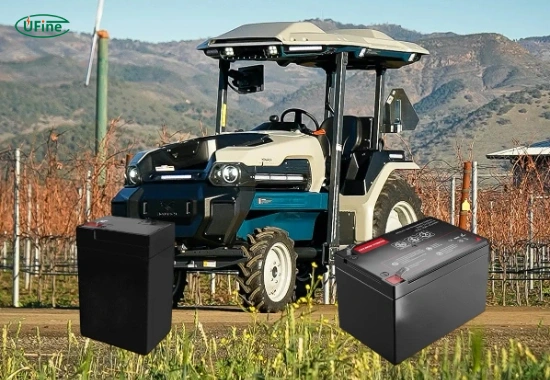
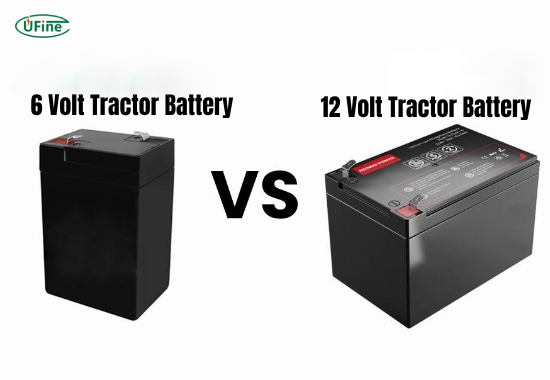
Do not compare batteries by voltage alone. CCA, amp-hours, reserve capacity, dimensions, terminal position, and battery construction vary by model. A heavy duty 6 volt tractor battery may provide more starting current than a small 12V battery.
For a broader comparison, see the guide to 6V and 12V battery system differences.
Part 3. Which tractors use a 6v tractor battery or 12v battery?
Many tractors manufactured before the 1960s originally used a 6V electrical system. Representative examples include some versions of:
- Ford 2N, 8N, and 9N
- Farmall Cub, A, B, C, and H
- John Deere A, B, and H
- Allis-Chalmers WC and WD
- Oliver 60 and 70
The correct voltage can vary by production year, engine, serial number, regional configuration, and previous conversion work. Always inspect the actual tractor before buying a replacement battery.
Most modern compact, utility, row-crop, and agricultural tractors use 12V systems. These systems can support:
- Electric starters and fuel shutoff solenoids
- High-output alternators
- Headlights and work lights
- Electronic dashboards and sensors
- GPS and guidance equipment
- Sprayer and implement controls
- Cab fans and air conditioning
- USB ports and 12V accessory outlets
| Tractor application | Typical battery system | Selection note |
|---|---|---|
| Historically accurate restoration | Original 6V system | Keep 6V when the original components remain serviceable. |
| Occasionally used vintage tractor | 6V or converted 12V | Inspect the charging system and wiring before ordering. |
| Daily-use vintage tractor | 6V or professionally converted 12V | A 12V conversion may improve starting and accessory support. |
| Modern compact or utility tractor | Usually 12V | Follow the manufacturer’s voltage, group size, and CCA specification. |
| Large agricultural equipment | 12V or higher-voltage system | The machine may use multiple batteries. |
Some tractors use two batteries. Two 12V batteries connected in parallel keep the system at 12V while increasing current capacity. Batteries connected in series increase total voltage. Learn more about battery series and parallel connections.
Part 4. How to choose a heavy duty 6 volt tractor battery
A heavy duty 6 volt tractor battery must fit the battery tray, meet the starter’s current demand, and work with the tractor’s charging system. Check the following specifications before buying.
Cold cranking amps
Cold Cranking Amps measure a battery’s ability to supply starting current at low temperature. Choose a CCA rating that meets or exceeds the tractor manufacturer’s requirement.
Do not use one universal CCA value for every tractor. Engine size, compression, temperature, oil viscosity, starter condition, and cable resistance all affect starting demand. See the detailed guide to cold cranking amps for battery selection.
Battery dimensions and group size
Measure the battery tray and check:
- Battery length, width, and height
- Terminal position and polarity
- Post type
- Hold-down design
- Cable reach
- Clearance above the terminals
The battery must not contact the hood, frame, hold-down bracket, or other metal parts.
Amp-hour and reserve capacity
Amp-hours indicate stored charge. Reserve capacity indicates how long the battery can supply a defined load. These ratings matter when the tractor runs lights or accessories at low engine speed.
However, a high Ah rating does not replace sufficient starting current. For a tractor starting battery, CCA remains a key specification.
Battery cable size
A 6V system requires low-resistance cables. Thin automotive cables can cause slow cranking and excessive voltage drop.
Use cables suitable for the starter current and cable length. Inspect both ends for corrosion, loose crimps, broken strands, and poor contact with the engine block or chassis.
Battery construction and maintenance
Flooded lead-acid batteries allow electrolyte inspection but need more maintenance. Sealed or maintenance-free batteries reduce routine service, but they must still match the tractor’s charging voltage and mounting requirements.
Part 5. Can you convert a 6 volt tractor battery to 12 volt?
You can convert a tractor from 6V to 12V, but replacing only the battery is unsafe. A correct conversion must consider the complete electrical system.
Connecting a 12V battery to unmodified 6V components can burn out bulbs, overheat the ignition coil, damage gauges, and affect the generator or voltage regulator. It can also make the original starter rotate much faster than designed.
Check the charging system
Replace or modify the 6V generator and voltage regulator. Many conversions use a compatible 12V alternator. Confirm pulley alignment, belt size, mounting, output, and wiring.
Check the ignition system
Install a 12V ignition coil or use the correct ballast resistor with a coil that requires external resistance. Incorrect resistance can overheat the coil and shorten breaker-point life.
Replace voltage-sensitive parts
Replace 6V bulbs with 12V versions. Check gauges, relays, solenoids, motors, and accessories. Some gauges may require a voltage reducer.
Evaluate the starter motor
Some converted tractors retain the original 6V starter. It may operate on 12V for short starts, but it will turn faster and may overheat during long cranking periods. Have it inspected before regular use.
Confirm ground polarity
Many vintage 6V tractors use positive ground. Most modern alternators require negative ground. Changing polarity may affect the ignition coil, ammeter, gauges, and electronic accessories.
Inspect wiring and circuit protection
Replace damaged or brittle wiring. Add suitable fuses or circuit breakers where required. Secure cables away from sharp edges, hot parts, and moving components.
Test the converted 12V tractor system
After conversion, test charging voltage, starter operation, ignition, lights, gauges, and accessory current. Stop testing if any wire, switch, cable, or component becomes hot.
| 6V-to-12V conversion item | Required check |
|---|---|
| Battery | Correct 12V size, polarity, terminal position, and CCA |
| Charging system | 12V generator and regulator or compatible alternator |
| Ignition coil | 12V coil or correct ballast resistor |
| Lights | Replace all 6V bulbs with 12V bulbs |
| Gauges and accessories | Confirm voltage compatibility or add a reducer |
| Starter | Inspect condition and avoid extended cranking |
| Ground polarity | Confirm compatibility with the alternator and accessories |
| Wiring | Repair damaged wiring and add circuit protection |
A qualified tractor electrician should inspect the system when the original wiring or previous modifications are unclear.
Part 6. 6v and 12v tractor battery maintenance and safety
Regular maintenance helps both 6V and 12V tractor batteries deliver reliable starting power.
- Keep the battery case clean and dry.
- Remove corrosion from terminals and cable ends.
- Tighten connections without damaging the battery posts.
- Inspect cables for heat damage, broken strands, and loose crimps.
- Check electrolyte levels in serviceable flooded batteries.
- Use only distilled water when topping up a flooded battery.
- Keep the battery secured with the correct hold-down bracket.
- Use a charger made for the correct voltage and battery type.
- Charge in a ventilated area away from sparks and flames.
- Wear suitable eye and hand protection.
Follow the OSHA battery charging safety requirements when developing workplace charging and maintenance procedures.
Do not place used lead-acid tractor batteries in household waste. Follow the EPA guidance for used lead-acid battery recycling or return the battery to an approved retailer or collection point.
Part 7. FAQs about 6 volt tractor battery vs 12 volt
Can I jump-start a 6-volt tractor with a 12-volt battery?
No. Direct 12V jump-starting can damage 6V electrical components. Use a 6V battery, booster, or charger.
Are 6-volt tractor batteries still available?
Yes. They are sold for vintage tractors, classic vehicles, and other 6V equipment.
Why does my 6V tractor battery keep losing charge?
Common causes include an old battery, poor ground, corroded terminals, a faulty generator or regulator, or an electrical drain.
Can two 6V batteries make a 12V tractor battery system?
Yes. Two matched 6V batteries connected in series produce 12V while keeping the same amp-hour capacity.
Is a 12V tractor battery better for cold weather?
Often, but not always. Cold starting also depends on CCA, battery condition, cable resistance, engine condition, and oil viscosity.
Related Tags:

More Articles
Buck vs. Boost vs. Buck-Boost Converter: Which Is Best for Battery?
Not sure which converter your battery-powered device needs? Compare Buck, Boost, and Buck-Boost designs and discover what affects voltage stability and runtime.
How to Match 18650 Cells for a Reliable Battery Pack?
Building an 18650 battery pack? Learn how to compare cell capacity, voltage, and internal resistance to avoid mismatches and improve reliability.
Why Do 18650 Battery Packs Get Hot During Discharge?
Is your 18650 battery pack overheating under load? Learn what causes excess heat, how to spot dangerous symptoms, and what to do next.
18650 Battery BMS: How to Get the Specs Right
Learn how to choose a BMS for an 18650 battery pack. Compare voltage, current ratings, protection features, and balancing before you buy.
Why Does My Ring Camera Battery Drain So Fast or Stop Charging?
Is your Ring camera battery draining fast or not charging? Discover common causes, practical fixes, and when to replace the battery.