
- Key Takeaways
- Part 1. What is an electric fence battery?
- Part 2. Best electric fence battery types compared
- Part 3. What size battery for an electric fence?
- Part 4. How long does an electric fence battery last?
- Part 5. How to choose a solar electric fence battery
- Part 6. Electric fence battery maintenance and troubleshooting
- Part 7. Electric fence battery selection checklist
- Part 8. Electric fence battery safety
- Part 9. FAQs about electric fence batteries
The best electric fence battery must match the energizer’s voltage, power consumption, required runtime, charging method, and operating environment. Choosing only by fence acreage or battery price can result in short runtime, weak fence pulses, or early battery failure.
This guide explains how to compare electric fence battery types, calculate the required amp-hour capacity, size a solar charging system, and troubleshoot common battery problems.
Key Takeaways
- Most medium and large battery-powered energizers use a 12V battery, but some portable units require 6V, 9V, or disposable batteries.
- A 12V deep-cycle AGM or compatible LiFePO4 battery is usually the best electric fence battery for repeated use.
- Battery capacity should be calculated from the energizer’s current draw and required runtime—not acreage alone.
- Car starter batteries are not ideal because they are not designed for repeated, long-duration discharge.
- Solar electric fence batteries require a compatible solar panel, charge controller, and sufficient reserve for cloudy days.
- Weak fence voltage may also be caused by vegetation, poor grounding, damaged insulators, or loose connections.
Part 1. What is an electric fence battery?
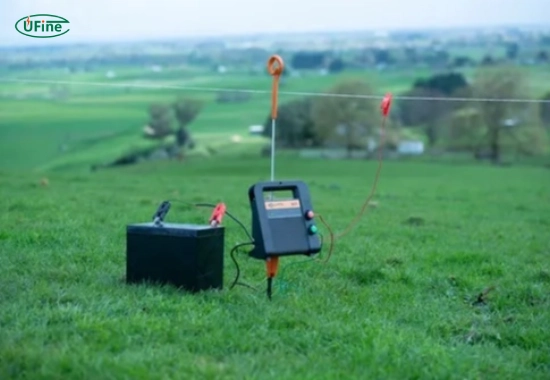
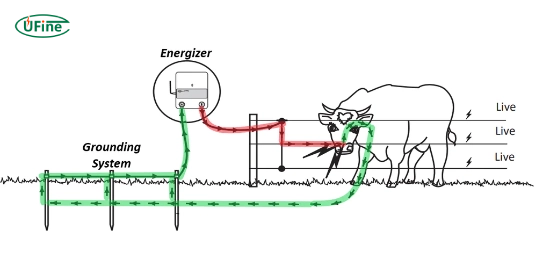
An electric fence battery supplies low-voltage DC power to an electric fence energizer. The energizer converts this energy into short, controlled high-voltage pulses that travel through the fence wire.
The battery must never be connected directly to the fence. It must power a compatible energizer that controls the pulse interval, output energy, and safety functions.
Common electric fence battery options include:
- 12V rechargeable deep-cycle batteries
- 12V AGM or gel batteries
- 12.8V LiFePO4 batteries
- 6V batteries for compact energizers
- 9V disposable electric fence batteries
- D-cell batteries for small portable systems
Battery-powered energizers may use rechargeable, disposable, or solar-charged batteries depending on their design. The Gallagher Electric Fencing 101 guide explains the main energizer power options and how solar panels, batteries, and energizers work together.
Part 2. Best electric fence battery types compared
The best battery for an electric fence depends on the energizer, installation type, charging system, climate, and maintenance schedule.
| Battery Type | Main Advantages | Main Limitations | Best Application |
|---|---|---|---|
| AGM deep-cycle battery | Sealed, widely available, simple to install, and compatible with many 12V energizers | Heavy and offers less usable capacity than LiFePO4 | Fixed farm, garden, and pasture fences |
| Gel deep-cycle battery | Sealed and suitable for steady, low-current discharge | Requires a charger with the correct voltage profile | Remote and low-maintenance installations |
| LiFePO4 battery | Lightweight, efficient, fast charging, and high usable capacity | Higher initial cost and requires compatible charging equipment | Portable, solar, and frequently cycled fences |
| 9V disposable fence battery | Simple installation and no recharging equipment required | Cannot be recharged and has a higher long-term operating cost | Temporary and seasonal fencing |
| Car starter battery | Easy to find and may work temporarily | Not designed for repeated deep discharge | Short-term emergency use only |
Is an AGM battery good for an electric fence?
A 12V AGM deep-cycle battery is a practical choice for many electric fence systems. It is sealed, resistant to vibration, and compatible with many standard energizers and solar controllers.
AGM is suitable when purchase cost and simple compatibility are more important than battery weight or maximum usable capacity.
Is a LiFePO4 battery good for an electric fence?
A LiFePO4 battery can provide longer runtime per kilogram, faster charging, and more usable capacity. It is useful for mobile fences, remote sites, and solar systems.
Before installation, confirm:
- The energizer’s permitted input-voltage range
- The battery’s maximum and minimum operating voltage
- Solar controller compatibility
- Low-temperature charging limits
- Battery management system protection
For more information about chemistry, charging, and service life, read our guide to 12V lithium deep-cycle batteries.
Can you use a car battery for an electric fence?
A car battery may power a compatible 12V energizer, but it is not the best long-term choice. Starter batteries are designed to deliver a short burst of high current rather than provide steady energy through repeated discharge cycles.
A deep-cycle or leisure battery is more suitable for continuous electric fence use. See our deep-cycle vs. regular battery comparison for a more detailed explanation.
Part 3. What size battery for an electric fence?
Electric fence battery size is measured in amp-hours, or Ah. A higher Ah rating provides a longer operating time when the energizer’s power consumption remains the same.
Do not select battery capacity from acreage alone. Fence length and condition help determine the required energizer, but battery size must be calculated from the energizer’s actual current draw.
Electric fence battery size formula
Required capacity (Ah) = Current draw (A) × Operating hours × Reserve factor ÷ Usable depth of discharge
For an initial estimate:
- Use a reserve factor of 1.2 to 1.3.
- Use the permitted depth of discharge stated by the battery manufacturer.
- A conservative lead-acid estimate may use 50% usable capacity.
- A suitable LiFePO4 battery may allow around 80% usable capacity, depending on its specification.
Electric fence battery size calculation example
Assume a 12V energizer consumes 50mA and must run for 14 days without charging.
Step 1: Convert milliamps to amps
50mA = 0.05A
Step 2: Calculate the required operating capacity
0.05A × 24 hours × 14 days = 16.8Ah
Step 3: Add a 25% reserve
16.8Ah × 1.25 = 21Ah
Step 4: Adjust for usable capacity
- AGM at 50% usable capacity: 21Ah ÷ 0.50 = 42Ah
- LiFePO4 at 80% usable capacity: 21Ah ÷ 0.80 = 26.25Ah
A practical starting point would therefore be a 45–50Ah AGM battery or a 30Ah LiFePO4 battery. The final choice must still match the energizer and charger specifications.
12V electric fence battery size table
The table below assumes 14 days of operation, a 25% reserve, 50% usable AGM capacity, and 80% usable LiFePO4 capacity.
| Energizer Current Draw | 14-Day Energy Use | Suggested AGM Battery | Suggested LiFePO4 Battery |
|---|---|---|---|
| 20mA | 6.72Ah | 18–20Ah | 12Ah |
| 50mA | 16.8Ah | 45–50Ah | 30Ah |
| 100mA | 33.6Ah | 90–100Ah | 55–60Ah |
| 150mA | 50.4Ah | 130–150Ah | 80–100Ah |
These figures are planning estimates. Always use the current draw and minimum battery capacity specified in the energizer manual.
Part 4. How long does an electric fence battery last?
“Battery life” can refer to operating runtime between charges or total service life before replacement.
Electric fence battery runtime
Use this formula to estimate runtime:
Runtime in hours = Usable battery capacity (Ah) ÷ Energizer current draw (A)
For example, a battery with 10Ah of usable capacity powering a 50mA energizer provides:
10Ah ÷ 0.05A = 200 hours, or about 8.3 days
Actual runtime may be shorter because of:
- Low temperatures
- Battery aging
- Self-discharge
- Charging losses
- Additional alarms or monitoring devices
- Incorrect battery sizing
Vegetation and fence faults do not always increase every energizer’s battery current in the same way. However, they reduce fence voltage and may cause some adaptive energizers to change their output or power consumption.
Electric fence battery service life
Total service life depends on battery chemistry, discharge depth, charging accuracy, temperature, storage conditions, and cycle frequency.
A larger battery may last longer because it operates at a shallower depth of discharge. However, correct charging and temperature control are just as important as capacity.
Part 5. How to choose a solar electric fence battery
A solar electric fence system uses a solar panel to recharge the battery during daylight. The battery powers the energizer at night and during periods of low sunlight.
Solar electric fence batteries are suitable for remote pastures, rotational grazing, wildlife control, temporary fencing, and gardens without grid power.
Calculate daily solar electric fence energy use
Daily energy use (Wh) = Battery voltage × Current draw × 24 hours
For a 12V energizer drawing 50mA:
12V × 0.05A × 24 = 14.4Wh per day
Calculate the solar panel size
Panel size (W) = Daily energy use ÷ Peak sun hours ÷ System efficiency
Assuming four peak-sun hours and 70% system efficiency:
14.4Wh ÷ 4 ÷ 0.70 = 5.14W
A 10W or larger panel would provide more practical reserve in this example. Actual panel size should also consider cloudy weather, seasonal sunlight, panel angle, dust, and battery recovery time.
Solar electric fence battery requirements
- Match the solar controller to the battery chemistry.
- Confirm the controller’s charging voltage.
- Provide enough battery capacity for several low-sunlight days.
- Keep the solar panel free from shade and dirt.
- Do not charge lithium batteries below their permitted charging temperature.
- Use weather-resistant cables, connectors, and enclosures.
For a broader explanation of capacity, chemistry, and solar compatibility, see our solar battery selection guide.
Part 6. Electric fence battery maintenance and troubleshooting
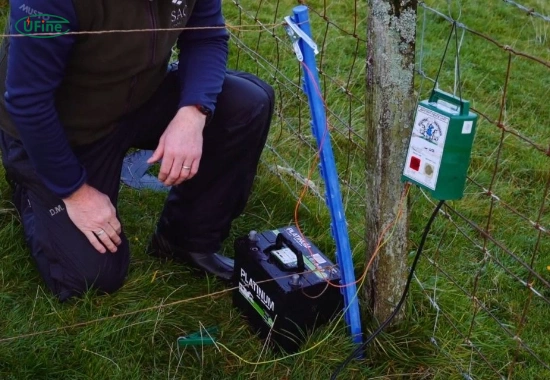
Regular maintenance helps prevent unexpected fence shutdowns and premature battery failure.
Electric fence battery maintenance tips
- Check the energizer’s battery indicator regularly.
- Recharge the battery before excessive discharge.
- Use a charger designed for the battery chemistry.
- Clean and tighten battery terminals.
- Inspect cables, connectors, and fuses.
- Protect the battery from rain, direct sunlight, standing water, and livestock.
- Keep ventilation openings clear where ventilation is required.
- Clean the solar panel and check its charging output.
Common electric fence battery problems
| Problem | Possible Cause | Recommended Check |
|---|---|---|
| Energizer does not start | Discharged battery, blown fuse, reversed polarity, or loose connection | Check voltage, polarity, fuse, and terminals |
| Fence voltage is low | Low battery, vegetation, poor grounding, damaged insulators, or fence leakage | Test the battery and energizer, then inspect the fence |
| Battery drains quickly | Battery is too small, aging, damaged, or not fully charged | Measure current draw and recalculate the required Ah capacity |
| Solar battery does not charge | Shaded panel, dirty panel, damaged cable, or incorrect controller | Measure panel and controller output in direct sunlight |
| Battery terminals become hot | Loose terminal, corrosion, damaged connector, or high resistance | Switch off the system and inspect all connections |
| Lithium battery shuts down | BMS overcurrent, undervoltage, or temperature protection | Check the load, battery voltage, temperature, and BMS status |
How to check whether the battery or fence is faulty
- Switch off the energizer before changing any connections.
- Inspect the battery, fuse, cables, polarity, and terminals.
- Test or recharge the battery according to its manufacturer’s instructions.
- Disconnect the energizer from the fence and test its output with a suitable fence tester.
- If the energizer output is normal, inspect the fence wire, vegetation, insulators, joints, and grounding system.
Part 7. Electric fence battery selection checklist
Use this checklist when choosing a battery for an electric fence:
- Input voltage: Confirm whether the energizer requires 6V, 9V, 12V, or another voltage.
- Current draw: Find the energizer’s normal operating current in mA or A.
- Required runtime: Decide how many days the fence must operate without charging.
- Battery chemistry: Compare AGM, gel, LiFePO4, and disposable options.
- Ah capacity: Calculate capacity and include a 20%–30% reserve.
- Charging method: Confirm charger or solar controller compatibility.
- Temperature: Check operating and charging temperature limits.
- Outdoor protection: Use a suitable battery box and protected connections.
- Future expansion: Allow capacity for longer fences, additional wires, or monitoring equipment.
A deep-cycle leisure battery designed for steady power delivery is generally more suitable than a starter battery for a frequently used electric fence.
Part 8. Electric fence battery safety
Electric fence safety depends on the complete system, including the battery, energizer, grounding, fence wire, warning signs, and installation method.
IEC 60335-2-76 covers safety requirements for electric fence energizers used in agricultural, domestic, animal-control, and security applications. Use an energizer designed and certified for its intended market and application.
- Never connect a battery directly to the fence wire.
- Switch off the energizer before servicing the battery or fence.
- Do not use two energizers on the same fence circuit.
- Do not electrify barbed wire or razor wire directly.
- Use the grounding method specified by the energizer manufacturer.
- Install warning signs where required by local regulations.
- Keep battery terminals away from tools and other conductive objects.
- Use correctly rated fuses, cables, and connectors.
- Replace swollen, leaking, cracked, or overheated batteries.
- Recycle used lead-acid and lithium batteries through approved collection channels.
For international product design and installation requirements, refer to the official IEC 60335-2-76 electric fence energizer safety standard.
Part 9. FAQs about electric fence batteries
What is the best 12V battery for an electric fence?
A 12V AGM deep-cycle or compatible LiFePO4 battery is usually the best choice. Select between them based on weight, usable capacity, charging system, temperature, and budget.
What size battery do I need for an electric fence?
Calculate capacity from the energizer’s current draw, required operating hours, reserve factor, and permitted depth of discharge. Do not select battery size from acreage alone.
Can I use a car battery for an electric fence?
A car battery may work temporarily, but repeated discharge can shorten its life. A deep-cycle or leisure battery is more suitable.
How long will a 12V battery run an electric fence?
Divide the battery’s usable Ah capacity by the energizer’s current draw in amps. A 10Ah usable capacity with a 0.05A load provides about 200 hours.
Can a solar panel charge an electric fence battery?
Yes. Use a solar panel and charge controller matched to the battery voltage and chemistry, with enough reserve for low-sunlight periods.
Related Tags:

More Articles

JST vs Molex: The Right Battery Connector Choice
JST or Molex for your battery? Learn how connector selection affects current, voltage drop, reliability, and device performance.
Custom Battery Pricing: Costs Manufacturers Don’t Mention
A low battery quote may not be the final cost. Discover common hidden expenses that affect custom lithium battery projects.
Battery Wire Length: Hidden Cause of Power Loss
A longer battery wire can cause voltage drop, power loss, and unstable operation. Learn how wire length affects battery performance.
How Device Sleep Modes Affect Battery Life
Think sleep mode extends battery life? Learn why devices still drain power and how firmware, hardware, and batteries affect runtime.
LiPo Battery and PCB Design: Clearance, Insulation, and Placement
Learn how to optimize LiPo battery PCB clearance, insulation, placement, wiring, and thermal design—and avoid common integration mistakes.


