- Key takeaways
- Part 1. What is a float battery?
- Part 2. Do lithium batteries need float charging?
- Part 3. How does float charging work?
- Part 4. What is the right float voltage for a lithium battery?
- Part 5. Why a lower float voltage helps
- Part 6. Float charging vs. trickle charging
- Part 7. Where is float charging used?
- Part 8. How to set up a float charger
- Part 9. Common float charging mistakes
- Part 10. Can you float charge forever?
- Part 11. How temperature affects float charging
- Part 12. Float charging best practices
- Part 13. Float charger selection checklist
- Part 14. Choosing the right battery for float charging
- Part 15. FAQs about float battery charging
Float charging keeps batteries ready in backup, solar, telecom, RV, and marine systems.
Lithium batteries need different handling. Some, like LiFePO4, may allow a low float voltage, while others should stop charging when full. Always follow the battery’s chemistry and manufacturer guidelines.
Key takeaways
- A float battery is not a special type. It is a battery kept at a stable voltage after charging.
- Many lithium batteries do not need float charging. Use it only if the manufacturer allows it.
- Some 12.8V LiFePO4 batteries use about 13.4V–13.6V as float voltage. This does not fit all 12V lithium batteries.
- Most 3.7V lithium-ion and LiPo cells use CC/CV charging with charge cut-off, not continuous float.
- Do not use lead-acid modes like equalization or desulfation on lithium batteries.
- The charger sets the charging profile. The BMS protects the battery but should not fix wrong charger settings.
Part 1. What is a float battery?
A float battery stays connected to a charger after it is full. The charger keeps a steady voltage so the battery stays ready.
The terms floating battery and float battery are common in UPS, telecom, and backup systems. In these setups, the battery often works in parallel with the charger and load.
A float battery is not a new chemistry. It can be lead-acid, LiFePO4, or others. Each type needs its own charging method.
What is float charging?
Float charging is a maintenance stage. After full charge, the charger lowers the voltage.
The charger then supplies only the needed current. If there is no load, current is very low. If devices run, the charger may power them.
The float voltage is lower than the main charge voltage. It is not the same as the maximum voltage.
What is a float charger?
A float charger can reduce voltage after charging. It keeps the battery in standby mode.
- Battery type selection
- Adjustable voltage
- Auto charge cut-off
- Float or standby mode
- Low-temperature protection
- Voltage and current monitoring
- BMS communication
When people ask about a floating charger, they usually mean a charger that can stay connected without overcharging.
Part 2. Do lithium batteries need float charging?
Most lithium batteries do not need float charging. This is different from lead-acid batteries.
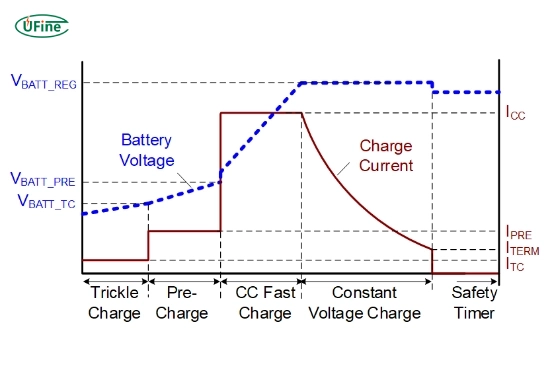
Most lithium cells use a CC/CV charging method for lithium batteries. First, the charger gives constant current. Then it holds a fixed voltage while current drops. Charging stops when current is low enough.
Keeping a battery at max voltage is not proper float charging. Lithium batteries need charge cut-off. This guide from Analog Devices explains lithium charge termination.
Some LiFePO4 batteries in solar or backup systems may allow a low float voltage. Always follow the battery datasheet.
| Battery Type | Charging Method | Float Use |
|---|---|---|
| Flooded lead-acid | Multi-stage | Float needed |
| AGM / gel | Multi-stage | Use specified float voltage |
| 12.8V LiFePO4 | CC/CV | Optional if approved |
| 3.7V Li-ion / LiPo | CC/CV + cut-off | Usually not needed |
| NMC / NCA pack | Pack-specific | Follow datasheet |
Part 3. How does float charging work?
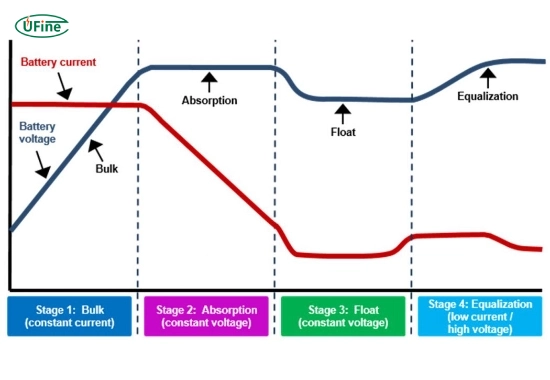
Float charging usually has these steps:
- Bulk: Current flows, voltage rises.
- Constant voltage: Voltage stays fixed, current drops.
- Charge cut-off: Charging stops or reduces.
- Float stage: Voltage lowers for standby.
Current is not fixed in float mode. It changes with load.
This is useful for systems that must stay ready:
- Backup power
- Telecom systems
- UPS
- Solar storage
- Security systems
- RV and marine systems
Part 4. What is the right float voltage for a lithium battery?
There is no single float voltage for all lithium batteries.
It depends on:
- Chemistry
- Cell count
- Nominal voltage
- Max charge voltage
- BMS design
- Balancing method
- System needs
- Manufacturer data
Float voltage for a 12V LiFePO4 battery
Some 12.8V LiFePO4 batteries use about 13.4V–13.6V. Around 13.5V is common.
For example, Victron uses 13.5V in some systems. But this is not universal. Always check specs. See Victron lithium charger settings guide.
| Pack Voltage | Cells | Float Range | Note |
|---|---|---|---|
| 12.8V | 4S | 13.4V–13.6V | Check datasheet |
| 25.6V | 8S | 26.8V–27.2V | Confirm profile |
| 51.2V | 16S | 53.6V–54.4V | Check BMS |
These are examples only. Always follow the battery spec.
What is the float voltage for a 3.7V lithium battery?
A 3.7V lithium cell usually charges to about 4.2V. Then charging stops.
Do not keep it at 4.2V for long. This can speed up aging.
Most devices stop charging and restart later. This is not true float charging.
A “12V lithium battery” can mean different things
The term “12V lithium battery” can be confusing.
A 12.8V LiFePO4 uses 4 cells. An 11.1V lithium-ion pack uses 3 cells. They need different voltages.
Always check chemistry and cell count first.
Part 5. Why a lower float voltage helps
High voltage for long time can age lithium batteries faster.
High temperature makes this worse. NREL research on lithium battery aging shows this clearly.
Designers must balance:
- Readiness: More stored energy
- Life: Less stress
Use the lowest approved float voltage that still meets system needs.
Part 6. Float charging vs. trickle charging
These two are different.
| Feature | Float | Trickle |
|---|---|---|
| Control | Constant voltage | Low current |
| Purpose | Maintain charge | Replace loss |
| Current | Changes | Continuous |
| Lithium use | Limited | Not suitable |
Some chargers use “trickle” for pre-charge. This is short and safe. It is not long-term charging.
Part 7. Where is float charging used?
| Application | Strategy | Focus |
|---|---|---|
| UPS | Standby | Reliability |
| Telecom | Float | Long life |
| Solar | Bulk + standby | Controller setup |
| RV / marine | Lithium profile | System match |
| Security | Always connected | Backup time |
| Portable devices | CC/CV | No float |
For solar systems, LiFePO4 batteries for solar storage are popular due to long life and safety.
Part 8. How to set up a float charger
Start with the battery datasheet.
What you need
- Datasheet
- Battery type
- Charger
- BMS
- Multimeter
- Temperature sensor
Identify chemistry
Check if it is LiFePO4, NMC, or others.
Read datasheet
Find voltage, current, and limits.
Use lithium charger
Avoid lead-acid modes.
Set charge voltage
Follow specs. Do not mix with float voltage.
Set float voltage
Only if allowed. Example: ~13.5V for some LiFePO4.
Set temperature limits
Use BMS rules. See lithium battery temperature limits guide.
Measure voltage
Check at battery terminals.
Test system
Check voltage, current, and temperature.
Part 9. Common float charging mistakes
1. Using one voltage for all
13.5V is not universal.
2. Using lead-acid charger
It may damage lithium batteries.
3. Using max voltage as float
This is incorrect.
4. Relying only on BMS
Battery Management System basics show it is for protection, not control.
5. Wrong temperature settings
Do not use lead-acid compensation.
6. Charging in cold
This can damage cells.
7. Keeping full charge too long
This reduces life.
8. Ignoring balancing
See lithium cell balancing explained.
Part 10. Can you float charge forever?
Only if the system is designed for it.
Check:
- Manufacturer approval
- Correct charger
- Right voltage
- BMS active
- Temperature control
For storage, do not use float. Follow storage guidelines.
Part 11. How temperature affects float charging
Low temperature
Charging in cold can damage cells.
High temperature
Heat speeds up aging.
Use correct limits
Always follow datasheet.
Part 12. Float charging best practices
- Use correct charger
- Follow datasheet
- Avoid high voltage too long
- Control temperature
- Use BMS
- Check voltage at terminals
Read more in battery life improvement tips.
Part 13. Float charger selection checklist
| Question | Reason |
|---|---|
| Chemistry? | Different limits |
| Cell count? | Sets voltage |
| Float allowed? | Not always |
| Correct voltage? | Avoid damage |
| Lithium support? | Needed |
| Temp sensing? | Safety |
| BMS link? | Better control |
| Standby needed? | Different setup |
| Safety standard? | See IEC 62619 standard or IEC 62133-2 certification |
Part 14. Choosing the right battery for float charging
Consider more than voltage:
- Runtime
- Temperature
- SOC
- Life target
- Charger match
- BMS
For custom needs, see custom lithium battery design services.
Part 15. FAQs about float battery charging
What does float charging do?
It keeps a battery at a stable, lower voltage after full charge so it stays ready; only use it if the battery supports standby operation.
Is there a standard float voltage for lithium batteries?
No, it depends on chemistry and design; some 12.8V LiFePO4 batteries use about 13.4V–13.6V, while others may not use float at all.
Can I use 13.5V for any 12V lithium battery?
Only for certain LiFePO4 batteries with manufacturer approval; always verify chemistry, cell count, and specs first.
What is a floating battery charger?
It maintains a controlled standby voltage after charging and must match lithium requirements like voltage limits, termination, and BMS compatibility.
Can lithium batteries stay on float charge continuously?
Yes only if the system is designed for it; otherwise use charge termination or controlled recharge and follow storage guidelines.
Related Tags:

More Articles
Dead Battery or Device Failure? How to Find the Cause
Think your device is broken? Learn how to tell if the problem comes from battery aging or hardware failure before replacing your electronics.
Why iPhone Duo Uses Two Batteries: The Engineering Behind Foldable Phone Power
Why do foldable phones need two batteries? Explore the engineering challenges behind iPhone Duo’s dual-battery architecture and future battery trends.
Solid-State Batteries: 3 Myths You Need to Know
Solid-state batteries promise safer EVs and longer range, but the reality is more complex. Discover the challenges behind this next-gen technology.
Battery Capacity vs Discharge Rate: The Choice Engineers Face
Higher capacity or higher discharge rate? Learn how to choose the right LiPo battery for longer runtime, stable power output, and better device performance.
Battery Cable Size Guide: Choose the Right Wire Fast
Not sure what battery cable size you need? Learn how to select the right wire gauge, terminal size, and cable for safer, more efficient battery systems.