
- Key Takeaways
- Part 1. What is a deep cycle battery vs regular battery?
- Part 2. Why more systems are moving from 12V to 24V
- Part 3. How a 24V deep cycle battery is built
- Part 4. 24V deep cycle battery chemistry comparison
- Part 5. How long does a 24V deep cycle battery last?
- Part 6. How to calculate if you need a 24V deep cycle battery
- Part 7. Cost comparison: AGM vs Lithium 24V Batteries
- Part 8. Best applications for 24V deep cycle batteries
- Part 9. Voltage drop: the hidden advantage of 24V
- Part 10. Common mistakes when using 24V deep cycle batteries
- Part 11. How to choose the best 24V deep cycle battery
- Part 12. FAQs
Key Takeaways
- A 24V deep cycle battery reduces current draw, heat loss, and cable size compared to 12V systems
- 24v deep cycle marine battery setups are becoming standard for trolling motors and electric boats
- Lithium 24V batteries usually cost more upfront but offer significantly lower long-term cost
- 24 volt AGM deep cycle battery options remain popular for budget-conscious users
- Voltage drop and cable efficiency are major reasons to choose 24V over 12V
- Real-world applications matter more than theoretical specs when choosing a battery
Part 1. What is a deep cycle battery vs regular battery?
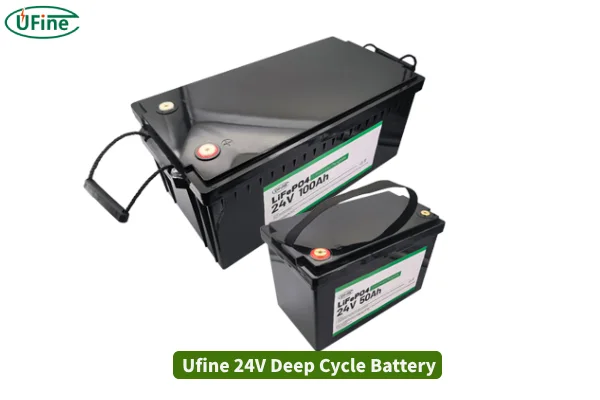
A deep cycle battery is designed to deliver steady power over a long period and handle repeated deep discharges. In contrast, a regular battery — often called a starting battery — is built to deliver a short burst of high current, mainly for starting engines.
This difference may sound subtle, but in real-world use, it matters a lot.
For example, when you’re using a 24V deep cycle battery in a marine, RV, or solar system, the battery is expected to provide continuous power for hours. A standard starting battery simply isn’t built for that kind of workload.
Deep cycle batteries typically have:
- Thicker internal plates
- Longer discharge capability
- Better cycle life
- More stable voltage under load
On the other hand, regular batteries are designed for:
- Short bursts of high current
- Quick engine starting
- Minimal deep discharge
Here’s a quick comparison:
| Feature | Deep Cycle Battery | Regular (Starting) Battery |
|---|---|---|
| Power Delivery | Long, steady output | Short burst |
| Plate Design | Thick plates | Thin plates |
| Cycle Life | High | Low |
| Deep Discharge | Yes | Not recommended |
| Best Use | Solar, RV, marine | Car engine starting |
This is why a 24 volt deep cycle battery is commonly used for trolling motors, solar energy storage, and RV systems. Using a regular battery in these applications often leads to faster wear, reduced capacity, and shorter lifespan.
Part 2. Why more systems are moving from 12V to 24V
Ten years ago, 12V systems dominated everything from RVs to marine setups. Today, however, more systems are shifting to 24V deep cycle battery configurations — and the reason is simple: efficiency.
When voltage increases, current decreases. And when current decreases, everything becomes easier — wiring, heat management, and overall system stability.
Imagine you’re running a 2000W load:
| System Voltage | Current Draw |
|---|---|
| 12V | 167A |
| 24V | 83A |
| 48V | 42A |
That’s a dramatic difference. At 12V, you’re dealing with heavy cables and significant heat buildup. At 24V, things become far more manageable.
To better understand battery health, check out our guide on measuring lithium battery internal resistance for accurate performance insights.
This is exactly why 24v deep cycle marine battery systems are now common in trolling motors, electric boats, and larger RV setups.
Lower current also means:
- Less voltage drop
- Smaller cable size
- Higher inverter efficiency
- Longer battery lifespan
And once you experience the stability of a 24 volt deep cycle battery, going back to 12V rarely makes sense.
Part 3. How a 24V deep cycle battery is built
A 24V deep cycle battery isn’t always a single battery. In many systems, it’s built using multiple cells or batteries connected in series.
For example, a 24V system can be configured as:
- Two 12V batteries in series
- Eight LiFePO4 3.2V cells
- Seven lithium-ion cells (3.7V nominal)
Each configuration behaves slightly differently in terms of balancing, charging, and protection.
This is where battery management systems (BMS) become critical. A good BMS protects against:
- Overcharge
- Over-discharge
- Short circuits
- Cell imbalance
In fact, poor balancing is one of the most common reasons 24v battery deep cycle systems fail prematurely.
If you’re designing a custom system, understanding how your 24v deep cycle battery is built matters just as much as choosing the chemistry.
Part 4. 24V deep cycle battery chemistry comparison
Not all 24V batteries are created equal. Chemistry plays a major role in performance, lifespan, and cost.
Here’s how the most common types compare:
| Battery Type | Cycle Life | Weight | Maintenance | Cost | Best Use |
|---|---|---|---|---|---|
| AGM | 300-500 | Heavy | Low | Low | Budget systems |
| Gel | 500-800 | Heavy | Low | Medium | Marine use |
| Lithium | 3000-6000 | Light | Very Low | High | Solar, RV |
| LiFePO4 | 4000-7000 | Light | Very Low | High | Professional systems |
A 24 volt AGM deep cycle battery still makes sense if you want lower upfront cost. However, lithium options often win in long-term value.
Not sure which chemistry to pick? Read our comparison between Gel battery vs lithium battery to make the right choice for your system.
Part 5. How long does a 24V deep cycle battery last?
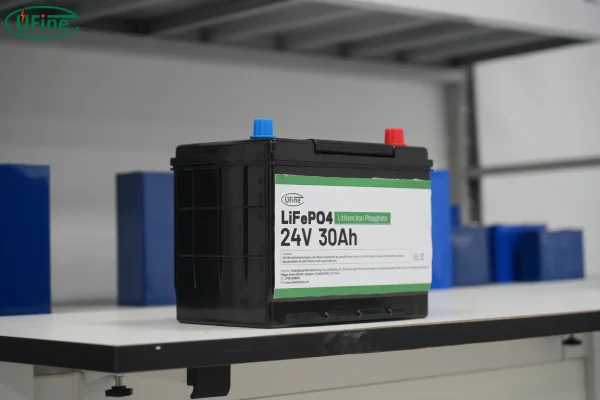
The lifespan of a 24V deep cycle battery depends on several factors, including battery chemistry, depth of discharge, usage frequency, and charging habits. While many people expect a simple answer, the reality is more nuanced.
In general, different battery types have very different lifespans:
| Battery Type | Typical Cycle Life | Estimated Lifespan |
|---|---|---|
| AGM | 300–500 cycles | 2–4 years |
| Gel | 500–800 cycles | 3–5 years |
| Lithium-ion | 2000–4000 cycles | 5–8 years |
| LiFePO4 | 4000–7000 cycles | 8–12 years |
For example, a 24 volt AGM deep cycle battery used daily in a marine or RV setup may last around 2–3 years. On the other hand, a lithium 24v deep cycle battery in the same conditions could last 8 years or more.
However, battery lifespan is not just about chemistry. How you use your battery matters just as much.
If you regularly discharge your battery deeply, it will wear out faster. For instance, draining a battery to 80% depth of discharge every day will significantly shorten its lifespan compared to shallow discharges.
Temperature also plays a major role. A 24v deep cycle marine battery used in high heat environments — such as enclosed boat compartments — may degrade faster than one used in moderate conditions.
Charging habits are another critical factor. Overcharging, undercharging, or using the wrong charger can reduce battery life dramatically. This is especially true for 24v agm deep cycle battery systems, which are more sensitive to improper charging.
One advantage of a 24V battery deep cycle system is that it often runs more efficiently than 12V systems. Because current is lower, batteries experience less stress and heat, which can help extend lifespan over time.
So while the typical answer might be:
- AGM: 2–4 years
- Lithium: 8–10 years
The real answer depends on how your system is designed and how you use it.
In many real-world setups, a well-maintained 24V deep cycle battery can last significantly longer than expected — especially when paired with proper charging, temperature control, and balanced loads.
Part 6. How to calculate if you need a 24V deep cycle battery
Instead of guessing, you can calculate whether a 24V deep cycle battery makes sense.
Let’s say your system uses 1500W.
12V system:
1500 ÷ 12 = 125A
24V system:
1500 ÷ 24 = 62.5A
Immediately, you reduce current by half.
That translates to:
- Lower heat
- Smaller wiring
- Better efficiency
- Less strain on battery
This is why many installers automatically recommend a 24v deep cycle battery for systems above 1000W.
Part 7. Cost comparison: AGM vs Lithium 24V Batteries
Upfront price often misleads buyers. A 24v agm deep cycle battery is cheaper initially, but long-term costs tell a different story.
Let’s compare:
| Battery Type | Cycle Life | Usable Capacity | Estimated Lifetime |
|---|---|---|---|
| AGM | 500 | 50% | 2-3 years |
| Lithium | 4000 | 80% | 8-10 years |
If you factor in replacement cost, lithium often becomes cheaper over time.
This is particularly important in 24v deep cycle marine battery systems where reliability matters more than initial savings.
Part 8. Best applications for 24V deep cycle batteries

Some systems simply perform better at 24V.
Marine setups, for example, often demand higher power for trolling motors. That’s why 24v deep cycle marine battery setups have become the standard.
Similarly, solar storage systems benefit from reduced current and better inverter efficiency.
RV users also prefer 24 volt deep cycle battery setups when running appliances like air conditioners or induction cooktops.
Industrial equipment is another growing area. Forklifts, mobile robots, and automated carts frequently use 24v battery deep cycle systems for improved efficiency.
The shift toward 24V isn’t just a trend — it’s a practical upgrade.
Part 9. Voltage drop: the hidden advantage of 24V
Voltage drop rarely gets attention, but it matters more than most people realize.
Long cables create resistance, which causes voltage drop. At lower voltages like 12V, this effect becomes more pronounced.
With a 24V deep cycle battery, voltage drop is reduced significantly. That means more stable power delivery, especially in marine and RV environments where cable runs can be long.
This is one of the biggest reasons engineers recommend 24V systems.
Part 10. Common mistakes when using 24V deep cycle batteries
Even experienced users sometimes run into problems with 24 volt deep cycle battery systems. Most issues come down to avoidable mistakes:
- Mixing old and new batteries
- Using different battery capacities
- Incorrect charging voltage
- Poor cable sizing
These issues often shorten battery lifespan and reduce system reliability.
Taking time to design the system properly can prevent most of these problems.
Part 11. How to choose the best 24V deep cycle battery
Choosing the best 24v deep cycle battery isn’t just about capacity. Instead, think about how you’ll actually use the battery.
Look at cycle life, temperature range, and charging compatibility. If you’re installing a 24v deep cycle marine battery, vibration resistance and waterproofing also matter.
If you’re using solar storage, lithium options often perform better. On the other hand, a 24 volt AGM deep cycle battery may be enough for occasional use.
Ultimately, the best battery is the one that matches your system — not just your budget.
Part 12. FAQs
1. Can I build a 24V deep cycle battery from two 12V batteries?
Yes, you can connect two 12V batteries in series to create a 24V deep cycle battery. However, both batteries should have the same capacity, age, and chemistry. Otherwise, imbalance can reduce performance and shorten lifespan.
2. What size charger do I need for a 24V deep cycle battery?
You should use a charger specifically designed for 24V systems. A general rule is choosing a charger rated at about 10–20% of battery capacity. For example, a 100Ah 24V deep cycle battery works well with a 10A–20A charger.
3. Can I use a 24V deep cycle battery for solar energy storage?
Yes, 24V systems are very common in solar setups. In fact, many off-grid solar systems prefer 24 volt deep cycle battery configurations because they balance efficiency and cost better than 12V systems.
4. Can a 24V deep cycle battery power an inverter?
Yes, 24V batteries are commonly used with inverters. In fact, many inverters perform more efficiently at 24V compared to 12V, especially for loads above 1000W.
5. Do 24V deep cycle marine batteries require special maintenance?
Most modern 24v deep cycle marine battery options require minimal maintenance. AGM and lithium batteries are typically maintenance-free, while flooded lead-acid batteries may require periodic checks.
Related Tags:

More Articles

JST vs Molex: The Right Battery Connector Choice
JST or Molex for your battery? Learn how connector selection affects current, voltage drop, reliability, and device performance.
Custom Battery Pricing: Costs Manufacturers Don’t Mention
A low battery quote may not be the final cost. Discover common hidden expenses that affect custom lithium battery projects.
Battery Wire Length: Hidden Cause of Power Loss
A longer battery wire can cause voltage drop, power loss, and unstable operation. Learn how wire length affects battery performance.
How Device Sleep Modes Affect Battery Life
Think sleep mode extends battery life? Learn why devices still drain power and how firmware, hardware, and batteries affect runtime.
LiPo Battery and PCB Design: Clearance, Insulation, and Placement
Learn how to optimize LiPo battery PCB clearance, insulation, placement, wiring, and thermal design—and avoid common integration mistakes.


