- Part 1. What is a 12Ah battery?
- Part 2. How long does a 12Ah battery last?
- Part 3. C-rate And DoD
- Part 4. Li-ion vs LiPo vs LiFePO4 for a 12Ah battery
- Part 5. How do you calculate how many Ah you need?
- Part 6. How long does a 12Ah lithium battery last over its lifetime?
- Part 7. How long does it take to charge a 12Ah battery?
- Part 8. How much does a 12V 12Ah lithium battery cost?
- Part 9. What should you check before buying a 12Ah lithium battery?
- Part 10. FAQs
The International Energy Agency (IEA) reported in February 2026 that the global lithium-ion battery market exceeded $150 billion in 2025, representing more than 20% growth from 2024.
For smaller electronic devices, robotics, backup equipment, mobility products, and portable power systems, a 12Ah lithium battery can provide a useful balance between energy capacity, size, weight, and cost.
This guide explains what a 12Ah battery means, how to calculate its energy and runtime, how much load it can handle, how C-rate and depth of discharge affect performance, how Li-ion, LiPo, and LiFePO4 compare, and what you should consider when choosing or buying a 12Ah lithium battery.
Key takeaways
- A 12V 12Ah lithium battery provides approximately 144Wh of nominal energy.
- Runtime depends on battery energy, device power consumption, usable capacity, and system efficiency.
- The maximum load of a 12Ah battery depends on its C-rate, cells, BMS, wiring, and thermal conditions rather than its Ah rating alone.
- Depth of discharge (DoD) affects both usable energy and battery cycle life.
- Li-ion, LiPo, and LiFePO4 batteries have different strengths in energy density, flexibility, weight, safety, and cycle life.
- The price of a 12V 12Ah lithium battery depends on chemistry, cells, BMS, construction, certifications, quantity, and customization.
- When selecting a battery, consider voltage, Wh, current, dimensions, charging requirements, temperature, and protection—not just Ah.
Part 1. What is a 12Ah battery?
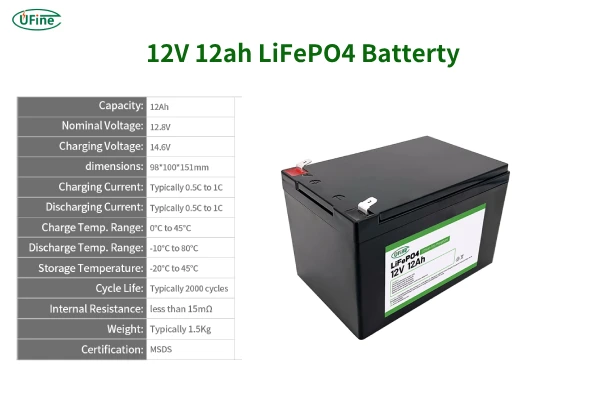
Ah stands for ampere-hour, which measures a battery’s rated charge capacity. In simple terms, a 12Ah battery can theoretically supply 12A for one hour, 6A for two hours, or 1A for 12 hours under specified conditions.
However, these examples should not be interpreted as guaranteed operating times because actual battery performance changes with discharge rate, temperature, battery chemistry, internal resistance, age, and the characteristics of the connected device.
It is also important to distinguish Ah from Wh. Amp-hours describe charge capacity, while watt-hours describe energy. To calculate nominal energy, multiply voltage by capacity:
Energy (Wh) = Voltage (V) × Capacity (Ah)
For example:
- 3.7V × 12Ah = 44.4Wh
- 12V × 12Ah = 144Wh
- 24V × 12Ah = 288Wh
This explains why two batteries can both have a 12Ah rating but store very different amounts of energy.
How much energy does a 12Ah lithium battery store?
The total nominal energy of a 12Ah lithium battery depends on its voltage.
| Battery configuration | Nominal voltage | Capacity | Nominal energy |
|---|---|---|---|
| 3.7V 12Ah | 3.7V | 12Ah | 44.4Wh |
| 12V 12Ah | 12V | 12Ah | 144Wh |
| 24V 12Ah | 24V | 12Ah | 288Wh |
A higher-voltage battery with the same Ah rating stores more nominal energy, but voltage compatibility must always come first. A 24V battery should not be connected to equipment designed for a 12V system simply because it offers more watt-hours.
When comparing batteries with different voltages, Wh is usually a more useful measure of total stored energy than Ah alone.
How much load can a 12Ah battery handle?
A common misunderstanding is that a 12Ah battery can automatically deliver 12A. Ah and maximum output current describe different characteristics.
The actual load capability depends on the battery’s cell design, C-rate, BMS or PCM rating, internal resistance, wiring, connectors, and operating temperature. For example, if a 12Ah battery is rated for a continuous discharge of 1C, its theoretical continuous current rating is:
12Ah × 1C = 12A
A 2C battery could theoretically support 24A, but only if the cells, protection circuit, thermal design, and other components are specified for that current.
For motors, pumps, speakers, and other loads with startup surges, you should also check the peak discharge current, since the startup requirement can be considerably higher than the device’s normal operating current.
Part 2. How long does a 12Ah battery last?
How long a 12Ah battery lasts depends primarily on the load connected to it. If the load is expressed in amps, a simple estimate is:
Runtime (hours) ≈ Capacity (Ah) ÷ Load (A)
If the device is specified in watts, use:
Runtime (hours) ≈ Battery energy (Wh) ÷ Load power (W)
For example, a 12V 12Ah battery contains approximately 144Wh of nominal energy. A device consuming 50W would therefore have a theoretical runtime of:
144Wh ÷ 50W = 2.88 hours
In real applications, the result will generally be lower because the complete rated capacity may not be usable and because power is lost through the battery, BMS, wiring, DC-DC converters, or inverters.
A more practical estimate can be made using:
Runtime ≈ V × Ah × Usable capacity × System efficiency ÷ Load (W)
If you assume 90% usable capacity and 90% system efficiency, a 12V 12Ah battery powering a 50W device would provide approximately:
12 × 12 × 0.90 × 0.90 ÷ 50 ≈ 2.33 hours
This remains an estimate because actual results depend on the battery and operating conditions.
How long will a 12V 12Ah battery last?
A 12V 12Ah battery has approximately 144Wh of nominal energy, so its theoretical runtime can be estimated as follows:
- A 10W device: about 14.4 hours
- A 20W device: about 7.2 hours
- A 50W device: about 2.9 hours
- A 100W device: about 1.4 hours
These figures are useful for initial sizing, but you should account for usable capacity and system efficiency before choosing the final battery capacity.
Part 3. C-rate And DoD
1 What is C-rate for a 12Ah battery?
C-rate expresses the charging or discharging current relative to the battery’s rated capacity. For a 12Ah battery, a 1C discharge corresponds to approximately 12A, while 0.5C corresponds to 6A.
For example:
- 0.5C = 6A
- 1C = 12A
- 2C = 24A
- 5C = 60A
These calculations describe the relationship between capacity and current rather than automatically defining the battery’s safe operating limits. The manufacturer’s specified continuous and peak discharge ratings should always take priority.
A higher discharge rate can also increase heat generation and voltage drop, while potentially reducing usable capacity under demanding conditions, so selecting a battery with an appropriate current rating is more important than simply choosing the largest possible C-rate.
2 What is depth of discharge (DoD)?
Depth of discharge (DoD) indicates how much of a battery’s available capacity has been used. If you use 6Ah from a 12Ah battery, the approximate DoD is 50%.
For a 12Ah battery:
- 25% DoD = about 3Ah used
- 50% DoD = about 6Ah used
- 80% DoD = about 9.6Ah used
- 100% DoD = about 12Ah used
DoD matters because repeatedly operating a battery at very high depth of discharge can place greater stress on the cells. If long service life is important, operating within the manufacturer’s recommended DoD range can provide a better balance between usable energy and cycle life.
This also explains why a battery rated at 12Ah may not provide 12Ah of usable capacity in every application.
Part 4. Li-ion vs LiPo vs LiFePO4 for a 12Ah battery
The 12Ah rating does not identify the battery chemistry. Li-ion, lithium polymer (LiPo), and LiFePO4 batteries can all be designed around a 12Ah capacity, but their characteristics differ.
Lithium-ion batteries generally offer high energy density and are widely used in portable electronics and battery packs where size and weight matter.
LiPo batteries use pouch-cell construction and can provide flexible dimensions, lightweight designs, and customized shapes, making them particularly suitable for compact consumer electronics, wearables, robotics, and products with limited internal space.
LiFePO4 batteries are known for strong thermal stability and long cycle life and are commonly used in energy storage, backup power, and applications where longevity is more important than maximum energy density. The IEA reported that LFP batteries represented more than half of EV batteries deployed globally in 2025, demonstrating their growing role in the broader lithium battery market.
The best chemistry depends on the application’s voltage, energy density, weight, dimensions, current requirements, cycle-life expectations, and operating environment.
Part 5. How do you calculate how many Ah you need?
If you know your device’s power consumption and required operating time, you can estimate the battery capacity you need.
Use this formula:
Required Ah ≈ Power (W) × Runtime (hours) ÷ Voltage (V)
For example, suppose a device consumes 30W and needs to operate for five hours from a 12V system:
30W × 5h ÷ 12V = 12.5Ah
The theoretical requirement is therefore about 12.5Ah. In practice, you should allow additional capacity because battery efficiency, usable DoD, temperature, discharge rate, and conversion losses can reduce the actual runtime.
For applications where space is limited, you may also need to balance capacity against battery dimensions and energy density rather than simply selecting the largest Ah rating.
Part 6. How long does a 12Ah lithium battery last over its lifetime?
Battery runtime and battery lifespan are two different concepts. Runtime describes how long the battery can power a device after one charge, while lifespan refers to how the battery’s capacity changes over repeated charge and discharge cycles.
Cycle life is influenced by:
- Depth of discharge
- Charging and discharging current
- Operating temperature
- Charging voltage
- Cell chemistry
- Storage conditions
- Battery construction
A battery’s specified cycle life is normally measured under defined laboratory conditions and should not be interpreted as an exact point at which the battery will suddenly stop working.
Part 7. How long does it take to charge a 12Ah battery?
Charging time depends on the battery’s chemistry, charger, charging current, and charging profile. As a simplified estimate:
Charging time ≈ Capacity (Ah) ÷ Charging current (A)
For a 12Ah battery:
- 1A charging current → approximately 12 hours theoretically
- 2A → approximately 6 hours
- 3A → approximately 4 hours
- 6A → approximately 2 hours
Actual charging normally takes longer because lithium batteries use a controlled charging process in which the current decreases during the final stage. Always use a charger with the correct voltage and charging profile for the specific battery chemistry.
Part 8. How much does a 12V 12Ah lithium battery cost?
The price of a 12V 12Ah lithium battery typically varies depending on the battery chemistry, cell quality, BMS, construction, certifications, and brand. As a general retail reference, 12V 12Ah LiFePO4 batteries from established brands and suppliers can range from around $80 to $150, while specialized or higher-performance models may cost more.
For example, Bioenno Power offers 12V 12Ah LiFePO4 batteries at around $125, while other suppliers may offer similar-capacity products at lower or higher prices depending on specifications and market. Retail prices can also vary by region, shipping, promotions, and included accessories.
When comparing brands such as Bioenno Power, Renogy, Dakota Lithium, and ExpertPower, don’t compare price alone. Check the battery chemistry, usable capacity, continuous discharge current, cycle life, BMS, dimensions, weight, warranty, and certifications to determine the overall value.
For custom or OEM applications, the 12V 12Ah lithium battery price is usually calculated based on the complete battery specification, including cell type, dimensions, protection circuit, connector, wires, certifications, order quantity, and other customization requirements. Therefore, a custom battery may have a different price from a standard retail product even when both are rated at 12V 12Ah.
Part 9. What should you check before buying a 12Ah lithium battery?
Before choosing a 12Ah lithium battery, look beyond the capacity rating and check whether the battery actually matches your application.
Voltage: Confirm that the nominal and charging voltages are compatible with your equipment.
Energy: Compare Wh when evaluating batteries with different voltages.
Discharge current: Make sure the continuous and peak current ratings meet the device’s requirements.
Charging requirements: Check the required charging voltage, current, and charging profile.
Dimensions and weight: A battery that meets the electrical requirements is still unsuitable if it cannot fit into the product.
BMS or PCM: Confirm that the protection system provides appropriate overcharge, over-discharge, overcurrent, and short-circuit protection where required.
Operating temperature: Check the specified charging, discharging, and storage temperature ranges.
Cycle life: Consider expected usage frequency and required service life.
Certifications: For commercial products, transportation, and regulated markets, verify the certifications and test documentation required for your application.
For custom battery projects, you may also need to specify the connector, wire length, PCB configuration, cell arrangement, dimensions, shape, and mechanical structure.
Part 10. FAQs
1. Can I replace a lead-acid battery with a 12Ah lithium battery?
Yes, in many applications a lithium battery can replace a lead-acid battery with similar voltage requirements, but you should check charging voltage, discharge current, battery dimensions, and BMS compatibility before replacing it. Lithium batteries usually offer higher usable capacity, lower weight, and longer cycle life compared with traditional lead-acid batteries.
2. Can a 12Ah lithium battery be used in cold temperatures?
A 12Ah lithium battery can operate in cold environments, but low temperatures may reduce available capacity and charging performance. Most lithium batteries have recommended operating temperature ranges, and charging below the specified temperature limit may require additional protection or a battery heating system.
3. Can I connect two 12Ah lithium batteries together?
Yes, two 12Ah lithium batteries can sometimes be connected in series or parallel to increase voltage or capacity, but they must be designed for that configuration. Connecting batteries with different voltages, ages, capacities, or charging conditions can cause safety and performance issues.
4. Does a higher Ah battery always provide better performance?
Not necessarily. A higher Ah rating provides more stored energy and potentially longer runtime, but the battery must also match the required voltage, current output, size, weight, and charging requirements of the application.
5. Can I use a different charger for a 12Ah lithium battery?
Only if the charger matches the battery chemistry, voltage, and charging requirements. A charger designed for lead-acid batteries or a different lithium chemistry may not provide the correct charging profile and could affect battery performance or safety.
Related Tags:

More Articles

JST vs Molex: The Right Battery Connector Choice
JST or Molex for your battery? Learn how connector selection affects current, voltage drop, reliability, and device performance.
Custom Battery Pricing: Costs Manufacturers Don’t Mention
A low battery quote may not be the final cost. Discover common hidden expenses that affect custom lithium battery projects.
Battery Wire Length: Hidden Cause of Power Loss
A longer battery wire can cause voltage drop, power loss, and unstable operation. Learn how wire length affects battery performance.
How Device Sleep Modes Affect Battery Life
Think sleep mode extends battery life? Learn why devices still drain power and how firmware, hardware, and batteries affect runtime.
LiPo Battery and PCB Design: Clearance, Insulation, and Placement
Learn how to optimize LiPo battery PCB clearance, insulation, placement, wiring, and thermal design—and avoid common integration mistakes.