- Key takeaways
- Part 1. Why battery packs generate heat
- Part 2. The main reasons battery packs overheat
- Part 3. How to identify the cause of battery pack overheating
- Part 4. How to prevent battery packs from overheating
- Part 5. How to test battery packs for overheating
- Part 6. What to do if a battery pack becomes too hot
- FAQs
A March 2026 study published by the National Institute of Standards and Technology (NIST) estimated that approximately 198,000 lithium-ion battery fires in structures had occurred in the United States since 2011, with a wide confidence interval reflecting incomplete and fragmented reporting. These figures cover lithium-ion battery fires broadly, not just consumer electronics or overheating incidents, but they highlight why battery safety deserves careful attention.
A battery pack naturally generates some heat during charging and discharging. The concern begins when heat builds up faster than the pack can release it, or when an electrical or internal battery fault causes an abnormal temperature rise. Understanding the reasons behind overheating helps you select safer batteries, improve device design, and reduce the risk of premature failure.
Key takeaways
- Excessive current, high internal resistance, charging faults, and poor heat dissipation are common causes of battery pack overheating.
- Compact consumer electronics can trap heat because of limited space and nearby heat-generating components.
- A battery protection circuit helps manage electrical risks, but it cannot eliminate every cause of overheating.
- Correct battery selection, charging control, wiring, and thermal testing are essential for reliable operation.
- Swelling, unusual odors, smoke, or rapidly rising temperatures are warning signs that require immediate attention.
Part 1. Why battery packs generate heat
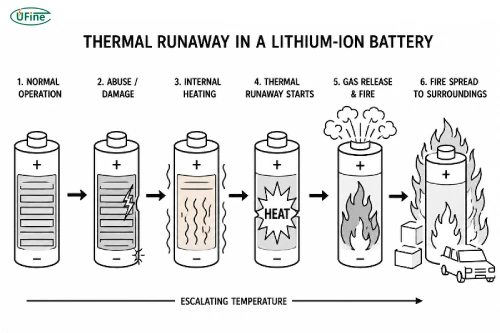
Heat generation is a normal part of battery operation. During charging and discharging, electrical current passes through the battery’s internal resistance, producing heat. The higher the current or resistance, the more heat the battery may generate.
A simplified formula illustrates this relationship:
Heat generation rate (W) = Current (A)^2 × Resistance (Ω)
For example, if the effective resistance is 0.05 ohms, increasing the current from 1 A to 2 A raises the resistive heat from 0.05 W to 0.20 W, assuming resistance remains constant. That is four times as much heat from resistive losses.
However, resistive heating is not the only source of heat. Electrochemical reactions, charging efficiency, and operating conditions also affect temperature.
Normal warmth is different from dangerous overheating. A battery may become slightly warm during operation without indicating a fault. Persistent or rapidly increasing heat, localized hot spots, swelling, or unusual odors are more concerning. The acceptable temperature range depends on the specific cell and battery pack design, so always consult the manufacturer’s specifications rather than applying one universal threshold.
Compact consumer electronics face an additional challenge: their batteries often sit close to processors, wireless modules, displays, or motors. With little room for airflow or heat-spreading materials, even a modest amount of heat can accumulate.
Part 2. The main reasons battery packs overheat
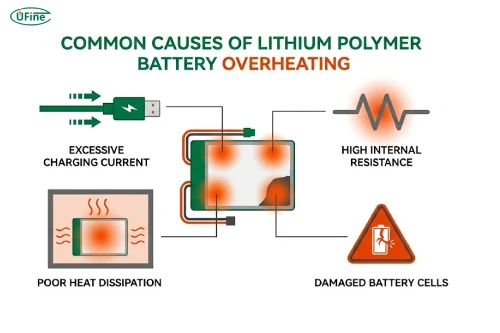
1 Excessive charging or discharging current
A battery pack must supply the current required by the device without exceeding its rated limits. Fast charging, heavy workloads, motor startup, and simultaneous operation of multiple components can increase current demand.
When current exceeds the battery’s suitable operating range, internal heating increases. Wires, connectors, and circuit-board components may also heat up if they are undersized for the load.
2 High internal resistance
Battery aging, cell damage, manufacturing defects, and poor electrical connections can increase resistance. At the same current, higher resistance means greater heat generation.
A loose connector or poor weld may create a localized hot spot even when the battery cells themselves are operating within their expected limits. This is why troubleshooting should examine the complete power path rather than the cells alone.
3 Incorrect charging parameters
Lithium-ion and lithium polymer batteries require charging parameters appropriate to their chemistry and specifications. An incompatible charger, incorrect voltage limit, excessive charging current, or faulty charge-control circuit can cause abnormal heating and may damage the cells.
Temperature monitoring is also important. If a sensor is poorly positioned, disconnected, or incorrectly interpreted by the control system, charging may continue under unsuitable conditions.
4 Poor thermal design
A battery pack can overheat even when its electrical ratings are appropriate if the device cannot dissipate heat effectively. Dense packaging, insulating materials, and proximity to hot components may allow temperatures to rise during prolonged operation.
Thermal design should therefore be considered early in product development, particularly for slim devices and sealed enclosures.
5 Damaged, aged, or defective cells
Physical impact, crushing, punctures, internal defects, and deterioration can compromise a cell’s internal structure. In severe cases, an internal short circuit may trigger thermal runaway, a self-accelerating process in which heat generation drives further heating and can lead to venting, fire, or other hazardous outcomes.
6 High ambient temperature
Using or charging a device in a hot environment reduces the battery’s ability to release heat. Direct sunlight, enclosed spaces, and nearby heat sources can worsen the problem. Charging and operating limits should always follow the battery manufacturer’s guidance.
Ufine Battery provides customized lithium polymer battery packs with tailored capacity, voltage, dimensions, and protection options to meet your product’s power and space requirements — from prototype development to mass production.
Find A Solution NowPart 3. How to identify the cause of battery pack overheating
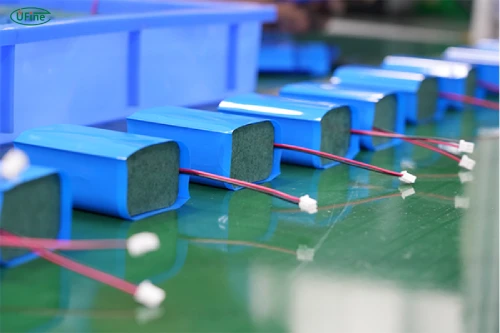
The timing of the temperature rise often provides a useful starting point. A battery that heats up during charging may have a different problem from one that becomes hot only when the device is under heavy load.
| When overheating occurs | Possible causes | What to investigate |
|---|---|---|
| During charging | Excessive charging current, incompatible charger, faulty temperature control | Charging voltage, current, and sensor operation |
| During high-load operation | High current demand, elevated resistance, undersized connections | Load current, voltage drop, and connector temperature |
| During standby | Abnormal leakage current, short circuit, or internal damage | Unexpected current draw and signs of battery damage |
| After physical impact | Internal damage or a short circuit | Stop using the pack and arrange a professional assessment |
| In hot environments | High ambient temperature and insufficient heat dissipation | Operating conditions and thermal design |
For engineering tests, measure temperature, current, and voltage under controlled conditions. Monitor the battery pack and its connections over time instead of relying on a single temperature reading. Comparing measurements at the battery terminals and the device input can help identify excessive voltage drop or resistance in the wiring.
If a battery becomes unusually hot, swells, emits an odor, or shows signs of damage, do not continue testing it under load. Safety takes priority over diagnosing the fault.
Part 4. How to prevent battery packs from overheating
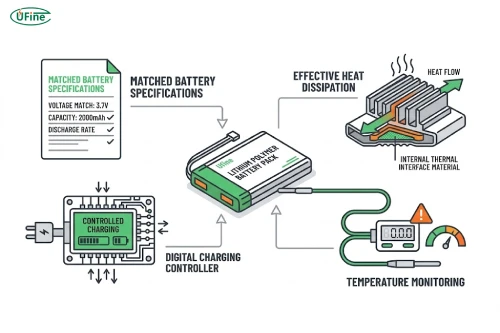
Choose a battery pack that matches the application
Start with the device’s actual power requirements. Consider continuous current, peak current, charging rate, capacity, operating temperature, and available space. A battery with sufficient capacity is not automatically suitable for a high-current application.
For custom lithium polymer battery packs, manufacturers can help match cell dimensions, voltage, capacity, discharge capability, and protection features to the device. This is particularly useful for compact electronics where battery size and thermal performance must be balanced.
Optimize charging and current control
Use a charging system designed for the battery’s chemistry and specified limits. Charging current and voltage must remain within the manufacturer’s recommendations, while the control system should respond appropriately to abnormal temperatures and electrical faults.
Protection features may include overcurrent, overvoltage, undervoltage, and overtemperature protection. However, these functions must be correctly designed and validated. A protection circuit cannot compensate for a damaged cell, poor thermal layout, or every possible internal failure.
Improve heat dissipation
Consider how heat moves through the complete device. Keeping the battery away from processors, motors, and other hot components can reduce unwanted heat transfer. Depending on the enclosure, engineers may also improve thermal paths through suitable structural materials or dedicated heat-spreading features.
Do not assume that simply adding more insulation or sealing the enclosure will improve safety. Insulation may protect against external heat, but it can also trap heat generated inside the battery pack.
Reduce resistance in wires and connections
Select wires, connectors, welds, and circuit-board conductors for the expected current. Poor connections can produce concentrated heating, even if the battery cells are correctly sized.
During assembly, verify connection quality and inspect for loose terminals, damaged wires, and inconsistent welds. Reliable electrical connections help reduce energy loss and improve long-term performance.
Add effective temperature monitoring
Temperature sensors can help a device adjust charging or operation when the battery becomes too hot. Their effectiveness depends on placement, response time, and the logic that controls the system.
A sensor positioned too far from a likely hot spot may not detect a developing problem quickly enough. Sensor placement and protective responses should therefore be validated in the assembled product.
Part 5. How to test battery packs for overheating
A battery pack should be evaluated under conditions that represent its intended use, including realistic charging cycles, normal workloads, peak loads, and expected ambient temperatures.
During testing, record temperature changes over time and examine multiple locations, including the cells, connectors, and nearby power electronics. A sudden rise or an unexpected hot spot may reveal a problem that would be missed by checking only the average pack temperature.
Protection functions also need validation. Engineers should verify that the system responds correctly to relevant fault conditions using controlled procedures and suitable test equipment. Deliberately overcharging, short-circuiting, or physically damaging cells without appropriate facilities and expertise is not a safe testing method.
The goal is to confirm that the battery pack, charging system, and device enclosure work together safely—not simply to establish that the battery can power the product.
Part 6. What to do if a battery pack becomes too hot
If a battery pack becomes unusually hot, stop using the device and disconnect its power source only if doing so is safe. Do not continue charging it to see whether the temperature returns to normal.
Never squeeze, puncture, dismantle, or attempt to repair a swollen or damaged battery. If you notice smoke, hissing, an unusual chemical odor, or rapidly increasing heat, move away from the device, keep others clear, and follow local emergency guidance. Do not handle or transport a battery that may be entering thermal runaway.
A battery that has suffered physical damage or repeated abnormal heating should be assessed by qualified personnel. Follow the manufacturer’s instructions and local requirements for battery disposal.
FAQs
1. Can a battery pack overheat even when the device is turned off?
Yes. A device may continue drawing a small amount of standby current even when it appears to be off. Internal circuit faults, abnormal leakage current, or battery damage can also cause heating. If a battery pack becomes warm or hot while the device is unused, disconnect it from external power if safe and arrange a qualified assessment.
2. Does a higher-capacity battery pack produce more heat?
Not necessarily. Capacity alone does not determine heat generation. The current drawn by the device, the battery’s internal resistance, its construction, and its operating conditions all matter. A higher-capacity battery may run cooler if it has lower internal resistance and operates at a lower relative discharge rate, but this is not guaranteed.
3. Can connecting multiple battery cells increase overheating risk?
Yes, if the pack is poorly designed. Cells connected in series or parallel must be suitable for the intended configuration, with appropriate electrical connections and protection. Differences in cell characteristics, poor connections, or an unsuitable pack design can lead to uneven current distribution or localized heating. Pack configuration should be designed and validated by qualified battery engineers.
4. Does frequent fast charging shorten battery pack life?
Frequent fast charging can accelerate battery degradation when it increases temperature or pushes the cells beyond their recommended charging conditions. The actual impact depends on the cell chemistry, charging rate, temperature, and control strategy. Following the battery manufacturer’s charging specifications helps balance charging speed, service life, and safety.
5. How should battery packs be stored when they are not in use?
Follow the manufacturer’s recommendations for storage temperature, charge level, and inspection intervals. Keep battery packs in a dry location away from direct sunlight, heat sources, and conductive objects that could cause a short circuit. Avoid storing damaged or swollen batteries, and do not leave battery packs in hot vehicles or other environments that exceed their specified limits.
Related Tags:

More Articles

Why Do 18650 Battery Packs Get Hot During Discharge?
Is your 18650 battery pack overheating under load? Learn what causes excess heat, how to spot dangerous symptoms, and what to do next.
18650 Battery BMS: How to Get the Specs Right
Learn how to choose a BMS for an 18650 battery pack. Compare voltage, current ratings, protection features, and balancing before you buy.
Why Does My Ring Camera Battery Drain So Fast or Stop Charging?
Is your Ring camera battery draining fast or not charging? Discover common causes, practical fixes, and when to replace the battery.
How to Select Battery Wire Gauge for High-Current Robot Applications
Not sure which wire gauge your robot needs? Compare AWG sizes, calculate current and voltage drop, and find a safer battery wiring solution.
How to Reduce Standby Power Drain in Battery-Powered Robots
Learn how to measure robot standby current, calculate battery drain, and optimize sensors, wireless modules, and power management.