- Key takeaways
- Part 1. What is battery overcharging?
- Part 2. Which battery types can be overcharged?
- Part 3. How overcharging affects battery performance?
- Part 4. Warning signs of an overcharged battery
- Part 5. How to identify an overcharged car battery?
- Part 6. How to prevent battery overcharging?
- Part 7. Best charging practices by battery type
- Part 8. Preventive technologies in modern batteries
- Part 9. Battery overcharging FAQs
Battery overcharging is one of the most common causes of premature battery failure and safety incidents in energy storage systems. It occurs when a battery continues to receive current after reaching full capacity, leading to heat buildup, chemical instability, and in severe cases, thermal runaway.
Understanding which battery types can be overcharged is essential for selecting the right charging method, improving system safety, and extending service life—especially in automotive, industrial, and lithium battery applications.
Key takeaways
- Overcharging happens when charging continues after full capacity is reached.
- Lead-acid and NiCd batteries are highly prone to overcharging damage.
- Lithium-ion batteries include protection systems but are still vulnerable under poor charging conditions.
- Heat, swelling, and voltage rise are key warning signs.
- Smart chargers and BMS systems are critical prevention tools.
Part 1. What is battery overcharging?
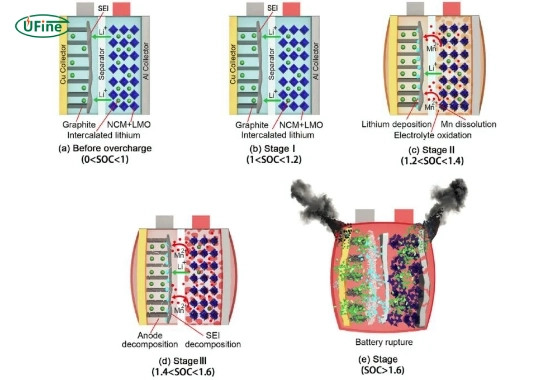
Battery overcharging occurs when electrical energy is continuously supplied to a fully charged battery. Instead of stopping, the charging current forces additional chemical reactions inside the cell.
This leads to:
- Excess heat generation that accelerates degradation
- Gas formation (especially in lead-acid systems)
- Uncontrolled chemical reactions that reduce capacity and lifespan
For example, in lead-acid batteries, overcharging breaks down water in the electrolyte into hydrogen and oxygen gas, increasing internal pressure and safety risks.
📌 Learn more about battery fundamentals:
Part 2. Which battery types can be overcharged?
Not all batteries respond the same way to overcharging. The risk depends on chemistry and built-in protection systems.
1. Lead-acid batteries (high risk)
Lead-acid batteries are widely used in vehicles, UPS systems, and backup power storage.
Overcharging effects:
- Electrolyte boiling and water loss
- Hydrogen gas generation (explosion risk in enclosed spaces)
- Plate corrosion and sulfation imbalance
These batteries require strict voltage control during charging.
2. Nickel-cadmium (NiCd) batteries (moderate to high risk)
NiCd batteries are older rechargeable systems still used in aviation and industrial tools.
Overcharging effects:
- Heat buildup due to oxygen recombination
- Memory effect worsens capacity loss
- Pressure increase in sealed cells
They tolerate some overcharge, but long-term exposure reduces performance significantly.
3. Lithium-ion batteries (controlled but still vulnerable)
Lithium-ion batteries power smartphones, EVs, and energy storage systems. They include protection circuits and are often managed by a Battery Management System (BMS).
However, they are not immune.
Overcharging risks:
- Lithium plating on anodes
- Thermal runaway in extreme conditions
- Accelerated electrolyte decomposition
Related reading: Can You Overcharge a Lithium Battery
Part 3. How overcharging affects battery performance?
Overcharging has cumulative effects that directly impact battery health:
- Increased internal temperature → accelerates chemical aging
- Reduced cycle life → fewer usable charge/discharge cycles
- Capacity loss → shorter runtime and energy output
- Structural damage → swelling or leakage in severe cases
In industrial systems, repeated overcharging can reduce battery lifespan by more than 30–50%.
Part 4. Warning signs of an overcharged battery
Identifying early symptoms helps prevent irreversible damage:
- Swelling or bulging casing due to gas expansion
- Abnormal heat during or after charging
- Rapid performance degradation
- Voltage instability under load
If these signs appear, the battery should be disconnected and tested immediately.
Part 5. How to identify an overcharged car battery?
Automotive lead-acid batteries are especially sensitive to charging system failures.
Key diagnostic methods:
Voltage check
Healthy range during charging: 13.7V–14.7V. Above this range may indicate overcharging from the alternator or charger.
Physical inspection
Look for bulging, cracks, or electrolyte leakage.
Temperature monitoring
Excessive heat after driving or charging is a warning sign.
Acid leakage detection
Indicates venting due to internal pressure buildup.
Part 6. How to prevent battery overcharging?
Modern systems use multiple layers of protection:
Smart Charging Systems
Smart chargers automatically stop charging when full capacity is reached.
Battery Management Systems (BMS)
Lithium battery systems from manufacturers like Ufine Battery integrate BMS protection to regulate:
- Voltage
- Current
- Temperature
Best Practices
- Avoid continuous overnight charging (unless smart-controlled)
- Follow manufacturer charging specifications
- Use certified chargers only
- Monitor high-load or high-temperature conditions
Part 7. Best charging practices by battery type
| Battery Type | Recommended Charging Practice | Risk Level |
|---|---|---|
| Lead-Acid | Controlled voltage + limited float charging | High |
| NiCd | Full discharge cycles preferred | Medium |
| Lithium-Ion | Maintain 20%–80% SOC range | Low–Medium (with BMS) |
Part 8. Preventive technologies in modern batteries
Modern lithium battery systems integrate multiple safety layers:
- Battery Management System (BMS)
- Thermal cutoff protection
- Voltage balancing circuits
- Intelligent charge controllers
These technologies significantly reduce overcharge risk but do not eliminate it completely in poorly designed systems.
Part 9. Battery overcharging FAQs
Can all batteries be overcharged?
Not all batteries behave the same, but most rechargeable batteries can be damaged if charging is not properly controlled.
Can you overcharge a lithium battery?
Yes, but only under abnormal conditions or system failure. Built-in BMS protection usually prevents it.
What happens if a battery is overcharged?
It may overheat, swell, lose capacity, or in extreme cases fail catastrophically.
How do smart chargers prevent overcharging?
They automatically reduce or stop current when the battery reaches full charge.
Is overnight charging safe?
It is generally safe for modern devices with protection systems, but industrial batteries should follow strict charging cycles.
Related Tags:

More Articles
Dead Battery or Device Failure? How to Find the Cause
Think your device is broken? Learn how to tell if the problem comes from battery aging or hardware failure before replacing your electronics.
Why iPhone Duo Uses Two Batteries: The Engineering Behind Foldable Phone Power
Why do foldable phones need two batteries? Explore the engineering challenges behind iPhone Duo’s dual-battery architecture and future battery trends.
Solid-State Batteries: 3 Myths You Need to Know
Solid-state batteries promise safer EVs and longer range, but the reality is more complex. Discover the challenges behind this next-gen technology.
Battery Capacity vs Discharge Rate: The Choice Engineers Face
Higher capacity or higher discharge rate? Learn how to choose the right LiPo battery for longer runtime, stable power output, and better device performance.
Battery Cable Size Guide: Choose the Right Wire Fast
Not sure what battery cable size you need? Learn how to select the right wire gauge, terminal size, and cable for safer, more efficient battery systems.