
- Part 1. Why foldable phones create new battery challenges
- Part 2. Why one large battery is difficult for foldable devices
- Part 3. How iPhone Duo’s dual-battery architecture solves foldable phone challenges
- Part 4. The technical challenges of managing two batteries
- Part 5. Why lithium polymer batteries fit foldable device designs
- Part 6. What iPhone Duo means for the future of battery design
- Part 7. FAQs
According to TrendForce, global foldable smartphone shipments are expected to reach approximately 20.2 million units in 2026, with Apple’s iPhone Duo projected to become a significant contributor after entering the market. TrendForce Meanwhile, Omdia forecasts that foldable smartphone shipments could grow to 36 million units by 2028 as more manufacturers introduce new form factors. Omdia
The arrival of iPhone Duo highlights an important shift in smartphone engineering. Unlike traditional iPhones that use a single battery pack, Apple’s first foldable model adopts a dual-battery architecture, with one battery placed on each side of the folding structure. Apple
This design choice raises an important question:
Why do foldable phones need two batteries instead of simply using one larger battery?
The answer is not only about increasing battery capacity. For foldable devices, battery design is closely connected with internal space, weight distribution, thermal management, and mechanical structure.
Key takeaways
- Foldable smartphones create new battery challenges because their internal space is divided by hinges, moving components, and thinner structural requirements.
- iPhone Duo introduces a dual-battery architecture, showing how battery design is becoming part of the overall device structure rather than just a component for storing energy. Apple
- Two smaller battery cells can provide better space utilization, weight balance, and design flexibility compared with a single large battery in foldable devices.
- Managing multiple batteries requires advanced battery management systems, thermal control, and charging optimization.
- Future foldable electronics will likely rely more on customized battery designs, including ultra-thin and high-density lithium polymer batteries.
Part 1. Why foldable phones create new battery challenges
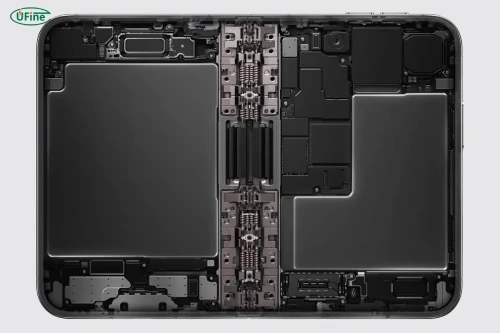
Traditional smartphones have followed a relatively simple internal layout for years. A large battery occupies most of the available flat space, while other components such as the motherboard, camera modules, and speakers are arranged around it.
Foldable phones completely change this approach.
When a smartphone folds, the internal space is divided into multiple sections. The hinge mechanism becomes a critical structural component, leaving less continuous space for a traditional battery pack.
A foldable device must balance several competing requirements:
| Traditional smartphones | Foldable smartphones |
|---|---|
| Single flat internal structure | Divided internal structure |
| Large battery area available | Limited battery placement areas |
| Focus on capacity | Focus on integration and balance |
| Fixed device shape | Changing mechanical structure |
For devices like iPhone Duo, the challenge becomes more complicated because the phone needs to support both a compact folded mode and a larger tablet-like unfolded experience. Apple’s device features a 7.6-inch inner display and a 5.4-inch outer display, creating higher power demands compared with conventional smartphones. Apple
A larger display means more energy consumption from:
- OLED panels
- higher brightness levels
- multitasking features
- advanced processors
- AI-powered applications
However, simply increasing battery size is not always possible.
A thicker battery could affect:
- device thickness
- folding comfort
- hinge durability
- overall weight
This is why foldable phones require a different battery strategy.
Part 2. Why one large battery is difficult for foldable devices
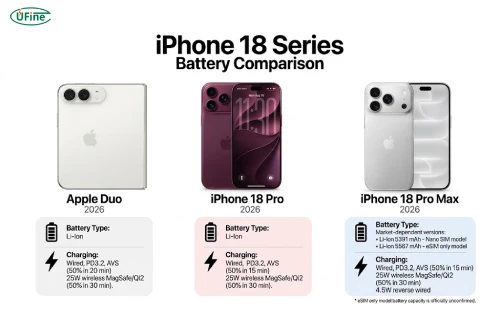
At first glance, using one large battery seems like the easiest solution. More capacity usually means longer operating time. However, foldable phones have unique structural limitations.
Limited internal space
A single large battery works well in traditional smartphones because the device has a large uninterrupted area.
A foldable phone has a different layout:
[ Battery ] | Hinge | [ Battery ]
The hinge separates the two halves of the device, making it difficult to place one large battery without sacrificing other design goals.
A dual-battery design allows manufacturers to use the available space more efficiently by placing cells in different areas of the device.
Weight distribution
Weight balance is another important factor.
A foldable smartphone has two sides connected by a hinge. If most of the weight is concentrated on one side, the device may feel unbalanced when opened or used in different positions.
By distributing battery weight across both sides, dual batteries can help create a more balanced design.
Maintaining a thin profile
Foldable smartphones compete heavily on portability. Users expect a large display experience without carrying a thick or heavy device.
Therefore, battery engineering becomes a compromise between:
- capacity
- thickness
- weight
- mechanical reliability
The goal is not simply to fit the biggest battery possible. The goal is to create the most efficient energy system within a limited physical space.
Part 3. How iPhone Duo’s dual-battery architecture solves foldable phone challenges
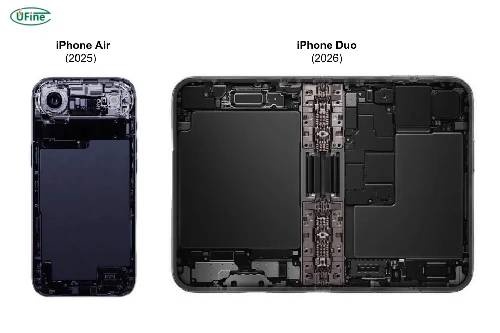
The introduction of iPhone Duo provides a clear example of how foldable smartphones are changing battery architecture. Apple designed the device with one high-energy battery on each side of the foldable structure, allowing both cells to work together as a unified power system. Apple states that energy rebalancing algorithms help the two batteries operate seamlessly as one, delivering up to 31 hours of video playback with the inner display and up to 44 hours with the outer display. Apple
This approach demonstrates an important principle:
Dual batteries are not simply about adding more battery capacity. They are about creating a power system that matches the physical structure of a foldable device.
Better use of limited internal space
In a traditional smartphone, engineers can place a large battery pack across most of the internal area. Foldable phones do not have the same freedom.
The hinge divides the device into two sections, and each side has its own components, including:
- display components
- cameras
- processors
- antennas
- mechanical structures
By placing a battery on each side, manufacturers can use previously separated spaces more efficiently.
| Battery design | Advantages | Limitations |
|---|---|---|
| Single large battery | Simple structure, easier management | Difficult to fit into foldable layouts |
| Dual-battery design | Better space utilization and weight balance | More complex battery management |
| Custom-shaped battery | Maximum design flexibility | Requires advanced manufacturing |
For iPhone Duo, the dual-battery layout allows Apple to maintain a thin foldable design while still providing enough energy for a larger display and high-performance hardware. Apple
Improved weight balance
Weight distribution is another important reason behind dual-battery designs.
A foldable phone is essentially two connected devices. When opened, users hold both halves of the phone, and uneven weight can affect comfort and usability.
A single large battery placed on one side could create:
- uneven weight distribution
- additional stress on the hinge
- less comfortable handheld use
A distributed battery system helps balance the two halves, making the device easier to handle in different positions.
This is especially important as foldable phones become thinner. Engineers cannot solve every problem simply by adding stronger materials or larger components. Many improvements must come from smarter internal layouts.
Supporting larger displays and advanced features
Foldable phones introduce new use cases, including:
- multitasking across multiple apps
- larger-screen gaming
- video editing
- AI-powered applications
These features require more processing power and energy.
At the same time, manufacturers need to prevent the device from becoming too thick or heavy.
Therefore, the battery challenge becomes a balancing act between:
- energy capacity
- device thickness
- thermal performance
- user comfort
The dual-battery approach provides more flexibility in solving this engineering problem.
Part 4. The technical challenges of managing two batteries
Although dual batteries offer structural advantages, they also create new engineering challenges.
Two batteries cannot simply be connected together and treated exactly like one larger battery. A sophisticated battery management system (BMS) is required to monitor and control both cells.
Coordinating charging and power distribution
When a device contains multiple battery cells, the system must carefully manage:
- charging speed
- voltage levels
- current distribution
- battery temperature
The goal is to ensure both batteries operate efficiently without causing unnecessary stress on either cell.
For example, if one battery experiences higher temperatures or faster discharge, the system needs to adjust power distribution to maintain stable performance.
This becomes even more important in foldable phones because different parts of the device may experience different thermal conditions.
Managing battery aging over time
All rechargeable batteries gradually lose capacity after repeated charging cycles.
With two separate battery cells, another challenge appears:
The two batteries may not age at exactly the same rate.
Factors affecting battery aging include:
- temperature differences
- charging patterns
- workload distribution
- physical location inside the device
A smart battery management system must continuously monitor battery health and optimize operation to extend the overall lifespan of the device.
Earlier reports about Apple’s foldable iPhone development suggested that future iPhones could require software support for monitoring multiple batteries, with references to battery-related functions appearing in iOS test versions.
Thermal management in ultra-thin foldable devices
Heat management is another major challenge.
Modern smartphones already generate heat from:
- processors
- cameras
- fast charging systems
- AI workloads
Foldable phones add another layer of complexity because their internal space is more compact.
iPhone Duo combines its dual-battery architecture with an advanced thermal management system, including a custom-designed vapor chamber, to support sustained performance.
Future foldable devices will likely require even more advanced solutions to balance:
- battery performance
- charging speed
- device thickness
- thermal safety
Part 5. Why lithium polymer batteries fit foldable device designs
The development of foldable smartphones is also changing what manufacturers expect from battery technology.
Traditional battery solutions designed for standard smartphones may not always meet the requirements of new form factors.
This is where lithium polymer (LiPo) batteries become increasingly important.
Ultra-thin design flexibility
Foldable devices require batteries that can fit into extremely limited spaces.
Compared with traditional rigid battery formats, lithium polymer batteries offer advantages such as:
- thinner profiles
- lightweight construction
- flexible packaging options
- customized dimensions
These characteristics make LiPo batteries suitable for devices where every millimeter of internal space matters.
Custom shapes for complex electronics
The future of consumer electronics is moving beyond rectangular devices.
Products such as:
- foldable smartphones
- smart wearables
- AI-powered accessories
- portable robotics
all require more customized power solutions.
Battery manufacturers increasingly need to design cells around the device instead of forcing devices to adapt to standard battery sizes.
For foldable electronics, battery shape, thickness, and placement can become as important as capacity itself.
Part 6. What iPhone Duo means for the future of battery design
The importance of iPhone Duo’s dual-battery architecture goes beyond one smartphone model.
It represents a broader change in how engineers approach portable power systems.
For many years, smartphone battery innovation focused mainly on:
- increasing capacity
- improving charging speed
- extending battery life
However, foldable devices introduce a new priority:
How can energy storage adapt to new hardware designs?
Future mobile devices may rely increasingly on:
- multi-cell battery architectures
- ultra-thin battery designs
- customized battery shapes
- smarter battery management systems
The same principles could eventually apply to other emerging products, including foldable tablets, wearable devices, and compact AI hardware.
As electronic devices continue to become thinner, smarter, and more flexible, batteries will no longer be viewed as simple components placed inside a product.
Instead, battery design will become an essential part of the overall engineering process.
The evolution from single batteries to dual-battery systems shows that the future of portable power is not only about storing more energy. It is about designing energy solutions that work together with the shape, function, and experience of next-generation devices.
Part 7. FAQs
1. Why does iPhone Duo use two batteries instead of one larger battery?
A dual-battery design helps foldable phones solve internal space limitations. Because the hinge separates the device into two sections, two smaller batteries can be placed more efficiently than one large battery.
2. Do two batteries mean a foldable phone will always have longer battery life?
Not necessarily. Battery life depends on multiple factors, including battery capacity, display size, processor efficiency, software optimization, and power management. Dual batteries mainly improve design flexibility and space utilization.
3. How are two batteries managed in a foldable smartphone?
Foldable phones with multiple batteries require advanced battery management systems to coordinate charging, power distribution, temperature monitoring, and battery health.
4. Will dual-battery designs become common in all smartphones?
Not necessarily. Traditional smartphones with simple internal layouts may continue using single batteries. Dual-battery systems are mainly beneficial for devices with unique space constraints, such as foldable products.
Related Tags:

More Articles

Solid-State Batteries: 3 Myths You Need to Know
Solid-state batteries promise safer EVs and longer range, but the reality is more complex. Discover the challenges behind this next-gen technology.
Battery Capacity vs Discharge Rate: The Choice Engineers Face
Higher capacity or higher discharge rate? Learn how to choose the right LiPo battery for longer runtime, stable power output, and better device performance.
Battery Cable Size Guide: Choose the Right Wire Fast
Not sure what battery cable size you need? Learn how to select the right wire gauge, terminal size, and cable for safer, more efficient battery systems.
How to build a12V 10.5Ah Li-ion battery pack with 18650 cells
Learn how to build a high-capacity 12V 10.5Ah battery pack with Ufine 18650 cells. Explore cell selection, 3S3P configuration, BMS wiring, and performance tests.
Building an ESP32 Robot Dog with a Custom Lithium Battery
See how a maker combines 3D printing, ESP32 control, and a custom lithium pack to create a powerful and reliable robotic companion.


