- Part 1. From AI concept to a moving mechanical pet
- Part 2. The hardware & power dilemma: why standard batteries fail
- Part 3. Case study: integrating the UFX 21700-4S custom lithium pack
- Part 4. Firmware, debugging & real-world realities
- Part 5. Conclusion: powering innovation without design compromises
Part 1. From AI concept to a moving mechanical pet
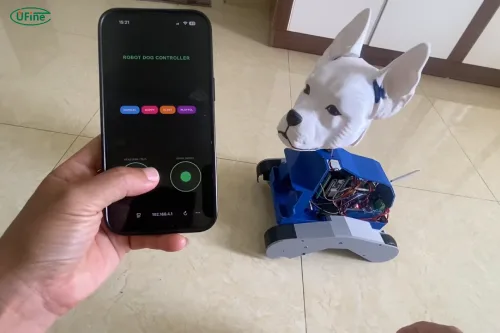
Building a customized quadruped robot dog used to require advanced robotics labs and heavy industrial engineering. Today, thanks to microcontrollers like the ESP32, accessible 3D printing, and generative AI tools, makers and hardware engineers can bring complex mechanical creations to life right from their workshops.
In a recent robotics project, a maker set out to build a phone-controlled DIY robot dog using an ESP32 as the central nervous system. To give the machine a personalized character, the creator transformed a photo of their pet dog into a 3D model using Meshi AI. With conversational prompts, the head was refined, aligned, and split into watertight STL files designed for seamless mounting onto mini servo shafts.
However, as every hardware engineer knows, creating an aesthetically pleasing 3D-printed chassis is only half the battle. Bringing a multi-jointed, motor-heavy quadruped to life introduces a critical engineering hurdle: managing power delivery and spatial constraints without compromising mechanical stability.
Part 2. The hardware & power dilemma: why standard batteries fail
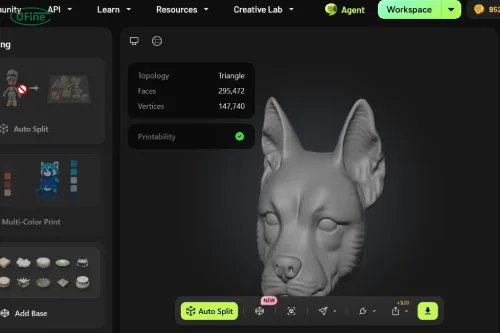
When designing small-scale robotics or IoT devices, power systems are often treated as an afterthought—until prototypes start failing during dynamic load testing.
The Peak Current Challenge of Multi-Servo Systems
Quadruped robots rely on multiple servo motors operating simultaneously to coordinate walking, steering, and posture adjustments. When these servos kick into action under load, they draw sudden, sharp current spikes.
Standard consumer battery packs—designed for low-draw, steady loads like LED lights or simple microcontrollers—often suffer from severe voltage sag under these conditions. This instantaneous voltage drop causes the ESP32 microcontroller to reset unexpectedly or trigger brownout protection.
Mechanical Packaging & Center of Gravity (CoG)
Robotics chassis design leaves very little room for error. Off-the-shelf lithium batteries come in rigid, fixed form factors (such as standard 18650 cylinders or fixed-size pouch cells).
Forcing a mismatched, bulky battery pack into a compact robot frame creates two distinct problems:
- Frame Redesign Fatigue: Engineers are forced to modify structural CAD models purely to accommodate an oversized battery.
- Center of Gravity Disruption: Placing heavy, ill-fitting power packs off-center makes quadruped balancing significantly harder, straining joint motors and wasting energy.
Part 3. Case study: integrating the UFX 21700-4S custom lithium pack
See the full DIY robot dog project in action, from 3D printing and hardware assembly to real-world movement powered by a custom lithium battery pack.
To resolve both the structural packaging and electrical performance roadblocks, the project integrated a custom-engineered power solution in partnership with Ufine Battery: the UFX 21700-4S lithium battery pack (14.4V 5000mAh).
| Specification | Technical Value |
|---|---|
| Model | UFX 21700-4S |
| Nominal Voltage / Capacity | 14.4V / 5000mAh (72Wh) |
| Max. Continuous Discharge Current | 25A |
| Over-Current Protection (PCB) | 44A – 56A (Typical 50A) |
| Pack Weight | Approx. 350g |
| Wiring Specification | UL3239 16AWG High-Flex Silicone |
| Cycle Life | ≥ 500 cycles (to 70% capacity) |
| Operating Temperature (Discharge) | -20°C to 60°C |
Perfect Form-Factor Integration & Weight Distribution
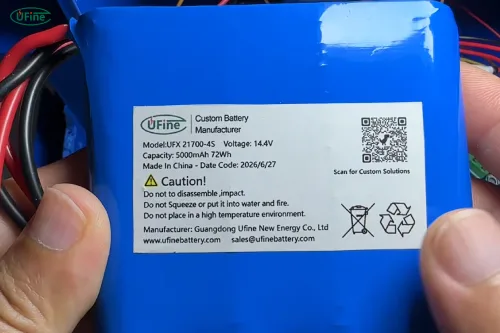
Rather than redesigning the robot dog’s chassis around off-the-shelf batteries, Ufine Battery built the UFX 21700-4S using high-density 21700 cells arranged in a 4S1P configuration.
Weighing only approximately 350g and wired with flexible 16AWG silicone wire, the pack was designed to fit directly into the bottom frame compartment. This kept the machine’s center of gravity balanced while leaving servo linkages completely unobstructed.
High-Discharge Output Under Dynamic Loads
With a 14.4V nominal voltage (16.8V max charge) and a massive 25A maximum continuous discharge current, the UFX 21700-4S satisfies the peak current demands of multiple high-torque servos operating simultaneously.
The integrated protection circuit board (PCB) features an over-current protection range of 44A–56A, helping prevent instantaneous voltage drops and microcontroller brownouts during heavy motor movements.
Prototype Flexibility for Makers & Engineers
Sourcing small-batch custom power solutions has historically been challenging due to high minimum order quantities (MOQs).
Ufine Battery supports the prototype stage by offering flexible custom battery solutions starting from one single piece. Backed by years of battery manufacturing experience and global safety certifications including UL 1642, IEC 62133, and UN38.3, developers can validate their designs with reliable power solutions before moving into mass production.
Part 4. Firmware, debugging & real-world realities
Building custom hardware rarely goes smoothly on the first try. Real-world debugging is where theoretical designs meet physical realities.
ESP32 Web Interface & Firmware Setup
The robot dog utilizes the ESP32’s onboard Wi-Fi capabilities to create a local wireless hotspot.
Users connect via smartphone, open a browser interface, and send real-time motion commands to the robot while monitoring system responses and debugging information.
Key Hardware Debugging Lessons
During initial dynamic testing, several common maker challenges appeared:
PWM Channel & Code Conflicts
Initial movement controls caused unexpected motor behavior due to timer and PWM configuration conflicts in the firmware. After refining the code and updating the firmware, the robot achieved stable movement control.
Dedicated Servo Power Rails
Servos failed to move during early testing because the dedicated servo power supply had not been activated.
This highlights an important robotics design principle: sensitive microcontroller circuits should be isolated from high-current motor power systems to prevent interference and voltage instability.
Torque & Weight Balance
The 3D-printed custom head turned out to be slightly heavier than expected for standard micro SG90 servos.
To achieve smoother head pan and tilt movements, the project upgraded to higher-torque MG996 metal-gear servos, improving mechanical stability and responsiveness.
Part 5. Conclusion: powering innovation without design compromises
By combining custom 3D-printed hardware, ESP32 wireless control, and the UFX 21700-4S 14.4V 5000mAh lithium battery pack, the DIY robot dog evolved from an AI-assisted concept into a fully functional and agile robotic platform.
The key takeaway for hardware engineers, makers, and IoT developers is clear:
Never compromise your structural design to fit a rigid off-the-shelf battery—customize your battery to fit your vision instead.
Whether you are building smart robotics, wearable medical devices, or high-performance IoT hardware, having a tailored energy solution ensures your project operates with optimized performance, reliability, and design flexibility.
Need a Custom Power Solution for Your Hardware Project?
Explore custom lithium battery options tailored to your exact voltage, capacity, discharge rate, and dimensional requirements.
Contact the engineering team at Ufine Battery to bring your next hardware innovation to life.
Related Tags:

More Articles

JST vs Molex: The Right Battery Connector Choice
JST or Molex for your battery? Learn how connector selection affects current, voltage drop, reliability, and device performance.
Custom Battery Pricing: Costs Manufacturers Don’t Mention
A low battery quote may not be the final cost. Discover common hidden expenses that affect custom lithium battery projects.
Battery Wire Length: Hidden Cause of Power Loss
A longer battery wire can cause voltage drop, power loss, and unstable operation. Learn how wire length affects battery performance.
How Device Sleep Modes Affect Battery Life
Think sleep mode extends battery life? Learn why devices still drain power and how firmware, hardware, and batteries affect runtime.
LiPo Battery and PCB Design: Clearance, Insulation, and Placement
Learn how to optimize LiPo battery PCB clearance, insulation, placement, wiring, and thermal design—and avoid common integration mistakes.