When powering custom DIY electronics, power tools, or portable energy systems, off-the-shelf battery solutions often fall short in capacity, form factor, or raw performance. For makers, hardware engineers, and product developers, building a custom battery pack is often the best path to achieving exact voltage and capacity requirements.
In a recent video collaboration, popular electronics creator EST Experiments demonstrated how to build a robust, high-capacity 12V 10,500mAh (10.5Ah) rechargeable lithium-ion battery pack. Designed for applications ranging from 12V inverters and LED lighting to heavy-duty DC motors, this project highlights how professional-grade battery cells can elevate a custom DIY project into a reliable, industrial-grade power system.
Part 1. Why EST Experiments chose Ufine 18650 battery cells
A battery pack is only as good as the individual cells inside it. Using recycled or unverified cells often leads to rapid capacity loss, thermal degradation, or premature failure under load.
To ensure maximum power density, safety, and cycle life, EST Experiments selected high-performance 18650 lithium-ion cells provided directly by Ufine Battery.
Ufine Battery advantage
| Advantage | Specification |
|---|---|
| Genuine capacity & specification | 3500mAh / 3.7V / 12.95Wh per cell |
| Flexible minimum order quantity | Low MOQ starting from 1 piece |
| Factory-direct pricing | No middlemen, direct-from-factory supply |
| Global safety certifications | UL, KC, PSE, IEC, UN38.3 |
Key features of Ufine 18650 cells
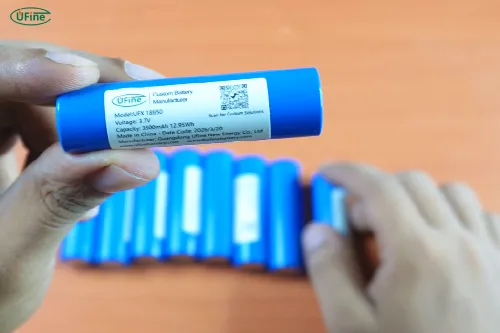
True 3500mAh capacity
Each Ufine 18650 cell delivers:
| Parameter | Specification |
|---|---|
| Nominal voltage | 3.7V |
| Capacity | 3500mAh |
| Energy capacity | 12.95Wh |
| Battery type | 18650 lithium-ion cell |
With stable discharge performance and low internal resistance, these cells provide reliable power output for applications requiring continuous current delivery.
Low MOQ (1 piece)
Hardware startups, engineers, and product developers can order small sample quantities for initial prototyping without facing high minimum order requirements.
Factory-direct pricing
By working directly with the manufacturer, customers can access competitive pricing without additional distributor costs.
Certified safety standards
Backed by 18 years of battery manufacturing expertise, Ufine batteries comply with multiple international certifications, including:
- UL
- KC
- PSE
- IEC
- UN38.3
End-to-end OEM/ODM customization
Beyond standard 18650 cells, Ufine provides customized battery solutions including:
- Lithium polymer batteries
- LiFePO4 batteries
- Ultra-thin lithium batteries
- High-rate discharge batteries
- Extreme-temperature battery solutions
These solutions can be customized according to specific voltage, capacity, size, shape, connector, and application requirements.
Part 2. Technical specifications & component list
Watch the full build video below to see how EST Experiments created a high-performance 12V 10.5Ah Li-ion battery pack using Ufine 18650 cells.
The goal of this project was to build a 12V battery pack capable of supplying sustained current for heavy loads while remaining compact and portable.
Key specifications
| Parameter | Specification |
|---|---|
| Cell configuration | 3S3P (3 Series, 3 Parallel) |
| Total cell count | 9 units (Ufine 18650 3500mAh cells) |
| Nominal voltage | 11.1V |
| Fully charged voltage | 12.6V |
| Total energy capacity | 10,500mAh (10.5Ah) / approximately 116.5Wh |
| Protection board | 3S 40A Li-ion BMS |
| Enclosure | Custom acrylic casing with digital capacity meter |
Bill of materials (BOM)
| No. | Component | Quantity |
|---|---|---|
| 1 | Ufine 18650 Li-ion cells (3.7V 3500mAh) | 9 pcs |
| 2 | Single 18650 battery holder brackets | 18 pcs |
| 3 | Pure nickel strips for spot welding | 1 set |
| 4 | 3S 40A BMS board | 1 pc |
| 5 | Digital battery capacity & voltage indicator | 1 pc |
| 6 | Heavy-duty screw terminals & DC charging socket | 2 pcs |
| 7 | Custom acrylic plates (7cm × 8.4cm casing) | 1 set |
Part 3. Step-by-step battery assembly process
Step 1: Cell alignment & holder setup
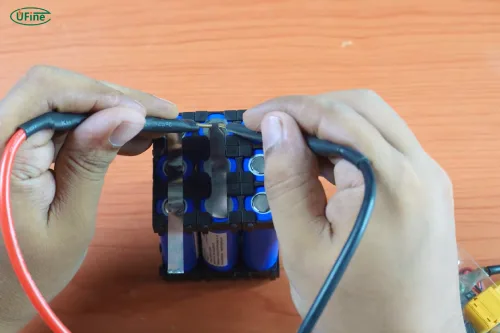
To keep the battery pack structurally stable and thermally safe, the 9 cells were arranged into interlocking 18650 battery holders.
The cells were configured in a 3S3P layout, combining three parallel cell groups connected in series to increase voltage while maintaining high capacity.
3S3P battery configuration
Parallel bank 1:
[ + ] [ + ] [ + ]

Parallel bank 2:
[ - ] [ - ] [ - ]

Parallel bank 3:
[ + ] [ + ] [ + ]

Connected in series
In this configuration:
- Three cells connected in parallel increase the total capacity.
- Three parallel groups connected in series increase the output voltage.
The final configuration provides:
- Nominal voltage: 11.1V
- Maximum charging voltage: 12.6V
- Total capacity: 10,500mAh
Step 2: Spot welding with nickel strips
Using a dedicated battery spot welder, pure nickel strips were attached across the cell terminals.
Parallel connection
Three cells in each group were connected together:
| Connection method | Calculation | Result |
|---|---|---|
| Parallel connection | 3500mAh × 3 cells | 10,500mAh capacity |
This allows the battery pack to deliver higher capacity while reducing the load on individual cells.
Series connection
The three parallel groups were connected in series:
| Connection method | Calculation | Result |
|---|---|---|
| Series connection | 3.7V × 3 groups | 11.1V nominal voltage |
| Full charge voltage | 4.2V × 3 groups | 12.6V maximum voltage |
Note: Spot welding is strongly recommended over direct soldering because excessive heat from soldering irons can damage internal cell separators and reduce battery safety.
Step 3: Wiring the BMS (Battery management system)
A 3S 40A BMS was installed to protect the battery pack from:
- Overcharging
- Over-discharging
- Short circuits
- Excessive current draw
BMS wiring configuration
| BMS terminal | Connection |
|---|---|
| B- | Main battery negative (0V) |
| B1 | First series junction (4.2V) |
| B2 | Second series junction (8.4V) |
| B+ | Main battery positive (12.6V) |
After wiring, the initial open-circuit voltage measurement showed:
12.71V total voltage
This confirmed that the Ufine cells arrived fully charged and properly balanced before assembly.
BMS wiring diagram
Main negative (0V)
        |
        |
       B-
        |
  3S 40A BMS board
        |
        |
B1 ---- First cell junction (4.2V)

B2 ---- Second cell junction (8.4V)

B+ ---- Main positive (12.6V)
Step 4: Enclosure assembly & digital meter integration
A custom acrylic housing was built to protect the battery pack and improve usability.
The front panel included a digital voltage and capacity meter for real-time monitoring.
Integrated features
| Feature | Function |
|---|---|
| Threaded terminal bolts | Easy connection for alligator clips, inverter leads, or motor wiring |
| DC charging port | Supports 12.6V–13.2V CC/CV charging adapter |
| Digital display | Shows battery voltage and remaining capacity |
| Low voltage alarm | Set at 10.6V to prevent deep discharge |
The transparent acrylic enclosure also allows users to visually inspect the internal battery structure while maintaining mechanical protection.
Part 4. Real-world performance & testing
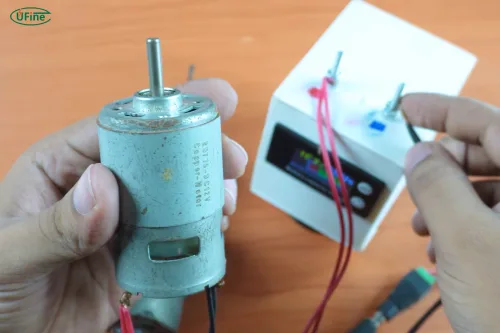
After assembly, the battery pack was tested under a high-load application using a 775 DC motor, which is commonly used in:
- Power tools
- Electric drills
- DIY machinery
- High-speed fans
Real-world load test results
| Test item | Result |
|---|---|
| Battery pack | Ufine 3S3P 18650 battery pack |
| Output voltage | 12.71V |
| Load device | 775 DC motor |
| Performance | Stable high-torque operation |
| BMS protection | No over-current shutdown triggered |
High torque & current output
The 775 motor operated at full power without triggering BMS protection or causing significant voltage drops.
This demonstrates the advantages of:
- Low internal resistance
- Stable discharge performance
- High-quality matched battery cells
The 3S3P configuration allows current to be distributed across multiple parallel cells, reducing stress on individual batteries and improving overall pack stability.
Thermal performance
During continuous operation, the cells remained cool due to:
- Efficient current distribution
- Balanced parallel configuration
- Reduced stress on individual cells
Good thermal performance is essential for maintaining battery lifespan, especially in high-current applications such as power tools and motors.
Smart power management
The integrated digital display was configured with an automatic sleep mode after 10 seconds.
This feature helps reduce unnecessary standby power consumption when the battery pack is stored or not actively monitored.
Part 5. Conclusion: Custom battery solutions for your next project
Building a high-capacity 12V battery pack becomes much easier when using reliable battery cells and proper pack design.
As demonstrated by EST Experiments, combining a carefully designed 3S3P configuration with genuine-capacity Ufine 18650 cells creates a professional-grade power solution capable of supporting demanding electrical loads.
From DIY electronics projects to commercial products, selecting the right battery cells directly affects:
- Operating stability
- Runtime performance
- Safety reliability
- Product lifespan
A well-designed battery pack requires not only high-quality cells but also proper consideration of electrical configuration, battery management systems, thermal control, and mechanical structure.
Whether you are developing a one-off prototype or scaling up commercial production for:
- IoT devices
- Medical equipment
- Robotics
- Power tools
- Portable electronics
Having a reliable battery partner is essential for creating products that meet real-world performance requirements.
Related Tags:

More Articles
Building an ESP32 Robot Dog with a Custom Lithium Battery
See how a maker combines 3D printing, ESP32 control, and a custom lithium pack to create a powerful and reliable robotic companion.
JST vs Molex: The Right Battery Connector Choice
JST or Molex for your battery? Learn how connector selection affects current, voltage drop, reliability, and device performance.
Custom Battery Pricing: Costs Manufacturers Don’t Mention
A low battery quote may not be the final cost. Discover common hidden expenses that affect custom lithium battery projects.
Battery Wire Length: Hidden Cause of Power Loss
A longer battery wire can cause voltage drop, power loss, and unstable operation. Learn how wire length affects battery performance.
How Device Sleep Modes Affect Battery Life
Think sleep mode extends battery life? Learn why devices still drain power and how firmware, hardware, and batteries affect runtime.