
- Part 1. Battery capacity and discharge rate represent different design priorities
- Part 2. Why higher capacity does not always improve device performance
- Part 3. Why higher discharge rate does not always mean a better battery
- Part 4. How consumer electronics balance battery capacity and discharge rate
- Part 5. How to choose between battery capacity and discharge rate
- Part 6. The best battery choice depends on your application
- Part 7. FAQs
Should you choose a battery with higher capacity or a battery with a higher discharge rate?
A higher capacity battery can store more energy and extend operating time. A higher discharge rate battery can deliver more current when the device requires sudden power output. However, choosing between them is not simply about selecting the larger number.
The right battery depends on how your device consumes energy.
A wearable device that runs continuously with low power consumption may benefit more from higher battery capacity. A robotic device with motors and frequent power peaks may require a higher battery discharge rate.
Understanding the difference between energy storage and power delivery is essential for creating reliable consumer electronics.
Key takeaways
- Battery capacity determines how much energy a battery stores, while battery discharge rate determines how quickly that energy can be delivered.
- A higher capacity battery does not always provide better performance if the device requires high peak current.
- A higher discharge rate battery improves power output but may involve trade-offs in energy density, size, and cost.
- Internal resistance plays an important role in voltage stability during high-current operation.
- The best battery design balances capacity, discharge performance, size, weight, and application requirements.
Part 1. Battery capacity and discharge rate represent different design priorities
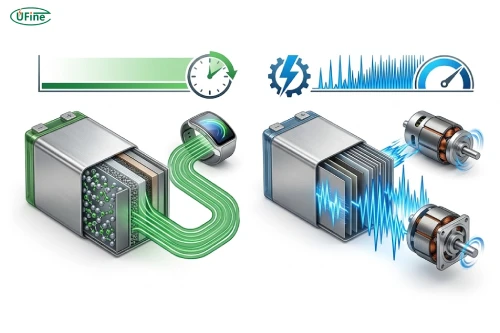
When selecting a lithium battery for consumer electronics, many designers initially focus on capacity because it directly relates to runtime. However, battery performance is determined by two different factors:
- How much energy the battery can store
- How much power the battery can deliver at a specific moment
Battery capacity and discharge rate answer different engineering questions.
Battery capacity answers:
How long can my device operate before recharging?
Battery discharge rate answers:
Can my battery provide enough current when my device suddenly needs more power?
These two specifications are connected but not interchangeable.
A battery with a large capacity may provide excellent runtime under normal conditions but struggle when a device requires high current bursts. On the other hand, a high discharge rate battery can support demanding loads but may not provide the longest operating time if its capacity is limited.
Battery capacity focuses on energy storage
Battery capacity is usually measured in milliamp hours (mAh) or watt hours (Wh). It represents the total amount of electrical energy stored inside the battery.
For example:
A 3.7V 2000mAh lithium polymer battery stores:
3.7V × 2Ah = 7.4Wh
A higher capacity battery generally allows a device to operate longer before charging.
For products such as:
- Smart watches
- Wireless earbuds
- Fitness trackers
- Portable sensors
- Medical monitoring devices
battery capacity is often a major design priority because these devices typically require long standby time and stable operation over extended periods.
However, capacity alone does not determine real-world runtime.
Actual battery life is also affected by:
- Device power consumption
- Circuit efficiency
- Operating temperature
- Battery aging
- Voltage stability
For example, increasing a battery from 1000mAh to 2000mAh does not necessarily double runtime if the device frequently enters high-power operating modes.
Battery discharge rate focuses on power delivery capability
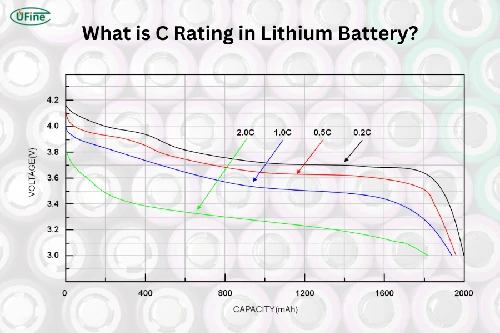
Battery discharge rate describes how quickly a battery can release stored energy. It is usually expressed using the C-rate.
For example:
A 2000mAh battery:
- 1C = 2A continuous discharge
- 5C = 10A continuous discharge
A higher C-rate means the battery can deliver more current without excessive voltage drop or overheating.
This capability becomes important when devices experience sudden increases in power demand.
Examples include:
Robotics
Robotic devices often require high current during:
- Motor startup
- Direction changes
- Acceleration
- Load changes
A battery with insufficient discharge capability may cause voltage drops, unstable operation, or system shutdown.
Drones
Drones require rapid power delivery because motors constantly adjust speed to maintain flight stability.
For these applications, a battery with higher discharge performance is often more important than simply increasing capacity.
Smart devices with advanced functions
Modern portable electronics increasingly include:
- High-performance processors
- Cameras
- AI features
- Wireless communication modules
Although average power consumption may remain low, short peak power events can significantly affect battery performance.
继续 Part 2:
Part 2. Why higher capacity does not always improve device performance
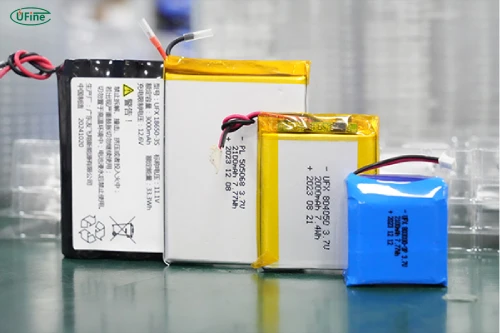
When engineers select a battery, choosing the highest possible capacity may seem like the easiest way to improve product performance. However, a larger capacity battery does not automatically mean better user experience.
The reason is that many modern electronic devices do not consume power at a constant rate.
A device may operate at low current most of the time but suddenly require much higher current during specific operations.
Examples include:
- A camera starting image processing
- A motor accelerating
- A wireless module transmitting data
- An AI processor performing complex calculations
During these peak power events, the battery’s discharge capability becomes just as important as its capacity.
The problem of voltage drop under high loads
One of the most common problems caused by insufficient discharge performance is voltage drop.
When a battery supplies high current, its internal resistance causes energy loss in the form of heat. This results in a temporary reduction in output voltage, often called voltage sag.
The relationship can be explained by:
Voltage drop = Current × Internal resistance
A battery with higher internal resistance will experience a larger voltage decrease when the current demand increases.
For example:
| Battery | Capacity | Discharge capability | Performance under high load |
|---|---|---|---|
| Battery A | 3000mAh | 1C | Longer runtime but limited peak current |
| Battery B | 2000mAh | 5C | Shorter runtime but stronger power delivery |
Although Battery A stores more energy, Battery B may perform better in applications that require sudden current output.
This is why a high-capacity battery may still cause:
- Device resets
- Motor slowdown
- Reduced processing performance
- Unexpected shutdowns
if the battery cannot provide sufficient current.
Internal resistance is a key factor in battery performance
Battery capacity and discharge rate are important specifications, but internal resistance often determines how well a battery performs in real-world conditions.
A battery with lower internal resistance can:
- Deliver current more efficiently
- Maintain more stable voltage
- Generate less heat
- Improve overall system reliability
Internal resistance is influenced by several factors, including:
- Electrode materials
- Cell structure
- Battery design
- Manufacturing quality
- Temperature conditions
For high-performance consumer electronics, selecting a battery based only on mAh ratings can lead to incorrect design decisions.
A 4000mAh battery is not always a better choice than a 2500mAh battery if the application requires frequent high-current operation.
Part 3. Why higher discharge rate does not always mean a better battery
While high discharge performance is essential for power-demanding devices, it is not always the best choice for every application.
A higher discharge rate means the battery is optimized for faster energy delivery. However, this usually requires different cell design approaches and may introduce certain trade-offs.
Higher power capability comes with design trade-offs
To achieve higher discharge performance, battery manufacturers typically focus on reducing internal resistance and improving current flow inside the cell.
This may involve:
- Optimized electrode materials
- Improved conductive pathways
- Enhanced cell structure
- Advanced manufacturing processes
However, improving discharge capability can affect other battery characteristics.
Common trade-offs include:
| Design priority | Possible impact |
|---|---|
| Higher discharge rate | Increased heat generation during operation |
| Lower internal resistance | More complex cell design |
| Higher power output | Potential reduction in energy density |
| Faster current delivery | Higher cost requirements |
For example, a high-rate LiPo battery designed for a drone motor may not provide the same energy density as a standard LiPo battery optimized for long runtime.
Therefore, the goal is not to choose the highest discharge rate available, but to select the performance level that matches the device.
High discharge batteries are unnecessary for low-power devices
Not every consumer electronic product benefits from high discharge capability.
Many devices operate with relatively stable and low current consumption.
Examples include:
- Smart sensors
- Low-power IoT devices
- Remote monitoring equipment
- Simple wearable devices
For these applications, increasing discharge capability may add unnecessary cost and weight without providing meaningful benefits.
Instead, designers may prioritize:
- Higher energy density
- Smaller dimensions
- Longer standby time
- Lower production cost
The ideal battery specification depends on the product’s actual power profile.
Part 4. How consumer electronics balance battery capacity and discharge rate
Different consumer electronics have different power requirements. A smartwatch, a robot, and a portable AI device may all use lithium batteries, but their battery priorities are completely different.
Understanding the application scenario is the first step toward selecting the right battery.
Wearable devices: capacity usually comes first
Wearable products are typically limited by size and weight.
Users expect:
- Comfortable wearing experience
- Long operating time
- Minimal charging frequency
Examples include:
- Smart watches
- Fitness trackers
- Smart glasses
- Wireless healthcare devices
For these products, battery designers usually prioritize:
- Higher capacity within limited space
- Thin battery structure
- Lightweight design
Lithium polymer batteries are widely used in wearable electronics because manufacturers can customize battery dimensions according to the available internal space.
A custom-shaped LiPo battery can help designers achieve higher energy storage without significantly increasing product size.
Robotics and motorized devices: discharge rate becomes critical
Robotic products have very different requirements.
Unlike a wearable device that consumes power gradually, robots often experience sudden current changes.
Examples:
- Robot dogs
- Robotic arms
- Small autonomous devices
- Smart toys with motors
During movement, motors may require several times more current than their average operating level.
In these applications, a battery with insufficient discharge capability may cause:
- Slow response
- Reduced motor performance
- System instability
A higher discharge rate battery helps maintain stable voltage during demanding operations.
继续 Part 3:
Smart portable electronics: balancing both factors
Many modern consumer electronics cannot be classified as either low-power or high-power devices. Instead, they require a balance between battery capacity and discharge performance.
Examples include:
- Portable AI devices
- Handheld terminals
- Smart cameras
- Advanced IoT equipment
- Portable medical electronics
These products often need:
- Long operating time during normal use
- Stable power output during peak performance
For these applications, selecting a battery with extremely high capacity or extremely high discharge capability may not be the optimal solution.
Engineers usually need to evaluate:
- Average current consumption
- Peak current requirements
- Available battery space
- Product weight limitations
- Expected operating temperature
A balanced battery design can provide both reliable runtime and stable performance.
Part 5. How to choose between battery capacity and discharge rate
Choosing between higher capacity and higher discharge rate starts with understanding the device’s power profile.
Instead of asking:
Which battery specification is better?
A more practical question is:
What does my device need the battery to do?
The answer depends on several design factors.
Analyze average and peak power consumption
The first step is separating average current from peak current.
Average current determines battery runtime.
Peak current determines whether the battery can support demanding operations.
For example:
A smart sensor may consume:
- 100mA during normal operation
- 300mA during data transmission
A robotic device may consume:
- 500mA during standby
- 5A during motor startup
Although both products use batteries, their requirements are completely different.
The sensor benefits more from higher capacity, while the robot requires stronger discharge capability.
Calculate the required battery capacity
Battery capacity should be selected based on expected operating time.
A simplified calculation:
Battery capacity (Ah) = Power consumption (W) × Operating time (h) ÷ Battery voltage (V)
However, engineers should also consider:
- Battery efficiency
- Safety margin
- Temperature impact
- Battery aging
Selecting a slightly higher capacity than the minimum requirement can improve user experience, but excessive capacity may increase:
- Product size
- Weight
- Cost
Determine the required discharge rate
To select the appropriate battery discharge rate, engineers should compare:
Maximum current demand ÷ Battery capacity
For example:
A device requires a maximum current of 3A.
With a 1500mAh battery:
3A ÷ 1.5Ah = 2C
The battery should support at least a 2C discharge rate.
However, designers should also consider whether the current demand is continuous or only temporary.
A battery that supports short peak loads may be sufficient for many consumer electronics applications.
Practical comparison: which battery specification should you prioritize?
The following table provides a quick reference for different product requirements.
| Product requirement | Priority battery characteristic | Reason |
|---|---|---|
| Longer standby time | Higher battery capacity | Stores more energy for extended operation |
| Motor-driven movement | Higher discharge rate | Supports sudden current demands |
| Ultra-thin wearable design | Higher energy density | Maximizes capacity within limited space |
| AI-powered portable device | Balanced capacity and discharge | Supports both runtime and peak processing |
| Low-power IoT product | Higher capacity | Reduces charging frequency |
| High-performance robotics | High discharge capability | Maintains stable output under heavy loads |
There is no universal battery specification that works for every product.
The correct choice depends on whether your device is mainly limited by energy consumption or power demand.
Part 6. The best battery choice depends on your application
When comparing a higher capacity battery with a higher discharge rate battery, the answer is not simply choosing one over the other.
Battery capacity determines how much energy your product can store.
Battery discharge rate determines how effectively your product can use that energy when power demand increases.
For many consumer electronics:
- Wearables and low-power devices often benefit from higher capacity.
- Robotics and motor-driven products often require higher discharge performance.
- Advanced portable electronics usually need a balance between both.
As product designs continue to become smaller and more powerful, battery selection must consider more than just mAh ratings. Factors such as internal resistance, current demand, thermal performance, and available space all influence the final battery design.
Choosing the right lithium polymer battery specification at the early design stage can improve product reliability, user experience, and long-term performance.
For companies developing new consumer electronics, working with an experienced custom battery manufacturer can help optimize capacity, discharge rate, and overall battery performance for the specific application.
Part 7. FAQs
1. Does increasing battery capacity affect discharge performance?
Increasing battery capacity does not automatically improve discharge performance. A larger battery may store more energy, but its ability to deliver high current depends on cell design, internal resistance, and discharge characteristics.
2. Why do two batteries with the same capacity have different performance?
Two batteries with identical capacity can perform differently because they may use different electrode materials, internal structures, manufacturing processes, and protection circuit designs.
3. Does a higher discharge rate battery charge faster?
Not necessarily. Discharge rate describes how quickly a battery can release energy, while charging speed depends on charging current limits, battery chemistry, temperature, and charging system design.
4. How does temperature affect battery discharge performance?
Low temperatures can increase internal resistance and reduce available current output. High-performance applications may require batteries designed for stable discharge under specific temperature conditions.
5. Does a higher mAh rating mean a battery can power more demanding devices?
Not always. The mAh rating indicates energy storage, but demanding devices also require sufficient discharge capability to provide the necessary current during operation.
Related Tags:

More Articles

Battery Cable Size Guide: Choose the Right Wire Fast
Not sure what battery cable size you need? Learn how to select the right wire gauge, terminal size, and cable for safer, more efficient battery systems.
How to build a12V 10.5Ah Li-ion battery pack with 18650 cells
Learn how to build a high-capacity 12V 10.5Ah battery pack with Ufine 18650 cells. Explore cell selection, 3S3P configuration, BMS wiring, and performance tests.
Building an ESP32 Robot Dog with a Custom Lithium Battery
See how a maker combines 3D printing, ESP32 control, and a custom lithium pack to create a powerful and reliable robotic companion.
JST vs Molex: The Right Battery Connector Choice
JST or Molex for your battery? Learn how connector selection affects current, voltage drop, reliability, and device performance.
Custom Battery Pricing: Costs Manufacturers Don’t Mention
A low battery quote may not be the final cost. Discover common hidden expenses that affect custom lithium battery projects.


