
- Myth 1: Solid-State Batteries Cannot Catch Fire
- Myth 2: Today’s Solid-State Battery Vehicles Are Using True All-Solid-State Batteries
- Myth 3: Sulfide Electrolytes Are the Only Future of Solid-State Batteries
- The Real Challenge: Commercializing Solid-State Batteries
- Solid-State Batteries Are a Long-Term Evolution, Not an Instant Revolution
- FAQs
Solid-state batteries are widely considered one of the most promising next-generation battery technologies.
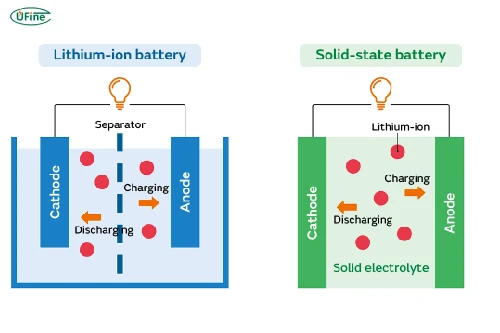
Compared with conventional lithium-ion batteries, solid-state batteries replace liquid electrolytes with solid electrolytes, creating the potential for higher energy density, improved safety, and faster charging.
This potential has attracted major investments from global companies including Toyota, QuantumScape, Solid Power, Samsung SDI, and other battery developers.
However, as solid-state battery technology moves from laboratories toward commercialization, some common assumptions have become exaggerated.
Solid-state batteries are not a perfect replacement for lithium-ion batteries yet. They still face major challenges in materials, manufacturing, and long-term reliability.
Here are three common misconceptions about solid-state batteries.
Key Takeaways
- Solid-state batteries can improve safety, but they are not completely immune to thermal runaway.
- Many “solid-state battery vehicles” today are actually semi-solid or hybrid systems rather than true all-solid-state batteries.
- Sulfide electrolytes are promising, but no single solid-state battery technology has become the industry standard.
- Manufacturing scale, interface stability, and cost remain the biggest barriers to commercialization.
Myth 1: Solid-State Batteries Cannot Catch Fire
One of the biggest claims surrounding solid-state batteries is that they completely eliminate battery fires because they do not use flammable liquid electrolytes.
This statement is only partially true.
In conventional lithium-ion batteries, liquid electrolytes are one factor contributing to thermal runaway. Since many solid electrolytes are less flammable, solid-state batteries can reduce certain fire risks.
However, removing liquid electrolyte does not mean removing all safety concerns.
A battery’s safety depends on the entire system, including:
- electrode materials
- electrolyte chemistry
- manufacturing quality
- battery structure
- thermal management
One major challenge in all-solid-state batteries is the solid-solid interface.
Unlike liquid electrolytes that can easily fill microscopic gaps between materials, solid electrolytes require precise physical contact with electrodes.
During repeated charging and discharging, electrode materials expand and contract. Over time, this can create:
- cracks
- interface separation
- increased resistance
- localized heat generation
For lithium-metal solid-state batteries, additional challenges exist. Lithium metal offers extremely high energy density, but it can also create dendrite growth and interface instability.
Therefore, solid-state batteries may reduce the risk of thermal runaway, but they cannot guarantee a completely fireproof battery.
Solid State Battery vs Lithium Ion: A Comparative Analysis
Myth 2: Today’s Solid-State Battery Vehicles Are Using True All-Solid-State Batteries
Another common misunderstanding is that every vehicle advertised with a “solid-state battery” uses a fully solid-state design.
In reality, many current products are semi-solid or hybrid solid-liquid batteries.
A true all-solid-state battery completely replaces liquid electrolyte with a solid electrolyte.
A semi-solid battery, however, still contains some liquid components while adding solid electrolyte materials to improve performance.
These hybrid systems are important because they allow manufacturers to improve battery performance while using manufacturing processes closer to existing lithium-ion production.
The transition to full solid-state batteries is much more difficult.
Manufacturers need to solve challenges including:
- new production equipment
- solid electrolyte processing
- interface control
- manufacturing consistency
- cost reduction
Companies such as Toyota, QuantumScape, and Solid Power are actively developing solid-state battery technologies, but most current projects remain focused on pilot production, testing, and validation rather than large-scale EV deployment.
The difference between producing prototype cells and manufacturing millions of reliable automotive batteries is significant.
A successful solid-state battery must achieve not only high energy density but also:
- long cycle life
- stable performance
- competitive cost
- high production yield
Myth 3: Sulfide Electrolytes Are the Only Future of Solid-State Batteries
Sulfide electrolytes are often considered one of the most promising solutions for solid-state batteries.
They offer excellent lithium-ion conductivity and can work well with high-energy-density lithium-metal anodes.
However, sulfide is not the only possible pathway.
Different solid electrolyte technologies have different advantages and challenges.
Sulfide Electrolytes
Advantages:
- high ionic conductivity
- good compatibility with lithium metal
- strong potential for high-performance EV batteries
Challenges:
- sensitive to moisture
- requires controlled manufacturing environments
- difficult large-scale processing
Oxide Electrolytes
Advantages:
- excellent chemical stability
- high thermal resistance
- easier handling
Challenges:
- higher interface resistance
- more difficult contact between solid materials
Polymer and Composite Electrolytes
Advantages:
- flexible structure
- easier processing
Challenges:
- lower ionic conductivity compared with some ceramic and sulfide systems
Because of these trade-offs, most battery companies are exploring multiple technology routes rather than relying on a single solution.
The future of solid-state batteries may not be dominated by one chemistry. Different technologies may serve different applications, from electric vehicles to robotics and aerospace.
The Real Challenge: Commercializing Solid-State Batteries
The biggest challenge for solid-state batteries is no longer proving that the technology works in a laboratory.
The real challenge is manufacturing.
Producing a few high-performance prototype cells is very different from producing millions of automotive-grade batteries.
Manufacturers must overcome:
Interface Engineering
Stable contact between solid materials is essential for performance and cycle life.
Production Yield
Battery factories must produce consistent cells with minimal defects.
Cost
New materials and manufacturing processes currently make solid-state batteries more expensive than traditional lithium-ion batteries.
These challenges explain why solid-state battery commercialization is taking longer than many early predictions suggested.
Solid-State Batteries Are a Long-Term Evolution, Not an Instant Revolution
Solid-state batteries represent one of the most exciting directions in battery technology.
They offer the potential for higher energy density, improved safety, and new possibilities for electric vehicles and advanced electronics.
However, the industry needs realistic expectations.
Solid-state batteries are not completely fireproof.
Many current “solid-state” products are not fully solid-state systems.
And no single electrolyte technology has been confirmed as the final winner.
The future of solid-state batteries will depend on solving practical engineering problems — improving interfaces, increasing manufacturing efficiency, and reducing costs.
The technology is progressing, but commercialization will be determined not by laboratory breakthroughs alone, but by the ability to produce reliable batteries at industrial scale.
FAQs
1. What is the difference between a solid-state battery and a lithium-ion battery?
A solid-state battery uses a solid electrolyte to transport lithium ions, while traditional lithium-ion batteries use a liquid electrolyte. This structural difference may enable higher energy density and improved safety, but solid-state batteries still face manufacturing and durability challenges.
2. Why are solid-state batteries difficult to manufacture?
Solid-state battery production requires precise control of solid material interfaces, pressure conditions, and manufacturing environments. Unlike liquid electrolytes, solid materials cannot easily fill microscopic gaps, making large-scale production more challenging.
3. Will solid-state batteries replace lithium-ion batteries completely?
Solid-state batteries are unlikely to replace all lithium-ion batteries immediately. Different battery technologies may continue to serve different markets depending on cost, performance requirements, and application scenarios.
4. When will solid-state batteries become widely available?
The timeline remains uncertain. Many companies are currently focused on pilot production, testing, and improving manufacturing processes. Large-scale adoption depends on solving challenges related to cost, reliability, and production capacity.
5. Are solid-state batteries safer for electric vehicles?
Solid-state batteries can reduce some risks associated with flammable liquid electrolytes, but they are not completely risk-free. Battery safety depends on the complete system, including materials, design, manufacturing, and thermal management.
Related Tags:

More Articles

Why iPhone Duo Uses Two Batteries: The Engineering Behind Foldable Phone Power
Why do foldable phones need two batteries? Explore the engineering challenges behind iPhone Duo’s dual-battery architecture and future battery trends.
Battery Capacity vs Discharge Rate: The Choice Engineers Face
Higher capacity or higher discharge rate? Learn how to choose the right LiPo battery for longer runtime, stable power output, and better device performance.
Battery Cable Size Guide: Choose the Right Wire Fast
Not sure what battery cable size you need? Learn how to select the right wire gauge, terminal size, and cable for safer, more efficient battery systems.
How to build a12V 10.5Ah Li-ion battery pack with 18650 cells
Learn how to build a high-capacity 12V 10.5Ah battery pack with Ufine 18650 cells. Explore cell selection, 3S3P configuration, BMS wiring, and performance tests.
Building an ESP32 Robot Dog with a Custom Lithium Battery
See how a maker combines 3D printing, ESP32 control, and a custom lithium pack to create a powerful and reliable robotic companion.


