- Key takeaways
- Part 1. What is an rc battery?
- Part 2. Rc battery types explained
- Part 3. Rc battery types comparison
- Part 4. Understanding rc battery specifications
- Part 5. How to choose the right rc battery?
- Part 6. Rc battery charging best practices
- Part 7. How to store rc batteries properly?
- Part 8. Common rc battery problems and solutions
- Part 9. How long do rc batteries last?
- Part 10. FAQs about rc batteries
Remote-controlled vehicles rely on batteries to deliver power, speed, and runtime. Whether you’re driving an RC car, flying an RC airplane, racing an RC boat, or operating an FPV drone, battery choice has a direct impact on performance.
Many beginners ask questions such as:
- What is an RC battery?
- What is RC in battery terminology?
- What are the different RC car battery types?
- Which battery is best for RC cars and RC airplanes?
- How long do RC batteries last?
This guide explains RC batteries in simple terms while providing practical information for hobbyists, racers, and engineers.
Key takeaways
- An RC battery is the rechargeable power source used in remote-controlled vehicles.
- The most common RC battery types are NiMH, LiPo, and Li-ion.
- LiPo batteries provide the highest performance and are the preferred choice for competitive RC applications.
- Voltage affects speed and power, while capacity (mAh) affects runtime.
- C rating determines how much current the battery can safely deliver.
- Proper charging, storage, and maintenance significantly extend battery life.
- Matching battery voltage, size, connector type, and discharge capability is essential for safe operation.
Part 1. What is an rc battery?
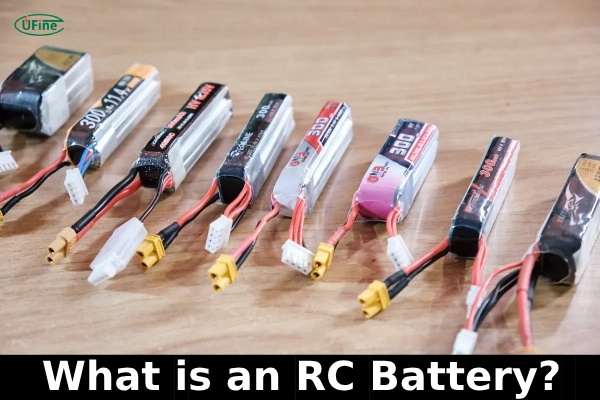
An RC battery is a rechargeable battery pack designed to power remote-controlled vehicles and equipment.
The term RC stands for Remote Control. Therefore, when people search for “RC battery” or “what is RC in battery,” they are referring to batteries used in:
- RC cars
- RC trucks
- RC airplanes
- RC helicopters
- RC boats
- FPV drones
- RC construction equipment
The battery supplies electricity to the motor, ESC (Electronic Speed Controller), receiver, servos, and onboard electronics.
A high-quality RC battery provides:
- Faster acceleration
- Higher top speed
- Longer runtime
- Better power consistency
- Improved overall performance
Part 2. Rc battery types explained
Understanding RC battery types is the first step in selecting the right battery for your model.
1 Nickel-cadmium (NiCd) batteries
NiCd batteries were once widely used in RC hobbies.
Advantages: Durable construction, high discharge capability, good performance in cold environments.
Disadvantages: Memory effect, lower energy density, heavier than lithium batteries, environmental concerns due to cadmium content.
Today, NiCd batteries are rarely used in modern RC vehicles.
2 Nickel-metal hydride (NiMH) batteries
NiMH batteries became popular as an upgrade from NiCd technology.
Advantages: Affordable, easy to use, safer than lithium batteries, less sensitive to charging mistakes.
Disadvantages: Heavier than LiPo batteries, lower power output, shorter runtime for the same size pack.
NiMH batteries remain a good choice for beginners and entry-level RC cars.
3 Lithium polymer (LiPo) batteries
LiPo batteries are currently the most popular RC battery technology.
Advantages: High energy density, lightweight, high discharge rates, excellent acceleration and speed, long runtime.
Disadvantages: Require proper charging procedures, sensitive to overcharging and over-discharging, need safe storage practices.
Most racing RC cars, RC airplanes, FPV drones, and high-performance RC vehicles use LiPo batteries because of their superior power-to-weight ratio.
If you’re selecting a custom lithium battery pack for an RC application, our guide on lithium battery pack design can help you understand voltage, capacity, and discharge requirements.
4 Lithium-ion (li-ion) batteries
Li-ion batteries use cylindrical cells such as 18650 or 21700 cells.
Advantages: Higher energy density, longer cycle life, good stability, longer runtime.
Disadvantages: Lower discharge rates than LiPo, not ideal for extreme racing applications.
Li-ion batteries are often used in long-range RC airplanes, endurance FPV platforms, and applications where runtime is more important than peak power.
Part 3. Rc battery types comparison
| Battery Type | Energy Density | Power Output | Weight | Lifespan | Typical Applications |
|---|---|---|---|---|---|
| NiCd | Low | High | Heavy | Moderate | Older RC models |
| NiMH | Medium | Medium | Heavy | Moderate | Beginner RC cars |
| LiPo | High | Very High | Light | Good | RC cars, drones, airplanes |
| Li-ion | Very High | Medium | Light | Excellent | Long-range aircraft, FPV |
Part 4. Understanding rc battery specifications
When comparing RC batteries, focus on four key specifications.
Voltage (V)
Voltage determines how much power the battery can provide.
Common LiPo configurations include:
| Battery Pack | Nominal Voltage |
|---|---|
| 2S LiPo | 7.4V |
| 3S LiPo | 11.1V |
| 4S LiPo | 14.8V |
| 6S LiPo | 22.2V |
Higher voltage generally means faster speed, stronger acceleration, and increased motor performance. Always follow the voltage range recommended by the manufacturer.
Capacity (mAh)
Capacity measures how much energy a battery stores.
For example:
- 2200mAh = smaller runtime
- 5000mAh = longer runtime
- 10000mAh = extended operation
Higher capacity usually provides longer driving or flying time but also increases size and weight.
Discharge rate (C rating)
The C rating indicates how quickly the battery can safely deliver current.
Example: A 5000mAh battery rated at 50C can theoretically provide 5000mAh × 50 = 250A.
Higher C ratings are important for RC racing cars, high-speed boats, 3D RC airplanes, and FPV racing drones. For casual driving, extremely high C ratings are often unnecessary.
Cell count (S rating)
LiPo batteries are commonly identified by their cell count.
Examples:
- 2S = 2 cells
- 3S = 3 cells
- 4S = 4 cells
- 6S = 6 cells
As cell count increases, voltage increases, speed increases, and power demand on electronics increases. Always verify ESC and motor compatibility before upgrading to a higher cell count.
Part 5. How to choose the right rc battery?
For rc cars
Choose a battery based on vehicle size, motor type, ESC specifications, and desired runtime.
| RC Car Type | Recommended Battery |
|---|---|
| Toy-grade RC car | NiMH |
| Beginner hobby car | 2S LiPo |
| Racing buggy | 2S–3S LiPo |
| Monster truck | 3S–6S LiPo |
For rc airplanes
RC airplane batteries should balance weight and flight time.
- Sport airplanes: 3S LiPo
- Aerobatic airplanes: 4S–6S LiPo
- Long-range aircraft: Li-ion packs
- Trainer aircraft: 3S LiPo
Check physical size
Even the best battery is useless if it does not fit. Before buying, verify length, width, height, and connector type.
Common connectors include: XT60, XT90, EC3, EC5, Deans (T-plug).
Part 6. Rc battery charging best practices
Proper charging is essential for performance and safety.
Use the correct charger
Different battery chemistries require different charging methods. LiPo batteries should always be charged using a balance charger.
For lithium battery charging guidelines, refer to recommendations from the International Electrotechnical Commission and battery manufacturer instructions.
Charge in a safe location
Best practices include:
- Use a fire-resistant charging bag
- Place batteries on nonflammable surfaces
- Never leave charging batteries unattended
- Stop charging immediately if swelling occurs
Follow recommended charge rates
Most RC batteries recommend charging at 1C.
Example: 5000mAh battery → 5A charge current. Faster charging may reduce battery lifespan.
Part 7. How to store rc batteries properly?
Improper storage is one of the biggest causes of battery failure.
LiPo storage voltage
Store LiPo batteries at approximately 3.7V–3.85V per cell. Most modern chargers include a storage-charge mode.
Ideal storage conditions
Store batteries in a cool, dry location, away from direct sunlight and metal objects, in fire-resistant containers.
Part 8. Common rc battery problems and solutions
Swollen LiPo battery
Possible causes: Overcharging, over-discharging, physical damage, excessive heat.
Solution: Stop using the battery immediately and dispose of it according to local regulations.
Short runtime
Possible causes: Aging cells, low capacity battery, incorrect charging, high power demand.
Solution: Test battery voltage and internal resistance. Replace batteries with significant capacity loss.
Excessive heat
Possible causes: C rating too low, motor overload, aggressive gearing, poor ventilation.
Solution: Use a battery with a higher discharge rating and improve cooling.
Part 9. How long do rc batteries last?
Battery lifespan depends on chemistry, usage, and maintenance.
| Battery Type | Typical Cycle Life |
|---|---|
| NiCd | 500–1000 cycles |
| NiMH | 300–500 cycles |
| LiPo | 300–500 cycles |
| Li-ion | 500–1000+ cycles |
Proper charging and storage can significantly extend battery life.
To better understand lithium battery performance and safety, you can also read our guides on LiPo battery charging, battery C rating, and custom lithium battery pack design.
Part 10. FAQs about rc batteries
What is RC in a battery?
RC stands for Remote Control. An RC battery is a rechargeable battery used to power remote-controlled vehicles such as RC cars, airplanes, boats, helicopters, and drones.
Which battery is best for RC cars?
LiPo batteries are generally the best choice for modern RC cars because they provide high power, light weight, and longer runtime. Beginners may prefer NiMH batteries because they are easier to use and maintain.
What are the most common RC car battery types?
The most common RC car battery types are NiMH, LiPo, and Li-ion. LiPo batteries dominate high-performance applications, while NiMH remains popular in entry-level models.
Can I use a higher-voltage battery in my RC vehicle?
Only if your ESC, motor, and electronics are designed to support it. Using excessive voltage can damage components and create safety risks.
How should I store RC batteries when not in use?
Store batteries in a cool, dry place. LiPo batteries should be stored at approximately 3.7–3.85V per cell using the charger’s storage mode to maximize lifespan and safety.
Related Tags:

More Articles
Dead Battery or Device Failure? How to Find the Cause
Think your device is broken? Learn how to tell if the problem comes from battery aging or hardware failure before replacing your electronics.
Why iPhone Duo Uses Two Batteries: The Engineering Behind Foldable Phone Power
Why do foldable phones need two batteries? Explore the engineering challenges behind iPhone Duo’s dual-battery architecture and future battery trends.
Solid-State Batteries: 3 Myths You Need to Know
Solid-state batteries promise safer EVs and longer range, but the reality is more complex. Discover the challenges behind this next-gen technology.
Battery Capacity vs Discharge Rate: The Choice Engineers Face
Higher capacity or higher discharge rate? Learn how to choose the right LiPo battery for longer runtime, stable power output, and better device performance.
Battery Cable Size Guide: Choose the Right Wire Fast
Not sure what battery cable size you need? Learn how to select the right wire gauge, terminal size, and cable for safer, more efficient battery systems.