
- Part 1. What does U1 mean on a battery?
- Part 2. U1 battery size and dimensions
- Part 3. U1 vs U1R vs U1P battery: What is the difference?
- Part 4. Types of U1 batteries
- Part 5. U1 vs. U1R battery: what’s the difference?
- Part 6. AGM vs. lithium U1 battery: which one is better?
- Part 7. Buying guide: 7 expert tips for U1 battery selection
- Part 8. Charging U1 batteries: doing it right
- Part 9. Maintenance and care tips
- Part 10 . FAQs
Batteries are the heart of modern electrical systems, and when it comes to small vehicles, mobility equipment, and backup power, the U1 battery plays a crucial role. Whether you’re maintaining a lawn tractor, operating a mobility scooter, or using a backup power system, choosing the right U1 battery size and type is essential for reliability and longevity.
But what does “U1” actually mean? How do different U1 batteries compare, and which one is best for your needs? If you’re considering an upgrade, should you go for an AGM U1 battery or a lithium U1 battery? This guide will answer all your questions and provide in-depth insights on choosing, charging, and maintaining a U1 battery for optimal performance.
Key takeaways
- A U1 battery is a battery group size classification based mainly on physical dimensions and terminal configuration, not a specific battery chemistry.
- Most Group U1 batteries measure around 7.7 × 5.2 × 7.3 inches (196 × 132 × 185 mm), although exact dimensions may vary by manufacturer.
- U1, U1R, and U1P batteries usually share similar sizes but have different terminal positions or orientations.
- U1 batteries are available in lead-acid, AGM, and lithium versions for different applications.
- A lithium U1 battery replacement can provide longer cycle life, lower weight, and better energy efficiency compared with traditional lead-acid batteries.
Part 1. What does U1 mean on a battery?
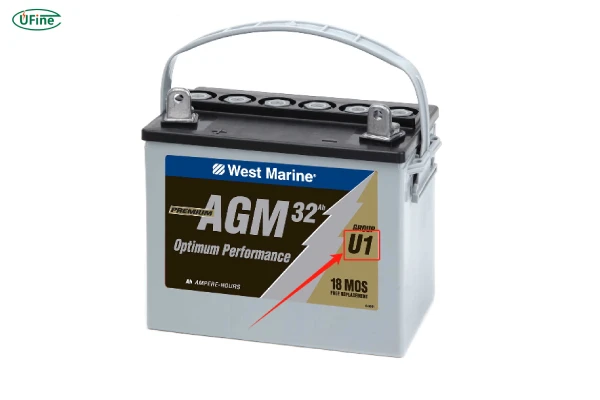
A U1 battery is a standardized battery size category defined by the Battery Council International (BCI). The term “U1” does not describe the battery chemistry, capacity, or brand. Instead, it refers to the physical size and terminal arrangement used to ensure compatibility between different manufacturers.
When people ask for “what does U1 mean on a battery,” they are usually trying to understand whether a U1 battery is a specific product or a universal size. In reality, a U1 battery can use different technologies, including flooded lead-acid, AGM, and lithium-ion chemistry.
A typical Group U1 battery is commonly used in applications that require a compact 12V power source, such as:
- Mobility scooters and electric wheelchairs
- Lawn and garden equipment
- Small tractors and utility vehicles
- Marine equipment
- Backup power systems
- Solar energy storage applications
Because U1 refers to size rather than chemistry, two U1 batteries can have very different performance characteristics depending on their internal design.
Part 2. U1 battery size and dimensions
A standard Group U1 battery usually falls within the following size range:
| Specification | Typical U1 battery measurement |
|---|---|
| Length | About 7.7 inches (196 mm) |
| Width | About 5.2 inches (132 mm) |
| Height | About 7.3 inches (185 mm) |
| Nominal voltage | 12V |
| Typical capacity range | 20Ah–40Ah |
Although Group U1 batteries follow industry size guidelines, dimensions can slightly vary depending on the manufacturer, battery housing design, handles, and terminal structure.
Before replacing your battery, you should check:
- Overall battery length, width, and height
- Positive and negative terminal locations
- Required voltage
- Available installation space
- Charger compatibility
A battery that has the correct voltage but incorrect dimensions or terminal placement may not be a direct replacement.
Are all U1 batteries the same size?
No. While Group U1 batteries are designed around a standard size category, not every U1 battery is exactly identical.
Small differences may appear in:
- Case dimensions
- Terminal position
- Handle design
- Battery height
- Mounting structure
For example, one manufacturer may produce a slightly taller U1 battery because of a different internal plate design or housing structure.
The safest replacement method is to compare the specifications of your existing battery with the new battery instead of relying only on the “U1” label.
Part 3. U1 vs U1R vs U1P battery: What is the difference?
“U1 vs U1R battery” or “U1 vs U1P battery” because these battery types look almost identical. The main difference is usually the terminal configuration rather than the overall battery size.
| Battery type | Main difference | Typical use |
|---|---|---|
| U1 | Standard terminal layout | General replacement applications |
| U1R | Reverse terminal arrangement | Equipment requiring opposite polarity positioning |
| U1P | Alternative terminal configuration | Specific equipment designs |
The “R” in U1R typically indicates a reversed terminal orientation. This means the positive and negative terminals may be positioned differently compared with a standard U1 battery.
Before installation, always confirm terminal placement because an incorrect orientation can prevent proper connection even if the battery fits physically.
Part 4. Types of U1 batteries
Not all U1 batteries are the same. While they share a standard size, their internal chemistry differs, affecting performance, longevity, and price. Here are the most common types:
1️⃣ Flooded Lead-Acid U1 Battery (Traditional Type)
🔹 The most affordable and widely available option.
🔹 Requires regular maintenance (checking water levels).
🔹 Susceptible to spills and leaks, making it less durable.
2️⃣ AGM (Absorbent Glass Mat) U1 Battery
🔹 Sealed and maintenance-free, eliminating the need for water refills.
🔹 Designed for better vibration resistance and deeper discharge cycles.
🔹 Ideal for mobility scooters, lawn tractors, and backup power systems.
3️⃣ Gel U1 Battery
🔹 Uses a thick gel electrolyte instead of liquid acid.
🔹 Extremely durable and leak-proof, great for extreme temperatures.
🔹 More expensive than standard lead-acid batteries.
4️⃣ Lithium-Ion U1 Battery (Modern Alternative)
🔹 Lighter and longer-lasting than lead-acid counterparts.
🔹 Provides higher efficiency and faster charging.
🔹 More expensive upfront but offers long-term savings.
Looking for a lightweight, high-performance U1 battery? Ufine Battery offers custom lithium-ion and LiFePO4 batteries that outperform traditional lead-acid options. Contact us today for a quote!
Part 5. U1 vs. U1R battery: what’s the difference?
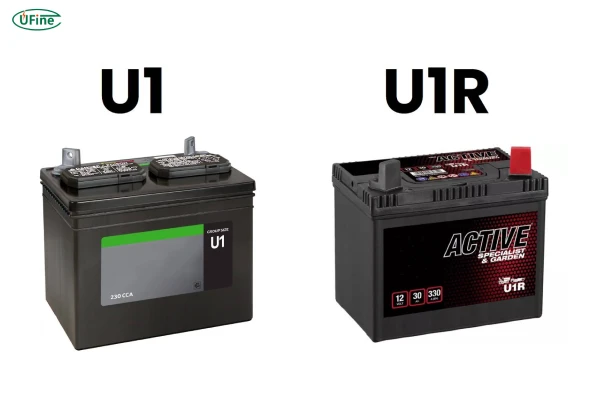
The only difference between U1 and U1R batteries is terminal placement.
| Battery Type | Dimensions (L × W × H) |
|---|---|
| U1 Battery | 7.7″ x 5.1″ x 6.1″ (196mm x 130mm x 155mm) |
| U1R Battery | 7.7″ x 5.1″ x 6.1″ (196mm x 130mm x 155mm) |
While the physical size is the same for both U1 and U1R batteries, there is an important difference: the terminal position.
- U1 batteries have the positive terminal on the left side.
- U1R batteries have the positive terminal on the right side.
This seemingly small distinction is critical for compatibility. If your equipment is designed for a U1 battery, using a U1R battery may require modifications to your cables or connectors.
Feature U1 Battery U1R Battery Terminal Position Positive terminal on the left Positive terminal on the right Size 7.7″ x 5.1″ x 6.1″ 7.7″ x 5.1″ x 6.1″ Compatibility Works with left-positive setups Works with right-positive setups
Installation Pitfalls to Avoid
During my marine electronics installation days, we frequently encountered U1/U1R confusion. Some key lessons:
- Cable length issues occur in 60% of mismatched installations
- Some terminals can be rotated 180°, but this voids warranties
- Always check your existing battery’s polarity before ordering
Part 6. AGM vs. lithium U1 battery: which one is better?
If you’re choosing between an AGM U1 battery and a lithium U1 battery, here’s how they compare:
Feature AGM U1 Battery Lithium U1 Battery Weight Heavy Up to 60% lighter Lifespan 3-5 years 5-10 years Charging Speed Slow Fast Maintenance None None Cost Cheaper upfront Higher initial cost, better long-term value
🔹 Choose AGM if you want affordability and maintenance-free reliability.
🔹 Choose lithium if you want lighter weight, longer lifespan, and better performance.
AGM vs Lithium Battery: Which One is Better?
Can a lithium battery replace a U1 lead-acid battery?
In many cases, yes, but several factors must be checked before making the switch.
A lithium replacement should match:
- Voltage requirements
- Physical dimensions
- Terminal configuration
- Charging system compatibility
- Battery management system (BMS) requirements
For example, replacing a 12V lead-acid U1 battery with a 12V lithium battery is usually possible when the charger and equipment are compatible with lithium charging characteristics.
Lithium batteries are often selected for replacement projects because they provide more usable energy, lower weight, and longer service life compared with conventional lead-acid batteries.
Part 7. Buying guide: 7 expert tips for U1 battery selection
Voltage Verification
- 6V systems are still common in older equipment
- Modern systems typically use 12V
- Always check your equipment manual
Terminal Type Matters
- SAE posts are most common
- Some European equipment uses DIN terminals
- Measure your existing cable ends
CCA vs CA Ratings
- Cold Cranking Amps (CCA) measures -18°C performance
- Cranking Amps (CA) measures 0°C performance
- Marine applications often prioritize CA
Capacity Calculations
- Calculate your amp-hour needs: (Load amps × Runtime) × 1.2 safety factor
- Example: (5A × 4 hours) × 1.2 = 24Ah minimum
Vibration Resistance
- Look for “HD” or heavy-duty models for rough terrain
- Rubber mounting kits can extend lifespan by 30%
Warranty Wisdom
- Pro-rated warranties often aren’t worth the hassle
- Look for no-questions-asked replacement periods
- Document your purchase date clearly
Brand Reputation Reality Check
- Top-tier brands: Odyssey, NorthStar, Ufine
- Avoid “white label” batteries with no manufacturer info
- Check independent review sites before buying
Part 8. Charging U1 batteries: doing it right
AGM Charging Protocol
- Bulk Charge: 14.4-14.8V until 80% full
- Absorption: 14.2-14.4V for 2-4 hours
- Float: 13.2-13.8V maintenance
Common Mistakes:
- Using automotive chargers (too aggressive)
- Ignoring temperature compensation
- Overcharging beyond 15V
Lithium Charging Advantages
What I love about lithium U1 batteries:
- No need for complex charging stages
- Can charge to 100% without damage
- Most include built-in charge controllers
Part 9. Maintenance and care tips
To extend your U1 battery’s lifespan:
🔋 Keep it charged – Avoid deep discharges.
🔋 Store in a cool, dry place – Heat shortens lifespan.
🔋 Check for corrosion – Clean terminals regularly.
🔋 Use a trickle charger – If storing for long periods.
Part 10 . FAQs
1. Can I replace a U1 battery with a U1R battery?
Yes, but you may need to adjust the cable placement due to the different terminal positions.
2. How long does a U1 battery last?
Lead-acid: 3-5 years; AGM: 4-6 years; Lithium: 5-10 years
3. What is the best U1 battery for cold weather?
An AGM U1 battery is better suited for cold climates due to its higher cold-cranking amps (CCA).
4. Can I use a car battery charger for a U1 battery?
Not recommended. Use a smart charger designed for AGM, gel, or lithium U1 batteries.
5. Is it worth upgrading to a lithium U1 battery?
Yes! If you want longer lifespan, faster charging, and lighter weight, lithium is a great investment.
Related Tags:

More Articles

JST vs Molex: The Right Battery Connector Choice
JST or Molex for your battery? Learn how connector selection affects current, voltage drop, reliability, and device performance.
Custom Battery Pricing: Costs Manufacturers Don’t Mention
A low battery quote may not be the final cost. Discover common hidden expenses that affect custom lithium battery projects.
Battery Wire Length: Hidden Cause of Power Loss
A longer battery wire can cause voltage drop, power loss, and unstable operation. Learn how wire length affects battery performance.
How Device Sleep Modes Affect Battery Life
Think sleep mode extends battery life? Learn why devices still drain power and how firmware, hardware, and batteries affect runtime.
LiPo Battery and PCB Design: Clearance, Insulation, and Placement
Learn how to optimize LiPo battery PCB clearance, insulation, placement, wiring, and thermal design—and avoid common integration mistakes.


