
- Key takeaways
- Part 1. Lithium-ion battery price chart: 2010–2025
- Part 2. Why have lithium-ion battery prices fallen?
- Part 3. Battery cell price vs. module price vs. pack price
- Part 4. How battery components affect the lithium cell price
- Part 5. How raw material prices affect battery costs
- Part 6. LiFePO4 price trend vs. NMC price trend
- Part 7. Regional differences in lithium battery prices
- Part 8. Why custom battery quotes can be higher
- Part 9. Battery price factors by application
- Part 10. How to compare lithium battery quotes
- Part 11. Future lithium battery price trend
- Part 12. FAQs about lithium cell price
Lithium-ion battery prices have dropped significantly over the past 15 years due to scale, improved manufacturing, and stronger competition.
In 2025, the global average battery pack price reached about $108 per kWh, but actual costs vary based on design, capacity, materials, and order volume. See BloombergNEF’s 2025 survey for details.
Key takeaways
- The global average lithium-ion battery pack price reached $108/kWh in 2025.
- Average LFP pack prices were about $81/kWh, compared with $128/kWh for NMC packs.
- China had the lowest average pack prices due to scale, supply-chain maturity, and strong competition.
- A lithium battery price chart shows market averages. It does not show the final price of a custom battery.
- Chemistry, capacity, discharge rate, cycle life, BMS or PCM design, testing, certification, and order volume all affect the final quote.
- The long-term lithium battery price trend remains downward, but raw material prices and trade rules can cause short-term increases.
Part 1. Lithium-ion battery price chart: 2010–2025
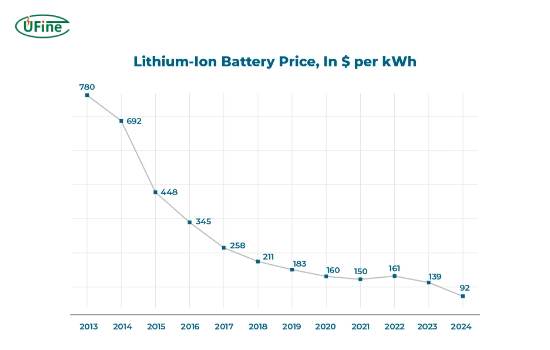
The lithium-ion battery price chart below shows a clear long-term decline. These figures are global pack averages across several applications. They should not be treated as retail prices or direct OEM quotations.
| Year | Average Pack Price | Main Market Change |
|---|---|---|
| 2010 | About $1,474/kWh | Low production volume and high manufacturing costs |
| 2018 | About $181/kWh | Rapid EV growth and better cell production |
| 2020 | About $140/kWh | Larger factories and higher energy density |
| 2021 | About $132/kWh | More production capacity and stronger competition |
| 2022 | About $151/kWh | Higher lithium, nickel, and cobalt prices |
| 2023 | About $139/kWh | Lower material prices and better supply |
| 2024 | About $115/kWh | Overcapacity, lower material costs, and wider LFP use |
| 2025 | About $108/kWh | Strong competition and continued LFP growth |
Average pack prices fell by about 93% in real terms between 2010 and 2025. The trend was not smooth. Prices rose in 2022 when battery metal costs increased. This shows that material shortages can temporarily reverse the lithium battery price trend.
Part 2. Why have lithium-ion battery prices fallen?
Battery prices have fallen because production, materials, cell design, and market structure have all improved.
1. Larger production scale
Modern battery factories produce far more cells than early production lines. Fixed costs such as equipment, dry rooms, quality systems, and engineering support can be spread across more units.
Large purchase volumes also reduce the cost of cathode materials, separators, electrolyte, copper foil, and aluminum foil.
2. Better manufacturing yield
Battery production now uses more automation and tighter process control. Better coating, slitting, stacking, winding, filling, formation, and aging processes raise output and reduce scrap.
Yield has a direct effect on the lithium cell price. A lower defect rate means that more cells can pass testing and be sold. The Argonne BatPaC battery cost model explains how materials, factory scale, production steps, and pack design affect manufacturing cost.
3. Improved cell and pack design
Higher energy density allows a cell to store more energy with less material and packaging. Many nickel-based cathodes also use less cobalt than earlier designs.
Cell-to-pack designs remove some modules, housings, fasteners, wires, and cooling parts. This can reduce pack cost even when the cell price changes only slightly.
4. Stronger competition
Global cell production capacity has grown faster than demand in several markets. This has increased price competition, especially in China and the energy storage sector.
In 2024, BloombergNEF estimated that commissioned battery cell capacity was more than 2.5 times annual lithium-ion battery demand. Read its analysis of battery overcapacity and the 2024 pack price decline.
5. Wider use of LFP chemistry
Lithium iron phosphate batteries use iron and phosphate instead of nickel and cobalt. These materials are usually less expensive and face fewer supply limits.
Growing LFP use in electric vehicles and energy storage has lowered the global average battery price. For more chemistry details, see our guide to the main lithium battery types and their applications.
Part 3. Battery cell price vs. module price vs. pack price
Most lithium battery price charts use dollars per kilowatt-hour. Buyers must first check whether the number refers to a cell, module, pack, or complete system.
| Price Level | Usually Included | Usually Excluded |
|---|---|---|
| Cell price | Electrodes, separator, electrolyte, tabs, casing, formation, and cell tests | BMS, enclosure, wires, connector, cooling, and pack assembly |
| Module price | Multiple cells, structure, electrical connections, and basic sensors | Full pack enclosure, advanced cooling, and device installation |
| Pack price | Cells, BMS, housing, wires, safety parts, and assembly | Charger, inverter, equipment installation, and some logistics costs |
| System price | Battery pack, controls, power electronics, and installation hardware | May exclude freight, import duties, site work, or extended service |
A large energy storage pack cannot be compared directly with a 500mAh custom pouch battery. Storage projects use standard cells and very high order volumes. A small OEM battery may need a custom size, connector, wire direction, protection board, test plan, and packaging method.
Part 4. How battery components affect the lithium cell price
The battery bill of materials changes with chemistry, format, energy density, and power demand. Cost shares also differ between LFP, NMC, LCO, NCA, cylindrical, prismatic, and pouch cells.
| Cost Area | Role in Battery Cost | Main Price Drivers |
|---|---|---|
| Cathode material | Often the largest material cost | Lithium, nickel, cobalt, manganese, iron phosphate, and processing |
| Anode | Major electrode cost | Natural graphite, synthetic graphite, silicon content, and coating |
| Separator | Key material and safety cost | Thickness, ceramic coating, heat resistance, and puncture strength |
| Electrolyte | Moves lithium ions inside the cell | Lithium salt, solvents, additives, and temperature requirements |
| Current collectors and tabs | Carry electrical current | Copper, aluminum, nickel tabs, tab size, and welding method |
| Manufacturing and yield | Affects the cost of every qualified cell | Energy, labor, dry-room use, scrap, formation, and aging time |
| Pack components | Added after cell production | PCM, BMS, NTC, connector, wiring, enclosure, insulation, and fuses |
The cathode has the greatest exposure to lithium, nickel, cobalt, manganese, and phosphate prices. However, the final lithium-ion battery price also includes production yield, cell testing, protection design, assembly, packaging, and logistics.
Part 5. How raw material prices affect battery costs
Lithium, nickel, cobalt, graphite, copper, and aluminum prices can change quickly. Their effect depends on the chemistry and the supplier’s purchase contracts.
Lithium
All common lithium-ion chemistries need lithium. A price increase can affect LFP, NMC, NCA, and LCO cells.
The effect may not appear in quotations at once. Large manufacturers often use long-term contracts, inventory, or direct material supply agreements to reduce short-term price changes.
The International Energy Agency’s battery market analysis reported that lithium prices rose again in early 2026. However, prices remained far below their 2022 peak. Strong cell competition may limit how much of this increase reaches buyers.
Nickel and cobalt
Nickel and cobalt mainly affect NMC, NCA, and LCO batteries. High-nickel cells can offer high energy density, but they are more exposed to metal price changes than LFP cells.
Cobalt prices increased in 2025 after supply restrictions in the Democratic Republic of the Congo. Even so, average pack prices continued to fall. Lower cobalt use, more LFP production, and strong factory competition reduced the effect.
Graphite
Graphite is the main anode material in most commercial lithium-ion cells. Natural and synthetic graphite have different costs. Purification, coating, energy use, and regional supply also affect the final price.
Copper and aluminum
Copper foil is normally used on the anode side. Aluminum foil is used on the cathode side. These metals receive less attention than lithium or cobalt, but they still affect high-capacity and high-current cell costs.
Part 6. LiFePO4 price trend vs. NMC price trend
The LiFePO4 price trend is a major reason for lower global battery costs. In 2025, the average LFP pack price was about $81/kWh. The average NMC pack price was about $128/kWh.
This made LFP packs more than 40% cheaper on average. LFP prices also fell faster during 2025 because of high production capacity and strong demand from energy storage projects.
| Factor | LiFePO4 Battery | NMC Battery |
|---|---|---|
| 2025 average pack price | About $81/kWh | About $128/kWh |
| Main cathode materials | Lithium, iron, and phosphate | Lithium, nickel, manganese, and cobalt |
| Energy density | Lower | Higher |
| Cycle life | Usually longer | Usually shorter under similar conditions |
| Thermal stability | High | Needs more careful thermal and BMS control |
| Common applications | Energy storage, backup power, solar systems, RVs, and standard-range EVs | Long-range EVs, drones, power tools, robotics, and compact devices |
LFP is often a better choice when cost, cycle life, and safety are the main goals. NMC is often better when weight and available space are limited.
See our LFP and NMC battery comparison for a deeper review of energy density, cycle life, safety, and application fit. You can also review our guide to LiFePO4 battery price ranges and cost per kWh.
Part 7. Regional differences in lithium battery prices
Battery prices differ by region because of manufacturing scale, labor costs, energy prices, supply chains, tariffs, and local demand.
In 2025, the average battery pack price in China was about $84/kWh. North American prices were about 44% higher. European prices were about 56% higher.
| Region | 2025 Price Position | Main Reasons |
|---|---|---|
| China | Lowest average price | Large factories, mature supply chains, high LFP output, and strong competition |
| North America | About 44% above China | Higher production costs, tariffs, and greater use of imported materials or cells |
| Europe | About 56% above China | Smaller production scale and higher energy, labor, and supply-chain costs |
Application also affects regional averages. In 2025, battery-electric vehicle packs averaged about $99/kWh. Stationary storage packs averaged about $70/kWh.
Some large LFP storage projects reported lower prices, but these projects use standard designs and large purchase contracts. Their prices do not apply to most custom battery orders.
Part 8. Why custom battery quotes can be higher
A global lithium battery price chart is useful for tracking the market. It cannot predict the exact unit price of a custom OEM battery.
The main custom battery cost factors include:
- Chemistry: LCO, NMC, LFP, LTO, and other chemistries have different costs and performance.
- Cell format: Cylindrical, prismatic, and pouch cells need different materials and processes.
- Capacity and voltage: More active material or more cells increase the total cost.
- Dimensions: A non-standard size may need new tooling or process changes.
- Discharge current: High-current batteries need suitable electrodes, tabs, wires, welds, and thermal design.
- PCM or BMS: Protection circuits add MOSFETs, control ICs, sensors, balancing, and assembly work.
- NTC and communication: Temperature sensing, CAN, UART, SMBus, Bluetooth, and fuel gauges increase complexity.
- Connector and wire: Connector brand, wire gauge, cable length, and outlet direction affect cost.
- Testing: Capacity, aging, cycle life, temperature, vibration, drop, and safety tests require time and samples.
- Certification: UN38.3, IEC 62133, UL, KC, and other standards may require extra testing and documents.
- Order volume: Prototype, pilot, and mass-production prices are different.
- Freight: Dangerous-goods packaging, shipping method, duties, and Incoterms affect landed cost.
A simple quotation model is:
Battery unit price = cell materials + manufacturing + protection parts + assembly + testing + packaging + logistics.
For an accurate quotation, provide the required voltage, capacity, maximum size, continuous current, peak current, charging method, temperature range, connector, wire length, protection functions, certification target, and expected order volume.
Ufine provides custom lithium battery design and quotation support for non-standard dimensions, connectors, PCM, NTC, special temperatures, and application-specific packs.
Part 9. Battery price factors by application
| Application | Common Battery Type | Main Cost Priorities | Common Buying Mistake |
|---|---|---|---|
| Wearables and compact devices | LiPo pouch, LCO, or NMC | Thin size, energy density, connector, protection, and swelling control | Comparing price per mAh without checking dimensions |
| Medical devices | LiPo pouch, NMC, or LMO | Reliability, traceability, cycle life, and documentation | Choosing the lowest price without reviewing quality control |
| Drones and robotics | High-rate LiPo or NMC | Discharge rate, weight, voltage sag, tabs, and heat | Using a low-rate cell for a high-current load |
| Electric vehicles | LFP, NMC, or NCA | Cost per kWh, energy density, cycle life, safety, and charging speed | Comparing cells without including BMS and cooling costs |
| Solar and energy storage | LiFePO4 | Cycle life, safety, warranty, usable energy, and BMS quality | Choosing by purchase price instead of lifetime cost |
| Outdoor and industrial equipment | LFP, NMC, LTO, or low-temperature cells | Temperature range, vibration, peak current, and service life | Using room-temperature data for outdoor operation |
Battery requirements differ by market. Review common lithium battery applications and power requirements before comparing suppliers only by unit price.
Part 10. How to compare lithium battery quotes
Two quotations are only comparable when they use the same technical and commercial terms.
- Confirm the product level. Check whether the quote covers a bare cell, protected cell, module, pack, or complete system.
- Compare the same specifications. Use the same chemistry, voltage, capacity, dimensions, current, and temperature range.
- Check test conditions. Rated capacity depends on charge voltage, discharge rate, cut-off voltage, and temperature.
- Separate continuous and peak current. A short pulse rating is not a continuous discharge rating.
- Review protection functions. Check overcharge, over-discharge, overcurrent, short-circuit, temperature, and balancing protection.
- Confirm the order basis. Sample, pilot, and annual-volume prices are not the same.
- Check the Incoterm. EXW, FOB, CIF, and DDP include different costs.
- Check certification scope. A cell certificate may not cover the battery pack or finished device.
- Confirm tooling charges. Ask whether tooling and engineering fees are separate.
- Compare total cost. Quality, lead time, cycle life, warranty, and supply stability may matter more than a small price gap.
Part 11. Future lithium battery price trend
The long-term lithium battery price trend is still downward. However, future declines may be slower and less stable.
Factors that may lower prices
- Higher factory use and better production yield
- Continued growth of LFP manufacturing
- Lower-cost cathode and electrolyte processes
- Dry-electrode and other simpler production methods
- Higher silicon content in anodes
- Cell-to-pack and structural pack designs
- More recycled battery materials
- Competition from sodium-ion batteries
Factors that may raise prices
- Higher lithium, graphite, nickel, or cobalt prices
- Mine, refinery, or shipping disruptions
- Tariffs and local-content rules
- Industry consolidation and less competition
- Higher energy, labor, or financing costs
- Stricter safety, recycling, and traceability rules
BloombergNEF expects average battery pack prices to continue falling as LFP use expands and manufacturing improves. However, very low material prices may be hard for some suppliers to maintain. This could slow future price declines.
Sodium-ion batteries may reduce costs in stationary storage and short-range vehicles. Solid-state batteries, lithium-metal anodes, and advanced silicon anodes may improve performance. However, early products are likely to cost more until production reaches scale.
Part 12. FAQs about lithium cell price
What is the average lithium-ion battery price per kWh?
The global average lithium-ion battery pack price was about $108/kWh in 2025. EV packs averaged about $99/kWh, while stationary storage packs averaged about $70/kWh. These are large-volume averages, not custom battery quotes.
Why did lithium-ion battery prices fall in 2025?
Prices fell because of high production capacity, strong competition, better manufacturing yield, and wider use of lower-cost LFP chemistry.
What is the current LiFePO4 price trend?
LiFePO4 prices remain lower than NMC prices. Average LFP pack prices reached about $81/kWh in 2025, compared with about $128/kWh for NMC packs.
Why does a custom battery cost more than a market average?
A custom battery may need a special size, connector, PCM, BMS, NTC, high discharge rate, testing, certification, or small-batch production. These features add material, engineering, and assembly costs.
Will lithium battery prices continue to fall?
Long-term prices are likely to decline as production improves and lower-cost chemistries expand. Short-term prices may still rise because of material costs, tariffs, supply disruptions, or lower factory competition.
Related Tags:

More Articles
Buck vs. Boost vs. Buck-Boost Converter: Which Is Best for Battery?
Not sure which converter your battery-powered device needs? Compare Buck, Boost, and Buck-Boost designs and discover what affects voltage stability and runtime.
How to Match 18650 Cells for a Reliable Battery Pack?
Building an 18650 battery pack? Learn how to compare cell capacity, voltage, and internal resistance to avoid mismatches and improve reliability.
Why Do 18650 Battery Packs Get Hot During Discharge?
Is your 18650 battery pack overheating under load? Learn what causes excess heat, how to spot dangerous symptoms, and what to do next.
18650 Battery BMS: How to Get the Specs Right
Learn how to choose a BMS for an 18650 battery pack. Compare voltage, current ratings, protection features, and balancing before you buy.
Why Does My Ring Camera Battery Drain So Fast or Stop Charging?
Is your Ring camera battery draining fast or not charging? Discover common causes, practical fixes, and when to replace the battery.


