
- Key takeaways
- Part 1. What is the structure of a lithium-ion battery?
- Part 2. How does a lithium-ion battery work?
- Part 3. What does a lithium battery look like?
- Part 4. Lithium-ion battery design considerations
- Part 5. How lithium-ion batteries are manufactured
- Part 6. Safety features built into lithium-ion battery structure
- Part 7. Challenges in lithium-ion battery structure
- Part 8. Innovations in lithium-ion battery structure
- Part 9. Applications of different lithium-ion battery structures
- Part 10. FAQs about lithium-ion battery structure
Lithium-ion batteries power smartphones, laptops, electric vehicles, and energy storage systems. Understanding the lithium-ion battery structure helps explain how batteries store energy, deliver power, and maintain safety. This guide covers the main lithium battery components, how they work together, common cell designs, and the latest battery innovations.
Key takeaways
- A lithium-ion battery consists of four primary components: anode, cathode, electrolyte, and separator.
- The movement of lithium ions between the electrodes enables charging and discharging.
- Common lithium-ion battery structures include cylindrical, prismatic, and pouch cells.
- Battery design directly affects energy density, safety, thermal performance, and cycle life.
- Modern innovations such as solid-state electrolytes, silicon anodes, and advanced battery management systems (BMS) continue to improve battery performance.
- Understanding lithium-ion battery components is essential when selecting batteries for consumer electronics, industrial equipment, EVs, and custom battery packs.
Part 1. What is the structure of a lithium-ion battery?
When people ask, “What is inside a lithium-ion battery?”, they are referring to a carefully engineered electrochemical system designed to store and release energy efficiently.
A typical lithium-ion battery structure contains:
- Anode (negative electrode)
- Cathode (positive electrode)
- Electrolyte
- Separator
- Current collectors
- Battery casing and safety components
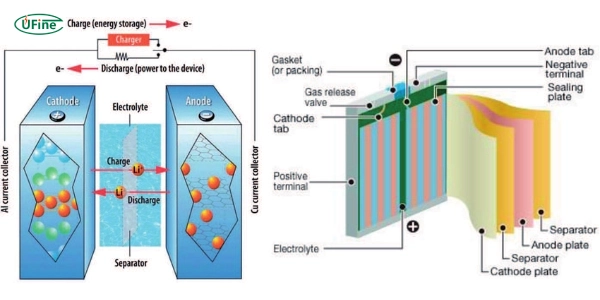
Anode (negative electrode)
The anode stores lithium ions during charging and releases them during discharge.
Graphite remains the most widely used anode material because of its stability and long cycle life. However, newer battery designs increasingly incorporate silicon to improve energy density.
Common anode materials:
- Graphite
- Silicon-graphite composites
- Lithium titanate (LTO)
Functions:
- Stores lithium ions during charging
- Releases lithium ions during discharge
- Influences charging speed and battery lifespan
Cathode (positive electrode)
The cathode largely determines battery capacity, voltage, safety, and cost.
Several cathode chemistries are used across industries:
| Cathode Material | Advantages | Typical Applications |
|---|---|---|
| LiCoO₂ (LCO) | High energy density | Smartphones, laptops |
| LiFePO₄ (LFP) | Excellent safety, long cycle life | Solar storage, industrial equipment |
| NMC (LiNiMnCoO₂) | Balanced performance | Electric vehicles |
| NCA (LiNiCoAlO₂) | High energy density | Premium EVs |
Functions:
- Stores lithium ions during discharge
- Releases ions during charging
- Determines battery voltage and capacity
Electrolyte
The electrolyte acts as the transport medium for lithium ions. It allows ions to move between electrodes while preventing electron flow through the battery interior.
Types of electrolytes:
- Liquid electrolyte (most common)
- Gel electrolyte
- Solid-state electrolyte
Functions:
- Conducts lithium ions
- Supports electrochemical reactions
- Influences battery safety and temperature performance
Separator
The separator is a thin porous membrane placed between the anode and cathode. Its job is simple but critical: prevent direct contact between electrodes while allowing lithium ions to pass.
Common materials:
- Polyethylene (PE)
- Polypropylene (PP)
- Ceramic-coated separators
Functions:
- Prevents short circuits
- Maintains battery safety
- Enables ion transport
Current collectors
Many explanations of lithium battery components overlook current collectors. These metal foils conduct electrons between the electrodes and external circuit.
Materials:
- Copper foil (anode)
- Aluminum foil (cathode)
Without current collectors, the battery could not deliver usable electrical energy.
Part 2. How does a lithium-ion battery work?
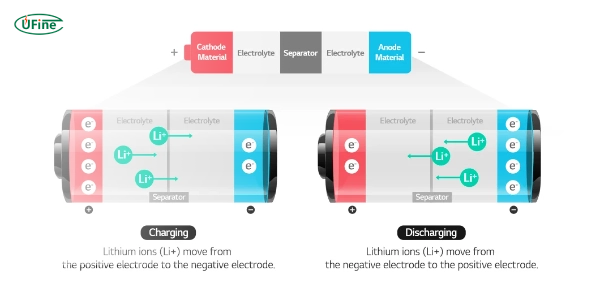
The operation of a lithium-ion battery relies on the movement of lithium ions and electrons.
During Charging
When connected to a charger:
- Lithium ions leave the cathode.
- They travel through the electrolyte.
- The ions are stored inside the anode.
- Electrons flow through the external charging circuit.
The battery stores energy in chemical form.
During Discharging
When powering a device:
- Lithium ions move back to the cathode.
- Electrons flow through the external circuit.
- Electrical energy powers the device.
This reversible process can occur hundreds or thousands of times depending on battery chemistry and operating conditions.
Why lithium-ion batteries are efficient
Compared with older battery technologies, lithium-ion batteries offer:
- High energy density
- Low self-discharge
- Fast charging capability
- Long cycle life
- Lightweight construction
These advantages explain why lithium-ion battery design dominates modern portable electronics and electric mobility.
Part 3. What does a lithium battery look like?
Many users searching for “what does a lithium battery look like” are surprised that lithium-ion batteries come in multiple formats. The internal battery structure remains similar, but the external design varies depending on the application.
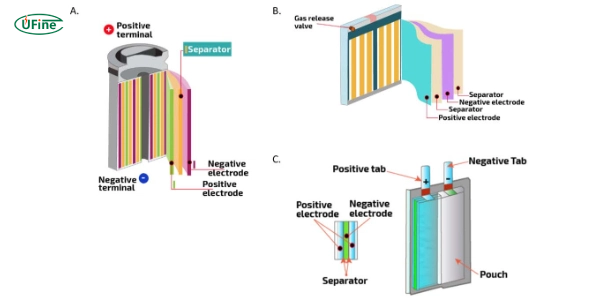
Cylindrical cells
Examples include: 18650 batteries, 21700 batteries, 4680 batteries.
Advantages
- Strong metal enclosure
- Excellent thermal performance
- Mature manufacturing process
- Cost-effective
Applications
- Power tools
- E-bikes
- Energy storage systems
- Electric vehicles
Prismatic cells
Prismatic batteries use a rectangular housing.
Advantages
- Better space utilization
- Higher packaging efficiency
- Compact design
Applications
- Smartphones
- Tablets
- Industrial devices
- EV battery packs
Pouch cells
Pouch cells use a flexible laminated outer package.
Advantages
- Highest packaging efficiency
- Lightweight
- Flexible form factor
Applications
- Drones
- Wearable devices
- Consumer electronics
- Electric vehicles
Limitation: Requires stronger external mechanical support.
Part 4. Lithium-ion battery design considerations
A successful lithium-ion battery design balances several competing factors:
| Design Goal | Impact |
|---|---|
| High energy density | Longer runtime |
| High power output | Faster discharge capability |
| Safety | Lower risk of thermal runaway |
| Long cycle life | Reduced replacement costs |
| Fast charging | Improved user experience |
| Low cost | Better commercial viability |
Engineers must optimize these factors according to application requirements.
For example, an electric vehicle battery prioritizes energy density and driving range, while an industrial battery may prioritize safety and cycle life.
For custom battery pack development, see our guide on custom lithium battery design.
Part 5. How lithium-ion batteries are manufactured
The lithium-ion battery manufacturing process includes several highly controlled stages.
- Electrode Preparation: Active materials are mixed into a slurry and coated onto metal foils.
- Drying and Calendering: The coated electrodes are dried and compressed to achieve consistent density.
- Cutting and Assembly: The electrodes and separator are cut and assembled into cell structures.
- Electrolyte Filling: Electrolyte is injected into the cell under controlled conditions.
- Sealing: The battery cell is sealed to prevent contamination and leakage.
- Formation and Aging: The cell undergoes initial charging and discharging cycles to stabilize performance.
- Testing and Quality Control: Manufacturers perform electrical, thermal, safety, and cycle-life testing before shipment.
Part 6. Safety features built into lithium-ion battery structure
Safety is a critical aspect of lithium-ion battery construction. Modern batteries include multiple protection mechanisms.
Separator Shutdown Function
Many separators can partially close their pores when overheating occurs, slowing ion movement and reducing risk.
Battery Management System (BMS)
A BMS monitors:
- Voltage
- Current
- Temperature
- State of charge (SOC)
The system protects against:
- Overcharging
- Overdischarging
- Overcurrent
- Short circuits
Learn more in our guide to battery management systems (BMS).
Thermal Management
Battery packs often include:
- Cooling plates
- Air cooling systems
- Liquid cooling systems
- Thermal interface materials
These systems help maintain safe operating temperatures.
Advanced Safety Materials
Manufacturers increasingly use:
- Ceramic-coated separators
- Flame-retardant electrolytes
- Thermal barriers
- Pressure relief mechanisms
For additional safety standards and testing information, refer to the UL 1642 Lithium Battery Safety Standard and the IEC 62133 battery safety standard.
Part 7. Challenges in lithium-ion battery structure
Despite significant progress, several challenges remain.
Thermal Runaway
Excessive heat can trigger chain reactions inside the cell. This remains one of the industry’s most important safety concerns.
Capacity Fade
Over time, batteries gradually lose capacity due to:
- Electrode degradation
- Electrolyte decomposition
- Growth of the SEI layer
Fast-Charging Stress
Aggressive charging can accelerate aging and reduce cycle life.
Material Costs
Critical materials such as lithium, nickel, and cobalt can affect battery pricing and supply stability.
Part 8. Innovations in lithium-ion battery structure
Battery technology continues to evolve rapidly.
Solid-state batteries replace liquid electrolytes with solid materials. Potential benefits:
- Higher energy density
- Improved safety
- Lower fire risk
- Longer lifespan
Silicon Anodes
Our guide to silicon anode lithium-ion battery technology explains how silicon can significantly increase energy storage compared with graphite. Potential improvements include:
- Higher capacity
- Faster charging
- Greater energy density
Lithium-sulfur chemistry offers:
- Very high theoretical energy density
- Lower material costs
- Reduced dependence on nickel and cobalt
Commercialization challenges still remain.
3D Battery Architectures
Researchers are developing three-dimensional electrode structures that can:
- Increase active material loading
- Improve ion transport
- Enable faster charging
These designs may significantly improve future battery performance.
Part 9. Applications of different lithium-ion battery structures
| Application | Preferred Cell Type | Key Requirement |
|---|---|---|
| Smartphones | Prismatic, Pouch | Thin profile |
| Laptops | Cylindrical, Prismatic | High energy density |
| Drones | Pouch | Lightweight |
| Power Tools | Cylindrical | High power output |
| Electric Vehicles | Cylindrical, Prismatic, Pouch | Range and safety |
| Energy Storage Systems | Cylindrical, LFP Prismatic | Long cycle life |
Part 10. FAQs about lithium-ion battery structure
What is inside a lithium-ion battery?
A lithium-ion battery contains an anode, cathode, electrolyte, separator, current collectors, and protective housing. These components work together to store and release electrical energy through lithium-ion movement.
What are the main lithium-ion battery components?
The four primary lithium battery components are the anode, cathode, electrolyte, and separator. Additional components include current collectors, safety devices, and battery management systems.
What does a lithium battery look like inside?
Inside a lithium battery, thin layers of electrodes and separators are stacked or wound together. These layers are filled with electrolyte and enclosed within a cylindrical, prismatic, or pouch casing.
Which lithium-ion battery structure is safest?
Lithium iron phosphate (LiFePO₄) batteries combined with advanced BMS protection and thermal management are widely considered among the safest lithium-ion battery designs available today.
Why is the separator important in lithium-ion battery construction?
The separator prevents direct contact between the anode and cathode while allowing lithium ions to pass through. Without it, internal short circuits and battery failure could occur.
Related Tags:

More Articles
Understanding Lipo Batteries: Capacity, Lifespan & Energy Density
Learn everything about Lipo batteries—capacity, energy density, cycle life, and more. Optimize performance and avoid common pitfalls with this in-depth guide.
A Step-by-Step Guide to Choose 24V Lithium Ion Battery
24V lithium ion battery explained in detail: voltage, lifespan, BMS, and real performance differences you must understand before buying.
How to DIY LiFePO4 Car Battery?
Want to make your own lithium car battery? Discover the tools, cells, wiring, and expert tips needed to build a reliable DIY LiFePO4 battery.
Difference Between Cold Cranking Amps and Reserve Capacity in Batteries
Learn what CCA and RC mean, how they are measured, and how to choose the right battery for reliable starting and continuous power.
Learn how to safely charge a dead battery. Step-by-step methods for cars, motorcycles, and devices, plus tips to extend battery life and avoid damage.


