- Key takeaways
- Part 1. Lithium-ion battery charging process (cc/cv method)
- Part 2. Lithium-ion battery charger types
- Part 3. Lithium-ion battery charging best practices
- Part 4. Why lithium-ion charging safety matters
- Part 5. Lithium-ion battery charging standards & safety guidelines?
- Part 6. FAQs about lithium-ion battery charging
Lithium-ion batteries power modern devices such as smartphones, laptops, electric vehicles, and energy storage systems. Because of their widespread use, understanding how to charge a lithium-ion battery safely is critical for performance, safety, and long cycle life.
Proper lithium ion battery charging helps avoid overheating, overvoltage, and capacity degradation. This guide explains the full charging process, key methods, and best practices used in both consumer and industrial applications.
Key takeaways
- Lithium-ion batteries use a CC/CV (constant current + constant voltage) charging method
- Safe charging depends on voltage control, temperature monitoring, and cut-off current
- Avoid deep discharge and frequent full charging to extend battery life
- Recommended working range is 20%–80% state of charge (SOC)
- A proper lithium-ion charger is essential for safe and stable performance
Part 1. Lithium-ion battery charging process (cc/cv method)
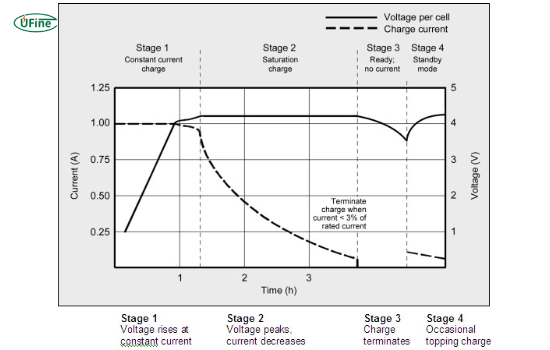
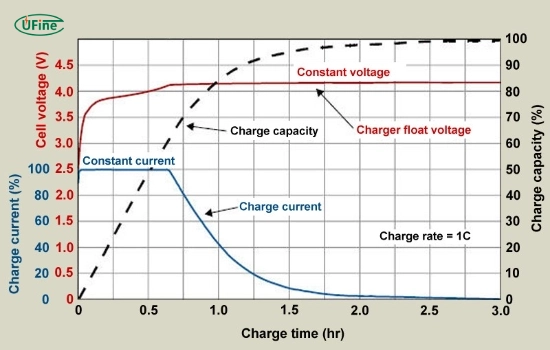
The standard lithium ion charging process is based on the CC/CV method, which ensures both efficiency and safety.
1. Pre-charging (trickle charge stage)
- Activated when cell voltage is below ~3.0V
- Uses low current to safely restore battery voltage
- Prevents damage from deep discharge conditions
If the battery is in normal condition, this stage is skipped.
2. Constant current (CC) charging stage
This is the main charging phase.
- Fixed current charging (based on battery capacity, e.g., 0.5C–1C)
- Voltage gradually increases
- Continuous monitoring of temperature and voltage
Termination conditions:
- Cell voltage reaches ~4.2V
- Temperature exceeds safe threshold (typically 45–60°C)
3. Constant voltage (CV) charging stage
- Voltage is held constant at ~4.2V
- Current gradually decreases
- Charging stops when current drops to 0.05C–0.1C
Additional safety cutoffs include:
- Maximum charging time
- Temperature protection
- Minimum current termination
This ensures safe and complete lithium ion battery charging.
Part 2. Lithium-ion battery charger types
1. Linear Chargers
- Simple structure
- Low cost
- Low efficiency with heat loss
- Suitable for low current applications
2. Switching Chargers (Recommended)
- High efficiency (up to ~90%)
- Better thermal control
- Suitable for EVs, industrial systems, and large packs
- Higher cost but safer and more stable
Most modern systems rely on switching chargers for reliable li ion battery charging.
Part 3. Lithium-ion battery charging best practices
To improve safety and lifespan, follow these lithium ion battery charging tips:
1. Avoid extreme charge levels
- Do not frequently charge to 100%
- Do not discharge to 0%
- Optimal range: 20%–80% SOC
2. Control charging temperature
- Ideal range: 10°C–45°C
- Avoid high-temperature environments
3. Use proper charger
Always use a lithium-ion compatible charger with CC/CV control.
4. Avoid unnecessary fast charging
Fast charging increases heat and accelerates degradation.
5. Proper storage
- Store at 40%–60% charge
- Keep in cool, dry environment
For runtime estimation and capacity analysis, refer to: Battery Runtime Life Calculator
Part 4. Why lithium-ion charging safety matters
Improper lithium ion battery charging may cause:
- Capacity loss
- Thermal runaway risk
- Increased internal resistance
- Shortened cycle life
High-quality battery systems from Ufine Battery use advanced BMS protection to ensure stable CC/CV charging control and safety.
Part 5. Lithium-ion battery charging standards & safety guidelines?
Lithium-ion battery charging systems are designed according to global safety and performance standards, including:
- IEC lithium battery safety standards
- UN 38.3 transport safety testing for lithium batteries
- UL safety certification frameworks for battery systems
These standards define strict requirements for:
- Maximum charge voltage
- Temperature limits
- Cycle safety testing
- Abuse and failure condition testing
Following these standards ensures safe and compliant lithium battery charging in consumer and industrial applications.
Part 6. FAQs about lithium-ion battery charging
What is the safest way to charge a lithium-ion battery?
Use a CC/CV-compatible lithium-ion charger and avoid extreme charge levels. Keep SOC between 20% and 80%.
Can lithium-ion batteries be charged overnight?
Yes, but modern batteries should still use a smart charger with overcharge protection.
What damages lithium-ion batteries during charging?
High temperature, overvoltage, deep discharge, and incompatible chargers are the main causes.
How long does lithium-ion battery charging take?
Typically 2–6 hours depending on capacity and charging current.
Do lithium-ion batteries need full charging cycles?
No. Partial charging is preferred and does not reduce performance.
Related Tags:

More Articles
Buck vs. Boost vs. Buck-Boost Converter: Which Is Best for Battery?
Not sure which converter your battery-powered device needs? Compare Buck, Boost, and Buck-Boost designs and discover what affects voltage stability and runtime.
How to Match 18650 Cells for a Reliable Battery Pack?
Building an 18650 battery pack? Learn how to compare cell capacity, voltage, and internal resistance to avoid mismatches and improve reliability.
Why Do 18650 Battery Packs Get Hot During Discharge?
Is your 18650 battery pack overheating under load? Learn what causes excess heat, how to spot dangerous symptoms, and what to do next.
18650 Battery BMS: How to Get the Specs Right
Learn how to choose a BMS for an 18650 battery pack. Compare voltage, current ratings, protection features, and balancing before you buy.
Why Does My Ring Camera Battery Drain So Fast or Stop Charging?
Is your Ring camera battery draining fast or not charging? Discover common causes, practical fixes, and when to replace the battery.