
- Part 1. What is a 24V lithium ion battery pack?
- Part 2. Electrical architecture of a 24V lithium battery system
- Part 3. How cell configuration affects performance
- Part 4. Battery pack design and BMS role
- Part 5. Battery life of a 24V lithium ion battery
- Part 6. Key parameters to consider
- Part 7. Common applications of 24V lithium batteries
- Part 8. How to choose the right 24V lithium ion battery pack
- Part 9. Common mistakes in 24V lithium battery design
- Part 10. Charging and maintenance: extending battery life
- Part 11. FAQs
Key takeaways
- A 24V lithium ion battery pack is typically built using a 7S lithium-ion configuration (25.2V nominal, 29.4V full charge).
- “24V” is a system-standard voltage class, not a fixed electrical value.
- Battery performance is strongly affected by cell internal resistance, BMS design, and discharge current profile.
- Two 24V lithium battery packs with the same capacity can deliver very different runtime depending on C-rate and thermal design.
- Proper system engineering can extend battery life from <800 cycles to over 2000+ cycles.
Part 1. What is a 24V lithium ion battery pack?
A 24V lithium ion battery pack is a rechargeable energy storage system designed to provide a nominal 24-volt output for industrial, commercial, and mobility applications.
In lithium-ion chemistry, a “24V system” is not a fixed voltage. Instead, it is typically built using a series-connected cell configuration.
Most commonly, a 24V lithium ion battery pack uses:
- 7S lithium-ion configuration
- Nominal voltage: 25.2V
- Fully charged voltage: 29.4V
- Discharge cutoff range: around 21V–22V
Part 2. Electrical architecture of a 24V lithium battery system
A 24V lithium ion battery is defined by its internal cell configuration rather than a fixed output voltage.
7S vs 8S system comparison
| System type | Chemistry | Nominal voltage | Full charge voltage | Typical use case |
|---|---|---|---|---|
| 7S Li-ion | NMC / NCA | 25.2V | 29.4V | Standard 24V lithium ion battery pack |
| 8S LiFePO4 | LFP | 25.6V | 29.2V | 24V replacement for lead-acid systems |
Even though both are called “24V systems”, their voltage curves and discharge behavior are significantly different.
A 7S lithium-ion system provides:
- Higher energy density
- Lighter weight
- Higher voltage swing during discharge
This is why most modern 24v lithium ion batteries use Li-ion chemistry instead of lead-acid or older chemistries.
When selecting a 24V lithium ion battery pack, choosing the right chemistry is critical, especially when comparing LFP vs NMC battery performance in real applications.
24V lithium ion battery vs lead-acid battery
Understanding the difference helps clarify why lithium systems are replacing traditional batteries.
| Feature | 24V lithium ion battery | Lead-acid battery |
|---|---|---|
| Weight | 60–70% lighter | Heavy |
| Cycle life | 800–3000 cycles | 300–500 cycles |
| Usable capacity | 80–95% | 50% recommended |
| Charging speed | Fast | Slow |
| Maintenance | None | Regular maintenance required |
| Energy density | High | Low |
This is why many industrial users upgrade from lead-acid to a 24v lithium battery pack.
Part 3. How cell configuration affects performance
When you design a lithium ion 24v battery pack, the performance is not only determined by capacity (Ah), but also by:
- Cell type (18650 / 21700 / pouch cells)
- Internal resistance
- Parallel configuration (7S2P, 7S4P, etc.)
- Thermal behavior under load
The performance and capacity of a lithium ion 24V battery pack are strongly affected by its configuration, which depends on how cells are arranged in series and parallel connection.
Voltage drop under load
A key engineering concept is internal resistance:
Voltage drop = Current × Internal resistance
This means:
- Higher load current → higher voltage sag
- Higher internal resistance → lower usable capacity
- Poor cell matching → uneven discharge behavior
So two identical “24V lithium batteries” can perform very differently in real applications.
Part 4. Battery pack design and BMS role
A 24V lithium ion battery pack is not just a group of cells. It is a controlled energy system managed by a Battery Management System (BMS).
The BMS is responsible for:
- Overcharge protection
- Over-discharge protection
- Over-current protection
- Cell balancing
- Temperature monitoring
Why BMS design matters
Battery life is not only determined by the cells themselves.
In real engineering systems:
The BMS often becomes the limiting factor of performance.
For example:
- A low-quality BMS may cut off early under load
- Undersized MOSFETs can overheat under peak current
- Poor balancing reduces long-term capacity consistency
So when evaluating a 24v lithium battery pack, BMS quality is just as important as cell quality.
Part 5. Battery life of a 24V lithium ion battery
Battery life is one of the most searched topics, especially for keywords like:
- lithium battery life
- 24v lithium ion battery lifespan
- how long does a 24v lithium battery last
In reality, battery life depends on multiple engineering factors rather than a single number.
Key factors affecting battery life
- Depth of discharge (DoD)
- Charge/discharge rate (C-rate)
- Operating temperature
- BMS cutoff settings
- Cell quality and consistency
Typical cycle life under different conditions
| Operating condition | Depth of discharge | Expected cycle life |
|---|---|---|
| High stress usage | 100% DoD, high current | 500–800 cycles |
| Normal industrial use | 80% DoD, moderate load | 1200–2000 cycles |
| Optimized system design | 60–80% DoD, low thermal stress | 2000+ cycles |
This explains why two identical 24v lithium ion batteries can have completely different lifespans in real-world use.
Part 6. Key parameters to consider
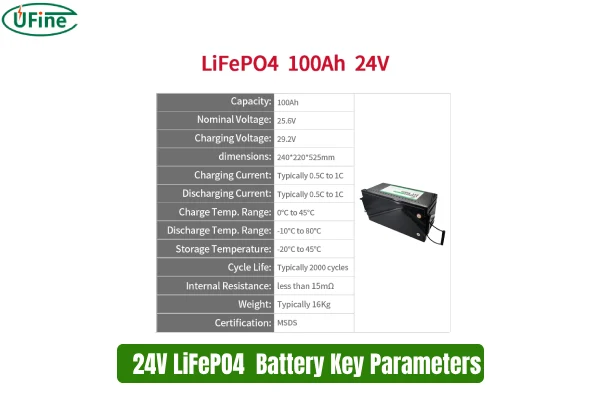
To make an informed decision, it’s crucial to understand the key parameters that define the performance and capabilities of a 24V lithium ion battery.
1. Capacity: The Energy Reservoir
Capacity, measured in amp-hours (Ah), represents the amount of electrical energy a battery can store. A higher capacity translates to longer run times for your devices and the ability to power more demanding applications.
2. Voltage: The Driving Force
Voltage determines the electrical potential of the battery. A 24V battery has a higher voltage than a 12V battery, meaning it can deliver more power. This is crucial for applications requiring a higher voltage, like electric vehicles and larger solar systems.
3. Cycle Life: The Measure of Longevity
Cycle life refers to the number of times a battery can be fully charged and discharged before its capacity significantly drops. A higher cycle life indicates a longer lifespan, making the battery a more valuable investment.
4. Temperature Range: Operating Within Limits
Lithium Battery Temperature Range: Everything you Need to Know
Temperature range specifies the operating temperatures at which the battery performs optimally. Exceeding the temperature range can negatively impact battery performance and lifespan. It’s essential to choose a battery with a temperature range that aligns with your expected operating environment.
Part 7. Common applications of 24V lithium batteries
A 24V lithium ion battery pack is widely used in systems that require stable DC power with medium voltage levels.
Typical applications include:
- Electric scooters and mobility devices
- AGVs (automated guided vehicles)
- Warehouse robotics
- Solar energy storage systems
- Marine and RV power systems
- Industrial control equipment
- Backup power systems
Each application has different discharge characteristics:
- Robotics → high peak current
- Solar → long steady discharge
- Mobility → vibration + burst current
This is why a “standard 24V battery” does not exist. Every lithium ion 24v battery pack must be designed for its load profile.
Part 8. How to choose the right 24V lithium ion battery pack
Selecting a proper battery pack is a system-level engineering decision.
Step 1: calculate energy requirement
Energy (Wh) is calculated as:
Wh = Voltage × Capacity (Ah)
This defines runtime baseline.
Step 2: define discharge requirements
You must consider:
- Continuous current (A)
- Peak current (A)
- Duty cycle (continuous or intermittent load)
Step 3: select correct cell configuration
- High energy applications → higher Ah parallel groups
- High power applications → low internal resistance cells
Step 4: choose appropriate BMS
A proper BMS must have:
- At least 20–30% current margin
- Correct cutoff voltage for lithium-ion chemistry
- Thermal protection thresholds
Part 9. Common mistakes in 24V lithium battery design
Many system failures are not caused by cells, but by design mistakes:
- Using undersized BMS current rating
- Ignoring voltage sag under peak load
- Mixing different cell batches
- Overestimating real usable capacity
- Poor thermal design in enclosed environments
These issues often cause:
- unexpected shutdown
- reduced runtime
- accelerated aging
- uneven cell degradation
Part 10. Charging and maintenance: extending battery life
Proper charging and maintenance are crucial for extending the lifespan of your 24V lithium ion battery.
1. Regular Charging: Avoid Deep Discharges
- Regularly charge the battery: Avoid letting the battery discharge completely, as this can shorten its lifespan.
- Follow the manufacturer’s charging recommendations: Use the recommended charger and charging methods.
2. Storage: Keep it Cool and Dry
- Store in a cool, dry place: High temperatures and humidity can degrade the battery.
- Avoid direct sunlight: Sunlight can also negatively impact battery performance.
3. Inspection: Catch Problems Early
- Regularly inspect the battery: Check for any signs of damage, leaks, or corrosion.
- Address any issues promptly: Contact the manufacturer or a qualified technician if you notice any problems.
Part 11. FAQs
1. Can a 24V lithium ion battery be connected in parallel to increase capacity?
Yes, 24V lithium battery packs can be connected in parallel, but only if voltage, internal resistance, and BMS configuration are properly matched. Otherwise, imbalance and current sharing issues may occur.
2. Is a higher Ah rating always better for a 24V lithium battery pack?
Not necessarily. Higher capacity increases runtime but also adds weight, cost, and may require a higher-rated BMS and charger system compatibility.
3. Can temperature affect the performance of a 24V lithium ion battery?
Yes. Low temperatures reduce discharge efficiency, while high temperatures accelerate chemical aging and reduce cycle life significantly.
4. Do all 24V lithium ion battery packs use the same charger?
No. Chargers must match the exact chemistry (Li-ion vs LiFePO4) and full charge voltage (e.g., 29.4V for 7S Li-ion systems).
Related Tags:

More Articles
Dead Battery or Device Failure? How to Find the Cause
Think your device is broken? Learn how to tell if the problem comes from battery aging or hardware failure before replacing your electronics.
Why iPhone Duo Uses Two Batteries: The Engineering Behind Foldable Phone Power
Why do foldable phones need two batteries? Explore the engineering challenges behind iPhone Duo’s dual-battery architecture and future battery trends.
Solid-State Batteries: 3 Myths You Need to Know
Solid-state batteries promise safer EVs and longer range, but the reality is more complex. Discover the challenges behind this next-gen technology.
Battery Capacity vs Discharge Rate: The Choice Engineers Face
Higher capacity or higher discharge rate? Learn how to choose the right LiPo battery for longer runtime, stable power output, and better device performance.
Battery Cable Size Guide: Choose the Right Wire Fast
Not sure what battery cable size you need? Learn how to select the right wire gauge, terminal size, and cable for safer, more efficient battery systems.


