
- Key Takeaways
- Part 1. 18500 battery size, voltage, and specifications
- Part 2. 18500 battery capacity, runtime, and cycle life
- Part 3. 18500 battery vs 18650, 18350, aa, and lipo batteries
- Part 4. Advantages and limitations of 18500 lithium batteries
- Part 5. Common 18500 battery applications
- Part 6. 18500 lithium battery charging, storage, and safety
- Part 7. How to choose the right 18500 li-ion cell
- Part 8. FAQs about 18500 batteries
An 18500 battery is a compact cylindrical lithium-ion cell with a nominal size of 18mm in diameter and 50mm in length. It is shorter than an 18650 battery but usually offers more capacity than a smaller 18350 cell.
This guide explains 18500 battery specifications, capacity, charging, runtime, applications, safety, and selection factors. It also compares 18500 batteries with 18650, 18350, AA, and lithium polymer batteries.
Key Takeaways
- An 18500 battery is approximately 18mm in diameter and 50mm long.
- Most 18500 Li-ion cells have a nominal voltage of 3.6V or 3.7V and charge to 4.2V.
- Typical commercial capacities are around 1,500–2,000mAh, depending on the cell design.
- 18500 lithium battery charging normally requires a dedicated CC/CV lithium-ion charger.
- An 18650 battery is about 15mm longer and is not a direct physical replacement.
- Protected, button-top, and flat-top 18500 batteries may have different finished dimensions.
- Capacity, discharge current, terminal type, protection, and compliance documents should all be checked before selection.
Part 1. 18500 battery size, voltage, and specifications
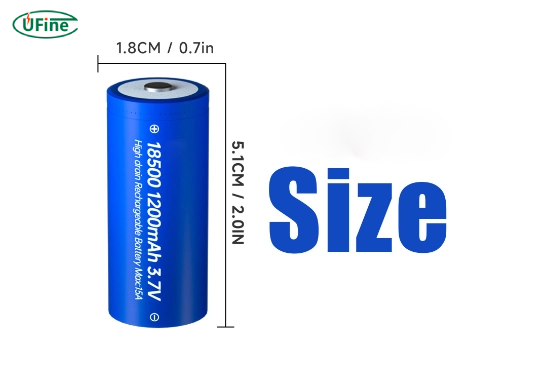
The number 18500 describes the approximate dimensions and shape of the cell:
- 18: Approximately 18mm in diameter
- 50: Approximately 50mm in length
- 0: Cylindrical cell format
These numbers are nominal. Actual dimensions vary between manufacturers. A button-top terminal, protection circuit, outer wrapper, or welded contact can also increase the finished length.
| 18500 Battery Parameter | Typical Value | Selection Note |
|---|---|---|
| Nominal size | 18 × 50mm | Check the maximum finished dimensions |
| Nominal voltage | 3.6V or 3.7V | Depends on the manufacturer and chemistry |
| Maximum charge voltage | Usually 4.2V | Follow the exact cell datasheet |
| Typical capacity | Approximately 1,500–2,000mAh | Capacity varies by model and discharge conditions |
| Cell chemistry | Usually rechargeable Li-ion | The size code alone does not confirm chemistry |
| Terminal design | Flat-top or button-top | Terminal style affects contact and overall length |
| Protection | Protected or unprotected | Bare cells require protection in the device or pack |
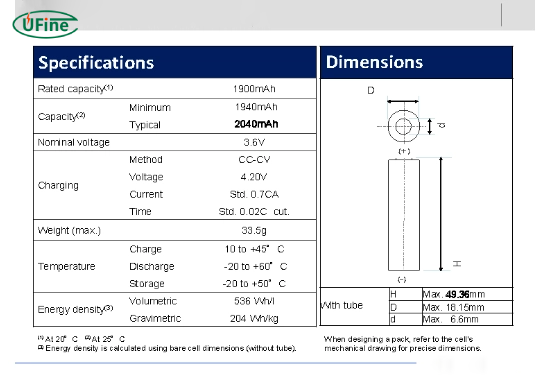
For example, the official Panasonic NCR18500A lithium-ion cell specifications list a nominal voltage of 3.6V and a typical capacity of 2,040mAh. Specifications from one model should not be applied to every 18500 battery.
Part 2. 18500 battery capacity, runtime, and cycle life
18500 battery capacity
Battery capacity is measured in milliamp-hours, or mAh. A higher capacity normally provides a longer runtime when voltage, load, temperature, and discharge cutoff remain similar.
Battery energy should also be compared in watt-hours:
Energy (Wh) = Nominal voltage (V) × Capacity (Ah)
For example, a 3.6V 2,000mAh 18500 battery stores approximately 7.2Wh:
3.6V × 2.0Ah = 7.2Wh
18500 battery runtime
A basic runtime estimate is:
Runtime (hours) ≈ Battery capacity (Ah) ÷ Average load current (A)
A 2,000mAh cell powering a 500mA load has an ideal runtime of about four hours. Actual runtime will usually be shorter because of:
- Voltage conversion losses
- Battery age and internal resistance
- Low operating temperatures
- Device standby current
- Peak current requirements
- The device’s discharge cutoff voltage
18500 battery discharge current
Capacity does not show how much current a cell can safely deliver. Some 18500 batteries are designed for longer runtime, while others support higher discharge currents.
Check these values in the cell datasheet:
- Maximum continuous discharge current
- Maximum pulse discharge current
- Recommended discharge rate
- Discharge cutoff voltage
- Internal resistance
- Operating temperature range
For a 2,000mAh cell, 1C equals 2A. However, this does not mean every 2,000mAh 18500 cell can safely discharge at 2A. The manufacturer’s current rating must take priority.
18500 battery cycle life
A quality 18500 lithium battery can normally provide several hundred cycles under the specified test conditions. Cycle life decreases faster with high temperatures, excessive charge voltage, deep discharge, and high current.
Cycle-life figures should only be compared when the charge rate, discharge rate, temperature, cutoff voltage, and remaining-capacity standard are similar. Learn more about the main factors that affect lithium-ion battery lifespan and cycle life.
Part 3. 18500 battery vs 18650, 18350, aa, and lipo batteries
| Battery Type | Nominal Size | Typical Voltage | Main Difference |
|---|---|---|---|
| 18500 Li-ion | 18 × 50mm | 3.6V or 3.7V | Compact cylindrical cell with moderate capacity |
| 18650 Li-ion | 18 × 65mm | 3.6V or 3.7V | Longer and usually offers more capacity |
| 18350 Li-ion | 18 × 35mm | 3.6V or 3.7V | Shorter but normally has less capacity |
| AA alkaline | About 14.5 × 50.5mm | 1.5V | Narrower and uses a much lower voltage |
| AA NiMH | About 14.5 × 50.5mm | 1.2V | Rechargeable but electrically different |
| LiPo pouch cell | Custom dimensions | Usually 3.7V | Flat, lightweight, and more flexible in shape |
18500 battery vs 18650 battery
The 18500 and 18650 have a similar diameter, but an 18650 is approximately 15mm longer. The extra internal volume usually allows an 18650 battery to provide more capacity or higher power.
An 18500 battery is more suitable when the enclosure cannot accept a 65mm-long cell. An 18650 is often preferred when runtime, supply availability, or model selection is more important than cell length.
See this guide to 18650 battery types, specifications, and applications for a more detailed comparison.
18500 battery vs 18350 battery
An 18350 battery is approximately 15mm shorter than an 18500. It fits smaller devices, but its reduced internal volume usually means lower capacity and shorter runtime.
18500 battery vs AA battery
An AA battery is narrower and has a much lower voltage. Alkaline AA batteries are normally rated at 1.5V, while rechargeable NiMH AA batteries are usually rated at 1.2V.
A lithium-ion 18500 cell is normally rated at 3.6V or 3.7V and reaches about 4.2V when fully charged. It should not replace an AA battery unless the complete electrical system was designed for the lithium-ion voltage range.
18500 lithium battery vs LiPo battery
An 18500 battery uses a rigid cylindrical metal housing. A lithium polymer battery uses a lightweight pouch and can be produced in many thicknesses, widths, and lengths.
An 18500 cell is suitable for products that need a standard cylindrical holder or removable battery. A custom lithium polymer battery is often better for thin, rectangular, curved, or space-limited products.
Part 4. Advantages and limitations of 18500 lithium batteries
| 18500 Battery Advantages | 18500 Battery Limitations |
|---|---|
| Shorter than an 18650 battery | Usually stores less energy than an 18650 |
| Normally offers more runtime than an 18350 | Fewer models are available than in the 18650 format |
| Rigid cylindrical housing provides stable dimensions | Protected cells may be longer than the nominal 50mm |
| Suitable for removable battery designs | Not a direct replacement for AA batteries |
| Rechargeable and suitable for repeated use | Requires lithium-ion charging and protection control |
The main value of the 18500 format is its balance between compact length and usable energy. Its main limitation is that fewer models and suppliers are available compared with the more common 18650 format.
Part 5. Common 18500 battery applications
18500 batteries are suitable for products that need more energy than an 18350 can provide but do not have enough space for an 18650.
| 18500 Battery Application | Why the 18500 Format Fits | Key Selection Factor |
|---|---|---|
| LED flashlights | Compact length with useful runtime | Button-top contact and discharge current |
| Portable test instruments | Rechargeable power in a stable cylindrical shape | Runtime and voltage regulation |
| Handheld industrial devices | Fits compact and removable battery designs | Temperature, vibration, and protection |
| Communication and telemetry equipment | Suitable for moderate loads and standby operation | Pulse current and self-discharge |
| Legacy equipment designed for 18500 cells | Maintains the original compartment dimensions | Voltage, polarity, terminal type, and cell length |
Battery size should not be the only selection factor. Engineers must also check peak current, charging design, operating temperature, required runtime, mechanical pressure, and protection requirements.
Part 6. 18500 lithium battery charging, storage, and safety
18500 lithium battery charging method
Most 18500 Li-ion cells use constant-current and constant-voltage charging, also called CC/CV charging.
- Pre-charge: A low current may be applied if the cell voltage is very low.
- Constant-current stage: The charger supplies a controlled current while the voltage rises.
- Constant-voltage stage: The charger holds the specified maximum voltage, usually 4.2V.
- Charge termination: Charging stops when current falls to the specified cutoff level.
The correct charging current depends on the exact cell model. It cannot be determined from the 18500 size alone. Follow the manufacturer’s standard and maximum charge-current limits.
For more details, read the guide to lithium-ion battery CC/CV charging and use this lithium-ion battery voltage chart to understand full-charge and discharge voltages.
18500 battery charging safety
- Use a charger designed for single-cell lithium-ion batteries.
- Confirm that the charger voltage matches the cell datasheet.
- Do not use an AA or NiMH battery charger.
- Check the positive and negative terminal direction.
- Do not charge dented, leaking, corroded, or overheated cells.
- Charge only within the specified temperature range.
- Stop charging if the battery becomes unusually hot or damaged.
A protection circuit can help prevent overcharge, over-discharge, overcurrent, and short circuits. It does not replace a correctly designed charger.
18500 battery storage
- Store batteries in a cool, dry, and ventilated place.
- Keep them away from direct sunlight and heat sources.
- Use an insulated battery case for loose cells.
- Prevent terminals from touching keys, coins, or metal tools.
- Use a partial state of charge for long-term storage.
- Check stored cells for leakage, corrosion, damage, or abnormal voltage.
18500 battery safety and transport standards
For portable rechargeable lithium cells and batteries, IEC 62133-2 lithium battery safety requirements cover tests for intended use and reasonably foreseeable misuse.
Lithium cells and batteries used in transport are tested according to UN Manual of Tests and Criteria, Subsection 38.3. Buyers may request a UN 38.3 test summary, safety data sheet, product specification, and applicable transport documents.
IEC 62133-2 and UN 38.3 have different purposes. IEC 62133-2 focuses on product safety, while UN 38.3 focuses on transport testing.
Part 7. How to choose the right 18500 li-ion cell
1. Check the 18500 battery size and terminal
Measure the maximum available diameter and length. Include space for terminals, springs, wrappers, insulation, and protection components.
Confirm whether the device requires a flat-top, button-top, welded tab, wire lead, or connector. Terminal design affects contact reliability and finished length.
2. Match the voltage and charging system
Confirm that the device supports a 3.6V or 3.7V lithium-ion cell and a full-charge voltage of about 4.2V. The charger must match the cell chemistry and charging limits.
3. Calculate capacity and required runtime
Use the device’s average current, peak current, conversion efficiency, operating time, and discharge cutoff to estimate the required capacity. Add design margin for aging and low-temperature use.
4. Verify discharge current and temperature
The cell must support both normal current and short peak loads without excessive voltage drop or overheating. Check the approved charging, discharging, and storage temperature ranges.
5. Review protection, quality, and documents
Choose between a protected battery and a bare cell based on the product’s battery management design. Request the specification sheet, batch traceability, safety data sheet, UN 38.3 test summary, and applicable certification reports.
Be cautious with unrealistic capacity claims. The 18500 format has limited internal volume, so very high capacity ratings should be verified through a reliable datasheet and defined test conditions.
For products with a non-standard enclosure, a custom lithium battery pack may provide a better mechanical and electrical fit than a standard cylindrical cell.
Part 8. FAQs about 18500 batteries
What voltage is an 18500 battery?
Most 18500 Li-ion batteries are rated at 3.6V or 3.7V nominal and charge to about 4.2V.
How long does an 18500 battery take to charge?
Charging time depends on capacity, charging current, initial charge level, and the CC/CV termination stage.
Can I charge an 18500 battery with an AA charger?
No. Use a lithium-ion charger that matches the battery’s voltage and charging specifications.
Can an 18500 battery replace an 18650 battery?
Not directly. An 18650 is about 15mm longer and normally will not fit an 18500 battery compartment.
Are protected and unprotected 18500 batteries the same size?
Not always. A protection circuit or button-top terminal can increase the battery’s total length.
Related Tags:

More Articles

Headphone Battery Comparison for Bluetooth Headphones: 10 Options and Selection Guide
Compare 10 headphone battery options for Bluetooth devices by capacity, size, voltage, connector, supplier role, compatibility, and price factors.
Speaker Battery Guide: 10 Bluetooth Speaker Battery Options Compared
Compare 10 speaker battery options by voltage, capacity, chemistry, connector and fit, including 2000mAh and 10000mAh Bluetooth speaker batteries.
10 Car Battery Manufacturers and Brands Compared in 2026
Compare 10 leading car battery manufacturers and brands in 2026, covering AGM, EFB, lead-acid and lithium types, uses, and key strengths.
How to Tell if Battery Is AGM?
Learn how to tell if a battery is AGM by checking the label, model, case design, and charging specs. Compare AGM vs regular lead-acid batteries.
Spicy Pillow Battery: Is Your Battery About to Fail?
Curious about "spicy pillow"? Find out how it relates to battery swelling and prevent issues with our easy-to-follow guide. Read more now!


