
- Key takeaways
- Part 1. What is IEC 62133 certification?
- Part 2. Why is IEC62133 certification important?
- Part 3. IEC 62133-2 technical requirements
- Part 4. IEC62133 testing procedures
- Part 5. What types of batteries does IEC62133 cover?
- Part 6. IEC 62133 vs UN38.3 vs UL certification
- Part 7. How long does IEC62133 certification take?
- Part 8. Common applications requiring IEC62133 battery certification
- Part 9. IEC 62133 certification FAQs
IEC 62133 certification is a global safety standard for rechargeable batteries used in electronics, medical devices, industrial equipment, and portable products. IEC 62133-2 focuses on lithium-ion and lithium polymer batteries. It verifies battery safety through electrical, mechanical, and thermal testing, helping manufacturers meet international compliance requirements and reduce safety risks.
Key takeaways
- IEC 62133 is an international safety standard for portable rechargeable batteries and cells.
- IEC 62133-2 specifically applies to lithium-ion and lithium polymer batteries.
- The standard evaluates electrical, mechanical, thermal, and environmental safety.
- IEC 62133 certification is widely required for consumer electronics and industrial battery products.
- IEC 62133 is different from UN38.3, which focuses on transportation safety testing.
- Battery manufacturers often combine IEC62133, UN38.3, CE, and UL certifications for global compliance.
Part 1. What is IEC 62133 certification?
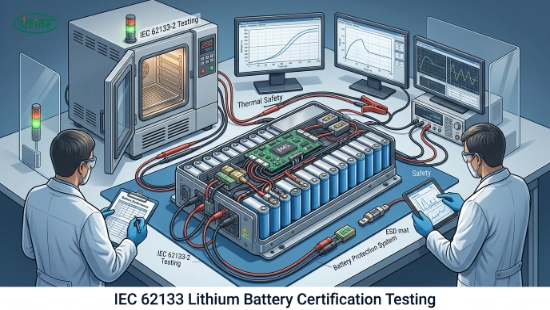
IEC 62133 is an international battery safety standard published by the International Electrotechnical Commission (IEC). It defines safety requirements for portable sealed secondary cells and batteries containing alkaline or other non-acid electrolytes.
The standard is commonly divided into two parts:
- IEC 62133-1: For nickel-based rechargeable batteries such as NiMH batteries.
- IEC 62133-2: For lithium-ion and lithium polymer batteries.
Today, when people mention “IEC62133 certification,” they usually mean IEC 62133-2 certification for lithium batteries.
This certification verifies that a battery can operate safely under normal use and foreseeable misuse conditions. It includes testing for:
- Overcharge protection
- External short circuit
- Thermal abuse
- Mechanical shock and vibration
- Drop and crush resistance
- Battery pack protection system performance
IEC62133 certification is widely used for:
- Consumer electronics
- Medical devices
- Portable industrial equipment
- Bluetooth devices
- Wearable electronics
- Portable energy storage systems
- IoT products
If you are designing a custom lithium battery pack, you may also want to review our guide on custom lithium-ion battery pack design.
Part 2. Why is IEC62133 certification important?
IEC 62133 battery certification is important because it improves both product safety and international market acceptance.
Without proper safety verification, lithium batteries may experience:
- Internal short circuits
- Thermal runaway
- Electrolyte leakage
- Fire or explosion risks
- Charging failures
- Cell swelling and overheating
For manufacturers, certification provides several advantages.
Benefits for battery manufacturers
- Demonstrates compliance with international battery safety standards.
- Improves buyer confidence for OEM and B2B projects.
- Supports export requirements in many countries and regions.
- Reduces product liability and compliance risks.
- Helps products enter medical, industrial, and consumer electronics markets.
- Strengthens brand reputation and engineering credibility.
Benefits for OEM buyers and consumers
- Reduces safety risks during charging and discharging.
- Improves long-term battery reliability.
- Ensures products meet recognized global standards.
- Provides safer operation in portable electronic devices.
- Helps avoid low-quality or non-compliant battery suppliers.
Benefits for regulatory compliance
- Supports harmonized international safety requirements.
- Simplifies product approval processes.
- Creates standardized testing procedures for laboratories and manufacturers.
- Improves consistency across global battery supply chains.
Part 3. IEC 62133-2 technical requirements
IEC 62133-2 certification includes both cell-level and battery pack-level evaluations.
Electrical safety requirements
- Protection against overcharge and over-discharge
- Stable charging and discharging behavior
- Short-circuit protection performance
- Proper voltage and capacity control
- Battery management system (BMS) verification
For lithium battery packs, the protection circuit design is especially important. Many failures happen because of poor BMS integration rather than cell defects alone.
Mechanical safety requirements
- Vibration resistance
- Shock resistance
- Drop testing
- Crush resistance
- Terminal connection reliability
These tests simulate transportation, handling, and daily product use conditions.
Thermal and environmental requirements
- High-temperature storage testing
- Temperature cycling evaluation
- Thermal abuse resistance
- Humidity exposure testing
- Operation under abnormal environmental conditions
Thermal safety is especially critical for high-energy-density lithium-ion batteries.
Part 4. IEC62133 testing procedures
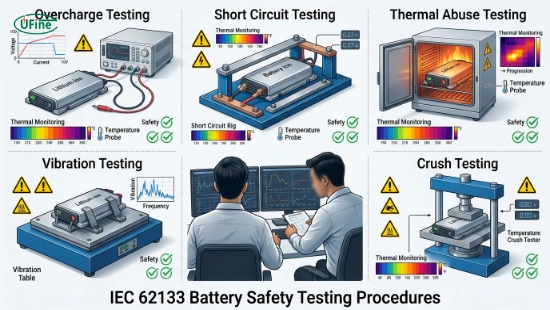
IEC62133 certification requires batteries to pass multiple safety tests performed by accredited laboratories.
Below are the most important testing categories.
1. External short circuit test
The battery is intentionally short-circuited under controlled conditions. The test verifies that the battery does not catch fire or explode.
2. Overcharge test
The battery is charged beyond its rated limit to evaluate protection circuit effectiveness and thermal stability.
3. Forced discharge test
This test checks how the cell behaves under abnormal discharge conditions.
4. Vibration and shock testing
Mechanical vibration and shock simulate shipping, handling, and portable device use.
5. Thermal abuse testing
The battery is exposed to elevated temperatures to assess resistance to overheating and thermal runaway.
6. Crush and impact testing
These tests evaluate how the battery responds to external mechanical force or accidental damage.
7. Molded case stress test
Battery enclosures and insulation structures are checked for safety and structural reliability.
8. Continuous low-rate charging test
This test verifies long-term charging stability and battery safety during extended charging conditions.
For transportation compliance, batteries usually also require UN38.3 certification testing.
Part 5. What types of batteries does IEC62133 cover?
IEC62133 applies mainly to portable rechargeable batteries.
1 Lithium-ion batteries
This is the most common category under IEC 62133-2 certification.
Applications include:
- Smartphones
- Laptops
- Medical devices
- Portable industrial equipment
- Bluetooth products
- Handheld electronics
- Portable monitoring systems
2 Lithium polymer (LiPo) batteries
LiPo batteries are widely used in:
- Drones
- RC devices
- Wearable electronics
- Ultra-thin portable devices
3 Nickel-metal hydride (NiMH) batteries
IEC 62133-1 covers rechargeable nickel-based batteries commonly used in:
- Toys
- Emergency lighting
- Power tools
- Consumer electronics
4 Battery packs with integrated protection circuits
Battery packs containing:
- BMS systems
- Protection ICs
- Temperature sensors
- Fuse protection
may also require complete pack-level IEC62133 testing.
Part 6. IEC 62133 vs UN38.3 vs UL certification
| Standard | Main Purpose | Focus Area | Common Applications |
|---|---|---|---|
| IEC 62133-2 | Battery safety certification | Product safety during use | Consumer and industrial electronics |
| UN38.3 | Transportation safety | Shipping and logistics compliance | Air, sea, and ground transport |
| UL 1642 | Cell safety testing | Lithium cell construction safety | North American markets |
| UL 2054 | Battery pack safety | Battery pack system safety | Portable battery packs |
Many lithium battery products require multiple certifications together.
For example:
- IEC62133 for product safety
- UN38.3 for transportation
- CE marking for Europe
- UL certification for North America
Part 7. How long does IEC62133 certification take?
The certification timeline depends on battery complexity, documentation quality, and laboratory scheduling.
Typical timelines are:
- Cell certification: 2–4 weeks
- Battery pack certification: 4–8 weeks
- Complex custom systems: 8+ weeks
Manufacturers usually need to prepare:
- Battery specifications
- Circuit diagrams
- BMS information
- Cell datasheets
- Product labels
- Safety documentation
Part 8. Common applications requiring IEC62133 battery certification
| Industry | Typical Products | Why Certification Matters |
|---|---|---|
| Consumer Electronics | Phones, tablets, laptops | High user safety requirements |
| Medical Devices | Portable monitors, pumps | Strict reliability standards |
| Industrial Equipment | Scanners, handheld tools | Harsh operating conditions |
| IoT Devices | Sensors, smart trackers | Long-term operational stability |
| Wearables | Smart watches, health devices | Compact battery safety |
Part 9. IEC 62133 certification FAQs
Is IEC 62133 certification mandatory?
IEC 62133 is not legally mandatory in every country, but many global markets, importers, and OEM customers require IEC 62133-2 certification for lithium battery products.
What is IEC 62133-2 certification?
IEC 62133-2 is the section of the IEC 62133 standard that applies specifically to lithium-ion and lithium polymer rechargeable batteries.
What is the difference between IEC62133 and UN38.3?
IEC62133 focuses on battery safety during product use, while UN38.3 focuses on transportation safety testing for shipping lithium batteries.
Which products need IEC 62133 battery certification?
Products using portable rechargeable lithium batteries often require IEC62133 certification, including laptops, medical devices, Bluetooth products, handheld electronics, IoT devices, and portable industrial equipment.
Can custom lithium battery packs get IEC62133 certified?
Yes. Custom lithium-ion battery packs can obtain IEC62133 certification if the cells, protection circuits, enclosure design, and battery management system meet the required safety standards.
Related Tags:

More Articles
Dead Battery or Device Failure? How to Find the Cause
Think your device is broken? Learn how to tell if the problem comes from battery aging or hardware failure before replacing your electronics.
Why iPhone Duo Uses Two Batteries: The Engineering Behind Foldable Phone Power
Why do foldable phones need two batteries? Explore the engineering challenges behind iPhone Duo’s dual-battery architecture and future battery trends.
Solid-State Batteries: 3 Myths You Need to Know
Solid-state batteries promise safer EVs and longer range, but the reality is more complex. Discover the challenges behind this next-gen technology.
Battery Capacity vs Discharge Rate: The Choice Engineers Face
Higher capacity or higher discharge rate? Learn how to choose the right LiPo battery for longer runtime, stable power output, and better device performance.
Battery Cable Size Guide: Choose the Right Wire Fast
Not sure what battery cable size you need? Learn how to select the right wire gauge, terminal size, and cable for safer, more efficient battery systems.


