- Key Takeaways
- Part 1. Drone battery comparison: How this guide was built
- Part 2. Drone batteries compared: 10 rc, fpv and uav options at a glance
- Part 3. Drone battery options for rc, fpv and custom uav applications
- Part 4. Drone battery engineering guide: How to choose the right pack
- Part 5. Drone battery life and durability: What affects real-world performance?
- Part 6. Custom drone batteries: What engineers should specify
- Part 7. Drone battery charging and storage compatibility
- Part 8. FAQs about drone batteries and drone battery life
Choosing the right drone battery is not simply about finding the highest capacity or C-rating. Voltage, cell count, weight, dimensions, connector type and discharge requirements all affect compatibility, flight time and performance.
This 2026 guide compares 10 drone battery options for micro RC drones, FPV platforms, larger RC aircraft and custom UAV projects. The products are compared by application fit rather than ranked from best to worst.
Key Takeaways
- Battery chemistry and cell configuration
- Voltage, capacity and discharge capability
- Weight and physical dimensions
- Connector and charging compatibility
- Target RC, FPV or UAV application
Part 1. Drone battery comparison: How this guide was built
Disclosure: Ufine Battery publishes this article and one Ufine battery is included in the comparison. Ufine specializes in custom lithium battery cells and packs, while several other products below are finished RC or FPV battery packs. Its inclusion represents the custom battery segment and should not be interpreted as an independent ranking against the other products.
This comparison is based on publicly available product information checked in 2026. Official manufacturer or brand pages are used where available. We did not independently laboratory-test competing batteries.
The comparison focuses on five factors that directly affect drone battery selection:
- Battery chemistry and cell configuration
- Voltage, capacity and discharge capability
- Weight and physical dimensions
- Connector and charging compatibility
- Target RC, FPV or UAV application
These batteries cover different aircraft sizes and power systems, so they are not direct substitutes. Always confirm the voltage, dimensions, connector and current requirements specified for your drone before changing batteries.
Part 2. Drone batteries compared: 10 rc, fpv and uav options at a glance
| Battery | Configuration | Capacity | Discharge Rating | Typical Application | Key Check |
|---|---|---|---|---|---|
| Fytoo 380mAh | 1S / 3.7V LiPo | 380mAh | Model-specific | Small RC drones | Connector and physical fit |
| GAONENG GNB 380mAh | 1S / 3.8V LiHV | 380mAh | 60C | 65mm FPV drones | LiHV charging and A30 connector |
| Tattu 850mAh | 4S / 14.8V LiPo | 850mAh | 75C | 150–180mm FPV quadcopters | 4S and XT60 compatibility |
| ASHATA RC Drone Battery | 3.7V lithium battery | 2600mAh listed | Not clearly specified | Model-specific RC drones | Exact model compatibility |
| Ufine 752555-20C | 1S / 3.7V LiPo | 1600mAh | Up to 20C pulse | Custom high-current UAV designs | Actual load profile |
| URGENEX 5200mAh | 2S / 7.4V LiPo | 5200mAh | 70C | Larger RC and UAV platforms | Weight, size and Deans T plug |
| CODDAR 3000mAh | 3S / 11.4V LiHV | 3000mAh | 120C listed | High-voltage RC applications | LiHV charging compatibility |
| Yowoo 3000mAh | 4S / 14.8V LiPo | 3000mAh | 150C listed | High-power multirotor and RC | Battery weight and current demand |
| Spektrum Smart 2200mAh | 4S / 14.8V LiPo | 2200mAh | 30C | Compatible RC aircraft | IC3 and Smart-system compatibility |
| Gens ace 2200mAh | 6S / 22.2V LiPo | 2200mAh | 45C | RC helicopters and aircraft | 6S voltage and EC3 connector |
Part 3. Drone battery options for rc, fpv and custom uav applications
Fytoo 3.7V 380mAh LiPo battery: Small RC drone replacement pack
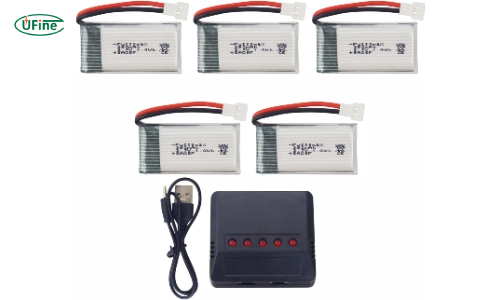
The Fytoo 3.7V 380mAh LiPo battery is designed for compatible mini quadcopters and other small RC aircraft. Public product information lists a compact pack with a Molex 51005-style 2.0mm discharge connector.
Best fit: Small RC drones that match the battery voltage, dimensions, polarity and connector.
Key consideration: This is a model-specific replacement battery rather than a universal 1S drone battery. Matching voltage alone does not guarantee compatibility.
See the Fytoo 380mAh battery specifications for the currently listed dimensions and connector details.
GAONENG GNB 380mAh 1S LiHV battery: Tiny-Whoop FPV option
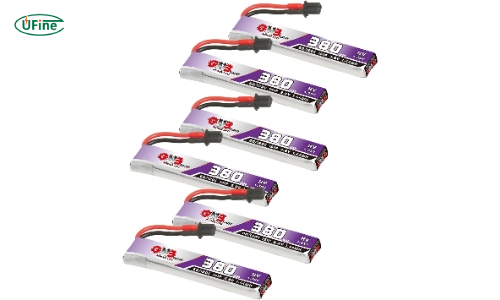
The GAONENG GNB 380mAh 1S LiHV battery is designed for very small FPV platforms. Current specifications list 3.8V, 380mAh, 60C discharge, an A30 connector and approximately 8g weight.
Best fit: 65mm FPV drones and Tiny-Whoop-style aircraft designed for 1S LiHV batteries.
Key consideration: LiHV cells use a higher maximum charging voltage than conventional LiPo cells, so both charger and aircraft compatibility should be confirmed.
Tattu 850mAh 4S 75C LiPo battery: Compact FPV drone pack
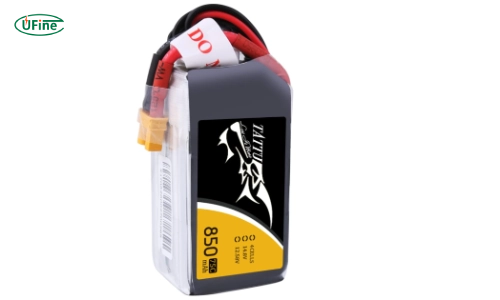
The Tattu 850mAh 4S 75C LiPo battery is designed for 150mm and 180mm FPV quadcopters. Current specifications list 14.8V, 850mAh, 75C continuous discharge, an XT60 connector, approximately 107g weight and dimensions of 60 × 30 × 30.5mm.
Best fit: Compact FPV quadcopters designed around a 4S power system.
Key consideration: The 850mAh capacity favors compact size and lower weight rather than maximum flight duration.
ASHATA 3.7V 2600mAh battery: Model-specific RC drone battery
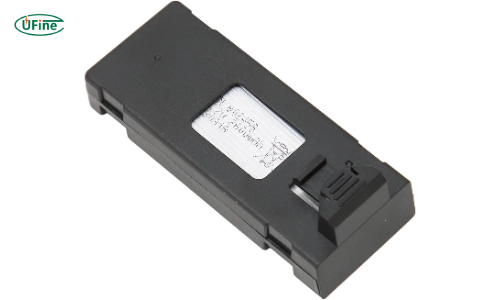
The ASHATA product included in the original comparison is listed as a 3.7V 2600mAh replacement battery for compatible RC drones. Public information for this specific version is limited compared with standardized hobby packs, particularly for discharge current and connector specifications.
Best fit: Replacing the original battery in a specifically compatible RC drone.
Key consideration: Confirm the exact aircraft model, connector, polarity, dimensions and charging requirements before purchase rather than selecting it by capacity alone.
Ufine 3.7V 1600mAh 752555-20C: Custom high-rate drone battery
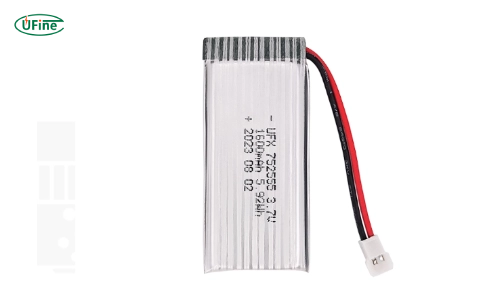
The Ufine 752555-20C high-rate lithium polymer battery is a 1S 3.7V 1600mAh pouch cell for high-current compact applications, including suitable drone and UAV designs. Current product information lists a 20C short-duration discharge capability and approximately 31g weight.
Unlike the finished RC packs above, this product represents the custom battery segment, where connector, wiring and pack configuration can be specified around the device design.
Best fit: Custom UAV projects requiring a compact 1S pouch battery with a defined current profile.
Key consideration: Continuous current, peak current, pulse duration and duty cycle should be defined before battery selection. It is not a direct replacement for proprietary smart drone batteries.
URGENEX 7.4V 5200mAh 2S 70C LiPo battery: Larger RC and UAV platforms
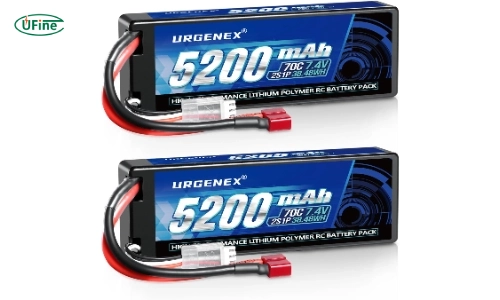
The URGENEX 5200mAh 2S 70C LiPo battery is marketed for RC aircraft, FPV drones, UAVs and other RC applications. Current specifications list 7.4V, 5200mAh, a 70C discharge rating, Deans T connector, dimensions of 138 × 46 × 25mm and approximately 273g weight.
Best fit: Larger RC or UAV platforms designed to carry a relatively large 2S battery.
Key consideration: Higher capacity can support longer runtime, but the 273g battery mass may offset part of that benefit on weight-sensitive multirotors.
CODDAR 3000mAh 3S 11.4V LiHV battery: High-voltage RC option
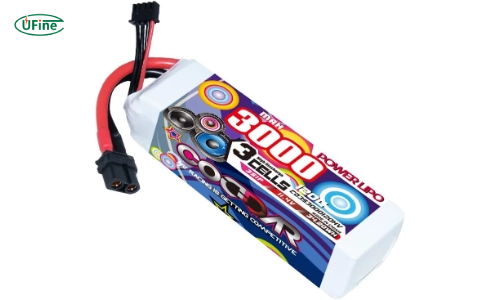
The CODDAR 3000mAh pack is publicly listed as a 3S 11.4V LiHV battery with a 120C stated discharge rating. This places it in a different category from standard 11.1V 3S LiPo packs.
Best fit: RC or FPV systems specifically designed for a 3S high-voltage lithium battery.
Key consideration: The 120C figure is a published product specification rather than an independent measurement from this guide. Verify continuous current capability, connector and maximum charging voltage for the intended application.
Current commercial specifications can be checked on the CODDAR 3000mAh 3S LiHV product listing.
Yowoo 3000mAh 4S 150C LiPo battery: High-power multirotor pack
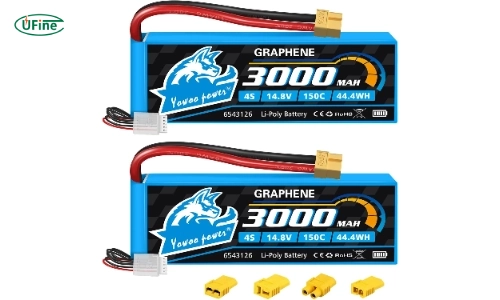
The Yowoo 4S pack is publicly listed at 14.8V, 3000mAh and 150C with an XT60 connector. Current listings give dimensions of approximately 136 × 45 × 27mm and a battery weight around 349g.
Best fit: Larger multirotor and RC platforms with sufficient payload capacity for a 3000mAh 4S pack.
Key consideration: Pack weight makes it unsuitable for many smaller FPV drones. The stated C-rating should also be compared with the aircraft’s actual continuous and peak-current requirements.
Spektrum Smart 2200mAh 4S 30C LiPo battery: Smart RC aircraft pack
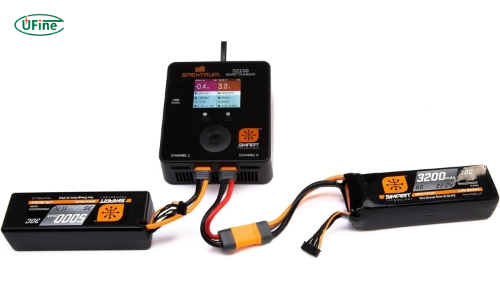
The Spektrum Smart 2200mAh 4S LiPo battery combines a 14.8V, 2200mAh, 30C pack with an IC3 connector and Spektrum Smart battery technology. Current specifications list approximately 230g weight and dimensions of 110 × 34 × 30mm.
Best fit: RC aircraft using compatible Spektrum Smart charging and connector systems.
Key consideration: This is an ecosystem-oriented aircraft battery rather than a universal drone pack. Confirm aircraft, connector and charging compatibility first.
Gens ace 2200mAh 6S 45C LiPo battery: RC helicopter and aircraft pack
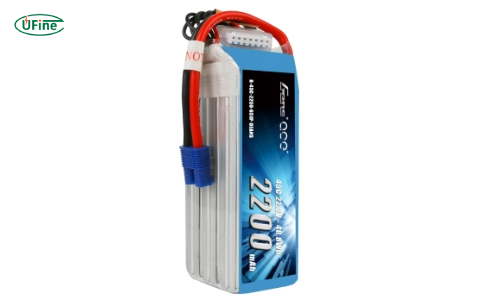
The Gens ace 2200mAh 6S 45C LiPo battery is currently positioned primarily for 450-size RC helicopters, gliders and EPP aircraft. Official specifications list 22.2V, 2200mAh, 45C continuous discharge, an EC3 connector, approximately 374g weight and dimensions of 125 × 39 × 36.7mm.
Best fit: Compatible 6S RC helicopter and aircraft power systems.
Key consideration: It should not be treated as a generic drone battery simply because it is used in aerial RC applications. The motor, ESC and complete electrical system must support 6S voltage.
Part 4. Drone battery engineering guide: How to choose the right pack
A drone battery must work with the complete propulsion and charging system. Capacity matters, but voltage, discharge current, weight and physical fit should normally be checked first.
Match drone battery voltage and cell count
A standard LiPo cell has a nominal voltage of about 3.7V, so 2S, 3S, 4S and 6S packs increase voltage by connecting cells in series. Do not move from one cell count to another unless the drone’s motor, ESC and electrical system support the new voltage.
LiHV batteries also use a different maximum charging voltage from conventional LiPo cells, so charger compatibility must be verified.
Compare drone battery energy, not only mAh
Capacity in mAh cannot be compared independently of voltage. Watt-hours provide a better indication of nominal stored energy:
Energy (Wh) = Nominal Voltage (V) × Capacity (Ah)
A 14.8V 2200mAh battery therefore stores substantially more nominal energy than a 3.7V 2200mAh battery, even though both use the same mAh figure.
Match drone battery C-rate to current demand
C-rating describes the stated relationship between capacity and discharge current. However, published ratings may refer to continuous discharge, short-duration bursts or manufacturer-specific test conditions.
For custom UAV projects, define continuous current, peak current, pulse duration and duty cycle instead of selecting a battery only by the highest advertised C-rating.
Check drone battery weight and dimensions
Higher capacity usually increases battery mass. More stored energy may increase flight time, but extra battery weight also increases the power required to keep the aircraft airborne.
- Check maximum battery-space dimensions.
- Confirm acceptable takeoff weight.
- Check the aircraft’s center of gravity.
- Allow space for cables, connectors and balance leads.
Verify drone battery connector and polarity
XT30, XT60, Deans T, PH2.0, A30, IC3 and proprietary drone connectors are not interchangeable. Verify the exact connector, polarity, wire gauge and available cable length before replacing or specifying a battery.
For a step-by-step engineering workflow, see how to choose the correct LiPo battery for a drone.
Part 5. Drone battery life and durability: What affects real-world performance?
Longer drone battery life depends on usable energy, battery weight, flight load, temperature and discharge depth—not capacity alone. A larger battery may extend runtime, but added weight can reduce the expected improvement.
For battery durability, monitor capacity retention, internal resistance, voltage sag, cell balance, abnormal heating and swelling. These indicators provide more useful information than relying on an advertised cycle-life figure alone.
For more detail, see the factors that determine drone battery runtime and service life.
Part 6. Custom drone batteries: What engineers should specify
Off-the-shelf batteries work well when a drone already uses a standardized pack. Custom UAV projects may require a battery designed around the available space, electrical load and connector system.
- Nominal voltage and cell configuration
- Required capacity and target energy
- Continuous and peak current
- Maximum dimensions and battery weight
- Connector, polarity and wire requirements
- Charging, protection and temperature requirements
- Required transport or compliance documentation
For repeat production, these electrical and mechanical requirements should be documented so later battery batches can be checked against the same approved specification.
Part 7. Drone battery charging and storage compatibility
Use a charger designed for the battery chemistry, cell count and maximum charge voltage. Multi-cell LiPo and LiHV packs may require balance charging, while proprietary smart batteries may require their own charging system. Do not use swollen, punctured or abnormally hot batteries. See how to charge and store a drone battery safely for detailed guidance.
Part 8. FAQs about drone batteries and drone battery life
What is the best drone battery?
There is no single best drone battery for every aircraft. Choose one that matches the required voltage, cell count, dimensions, weight, connector and discharge current.
What drone battery gives the longest flight time?
The best flight time comes from balancing usable energy and battery weight. A higher-capacity battery helps only if the drone can efficiently carry the added mass.
Can I use a higher-capacity battery in my drone?
Yes, if voltage, connector, dimensions, weight and discharge capability remain compatible. Extra battery weight can affect flight time and handling.
How do I know if a drone battery is failing?
Warning signs include swelling, damage, abnormal heating, increased voltage sag, poor cell balance and noticeably shorter flight time.
Can I use an RC drone battery from another brand?
Yes, if the electrical and mechanical specifications match. Check voltage, chemistry, connector, polarity, dimensions, weight and charging requirements first.
Related Tags:

More Articles

JST vs Molex: The Right Battery Connector Choice
JST or Molex for your battery? Learn how connector selection affects current, voltage drop, reliability, and device performance.
Custom Battery Pricing: Costs Manufacturers Don’t Mention
A low battery quote may not be the final cost. Discover common hidden expenses that affect custom lithium battery projects.
Battery Wire Length: Hidden Cause of Power Loss
A longer battery wire can cause voltage drop, power loss, and unstable operation. Learn how wire length affects battery performance.
How Device Sleep Modes Affect Battery Life
Think sleep mode extends battery life? Learn why devices still drain power and how firmware, hardware, and batteries affect runtime.
LiPo Battery and PCB Design: Clearance, Insulation, and Placement
Learn how to optimize LiPo battery PCB clearance, insulation, placement, wiring, and thermal design—and avoid common integration mistakes.