- Key Takeaways
- Part 1. What is a molten salt battery?
- Part 2. Main molten salt battery types and chemistries
- Part 3. Molten salt battery components and functions
- Part 4. How does a molten salt battery work?
- Part 5. Molten salt battery performance and operating temperature
- Part 6. Molten salt battery vs. lithium-ion and lead-acid batteries
- Part 7. Advantages of molten salt batteries
- Part 8. Molten salt battery disadvantages and engineering risks
- Part 9. Molten salt for energy storage: Battery vs. thermal storage
- Part 10. Molten salt battery applications
- Part 11. How to select a molten salt battery system
- Part 12. Future development of molten salt battery technology
- Part 13. FAQs about molten salt batteries
A molten salt battery is a high-temperature electrochemical battery that uses molten salt, molten active materials, or both to move ions and store energy. Common rechargeable types include sodium-sulfur and sodium-nickel-chloride batteries.
These batteries are mainly used for stationary energy storage and specialized high-power systems. They are not common in phones, laptops, or other portable devices because they need heating, insulation, and thermal control.
Key Takeaways
- A molten salt battery uses high temperature to keep its electrolyte or active materials conductive.
- Commercial sodium-sulfur batteries usually operate at about 300–350°C.
- Sodium-nickel-chloride batteries commonly operate at about 270–300°C.
- Main benefits include multi-hour discharge, long operating life, and the use of abundant sodium-based materials.
- Main molten salt battery disadvantages include heater losses, startup time, corrosion, insulation needs, and separator failure risks.
- Molten salt batteries store chemical energy. Molten salt thermal storage stores heat.
Part 1. What is a molten salt battery?
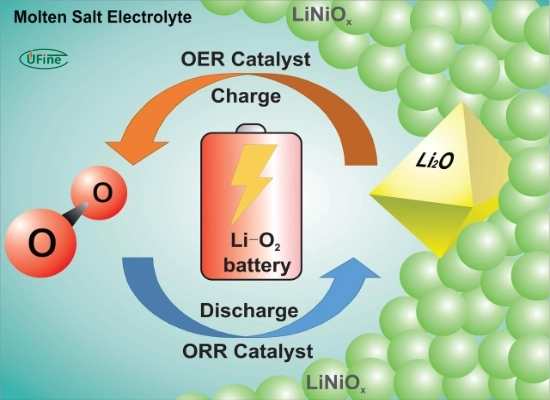
The term molten salt battery covers several battery chemistries that use salt-based materials in a molten state. The molten material may act as an electrolyte, a catholyte, or part of the active electrode system.
The phrase liquid salt battery is sometimes used for the same technology. However, it should not be confused with a saltwater battery. Saltwater batteries use a water-based electrolyte and work near room temperature. A molten battery requires heat to maintain ion conductivity.
The best-known rechargeable molten salt battery types are:
- Sodium-sulfur batteries
- Sodium-nickel-chloride batteries
- Liquid metal batteries
Primary thermal batteries also use molten salt electrolytes. However, they remain inactive until an internal heat source melts the electrolyte. They are designed for reserve power rather than daily rechargeable storage.
Part 2. Main molten salt battery types and chemistries
There is no single molten salt battery design. Each chemistry has different materials, temperatures, safety requirements, and applications.
| Molten salt battery type | Main materials | Typical operating condition | Main use |
|---|---|---|---|
| Sodium-sulfur battery | Molten sodium, sulfur or sodium polysulfides, and a ceramic separator | Usually 300–350°C | Grid storage and renewable energy shifting |
| Sodium-nickel-chloride battery | Molten sodium, nickel chloride, metal-halide catholyte, and a ceramic separator | Usually 270–300°C | Stationary storage, backup power, and selected industrial systems |
| Liquid metal battery | Two liquid metal electrodes separated by molten salt | Depends on the metal and salt combination | Emerging grid and long-duration storage |
| Thermal battery | Solid salt electrolyte activated by an internal heat source | Activated only when power is required | Missiles, launch systems, emergency equipment, and reserve power |
Sodium-sulfur molten salt batteries
A sodium-sulfur battery, or NaS battery, uses molten sodium at the negative electrode and sulfur-based materials at the positive electrode. A beta-alumina ceramic separator carries sodium ions while keeping the active materials apart.
NaS batteries support several hours of discharge and are mainly used for stationary energy storage. Their safety design is critical because molten sodium can react strongly if the ceramic separator fails.
Sodium-nickel-chloride molten salt batteries
A sodium-nickel-chloride battery is also known as a ZEBRA battery. It uses molten sodium, a nickel-chloride-based positive electrode, and a metal-halide molten salt catholyte.
This chemistry has a different failure response from sodium-sulfur technology. It still requires a sealed cell, high-temperature materials, heating, insulation, and system monitoring.
Liquid metal batteries with molten salt electrolytes
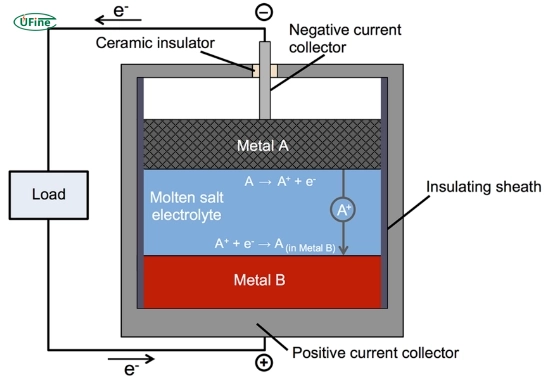
A liquid metal battery uses liquid metal electrodes separated by a molten salt electrolyte. The layers can remain separated because they have different densities and do not mix easily.
This design is being developed for large stationary systems. Learn more about its structure in our guide to liquid metal battery working principles and energy storage.
Part 3. Molten salt battery components and functions
A rechargeable molten sodium battery normally includes five main parts.
1. Negative electrode
The negative electrode is commonly molten sodium. During discharge, sodium atoms release electrons and form sodium ions.
2. Positive electrode
The positive electrode may contain sulfur, sodium polysulfides, nickel chloride, iron chloride, or another metal-halide material.
3. Molten salt electrolyte or catholyte
The molten salt phase supports ion transport. Its composition affects melting point, conductivity, voltage stability, corrosion, and electrode compatibility.
For example, sodium-nickel-chloride batteries often use sodium tetrachloroaluminate as a molten catholyte. Not every molten salt battery uses simple sodium chloride or potassium chloride as its main electrolyte.
4. Ceramic separator
Many molten sodium batteries use beta-alumina solid electrolyte. This ceramic material allows sodium ions to pass while preventing direct contact between the electrodes.
5. Thermal enclosure and control system
The cells sit inside an insulated enclosure with heaters, temperature sensors, electrical controls, and fault monitoring. These parts maintain the required temperature and protect the complete battery system.
Part 4. How does a molten salt battery work?
A rechargeable molten salt battery converts electrical energy into chemical energy during charging. During discharge, the reactions reverse and supply electrical power.
The molten salt battery is heated
The system is heated until the required salt and active materials become conductive. Traditional commercial molten sodium batteries operate near 300°C.
The battery releases electrons
During discharge, sodium at the negative electrode loses electrons. The electrons move through the external circuit and power the connected load.
Sodium ions move through the separator
Sodium ions cross the ceramic separator and react at the positive electrode.
In a sodium-sulfur battery, they form sodium polysulfides. In a sodium-nickel-chloride battery, they take part in reactions involving sodium chloride, nickel, and nickel chloride.
Charging reverses the reaction
An external power source moves the electrons and sodium ions in the opposite direction. Sodium is restored at the negative electrode, and the positive-electrode materials return toward their charged state.
Insulation maintains battery temperature
The insulated enclosure limits heat loss. Heaters add energy when internal heat is not enough to maintain the operating temperature.
Heater power and standby heat loss must be included when calculating total system efficiency.
Part 5. Molten salt battery performance and operating temperature
The following reference values come from the U.S. Department of Energy sodium battery technology assessment.
| Performance factor | Sodium-sulfur battery | Sodium-nickel-chloride battery |
|---|---|---|
| Practical volumetric energy density | 300–400 Wh/L | 150–190 Wh/L |
| Expected cycle life at 80% depth of discharge | About 7,300 cycles | More than 4,500 cycles |
| Expected operating life | About 20 years | About 20 years |
| Operating temperature | 300–350°C | 270–300°C |
| Rated discharge duration | 6–8 hours | 2–4 hours |
| Round-trip efficiency | 80%–85% | 80%–85% |
These are reference values, not universal specifications. Actual performance depends on cell design, depth of discharge, thermal conditions, cycling frequency, heater consumption, and end-of-life criteria.
Part 6. Molten salt battery vs. lithium-ion and lead-acid batteries
Molten salt batteries are not direct replacements for every lithium-ion or lead-acid system. The best technology depends on the required size, discharge duration, temperature, startup time, and duty cycle.
| Selection factor | Molten salt battery | Lithium-ion battery | Lead-acid battery |
|---|---|---|---|
| Operating condition | Requires elevated internal temperature | Normally operates near ambient temperature | Normally operates near ambient temperature |
| Typical applications | Stationary and specialized high-power systems | Electronics, EVs, industrial equipment, and energy storage | Starting, backup power, and cost-sensitive systems |
| Cold startup | May require several hours of heating | Usually available immediately | Usually available immediately |
| Multi-hour discharge | Suitable for long stationary discharge | Available, but cost depends on duration and cycling | Deep discharge can reduce service life |
| Thermal system | Needs heaters, insulation, and high-temperature materials | Needs cooling and thermal-runaway protection | May need ventilation and temperature control |
| Portable use | Poor suitability | Excellent suitability | Limited by size and weight |
| Main safety concern | Reactive molten materials, corrosion, and separator failure | Flammable electrolyte and thermal runaway | Acid leakage, hydrogen gas, and high fault current |
Lithium-ion is normally better when low weight, small size, fast startup, and room-temperature operation are required. Molten salt technology is more relevant for stationary systems that value long discharge duration and long operating life.
See our detailed molten salt battery vs. lithium-ion battery comparison for more performance and application differences.
Part 7. Advantages of molten salt batteries
Abundant sodium-based materials
Sodium is widely available and less geographically concentrated than lithium. This can reduce exposure to some raw-material supply risks.
However, the complete system may still require nickel, specialty ceramics, corrosion-resistant metals, seals, and insulation.
Long operating life
Commercial molten sodium systems can provide long cycle and calendar life when operated within their specified electrical and thermal limits.
Multi-hour energy storage
Molten salt batteries can support several hours of rated discharge. This is useful for renewable energy shifting, peak management, and industrial backup power.
No flammable organic electrolyte
Molten salt systems do not use the same volatile organic electrolyte found in conventional lithium-ion cells. This reduces some thermal-runaway and fire-propagation mechanisms.
It does not remove all hazards. Reactive sodium, high temperatures, corrosion, and internal faults still require careful control.
Stable internal operating conditions
A well-insulated system maintains a controlled internal temperature. This can reduce the direct effect of changing outdoor temperature on the electrochemical reaction.
Part 8. Molten salt battery disadvantages and engineering risks
1. High operating temperature
Traditional molten sodium batteries must remain near 300°C. This creates extra thermal, material, and safety requirements.
2. Heater and standby energy loss
Heaters consume power during startup, light-load operation, and long standby periods. These auxiliary loads reduce total system efficiency.
3. Slow cold startup
A cooled battery may need several hours to reach operating temperature. It cannot always provide immediate emergency power from a cold state.
4. Insulation and system complexity
The battery needs insulation, heaters, sensors, seals, thermal protection, and high-temperature wiring. These parts add cost, weight, and maintenance requirements.
5. Corrosion and seal degradation
Molten salts and sulfur-based materials can be corrosive. Cell housings, welds, seals, current collectors, and coatings must remain stable for many years.
6. Ceramic separator failure
The ceramic separator must carry ions while keeping reactive materials apart. Cracks, defects, or seal failure can cause internal short circuits or contact between the electrodes.
7. Freeze-thaw limitations
Cooling and reheating may place stress on internal materials. Buyers should confirm permitted freeze-thaw cycles, restart procedures, and warranty conditions.
8. Poor suitability for small devices
The heating and insulation system is difficult to justify in smartphones, wearables, laptops, and most compact medical devices.
9. Low-cost materials do not guarantee a low-cost system
Sodium and sulfur may be inexpensive, but ceramics, thermal management, containment, controls, installation, and certification can raise the total project cost.
Part 9. Molten salt for energy storage: Battery vs. thermal storage
The keyword molten salt for energy storage can describe two different technologies.
| Technology | Stored energy | How energy is released | Typical system |
|---|---|---|---|
| Molten salt battery | Chemical energy | Electrochemical reactions produce direct current | Sodium-sulfur battery |
| Molten salt thermal storage | Heat | Stored heat supports heating or electricity generation | Concentrated solar power storage tank |
A molten salt thermal storage tank is not a battery. The U.S. Department of Energy guide to solar and thermal energy storage explains that molten salt can store heat inside an insulated tank. The heat can later be used directly or converted into electricity.
A molten salt battery stores chemical energy inside electrochemical cells and supplies DC electricity through reversible battery reactions.
Part 10. Molten salt battery applications
| Molten salt battery application | Main function | Why the technology fits |
|---|---|---|
| Renewable energy storage | Store excess solar or wind power | Supports multi-hour discharge |
| Load shifting | Move electricity use from peak to off-peak periods | Designed for regular stationary cycling |
| Peak shaving | Reduce power demand during high-load periods | Can deliver rated power for several hours |
| Grid support | Support frequency, voltage, and renewable output | Can respond electrically when maintained at operating temperature |
| Industrial backup power | Support factories, telecom sites, and critical infrastructure | Provides long-duration stationary energy |
| Specialized reserve power | Deliver high power after activation | Thermal batteries can remain inactive during long storage |
Selected transport systems have tested sodium-nickel-chloride batteries. However, heating requirements, startup time, and thermal-system weight limit their use in mainstream electric vehicles.
Part 11. How to select a molten salt battery system
Confirm the molten salt battery chemistry
Identify whether the system uses sodium-sulfur, sodium-nickel-chloride, liquid metal, or primary thermal battery technology. Their performance and operating modes are different.
Define the required power and duration
Specify rated power, usable energy, discharge duration, depth of discharge, charge time, and expected annual cycles.
Calculate complete system efficiency
Check whether the stated efficiency includes heaters, standby losses, inverters, controls, pumps, and other auxiliary equipment.
Review thermal operating requirements
Confirm startup time, operating temperature, ambient range, standby heat loss, freeze-thaw limits, and restart procedures.
Review molten salt battery safety controls
Evaluate fault detection, electrical isolation, temperature monitoring, fire containment, emergency shutdown, ventilation, and site response procedures.
Verify molten salt battery life conditions
Cycle-life data should state depth of discharge, charge rate, discharge rate, temperature, end-of-life capacity, and test method.
Compare total installed cost
Include battery modules, power conversion, heating, controls, civil work, fire protection, installation, maintenance, and end-of-life handling.
Projects that do not benefit from high-temperature operation can also evaluate room-temperature sodium-ion battery technology or lithium-ion systems.
Part 12. Future development of molten salt battery technology
Molten salt battery research is focused on reducing operating temperature, limiting corrosion, improving ceramic separators, and lowering auxiliary energy use.
Sandia National Laboratories developed an experimental sodium-iodide battery that operated at about 110°C. This is much lower than the temperature used by traditional commercial molten sodium systems.
A lower operating temperature can reduce insulation, wiring, heater energy, material stress, and system cost. However, laboratory results must still pass long-term cycling, scale-up, safety, and commercial validation.
Read Sandia’s report on its lower-temperature molten sodium battery research for more technical background.
Part 13. FAQs about molten salt batteries
What is a molten salt battery?
A molten salt battery is a high-temperature battery that uses molten salt, molten active materials, or both to support ion movement and energy storage.
How does a molten salt battery work?
Heat makes the materials conductive. Ions move inside the cell while electrons flow through the external circuit. Charging reverses the reaction.
What are the main molten salt battery disadvantages?
Main disadvantages include high operating temperature, heater losses, slow cold startup, corrosion, insulation cost, and ceramic separator risks.
Are molten salt batteries safe?
They avoid flammable organic electrolytes, but reactive sodium, high temperatures, corrosion, and separator failure still require strong safety controls.
Are molten salt batteries better than lithium-ion batteries?
They can suit long-duration stationary storage. Lithium-ion is usually better for portable devices, electric vehicles, and systems that need immediate room-temperature operation.
Related Tags:

More Articles

JST vs Molex: The Right Battery Connector Choice
JST or Molex for your battery? Learn how connector selection affects current, voltage drop, reliability, and device performance.
Custom Battery Pricing: Costs Manufacturers Don’t Mention
A low battery quote may not be the final cost. Discover common hidden expenses that affect custom lithium battery projects.
Battery Wire Length: Hidden Cause of Power Loss
A longer battery wire can cause voltage drop, power loss, and unstable operation. Learn how wire length affects battery performance.
How Device Sleep Modes Affect Battery Life
Think sleep mode extends battery life? Learn why devices still drain power and how firmware, hardware, and batteries affect runtime.
LiPo Battery and PCB Design: Clearance, Insulation, and Placement
Learn how to optimize LiPo battery PCB clearance, insulation, placement, wiring, and thermal design—and avoid common integration mistakes.