- Key takeaways
- Part 1. What is a liquid metal battery?
- Part 2. How does a liquid metal battery work?
- Part 3. Why liquid metal batteries work well for grid storage
- Part 4. Advantages of liquid metal batteries
- Part 5. Limitations of liquid metal batteries
- Part 6. Liquid metal battery vs lithium-ion battery
- Part 7. Applications of liquid metal batteries
- Part 8. Future development of liquid metal batteries
- Part 9. Liquid metal battery in energy transition
- Part 10. FAQs about liquid metal battery
Energy storage is critical for modern power systems. Solar and wind power are growing fast, but they are unstable energy sources. Grid operators need batteries that can store energy for long time use, stay safe, and keep cost per kWh low.
A liquid metal battery is a grid-scale storage technology that uses molten metals instead of solid electrodes. This design changes how energy is stored and released.
This guide explains how liquid metal batteries work, where they are used, and how they compare with lithium-ion systems.
Key takeaways
- Liquid metal batteries use molten metal electrodes and molten salt electrolyte
- They are designed for grid-level energy storage, not portable devices
- Lifespan can exceed 10,000 cycles under stable conditions
- Main advantage is low cost and high scalability
- Main limitation is high operating temperature (300–500°C)
- They compete with lithium-ion only in stationary storage, not EVs or electronics
Part 1. What is a liquid metal battery?
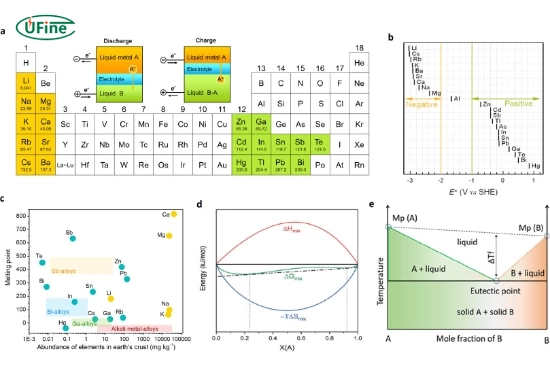
A liquid metal battery is a rechargeable energy storage system where both electrodes are in liquid form during operation.
Unlike lithium-ion batteries, which rely on solid electrode structures, liquid metal batteries maintain three liquid layers:
- A light liquid metal (top electrode)
- A molten salt electrolyte (middle layer)
- A heavy liquid metal (bottom electrode)
This structure naturally separates materials by density, removing the need for complex membranes.
The concept was developed at MIT by researcher Donald Sadoway and his team. Commercial development is led by companies such as Ambri.
Part 2. How does a liquid metal battery work?
The operating principle is based on electrochemical separation in liquid phase.
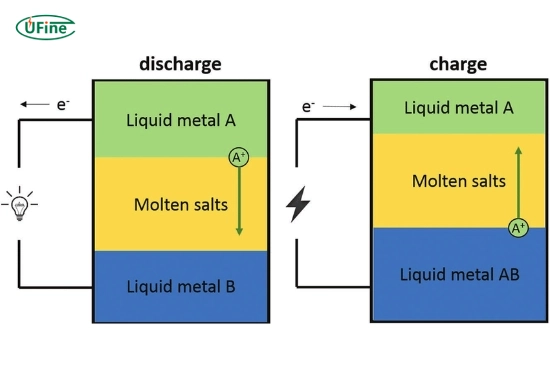
Battery Structure
- Top electrode (cathode): low-density liquid metal (e.g., calcium, lithium-based alloys)
- Electrolyte: molten salt allowing ion transport
- Bottom electrode (anode): high-density liquid metal (e.g., antimony, lead alloys)
Charging Process
- Electrical energy is applied to the system
- Metal ions move through molten salt electrolyte
- Ions dissolve into the top liquid metal layer
- Energy is stored in chemical form
Discharging Process
- Ions flow back to the bottom layer
- Electrons move through external circuit
- Electrical power is delivered to the grid
Because all active materials remain liquid, the system avoids structural cracking and electrode fatigue common in solid-state systems.
Part 3. Why liquid metal batteries work well for grid storage
Liquid metal battery design is optimized for stationary energy storage systems, not mobile use.
Core Engineering Advantages
- Self-separation of layers reduces mechanical complexity
- No solid-state degradation during cycling
- High thermal stability at operating temperature
- Low internal resistance in molten state
These properties make the system suitable for long-duration energy buffering.
For a deeper technical comparison with lithium systems, see this analysis of liquid metal battery vs lithium battery differences.
Part 4. Advantages of liquid metal batteries
1. Long cycle life
Systems can exceed 10,000 cycles, making them suitable for multi-decade infrastructure.
2. Low material cost
They rely on abundant metals such as aluminum, magnesium, and antimony. This reduces dependency on cobalt and nickel supply chains.
3. High efficiency
Round-trip efficiency can reach ~90% or higher in optimized designs.
4. Improved safety profile
No flammable organic electrolyte is used, reducing thermal runaway risk compared to lithium-ion systems.
5. High scalability
Design can be scaled from container size to grid-scale installations.
Part 5. Limitations of liquid metal batteries
1. High operating temperature
Typical operating range: 300–500°C
This requires:
- Continuous thermal management
- Insulation systems
- Energy overhead for heating
2. Not suitable for portable applications
Due to size constraints, thermal requirements, and slow thermal ramp-up, they cannot be used in EVs, laptops, or mobile devices.
3. Slow response time
Thermal inertia prevents instant power delivery compared to lithium-ion systems.
Part 6. Liquid metal battery vs lithium-ion battery
Lithium-ion batteries dominate consumer electronics and EVs, but they are not always optimal for grid storage.
| Feature | Liquid Metal Battery | Lithium-Ion Battery |
|---|---|---|
| Cycle life | 10,000+ | 2,000–3,000 |
| Cost structure | Low material cost | Higher (lithium, cobalt, nickel) |
| Safety | No flammable electrolyte | Thermal runaway risk |
| Efficiency | ~90%+ | 85–95% |
| Use case | Grid storage | EVs, electronics |
| Operating temperature | 300–500°C | Ambient |
Engineering interpretation
- Lithium-ion = energy density optimized system
- Liquid metal = cost and durability optimized system
They are complementary, not direct replacements.
Part 7. Applications of liquid metal batteries
1. Renewable energy storage
Used to store excess solar and wind energy for later use.
2. Grid balancing
Helps stabilize frequency and prevent blackouts during demand spikes.
3. Industrial energy management
Factories can reduce peak electricity costs by storing off-peak energy.
4. Long-duration storage systems
Suitable for 8–100+ hour storage applications where lithium-ion becomes expensive.
Part 8. Future development of liquid metal batteries
Research is focused on three main areas:
- Lowering operating temperature below 300°C
- Improving thermal insulation efficiency
- Scaling manufacturing for commercial deployment
If successful, these systems could become a core component of grid-level energy storage infrastructure, especially in regions with high renewable penetration.
For comparison, other emerging technologies like advanced lithium systems and LFP batteries are currently more widely deployed but serve different use cases.
Part 9. Liquid metal battery in energy transition
Liquid metal systems are positioned in the utility-scale storage segment, where:
- Cost per kWh matters more than energy density
- Lifespan and cycle stability are critical
- Safety regulations are strict
They are not competing with lithium-ion in consumer markets, but rather in grid infrastructure replacement cycles.
Part 10. FAQs about liquid metal battery
What is a liquid metal battery?
It is a rechargeable battery using molten metal electrodes and molten salt electrolyte for energy storage.
Are liquid metal batteries commercially available?
Limited commercial deployments exist, mainly through companies like Ambri, but large-scale adoption is still developing.
Why do liquid metal batteries need high temperature?
The metals and electrolyte must remain in liquid state to enable ion flow and self-layer separation.
Can liquid metal batteries replace lithium-ion batteries?
No. They are designed for grid storage, while lithium-ion is optimized for portable and vehicle applications.
What is the main advantage of liquid metal battery technology?
Low cost long-duration energy storage with high cycle life and improved safety.
Related Tags:

More Articles
Dead Battery or Device Failure? How to Find the Cause
Think your device is broken? Learn how to tell if the problem comes from battery aging or hardware failure before replacing your electronics.
Why iPhone Duo Uses Two Batteries: The Engineering Behind Foldable Phone Power
Why do foldable phones need two batteries? Explore the engineering challenges behind iPhone Duo’s dual-battery architecture and future battery trends.
Solid-State Batteries: 3 Myths You Need to Know
Solid-state batteries promise safer EVs and longer range, but the reality is more complex. Discover the challenges behind this next-gen technology.
Battery Capacity vs Discharge Rate: The Choice Engineers Face
Higher capacity or higher discharge rate? Learn how to choose the right LiPo battery for longer runtime, stable power output, and better device performance.
Battery Cable Size Guide: Choose the Right Wire Fast
Not sure what battery cable size you need? Learn how to select the right wire gauge, terminal size, and cable for safer, more efficient battery systems.