
Battery separators are critical to battery safety, performance, and lifespan. Yet they are often overlooked during battery selection or design.
This guide explains what a battery separator is, how it works, the types of battery separators, and the battery separator manufacturing process, with practical insights for engineers and buyers.
Key Takeaways
- A battery separator prevents short circuits while allowing ion flow.
- Separator design directly affects safety, cycle life, and charge/discharge performance.
- Common battery separator materials include PE, PP, ceramic coatings, glass fiber, and nonwoven fabrics.
- The main battery separator manufacturing processes are wet and dry methods.
- Ceramic-coated separators improve safety in high-temperature lithium battery applications.
Part 1. What is a battery separator?
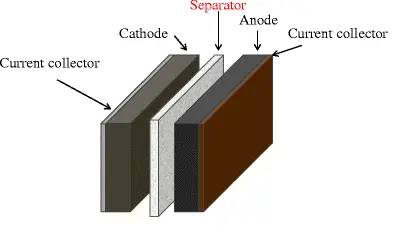
A battery separator is a thin, porous membrane placed between the cathode and anode.
Its key roles:
- Prevent direct contact between electrodes
- Allow ions (such as lithium ions) to pass through
In lithium-ion batteries, separators are usually microporous polymer films with controlled thickness and pore size.
For a broader understanding of lithium battery structure, see this lithium battery guide.
1 Functions of a battery separator
- Ion Transport Control
- The separator allows ions to move between electrodes.
- Higher porosity → better rate performance
- Uniform structure → stable battery behavior
- Electrical Insulation
- The separator blocks electron flow.
- Prevents internal short circuits
- Ensures safe battery operation
- Electrolyte Retention
- Separators absorb electrolyte and keep it evenly distributed.
- Maintains ionic conductivity
- Supports long cycle life
- Mechanical Stability
- The separator keeps electrode spacing stable.
- Prevents deformation
- Helps resist internal damage
- Thermal Shutdown (Safety Feature)
- Some polymer separators (like PE) can shut down at high temperatures:
- Pores close when temperature rises
- Ion flow stops → reaction slows or stops
Part 2. Types of battery separators
1 Polymeric separators (PE / PP)
Most common lithium battery separator
Materials:
- Polyethylene (PE)
- Polypropylene (PP)
Advantages:
- Low cost
- Good chemical stability
- Thermal shutdown capability
Limitations:
- Limited high-temperature resistance
2 Ceramic-coated separators
Polymer separators coated with ceramic particles (e.g., Al₂O₃).
Advantages:
- High thermal stability
- Better safety under extreme conditions
- Reduced shrinkage risk
Applications:
- Electric vehicles
- Energy storage systems
3 Glass fiber separators
Made from woven glass microfibers.
Features:
- High temperature resistance
- Strong electrolyte absorption
- Good chemical stability
Applications:
- Lead-acid batteries (AGM)
4 Nonwoven separators
Made from entangled synthetic fibers.
Advantages:
- Lightweight and flexible
- Good electrolyte compatibility
Applications:
- NiMH batteries
- Alkaline batteries
Part 3. Battery separator materials comparison
| Material Type | Temperature Resistance | Cost | Typical Use |
|---|---|---|---|
| PE / PP | Medium | Low | Lithium-ion batteries |
| Ceramic-coated | High | Medium-High | EV, ESS |
| Glass fiber | Very High | Medium | Lead-acid (AGM) |
| Nonwoven | Medium | Low | NiMH, alkaline |
Part 4. Battery separator manufacturing process
The battery separator manufacturing process determines pore structure and performance.
1 Wet process (solution method)
Used for high-performance separators.
Steps:
- Polymer dissolved in solvent
- Coating on substrate
- Solvent removal
- Stretching and pore formation
- Thickness control (calendering)
- Quality inspection
Advantages:
- High uniformity
- Precise pore control
Limitations:
- Higher cost
- Solvent handling required
2 Dry process (stretching method)
Common for large-scale production.
Steps:
- Melt extrusion
- Film stretching
- Pore formation
- Heat treatment
Advantages:
- Lower cost
- No solvent needed
- Scalable
Limitations:
- Less precise pore control
3 Ceramic coating process
Used in advanced lithium batteries:
- Base polymer separator
- Ceramic coating layer
- Drying and curing
This improves safety without reducing flexibility.
Part 5. How to choose the right battery separator
- Application Requirements
- EV / ESS → ceramic-coated separators
- Consumer electronics → PE/PP separators
- Temperature Stability
- Ceramic-coated separators
- Glass fiber separators
- Energy Density vs Safety
- Thin separator → higher energy density
- Thick or coated separator → better safety
- Electrolyte Compatibility
- Ensure good wettability and chemical stability with the electrolyte.
For industry standards and testing methods, refer to battery safety resources from the U.S. Department of Energy.
Part 6. Battery separator FAQs
What is a battery separator?
A battery separator is a porous membrane that prevents short circuits while allowing ion flow.
What are the main types of battery separators?
Polymeric (PE/PP), ceramic-coated, glass fiber, and nonwoven separators.
What is the difference between wet and dry separator manufacturing?
Wet process offers better performance and uniformity; dry process is more cost-effective and scalable.
Why are ceramic separators important in lithium batteries?
They improve thermal stability and reduce safety risks in high-temperature conditions.
How does separator thickness affect battery performance?
Thinner separators increase energy density, while thicker ones improve safety and durability.
Related Tags:

More Articles

JST vs Molex: The Right Battery Connector Choice
JST or Molex for your battery? Learn how connector selection affects current, voltage drop, reliability, and device performance.
Custom Battery Pricing: Costs Manufacturers Don’t Mention
A low battery quote may not be the final cost. Discover common hidden expenses that affect custom lithium battery projects.
Battery Wire Length: Hidden Cause of Power Loss
A longer battery wire can cause voltage drop, power loss, and unstable operation. Learn how wire length affects battery performance.
How Device Sleep Modes Affect Battery Life
Think sleep mode extends battery life? Learn why devices still drain power and how firmware, hardware, and batteries affect runtime.
LiPo Battery and PCB Design: Clearance, Insulation, and Placement
Learn how to optimize LiPo battery PCB clearance, insulation, placement, wiring, and thermal design—and avoid common integration mistakes.


