
- Key Takeaways
- Part 1. What is a lithium polymer battery?
- Part 2. Lithium battery components explained
- Part 3. How lithium polymer batteries work?
- Part 4. Advantages of lithium polymer batteries
- Part 5. Disadvantages and lithium polymer battery swelling
- Part 6. Lithium polymer vs lithium-ion batteries
- Part 7. Application scenarios of lithium polymer batteries
- Part 8. How to choose the right lithium polymer battery?
- Part 9. Lithium polymer battery FAQs
Lithium polymer batteries (LiPo) are a type of lithium battery that use a polymer or gel electrolyte instead of liquid electrolyte. This design allows lightweight, ultra-thin, and custom-shaped cells that are widely used in modern electronics and industrial devices.
This guide explains lipo battery chemistry, key lithium battery components, performance advantages, lithium polymer battery swelling risks, and how to select the right lithium polymer battery for your application.
Key Takeaways
- Lithium polymer batteries use a polymer electrolyte and pouch packaging, enabling ultra-thin and flexible designs.
- Compared with cylindrical lithium-ion cells, lithium polymer batteries offer better form factor customization but require stricter protection control.
- Lithium polymer battery swelling is mainly caused by overcharging, overheating, or internal chemical degradation.
- Typical cycle life is 300–500 cycles, depending on temperature, depth of discharge, and charging strategy.
- For B2B applications, selection depends on voltage, capacity, discharge rate, size constraints, and certification requirements.
Part 1. What is a lithium polymer battery?
A lithium polymer battery is a rechargeable battery that uses a polymer-based electrolyte. Unlike traditional lithium-ion batteries with liquid electrolyte and metal casing, LiPo cells use:
- Gel or solid polymer electrolyte
- Aluminum-plastic pouch packaging
This structure creates key advantages:
- Ultra-thin designs (as thin as ~0.5 mm)
- Flexible shapes and custom sizes
- Lower weight compared to metal-cased cells
In simple terms, lithium polymer batteries are optimized for design flexibility rather than maximum durability.
Part 2. Lithium battery components explained
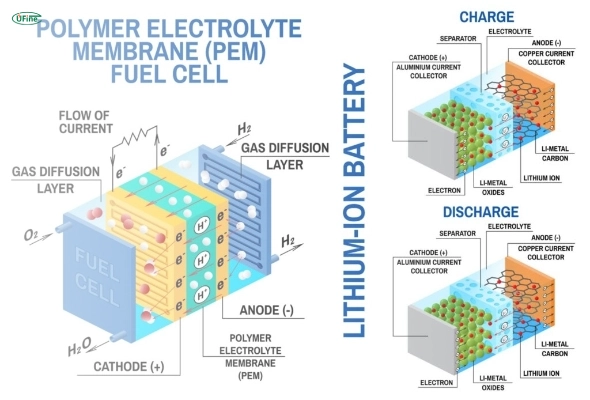
Understanding lithium battery components helps evaluate performance, safety, and lifespan. Lithium polymer batteries share the same core structure as other lithium batteries, but differ in electrolyte and packaging.
1. Battery Anode
- Material: Graphite or carbon-based materials
- Function: Stores lithium ions during charging
2. Battery Cathode
- Common materials: LCO, LFP, LMO
- Function: Determines voltage and capacity
3. Polymer Electrolyte
- Gel or solid-state lithium salt medium
- Enables ion transport
- Reduces leakage risk compared to liquid electrolyte
4. Separator
- Microporous polymer film
- Prevents short circuits while allowing ion flow
5. Current Collectors
- Anode: Copper foil
- Cathode: Aluminum foil
Part 3. How lithium polymer batteries work?
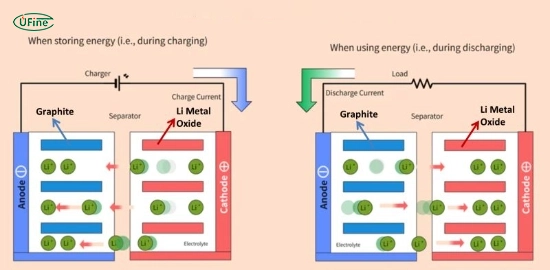
- Charging Process
- Lithium ions move from cathode to anode through the electrolyte. Electrons flow through the external circuit.
- Discharging Process
- Lithium ions return to the cathode. The electron flow powers the device.
- Cycle Life and Efficiency
- Typical lifespan: 300–500 cycles
- Capacity gradually decreases over time
Part 4. Advantages of lithium polymer batteries
- Flexible form factor: Ideal for slim or irregular devices
- Lightweight: Up to 30–40% lighter than steel-cased cells
- High energy density: 3.6–3.8V per cell
- Low internal resistance: Supports high discharge rates
- No memory effect: Flexible charging behavior
These advantages make lithium polymer batteries widely used in portable electronics and custom industrial systems.
Part 5. Disadvantages and lithium polymer battery swelling
- Limited Lifespan
- LiPo batteries usually have shorter cycle life than LFP batteries.
- Sensitive to Charging Conditions
- Incorrect charging can cause permanent damage or safety issues.
- Lithium Polymer Battery Swelling
- Lithium polymer battery swelling occurs when gas forms inside the pouch cell due to electrolyte decomposition.
- Common causes:
- Overcharging or wrong charger
- High temperature operation
- Over-discharge or aging
- Mechanical damage or puncture
A swollen battery should be removed immediately and handled according to standards from UL and IEEE.
Part 6. Lithium polymer vs lithium-ion batteries
| Feature | Lithium Polymer Batteries | Lithium-Ion Batteries |
|---|---|---|
| Packaging | Pouch (flexible) | Metal casing |
| Shape flexibility | Very high | Limited |
| Energy density | Moderate–high | High |
| Mechanical strength | Lower | Higher |
| Customization | Excellent | Limited |
For detailed comparison, see lithium-ion vs lithium polymer battery guide.
Part 7. Application scenarios of lithium polymer batteries
| Application | Why Lithium Polymer Batteries Are Used |
|---|---|
| Smartphones & tablets | Thin design, lightweight |
| Wearables | Compact and flexible shapes |
| Medical devices | Custom size and stable output |
| Drones & RC | High discharge rate (high C-rating) |
| Industrial IoT | Custom battery packs for embedded systems |
| Aerospace & defense | Weight reduction and design flexibility |
Part 8. How to choose the right lithium polymer battery?
Selecting the correct lithium polymer battery requires matching technical parameters to your application.
1. Voltage And Capacity
- Match system voltage (e.g., 3.7V, 7.4V)
- Select capacity based on runtime requirements
2. Discharge Rate (C-Rating)
- High-drain devices need higher C-rating
- Example: drones, robotics
3. Size And Form Factor
- Define thickness, width, and length
- Consider custom pouch design
4. Safety And Protection
- Ensure PCM/BMS protection
- Check certifications (UL, UN38.3, IEC62133)
5. Supplier Capability
- Customization ability
- MOQ flexibility
- Production quality
For example, working with a manufacturer like Ufine Battery allows custom lithium polymer battery design based on real application needs.
Part 9. Lithium polymer battery FAQs
Are lithium polymer batteries rechargeable?
Yes. All lithium polymer batteries are rechargeable and use a CC/CV charging method.
What is lithium polymer battery chemistry?
LiPo battery chemistry is based on lithium-ion movement between electrodes, but uses a polymer electrolyte instead of liquid electrolyte.
What causes lithium polymer battery swelling?
Swelling is caused by gas buildup from overcharging, overheating, aging, or internal damage.
How long do lithium polymer batteries last?
Most lithium polymer batteries last 300–500 cycles. Proper charging and temperature control can extend lifespan.
Are lithium polymer batteries safe?
Yes, if used correctly with proper protection circuits and certified chargers. Improper handling increases risk.
Related Tags:

More Articles
12V Lithium-Ion What Voltage at Fully Charged and Why Your Battery Might Not Reach It
Check the 12V lithium battery voltage chart for 3S Li-ion and 4S LiFePO4. Learn full charge, resting voltage, charger limits, and fault checks.
LiFePO4 Voltage Chart Guide: Everything You Need to Know
Check the LiFePO4 voltage chart for 3.2V, 12V, 24V and 51.2V batteries. Compare SOC, charging voltage, cutoff limits and internal resistance.
Lithium Ion Cell Sizes: A Comprehensive Guide
Compare lithium ion cell sizes with a chart of dimensions, capacity ranges, cell types, applications, and key factors for selecting the right battery.
6 Volt Tractor Battery vs 12 Volt: Which One Fits Your Farm Equipment Best?
Compare 6V and 12V tractor batteries. Learn which voltage fits vintage or modern tractors, which specifications matter, and how to convert safely.
The Ultimate Guide to a Molten Salt Battery
Learn how a molten salt battery works, its main types, advantages, disadvantages, operating temperature, safety, and grid energy storage uses.


