Did you know most modern vehicles and energy systems rely on multiple battery relays to control power safely? As electrical systems become more complex, understanding what a battery relay is and what a battery relay does is critical for engineers, buyers, and system designers.
Key Takeaways
- A battery relay is an electromechanical switch used to control high current circuits with a low-power signal.
- It improves system safety, battery protection, and power efficiency in vehicles and energy systems.
- Choosing the right battery relay switch depends on voltage, current, load type, and environment.
- Solid-state relays offer faster switching and longer life, while mechanical relays handle higher currents.
- Incorrect relay selection or wiring is a common cause of system failure and battery drain.
Part 1. What is a battery relay?
A battery relay (also called a relay battery switch) is an electrically controlled switch. It connects or disconnects a battery from a load based on a control signal.
In simple terms:
- ON state: Battery supplies power to the device
- OFF state: Battery is isolated to prevent drain or damage
This makes it a key component in power distribution, protection, and automation systems.
1 Main components of a battery relay
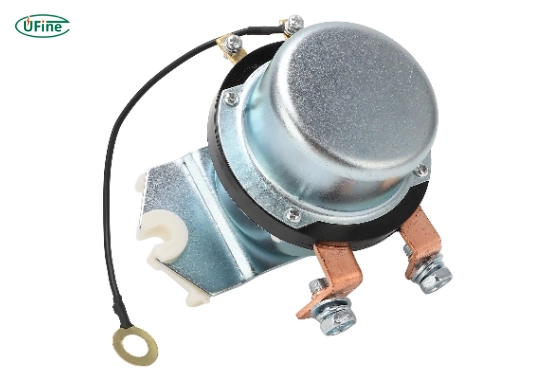
A typical battery relay includes:
- Coil
Creates a magnetic field when energized. - Armature
Moves under magnetic force to open or close contacts. - Contacts (NO / NC / Common)
NO (Normally Open)
NC (Normally Closed)
Common terminal for switching - Spring
Returns the relay to its default state. - Yoke
Guides magnetic flux for efficient operation. - Housing
Protects internal parts from dust, moisture, and vibration.
2 Battery relay key technical specifications
Industry standards ensure reliability and safety:
- SAE standards (vibration resistance)
- UL 508 (electrical safety)
Typical performance values of a battery relay:
- Contact resistance: ≤50 mΩ
- Insulation resistance: ≥100 MΩ
- Operating time: ≤15 ms
3 Battery relay specifications comparison
| Type | Voltage Range | Current Capacity | Lifespan | Best Use |
|---|---|---|---|---|
| Standard (SPDT) | 12–24V | 30–40A | ~100,000 cycles | Automotive |
| Heavy-duty | 24–48V | 80–100A | ~50,000 cycles | Marine / industrial |
| Solid-state (SSR) | 5–32V | 20–30A | ~500,000 cycles | Solar / automation |
Part 2. How does a battery relay work?
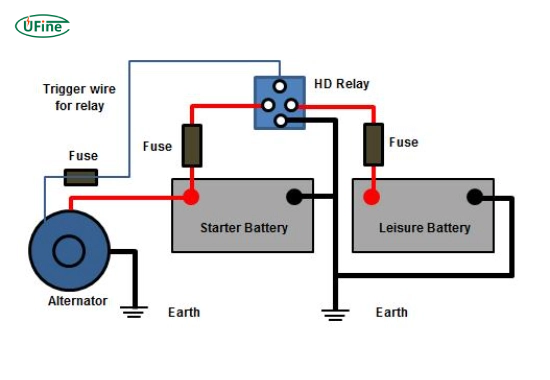
If you’re asking how does a battery relay work, the process is simple and efficient:
- Control signal applied (low voltage, e.g., 12V)
- Coil generates magnetic field
- Armature moves
- Contacts open or close
- Current flows or stops in the main circuit
This allows a small signal to control large loads (up to 100A or more).
Types of battery relays
Understanding types helps you choose the right battery relay switch:
- Standard relays
Mechanical contacts
Widely used in automotive systems - Latching relays
Maintain state without continuous power
Ideal for energy-saving systems - Solid-state relays (SSR)
No moving parts
Faster switching and longer life
Best for high-frequency switching - Automotive relays
Designed for vibration, heat, and harsh environments
Part 3. Applications of battery relays
Battery relays are used across many industries:
- Automotive systems
Headlights, fuel pumps, starter systems - Solar energy systems
Control battery-to-inverter connections
Improve system safety
👉 Related reading: Lithium Battery Voltage Guide
- Marine systems
Battery isolation and load distribution - Industrial & automation
Control motors, pumps, and control panels
1 Benefits of using a battery relay
- Improved safety: Prevent overload and short circuits
- Battery protection: Avoid unnecessary discharge
- Remote control: Operate high-power systems safely
- System reliability: Stable switching under load
Part 4. How to choose the right battery relay?
Choosing the correct relay battery is critical for performance and safety.
Key selection factors
- Voltage rating
Match system voltage (12V, 24V, 48V) - Current rating
Select ≥25% above peak load - Load type
Inductive (motors, pumps)
Resistive (heaters, lights) - Environment
Use IP67 for outdoor or marine
High-temp relays for industrial use
1 Battery relay selection checklist
Use this checklist when choosing the right battery relay switch or relay battery solution:
- Match voltage (±10% of system rating)
- Current rating ≥1.25× peak load
- Choose correct type (mechanical vs solid-state battery relay)
- Ensure proper IP rating for environment (IP67 for outdoor/marine)
- Select relays with built-in diode for inductive loads
- Verify UL / CE certification
Part 5. How to install a battery relay
Basic installation steps:
- Disconnect power
- Mount relay securely
- Connect wiring:
- Battery → relay input
- Relay output → load
- Ground connection
- Control switch → coil
- Test operation
👉 Tip: Always follow manufacturer wiring diagrams to avoid failure.
Part 6. Common battery relay problems
- Sticking contacts
Cause: wear or corrosion
Solution: replace or clean contacts - Burned coil
Cause: overvoltage or overheating - Wiring errors
Cause: incorrect installation
Result: system failure or short circuit
Regular inspection improves reliability and lifespan.
Part 7. FAQs about battery relay
What does a battery relay do?
A battery relay controls the flow of electricity between a battery and a load. It acts as a switch to protect the system and manage power distribution.
What is the difference between a relay and a battery relay switch?
They are essentially the same. “Battery relay switch” emphasizes its use in battery-powered systems.
How long does a battery relay last?
Typically 5–7 years or around 100,000 cycles. Harsh environments may reduce lifespan.
Can I bypass a battery relay?
Not recommended. Bypassing removes protection and increases risk of short circuits and battery drain.
Why is my battery relay clicking?
Common causes: low battery voltage, poor connections, faulty control signal.
Related Tags:

More Articles
Dead Battery or Device Failure? How to Find the Cause
Think your device is broken? Learn how to tell if the problem comes from battery aging or hardware failure before replacing your electronics.
Why iPhone Duo Uses Two Batteries: The Engineering Behind Foldable Phone Power
Why do foldable phones need two batteries? Explore the engineering challenges behind iPhone Duo’s dual-battery architecture and future battery trends.
Solid-State Batteries: 3 Myths You Need to Know
Solid-state batteries promise safer EVs and longer range, but the reality is more complex. Discover the challenges behind this next-gen technology.
Battery Capacity vs Discharge Rate: The Choice Engineers Face
Higher capacity or higher discharge rate? Learn how to choose the right LiPo battery for longer runtime, stable power output, and better device performance.
Battery Cable Size Guide: Choose the Right Wire Fast
Not sure what battery cable size you need? Learn how to select the right wire gauge, terminal size, and cable for safer, more efficient battery systems.