
Deep cycle battery size defines the battery’s physical dimensions and directly determines installation fit, usable capacity, weight, and application suitability in RV, marine, solar, and backup power systems.
Key Takeaways
- Deep cycle battery size refers to standardized physical dimensions (BCI groups), not capacity alone.
- Larger battery sizes generally offer higher Ah capacity, but chemistry and internal design matter just as much.
- Correct battery sizing starts with installation space, then power demand, then lifecycle economics.
- Deep cell batteries differ by type (FLA, AGM, Gel, Lithium), affecting weight, maintenance, and usable depth of discharge.
- Lithium (LiFePO4) batteries deliver the highest energy density and longest cycle life, often reducing required physical size.
- Mismatched battery sizes or types in a battery bank reduce efficiency and shorten system lifespan.
Part 1. What does deep cycle battery size mean?
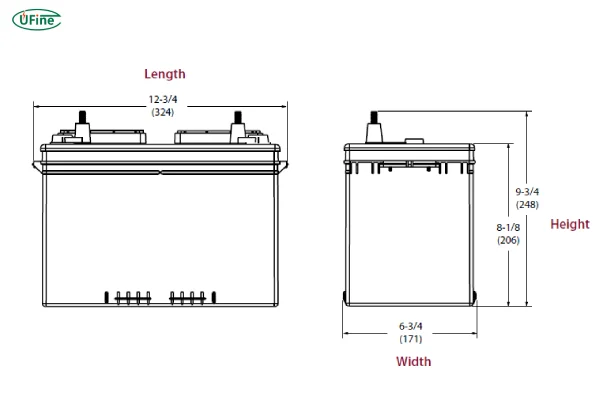
In the context of deep cycle batteries, size primarily refers to the battery’s physical dimensions: length, width, and height. These dimensions determine whether a battery fits safely into a designated compartment in an RV, boat, solar cabinet, or equipment enclosure.
Unlike starter batteries that prioritize short bursts of cranking power, deep cycle batteries are engineered for sustained energy delivery over long periods. As a result, physical size is closely related to:
- Energy storage capacity (Ah / Wh)
- Plate thickness and internal structure
- Battery weight and handling requirements
- Thermal performance and ventilation needs
To standardize fitment across applications, the Battery Council International (BCI) established group size classifications. These ensure batteries from different manufacturers share consistent external dimensions, even if internal capacity varies.
Part 2. Common deep cycle battery sizes (BCI groups)
The table below summarizes the most widely used deep cycle battery sizes. Dimensions are standardized, but internal capacity and chemistry may vary by manufacturer.
| Battery Group Size | Standard Dimensions (L × W × H) |
|---|---|
| Group 24 | 10.3″ × 6.6″ × 8.7″ |
| Group 27 | 12.0″ × 6.8″ × 8.9″ |
| Group 29 | 12.0″ × 6.5″ × 8.7″ |
| Group 31 | 13.0″ × 6.8″ × 9.4″ |
| Group 4D | 20.5″ × 10.5″ × 9.8″ |
| Group 8D | 20.7″ × 10.9″ × 9.3″ |
| GC2 (6V) | 10.0″ × 7.1″ × 11.0″ |
| L16 (6V) | 11.5″ × 7.3″ × 16.3″ |
| T-105 (6V) | 10.3″ × 7.1″ × 11.0″ |
Engineering note: Always verify manufacturer datasheets before procurement. Terminal orientation, handle height, and casing tolerance can vary slightly.
Part 3. How to choose the right deep cycle battery size
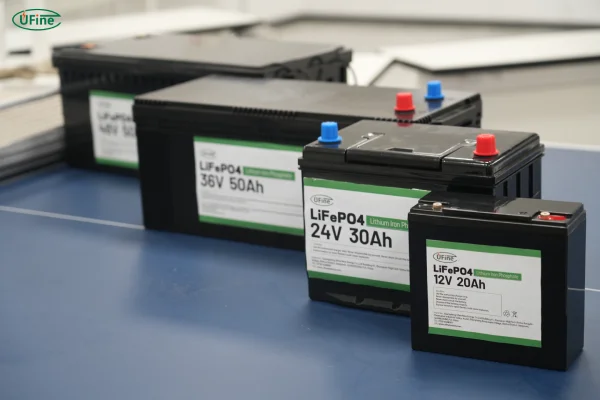
Step 1: Confirm installation space
Measure the battery compartment carefully, including clearance for cabling, ventilation, and maintenance access.
- Length & Width: Prevent vibration or movement during operation.
- Height: Especially critical in marine and enclosed systems.
Step 2: Match size to power demand
Physical size often correlates with capacity, but chemistry and plate design can significantly change usable energy.
- Light-duty loads: Group 24 / Group 27
- Medium RV / marine loads: Group 31
- High-demand or backup systems: Group 4D / 8D
Step 3: Evaluate battery weight
Larger batteries can exceed 60–70 kg. Weight limitations are critical for boats, trailers, and mobile platforms.
How Much Does a Deep Cycle Battery Weigh?
Part 4. Typical applications by deep cycle battery size
- Group 24–27: Small RVs, weekend boats, lighting systems
- Group 31: Larger RVs, marine electronics, refrigeration
- Group 4D / 8D: Commercial vehicles, backup power, industrial solar
- GC2 / L16 (6V): Golf carts, off-grid solar battery banks
Part 5. Key questions before choosing a deep cell battery
Selecting a deep cell battery requires evaluating both system requirements and battery limitations. The questions below cover the critical factors that determine battery compatibility, lifespan, and total cost of ownership.
1 What will the battery be used for?
The application determines the required battery size, capacity, discharge depth, chemistry, and expected cycle life.
2 What battery type fits your system?
- Flooded Lead Acid: Low upfront cost, requires regular maintenance
- AGM: Maintenance-free, moderate cycle life, good vibration resistance
- Gel: Tolerates deep discharge but requires precise charging control
- LiFePO4: High energy density, long cycle life, lightweight
Learn more about LiFePO4 batteries
3 What capacity (Ah) is required?
Calculate daily energy consumption and include a 20–30% reserve to reduce depth of discharge and extend battery life.
4 How many cycles are required over the system’s lifetime?
Cycle life directly affects replacement frequency, downtime, and long-term operating cost.
5 How will the battery be charged?
Charging profiles must match battery chemistry. AGM, Gel, and Lithium batteries require different voltage limits and charge stages.
6 Can the battery bank be configured safely?
All batteries in a bank should be identical in size, type, capacity, and age to avoid imbalance and premature failure.
7 What is the total cost of ownership?
Compare cost per cycle and expected service life instead of focusing only on initial purchase price.
Related Tags:

More Articles
Buck vs. Boost vs. Buck-Boost Converter: Which Is Best for Battery?
Not sure which converter your battery-powered device needs? Compare Buck, Boost, and Buck-Boost designs and discover what affects voltage stability and runtime.
How to Match 18650 Cells for a Reliable Battery Pack?
Building an 18650 battery pack? Learn how to compare cell capacity, voltage, and internal resistance to avoid mismatches and improve reliability.
Why Do 18650 Battery Packs Get Hot During Discharge?
Is your 18650 battery pack overheating under load? Learn what causes excess heat, how to spot dangerous symptoms, and what to do next.
18650 Battery BMS: How to Get the Specs Right
Learn how to choose a BMS for an 18650 battery pack. Compare voltage, current ratings, protection features, and balancing before you buy.
Why Does My Ring Camera Battery Drain So Fast or Stop Charging?
Is your Ring camera battery draining fast or not charging? Discover common causes, practical fixes, and when to replace the battery.


