Hot Selling 18650 Battery Pack
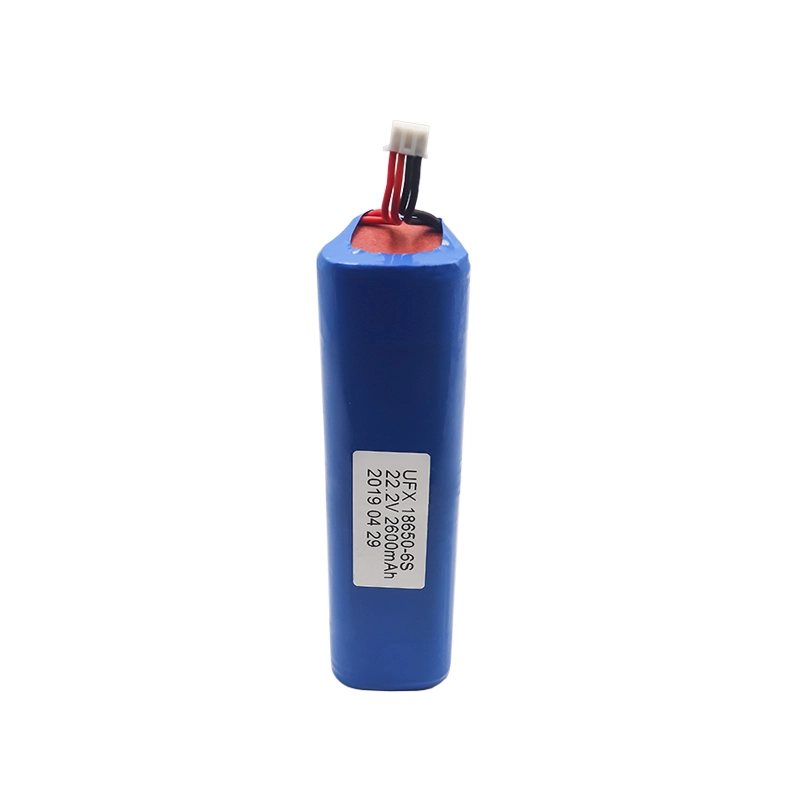
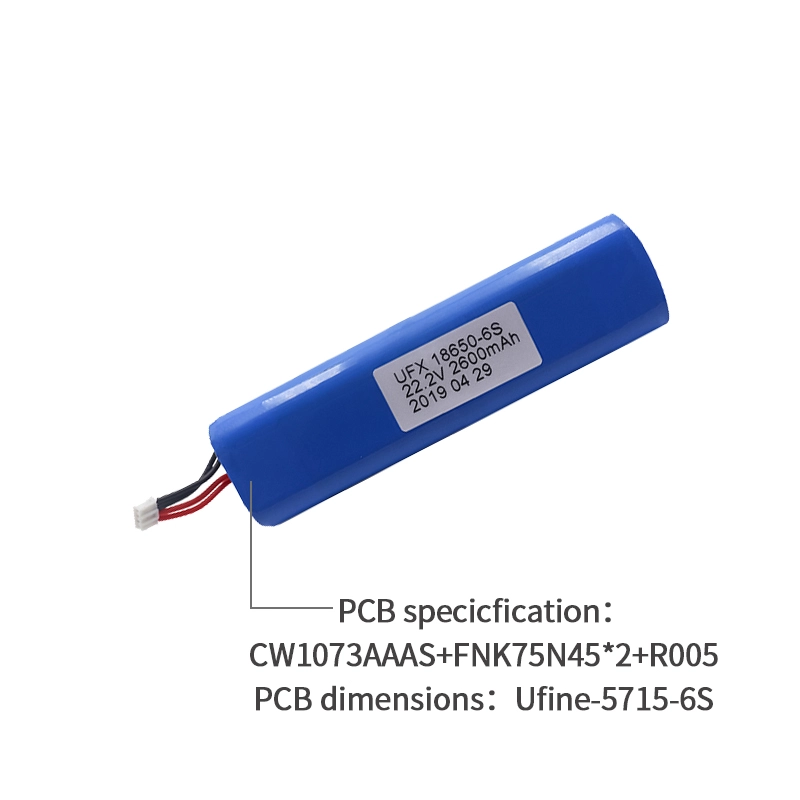
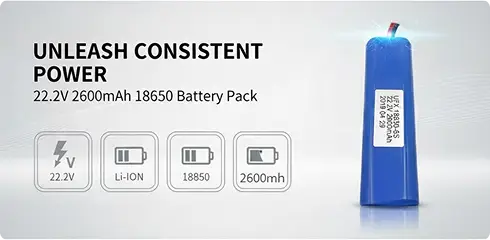
22.2 V 2600mah 18650 Battery Pack 18650-6S

- 16 Years Experience
- 200+ Certifications
- 1000+ Customers
- 7X24 Customer Support
-
Product Details
-
Specs
-
Content
-
FAQs

True 22.2V Output With Minimal Voltage Sag
Unlike many low-quality 6S packs that show noticeable voltage drop under load, this pack maintains a stable 22.2V thanks to optimized internal resistance (<260mΩ), ensuring consistent power delivery for high-performance devices.
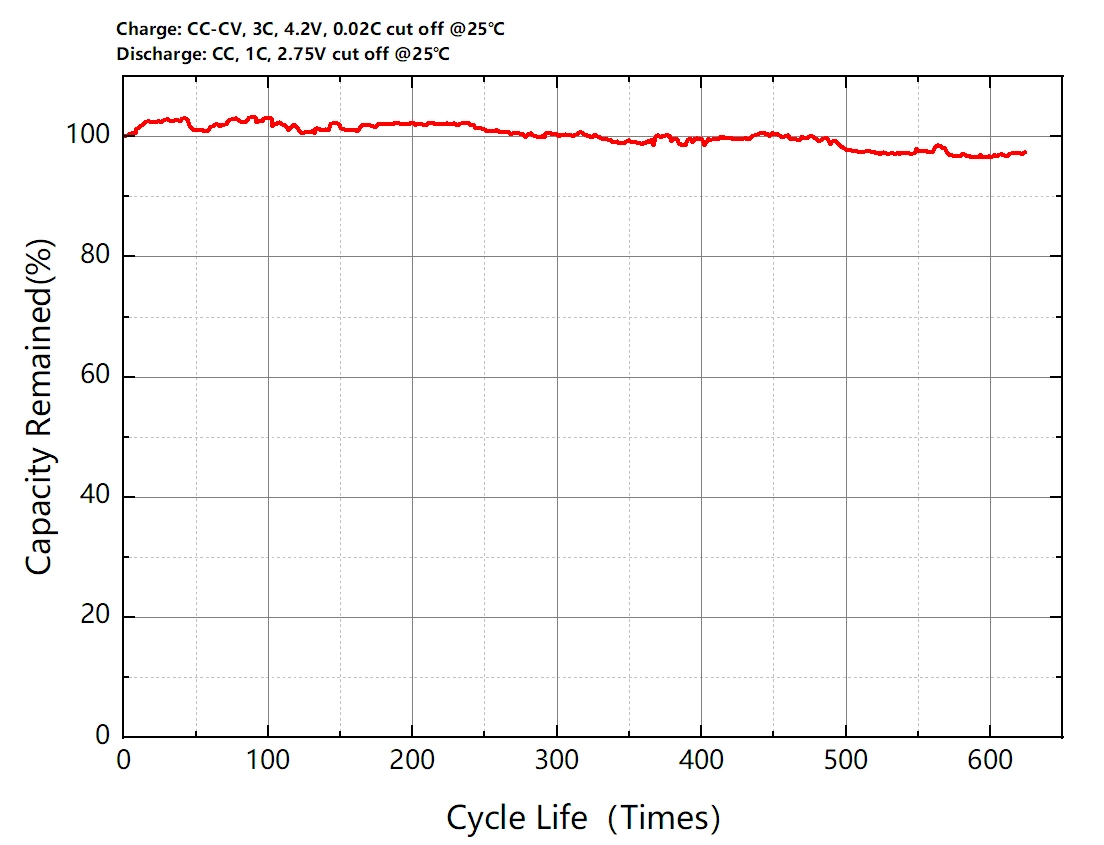
Test Curves of 3.7v Cell
Take a closer look at the battery test curves—see the stability and performance you can trust for all your power needs!
- Cycle Life
- Self-Discharge
- Discharge Rate
- Temp Performance
Long-Lasting Power
This battery is a long-lasting powerhouse, retaining over 95% of its initial capacity even after 600 charge-discharge cycles. This outstanding longevity ensures a reliable and consistent performance, making it the perfect choice for devices that require extended use and durability.
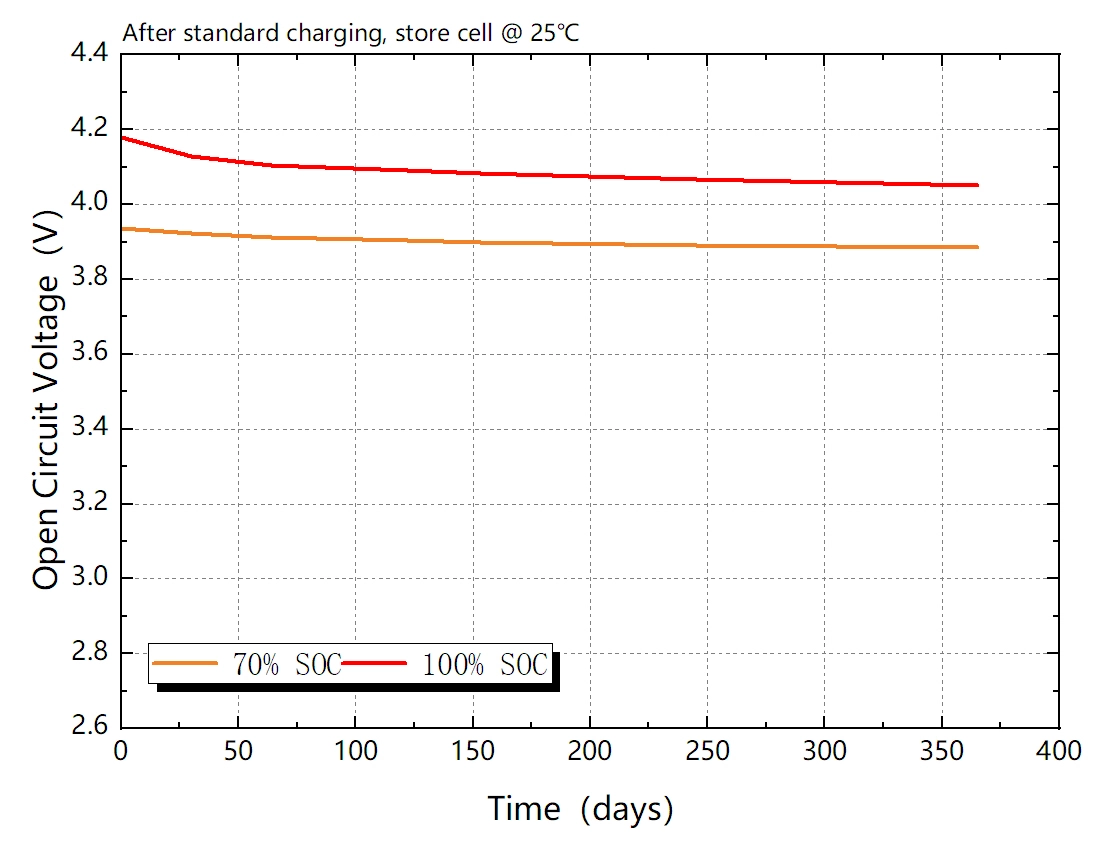
Incredible Charge Retention
With an incredibly low self-discharge rate, this battery holds its charge exceptionally well. After a full year of storage, its voltage only shows a minimal drop from 4.15V to 4.05V, keeping your device ready to go even after long periods of inactivity.
Learn More About Discharge Rate 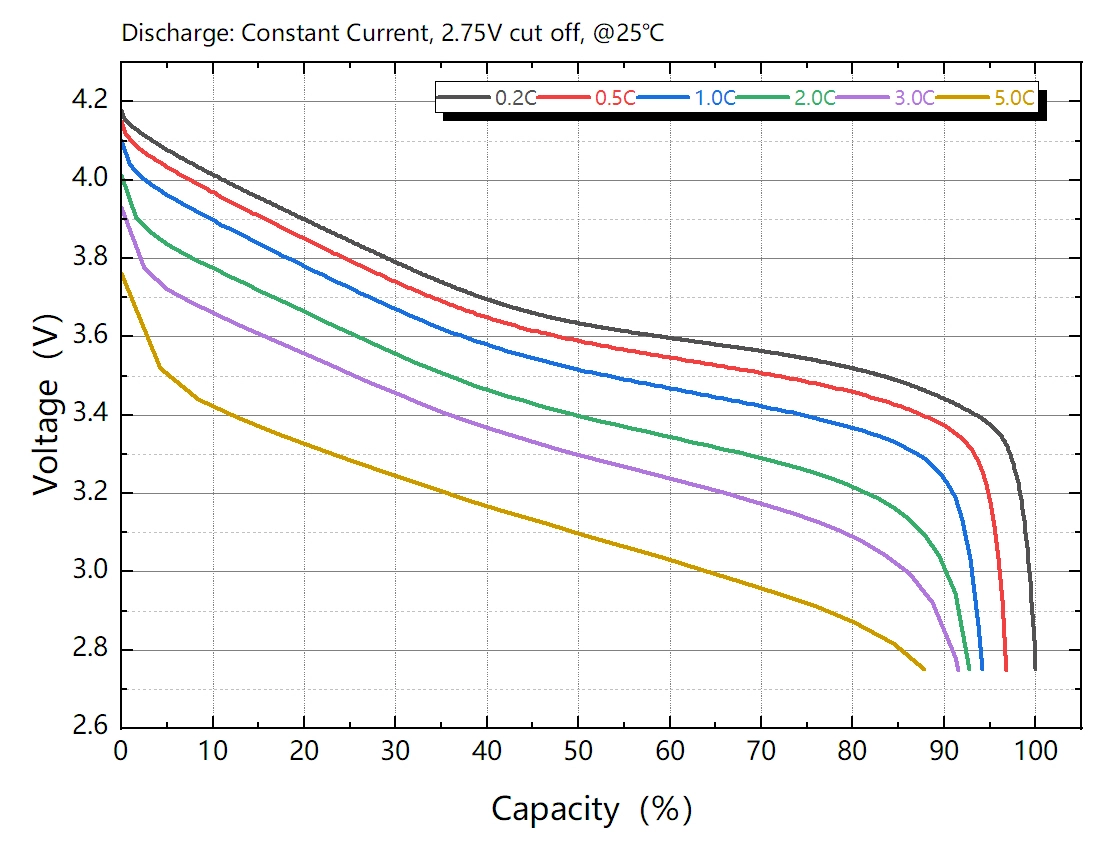
Discharge Characteristics
Experience stable and reliable power delivery. The battery maintains an operating voltage above 3.4V for over 80% of its discharge cycle, ensuring consistent performance. It also delivers high capacity, retaining over 90% even at a high 5.0C discharge rate.
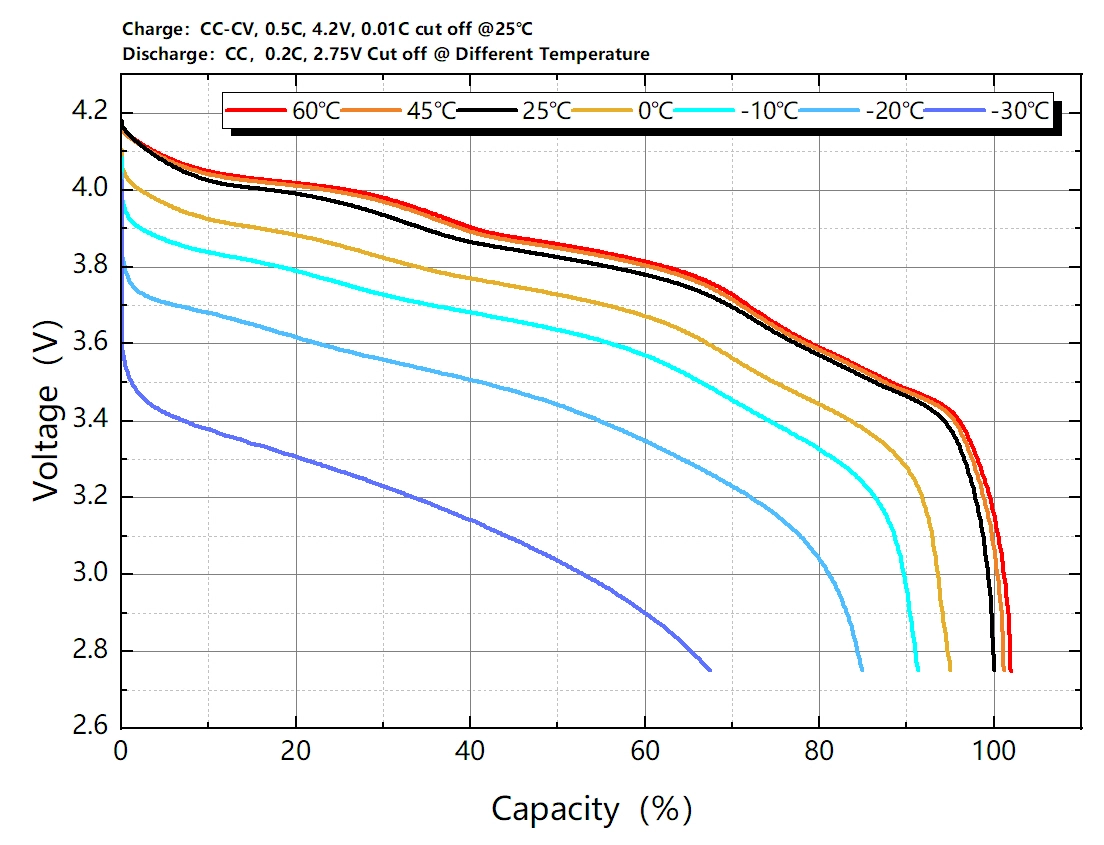
Extreme Temperature Performance
This battery is built for a wide range of climates. It offers consistent, high-capacity performance from 25°C to 60°C. Even in freezing conditions, it remains reliable, providing approximately 65% of its capacity at a frigid -30°C.
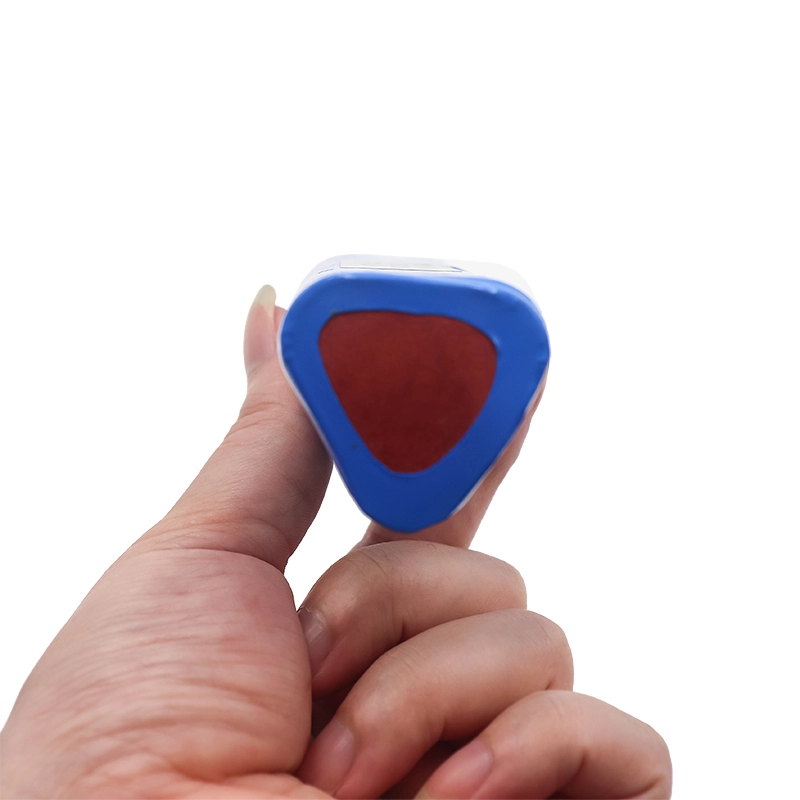
Trimetric Tri-Prism Design — Power That Fits
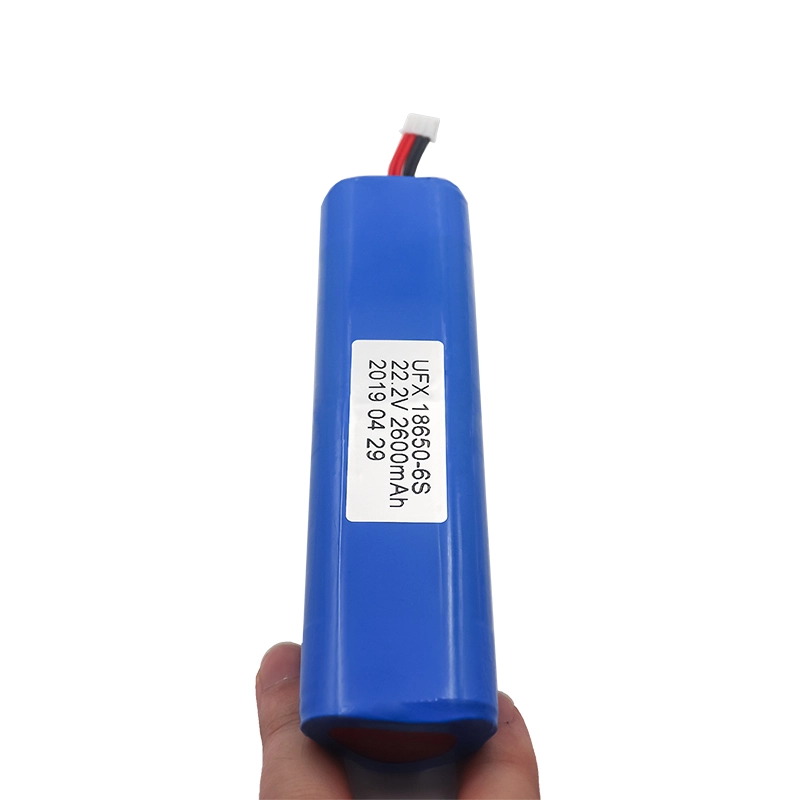
This 22.2V 6S pack uses a smart triangular-prism shape that hugs tight spaces and looks great in compact products. With its compact 36×39×140 mm size and efficient 6-series (6S) cell layout, the pack delivers high voltage in a slim, space-saving form—perfect for devices where every millimeter matters.

Simple, Safe, Ready to Connect
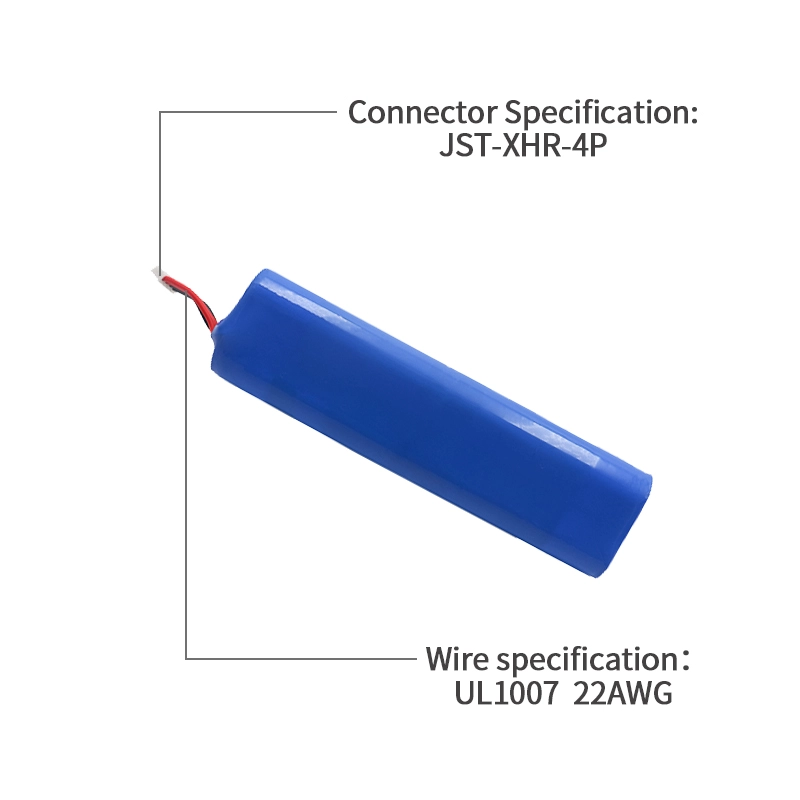
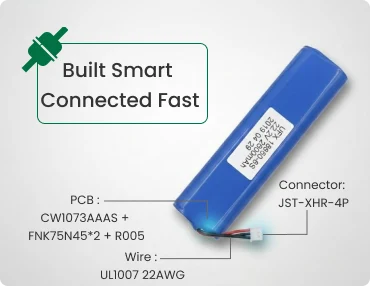
This battery pack features a built-in protection board with a standard JST-XHR connector and durable UL1007 wiring. Everything is pre-integrated for safe operation and quick, hassle-free installation—just plug it in and power up.
- Easy to integrate
- Easy to replace
- Safe for high-current reliability
- Great for manufacturers and prototyping teams.
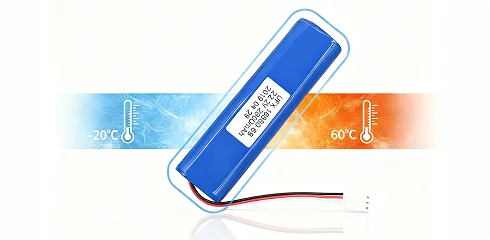
Wide Temperature Performance for All-Season Deployment
The –20°C to 60°C discharge range allows reliable operation in outdoor, industrial, and mobile systems—even in winter and high-heat conditions where many consumer-grade cells fail.
Why Choose Ufine Battery
Ufine Battery (Direct Factory)
- Direct manufacturer with full production control, ensuring consistent quality for every 18650 battery pack
- Volume-based pricing with competitive factory cost
- Supports custom battery pack size, PCM/BMS, connectors, cables, and configurations
- Flexible MOQ, suitable for prototypes and small pilot runs
- 17 years of lithium battery manufacturing experience; provides technical drawings, pack design, and engineering guidance
- Complete reports available: MSDS, UN38.3, CE, RoHS, etc.
- Stable production with predictable lead time, ideal for OEM/ODM projects
- Professional after-sales service with quick response for B2B clients
Ordinary Channels / Traders / Small Workshops
- Often resell from unknown factories; inconsistent quality and higher failure risk
- Middleman markups lead to unstable or higher pricing
- Limited or no customization; mostly standard products only
- High MOQ, difficult for new projects to start
- Little to no technical support; only sells finished goods
- Certifications often missing or incomplete, causing delays in shipping or customs
- Lead time uncertain; stock availability unstable
- Limited support; difficult to handle quality claims
Battery Specification
-
1. Mechanical Characteristics
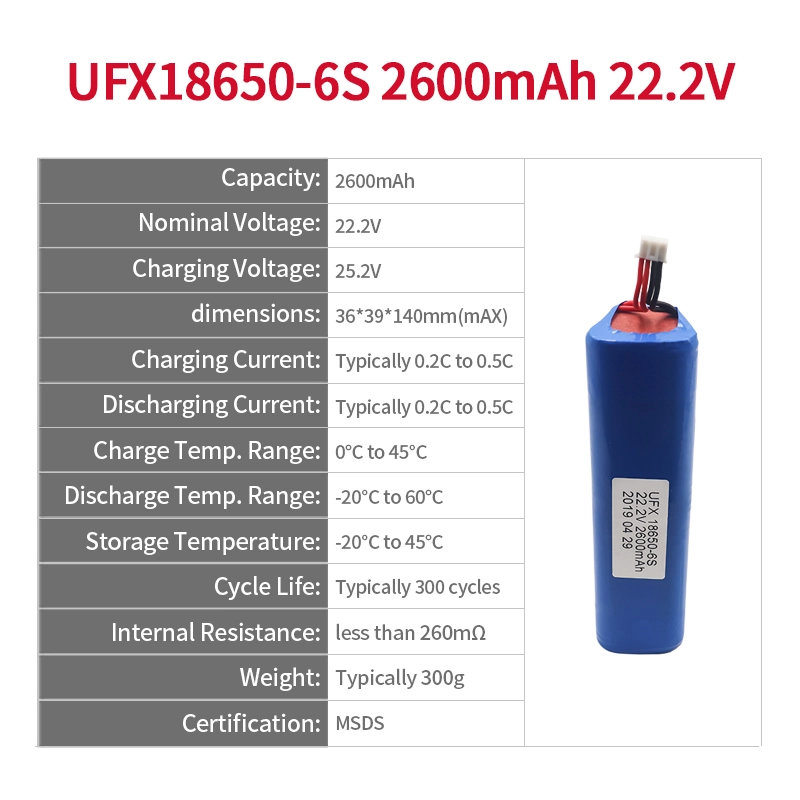
Cell 18650-6S PCM Yes NTC No Weight appr. 300g Configuration 6S1P -
2. Electrical Specification
Capacity 2600mAh Nominal Voltage 22.2V Energy 55.72Wh Internal Resistance less than 260mΩ Max. Charge Voltage 25.2V Discharge Cut Off 16.5V Max. Charge Current 1300mA Max. Discharge Current 1300mA Standard Charge Current 520mA Standard Discharge Current 520mA Charging Temperature 0℃ to 45℃ Discharging Temperature -20℃ to 60℃ Storage Temp.Range 1 year at -20℃ to +30℃ 3 mos. at -20℃ to +45℃ 1 mo. at -20℃ to +60℃ Cycle life 100 cycles ≥92% 300 cycles ≥88% 500 cycles ≥80% -
3. Cell protection
Overcharge Detection 4.28V ±50mV (80 to 200msec delay, release 4.08V ±50mV) Overdischarge Detection 2.4V ±100mV (40 to 120msec. delay, release 3.0V ±100mV) Overcurrent Detection 2.5A to 4.5A (5 to 10msec. delay) Short protection Yes
Part 1. What Do “S” and “P” Mean in Battery Packs?
Battery packs can be configured in two basic ways:
-
S (Series): Cells are connected end-to-end to increase voltage. Example: 6S = six cells in series → voltage adds up.
-
P (Parallel): Cells are connected side-by-side to increase capacity (mAh). Example: 2P = two cells in parallel → capacity doubles.
-
A pack like 6S1P means:
6 cells in series
1 cell in parallel
Final voltage = 6 × 3.7V = 22.2V
Capacity remains the same as a single cell
How to Connect Lithium Batteries in Series and Parallel?
Part 2. How Many Cells Are in a 6S Battery?
A 6S battery pack contains six individual cells wired in series. For a 6S 18650 pack, that means six cylindrical 18650 cells arranged in a layout (straight line, triangular prism, rectangular block, etc.) depending on the design.
- Nominal voltage: 3.7V × 6 = 22.2V
- Full charge voltage: 4.2V × 6 = 25.2V
- Cutoff voltage: 3.0V × 6 ≈ 18V
Part 3. 6S 18650 Pack vs. 6S LiPo Battery: What’s the Difference?
Although both are “6S” and share the same voltage, they are not the same.
| Type | Characteristics | Typical Use |
|---|---|---|
| 6S 18650 Battery Pack | Cylindrical cells, higher energy density, longer cycle life, better thermal stability, usually built-in BMS protection | Tools, portable devices, robotics, instruments |
| 6S LiPo Battery (Lithium Polymer) | Soft pouch cells, higher discharge rates (C-rate), lightweight and flexible shape, often uses balance charger without BMS | RC drones, racing, high-current projects |
Quick takeaway: → 18650 = safer, longer-lasting, more stable → LiPo = lighter, higher performance, but more fragile
Part 4. How Long Does a 2600mAh 6S Battery Last?
Runtime depends on current draw.
Formula: Runtime (hours) = Capacity (Ah) ÷ Load Current (A)
2600mAh = 2.6Ah
- Load: 1A → ≈ 2.6 hours
- Load: 2A → ≈ 1.3 hours
- Load: 0.5A → ≈ 5.2 hours
Keep in mind: Higher discharge currents shorten runtime. Temperature, age, and efficiency also affect performance.
Part 5. Does Fast Charging Damage Battery Life?
Yes—to a degree. Fast charging increases heat, and heat accelerates battery aging. This can:
- Reduce overall cycle life
- Damage internal SEI layers
- Increase internal resistance
- Cause voltage imbalance over time
What’s safe?
Charging at 0.2C–0.5C (as recommended for your 18650 pack) is the sweet spot. Fast charging is convenient, but standard charging significantly extends lifespan.
Part 6. How to Choose a Proper 6S Battery Charger
For a 6S lithium-ion pack, use a charger that meets these requirements:
✔ Output Voltage: 25.2V — The correct charging voltage for 6S Li-ion.
✔ Proper Charging Current — Match the range recommended by the battery manufacturer (typically 0.2C–0.5C).
✔ Support for Lithium-Ion Chemistry — Do NOT use a LiPo-only charger unless it's compatible with Li-ion settings.
✔ Overcharge & Short-Circuit Protection — If the pack includes its own BMS, choose a charger with stable CC/CV output.
✔ Reliable Brand — Cheap chargers can overshoot voltage and damage cells.
Part 7. Buyer’s Checklist
Before buying a 6S 18650 battery pack, confirm:
✔ Voltage: 22.2V nominal / 25.2V full
✔ Capacity meets your runtime needs
✔ Reliable BMS with overcharge/discharge protection
✔ Connector type matches your device (JST-XH, XT60, etc.)
✔ Dimensions fit your housing or design
✔ Temperature tolerance suits your environment
✔ Required certifications (MSDS, UN38.3 if shipping)
✔ Trusted manufacturer with real cell quality
Part 8. Common Mistakes to Avoid
❌ Using the wrong charger (wrong voltage or chemistry)
❌ Assuming mAh = runtime without considering current draw
❌ Buying packs without a proper BMS
❌ Storing batteries fully charged for long periods
❌ Mixing cells with different brands or ages
❌ Over-discharging below 3.0V per cell
❌ Installing in tight spaces without ventilation
FAQs
-
Can I connect two 6S 18650 battery packs in parallel?
Yes, but only if both packs are identical in voltage, capacity, and cell type. Otherwise, imbalances can cause overheating or damage. -
How do I store a 6S 18650 pack long-term?
Store at ~50% charge, in a cool, dry place. Avoid full charge or deep discharge during storage. -
Can 6S 18650 packs be used in high-drain drones?
Yes, if the pack’s C-rate supports the required discharge current and it has proper BMS protection. -
What happens if I exceed the maximum voltage of a 6S pack?
Overvoltage can damage cells, shorten lifespan, and may lead to swelling or thermal runaway. -
How do I know if my 6S battery pack is fully balanced?
Use a BMS or voltage monitoring tool. All six cells should have nearly equal voltage (<0.05V difference).
Ready to Power Your Project?
We’ll help you design the perfect power source — tailored to your voltage, capacity, size, C-rate, and performance needs.
Contact Us NowWhat Our Customers Are Saying
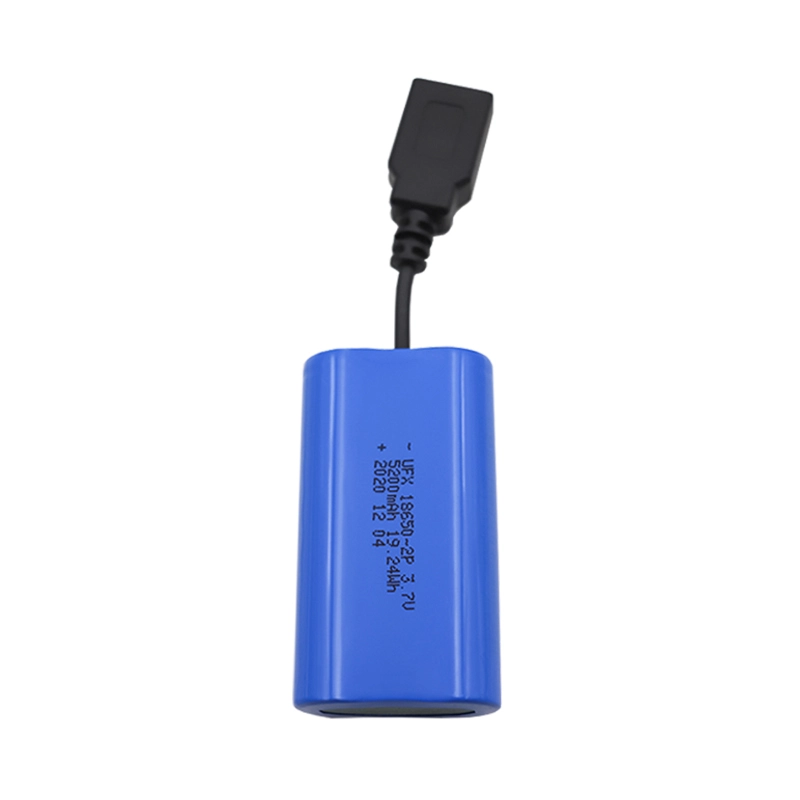
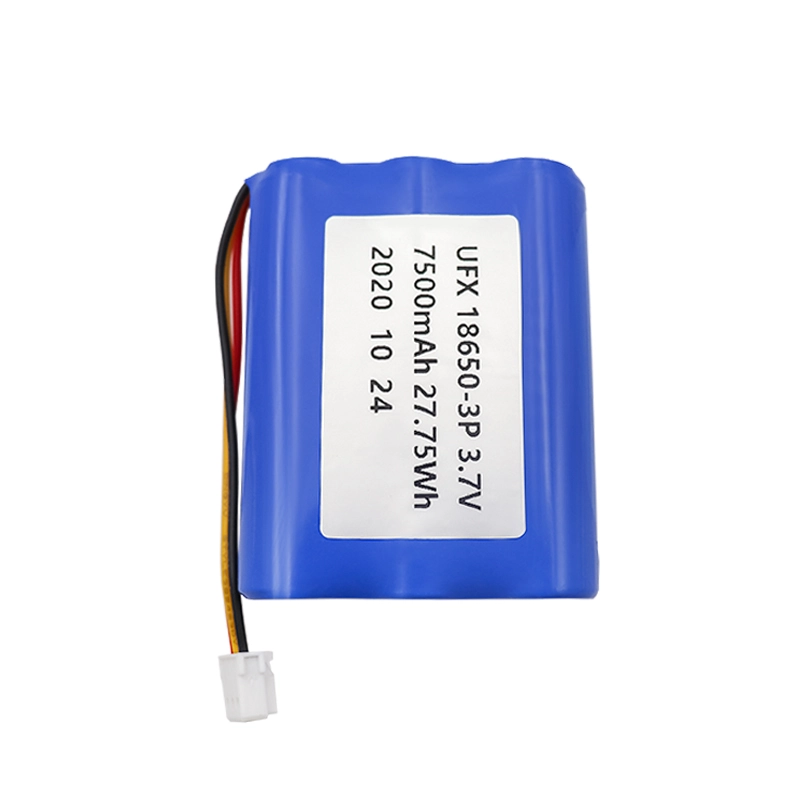
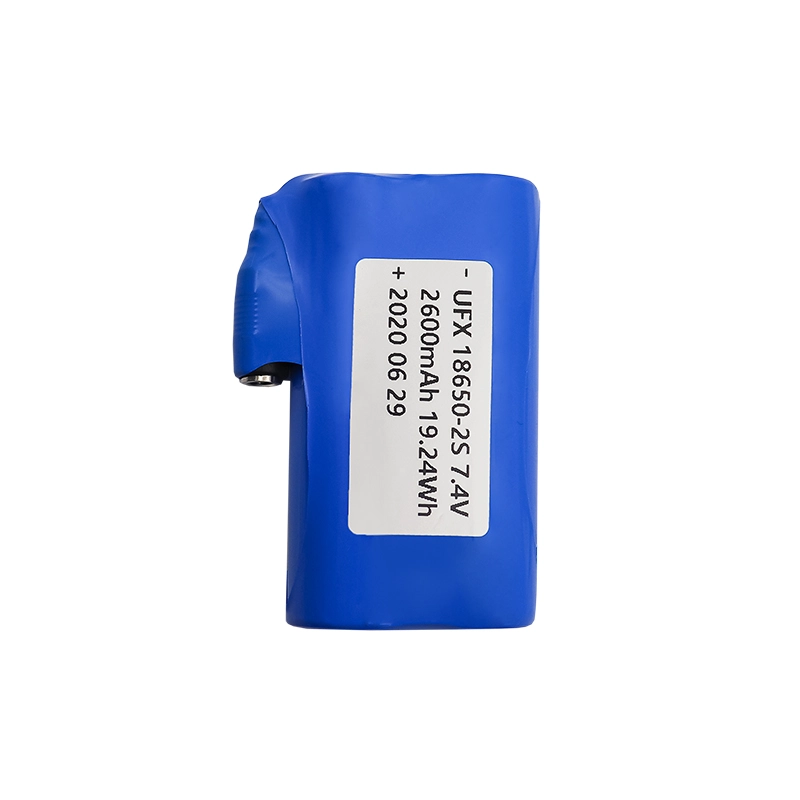
We love hearing from you! Your experiences help us improve and inspire others. Check out what our happy customers have to say about our lithium batteries—share your thoughts with us too!









Latest Articles
About Lithium Battery Industry News
Buck vs. Boost vs. Buck-Boost Converter: Which Is Best for Battery?
Not sure which converter your battery-powered device needs? Compare Buck, Boost, and Buck-Boost designs and discover what affects voltage stability and runtime.
2026-10-20 Ufine

How to Match 18650 Cells for a Reliable Battery Pack?
Building an 18650 battery pack? Learn how to compare cell capacity, voltage, and internal resistance to avoid mismatches and improve reliability.
2026-10-19 Ufine

Why Do 18650 Battery Packs Get Hot During Discharge?
Is your 18650 battery pack overheating under load? Learn what causes excess heat, how to spot dangerous symptoms, and what to do next.
2026-10-19 Ufine