
- Part 1. Key takeaways
- Part 2. What is a 100 watt hour battery?
- Part 3. What does wh mean in batteries?
- Part 4. How does a 100wh battery work?
- Part 5. How long does a 100wh battery last?
- Part 6. Why is the 100wh limit important for air travel?
- Part 7. Common applications of 100wh batteries
- Part 8. 100wh lithium battery vs car battery watt hours
- Part 9. Types of 100wh battery chemistries
- Part 10. How to choose the right 100wh battery?
- Part 11. Are 100wh batteries safe?
- Part 12. Future trends in 100wh batteries
- Part 13. FAQs about 100 watt hour battery
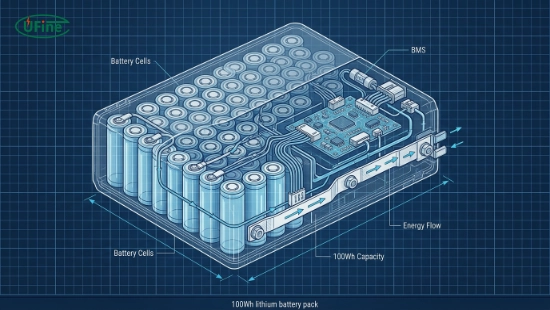
A 100Wh battery stores 100 watt hours of energy and is commonly used in laptops, drones, power banks, and portable electronics. It offers a good balance between runtime, portability, and airline safety compliance. Understanding watt hours helps you compare battery capacity, estimate runtime, and choose the right lithium battery for your application.
Part 1. Key takeaways
- A 100 watt hour battery stores 100Wh of energy.
- Watt hours measure battery energy capacity, not output power.
- A 100Wh battery can theoretically run a 100W device for 1 hour.
- Most airlines allow batteries under 100Wh in carry-on luggage.
- 100Wh lithium batteries are common in drones, laptops, power banks, and portable electronics.
- Battery runtime depends on device wattage, efficiency, and temperature.
- Lithium-ion and LiFePO4 are the most common chemistries used in 100Wh battery packs.
Part 2. What is a 100 watt hour battery?
A 100 watt hour battery is a battery capable of storing 100 watt hours (Wh) of electrical energy.
In simple terms:
- It can supply 100 watts for 1 hour
- Or 50 watts for 2 hours
- Or 10 watts for 10 hours
The watt-hour rating tells you how much total energy the battery can deliver before it needs recharging.
Many people search for:
- what is 100 watt hours
- what is a 100wh battery
- wh battery meaning
The answer is simple: watt hours measure stored energy capacity, similar to how a fuel tank measures how much fuel a vehicle can hold.
Today, 100Wh batteries are widely used in:
- Portable power banks
- Laptops and mobile workstations
- Drone battery packs
- Camera systems
- Medical devices
- Portable industrial equipment
- Outdoor and camping power systems
Part 3. What does wh mean in batteries?
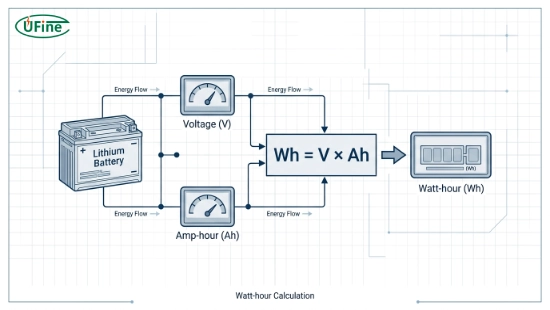
The term Wh battery meaning refers to the amount of energy stored inside a battery.
The formula is:
Wh = V × Ah
Where:
- Wh = watt hours
- V = voltage
- Ah = amp hours
For example:
- A 12V battery with 8.3Ah capacity: 12 × 8.3 ≈ 100Wh
This calculation is important because amp hours alone do not show total energy unless voltage is included.
Watt hours vs amp hours:
| Measurement | Meaning | Best Used For |
|---|---|---|
| Amp Hours (Ah) | Current capacity | Comparing similar-voltage batteries |
| Watt Hours (Wh) | Total stored energy | Comparing all battery systems |
This is why airlines, engineers, and power station manufacturers usually use watt hours instead of amp hours.
For a deeper comparison, see Ufine’s Watt Hours to Amp Hours Guide.
Part 4. How does a 100wh battery work?
A 100Wh battery stores energy chemically and releases it as electricity when connected to a device.
The process happens in three stages:
Charging
Electrical energy flows into the battery and is stored chemically inside the cells.
Energy storage
Lithium ions move between electrodes and remain stored until needed.
Discharging
When powering a device, the battery converts chemical energy back into electrical energy.
Most modern 100 watt hour lithium batteries use:
- Lithium-ion (Li-ion)
- Lithium polymer (LiPo)
- Lithium iron phosphate (LiFePO4)
Each chemistry has different advantages in energy density, cycle life, safety, and cost.
Part 5. How long does a 100wh battery last?
Battery runtime depends on device power consumption.
The formula is:
Runtime (hours) = Battery Capacity (Wh) ÷ Device Power (W)
Runtime examples:
| Device Power Consumption | Estimated Runtime |
|---|---|
| 10W LED light | About 10 hours |
| 20W laptop | About 5 hours |
| 50W monitor | About 2 hours |
| 100W device | About 1 hour |
Real-world runtime is usually 10–15% lower because of:
- Power conversion losses
- Battery aging
- Cold temperatures
- Device efficiency variations
Part 6. Why is the 100wh limit important for air travel?
The 100 watt hour battery threshold is important because many airlines follow this limit for lithium battery safety.
According to the International Air Transport Association (IATA) Lithium Battery Guidance:
- Batteries under 100Wh are generally allowed in carry-on luggage.
- Batteries between 100Wh and 160Wh may require airline approval.
- Batteries above 160Wh are heavily restricted.
This is why many manufacturers design portable power banks and laptop batteries close to — but below — 100Wh.
A 100 watt hour power bank is popular with travelers because it maximizes usable energy while remaining airline compliant.
Important travel tips:
- Carry lithium batteries in hand luggage only.
- Protect terminals from short circuits.
- Use protective battery cases when traveling.
- Check airline-specific regulations before flying.
Part 7. Common applications of 100wh batteries
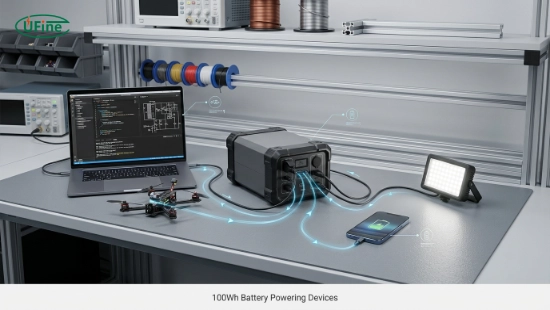
Laptops and mobile workstations
High-performance laptops often use batteries close to 100Wh for longer runtime.
Drones
Professional drones require lightweight batteries with high energy density.
Portable power banks
A 100 watt hour power bank can charge:
- Smartphones multiple times
- Tablets several times
- Laptops one or two times
Medical devices
Portable diagnostic and monitoring equipment often relies on compact lithium batteries.
Outdoor and camping systems
100Wh batteries are common in:
- Portable lighting
- Mini refrigerators
- CPAP machines
- Portable communication systems
Part 8. 100wh lithium battery vs car battery watt hours
Many users compare portable batteries with vehicle batteries.
Typical comparison:
| Battery Type | Approximate Capacity |
|---|---|
| 100Wh lithium battery | 100Wh |
| Small motorcycle battery | 100–300Wh |
| Standard car battery | 500–1000Wh+ |
This explains why car battery watt hours are much higher than portable electronics batteries.
However, car batteries are designed for engine starting current, not portable energy storage.
Portable lithium batteries provide:
- Lower weight
- Better energy density
- Rechargeability
- Portable form factor
Part 9. Types of 100wh battery chemistries
1 Lithium-ion (Li-ion)
Most common option for laptops and portable electronics.
Advantages:
- High energy density
- Lightweight
- Widely available
2 Lithium polymer (LiPo)
Common in drones and slim electronics.
Advantages:
- Flexible shapes
- High discharge rates
- Compact design
3 LiFePO4 (lithium iron phosphate)
Increasingly popular for industrial and outdoor applications.
Advantages:
- Long cycle life
- Better thermal stability
- Improved safety
You can also explore Ufine custom lithium battery solutions for industrial and OEM applications.
Part 10. How to choose the right 100wh battery?
Choosing the correct battery depends on more than just capacity.
1. Check voltage compatibility
The battery voltage must match your device requirements.
2. Consider battery chemistry
Different chemistries affect:
- Weight
- Safety
- Cycle life
- Discharge performance
3. Evaluate cycle life
Industrial users should prioritize longer lifespan batteries.
4. Verify safety certifications
Look for certifications such as:
- UN38.3
- CE
- UL
- IEC standards
Fast charging may require specialized battery management systems (BMS).
Part 11. Are 100wh batteries safe?
Yes. Modern lithium batteries are generally safe when properly designed and used.
Most quality battery packs include a Battery Management System (BMS) that protects against:
- Overcharging
- Over-discharging
- Short circuits
- Overheating
- Overcurrent conditions
Battery safety best practices:
- Use approved chargers only.
- Avoid puncturing or crushing batteries.
- Do not expose batteries to extreme heat.
- Store batteries at partial charge for long-term storage.
- Replace swollen or damaged batteries immediately.
For official battery transport guidance, refer to the FAA lithium battery safety page.
Part 12. Future trends in 100wh batteries
Battery technology continues to improve rapidly.
Key developments include:
- Higher energy density cells
- Faster charging systems
- Safer solid-state batteries
- Longer cycle life designs
- Improved thermal management
As portable electronics, robotics, drones, and renewable energy systems expand, demand for compact high-capacity lithium batteries will continue to grow.
Part 13. FAQs about 100 watt hour battery
What is 100 watt hours?
100 watt hours means a battery can theoretically deliver 100 watts for one hour, or smaller amounts of power over a longer period.
Can I take a 100Wh battery on a plane?
Yes. Most airlines allow batteries under 100Wh in carry-on baggage, although airline policies should always be checked before travel.
How many phone charges can a 100 watt hour power bank provide?
A 100Wh power bank can usually charge a modern smartphone about 5–7 times, depending on phone battery size and conversion efficiency.
Is a 100Wh battery large?
For portable electronics, a 100Wh battery is considered relatively large. For automotive or solar systems, it is comparatively small.
What is the difference between a 100Wh battery and a 100W device?
A 100Wh battery measures stored energy. A 100W device measures power consumption rate. One describes capacity, the other describes usage speed.
Related Tags:

More Articles

JST vs Molex: The Right Battery Connector Choice
JST or Molex for your battery? Learn how connector selection affects current, voltage drop, reliability, and device performance.
Custom Battery Pricing: Costs Manufacturers Don’t Mention
A low battery quote may not be the final cost. Discover common hidden expenses that affect custom lithium battery projects.
Battery Wire Length: Hidden Cause of Power Loss
A longer battery wire can cause voltage drop, power loss, and unstable operation. Learn how wire length affects battery performance.
How Device Sleep Modes Affect Battery Life
Think sleep mode extends battery life? Learn why devices still drain power and how firmware, hardware, and batteries affect runtime.
LiPo Battery and PCB Design: Clearance, Insulation, and Placement
Learn how to optimize LiPo battery PCB clearance, insulation, placement, wiring, and thermal design—and avoid common integration mistakes.


