
- Part 1. Why battery performance matters in floor scrubbers
- Part 2. Main Types of floor scrubber batteries
- Part 3. Floor scrubber battery comparison
- Part 4. Understanding voltage and capacity in floor machine batteries
- Battery Run Time
- Part 5. Why lithium batteries are replacing lead-acid in commercial cleaning
- Part 6. Common floor scrubber battery problems
- Part 7. Choosing the right battery for different industries
- Part 8. Can you upgrade a floor scrubber to lithium?
- Part 9. Custom lithium battery solutions for floor machines
- Part 10. FAQs
A floor machine battery is the main energy source used in commercial cleaning equipment including walk-behind scrubbers, ride-on scrubbers, floor polishers, burnishers, and automatic floor cleaning machines. The battery supplies electrical power to every major operating system inside the machine.
Modern floor scrubbers depend on battery power for propulsion motors, rotating brushes, vacuum suction motors, water pumps, onboard electronics, and control systems. Unlike smaller consumer cleaning tools, industrial floor machines require high-capacity deep-cycle batteries capable of delivering stable power continuously for several hours under heavy load conditions.
Because commercial cleaning environments often involve large floor areas and long operating shifts, the battery must withstand repeated deep discharge cycles while maintaining consistent voltage output. If voltage drops too quickly during operation, cleaning performance immediately suffers. Brush motors lose torque, water recovery becomes less efficient, and machine movement becomes weaker and less stable.
This is why commercial cleaning operators increasingly evaluate batteries not simply by price, but by overall operating efficiency and long-term reliability.
Part 1. Why battery performance matters in floor scrubbers

Many operators underestimate how strongly battery performance affects actual cleaning results. Two machines with identical motors and brush systems can perform very differently depending on the battery installed.
Lithium-ion batteries maintain relatively stable voltage throughout the discharge cycle. As a result, the scrubber delivers consistent cleaning pressure and suction performance even after several hours of operation. Lead-acid batteries behave differently because voltage gradually declines during discharge. Operators often notice weaker brush rotation, slower machine response, and reduced suction toward the end of a cleaning shift.
Charging speed also has a major operational impact. Traditional lead-acid floor scrubber batteries commonly require eight to ten hours of charging plus additional cooling time. This forces many cleaning companies to maintain spare machines or extra battery sets. Lithium batteries reduce this downtime significantly because they support fast charging and opportunity charging between shifts or during breaks.
Battery weight further influences machine usability. Lead-acid batteries are extremely heavy, especially in larger ride-on scrubbers. The extra weight increases transportation difficulty, creates more strain on drive motors, and may contribute to operator fatigue during maneuvering. Lithium battery systems are substantially lighter, improving machine handling and efficiency without sacrificing runtime.
Perhaps the most overlooked factor is total operating cost. Lead-acid batteries usually appear cheaper at the time of purchase, but their shorter lifespan, higher maintenance needs, lower energy efficiency, and more frequent replacement cycles often result in higher long-term costs.
Part 2. Main Types of floor scrubber batteries
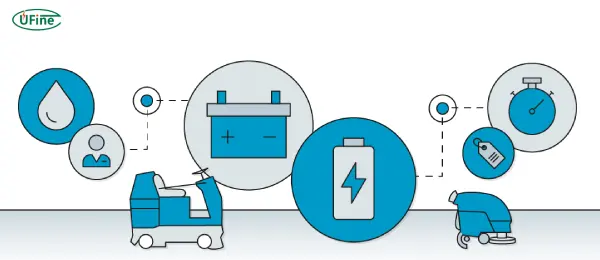
Commercial floor cleaning equipment commonly uses four battery categories, each with different performance characteristics, maintenance requirements, and cost structures.
1 Flooded Lead-Acid Batteries
Flooded lead-acid batteries remain common in older or lower-cost floor scrubbers. They use liquid electrolyte and require periodic watering to maintain performance. These batteries are relatively inexpensive initially, which makes them attractive for small businesses with limited budgets.
However, flooded batteries also present several operational disadvantages. They are heavy, require routine maintenance, generate gas during charging, and can suffer from sulfation if charging practices are inconsistent. In demanding commercial cleaning environments, their shorter cycle life often leads to more frequent replacement costs.
2 AGM Batteries
AGM (Absorbent Glass Mat) batteries are sealed lead-acid batteries designed to reduce maintenance requirements. Because the electrolyte is absorbed into fiberglass mats, AGM batteries are spill-resistant and safer than flooded systems.
AGM batteries offer improved vibration resistance and eliminate watering requirements, making them more convenient for medium-duty cleaning applications. However, they still suffer from many limitations associated with lead-acid chemistry, including lower energy density and relatively limited cycle life.
3 Gel Batteries
Gel batteries use silica-thickened electrolyte to improve stability and deep-cycle durability. These batteries perform better under vibration and repeated deep discharge conditions compared to flooded systems.
Gel batteries are commonly used in environments requiring reliable deep cycling and improved spill resistance. However, charging sensitivity and higher costs have limited their adoption in many commercial cleaning operations.
4 Lithium-Ion Batteries
Lithium-ion batteries, especially LiFePO4 chemistry, have become increasingly dominant in modern floor scrubbers because they provide longer runtime, significantly longer cycle life, fast charging capability, lightweight construction, and virtually maintenance-free operation.
Lithium battery systems also support advanced battery management systems (BMS), which improve safety, optimize charging performance, balance cell voltage, and protect against overheating or overcurrent conditions.
For commercial cleaning companies operating multiple shifts or large facilities, lithium technology often delivers substantial productivity improvements and lower long-term operating costs.
Part 3. Floor scrubber battery comparison
| Feature | Lithium-Ion (LiFePO4) | Flooded Lead-Acid | AGM | Gel |
|---|---|---|---|---|
| Average Cycle Life | 2000–4000 cycles | 300–500 cycles | 400–600 cycles | 500–800 cycles |
| Charging Time | 2–3 hours | 8–10 hours | 6–8 hours | 6–8 hours |
| Maintenance | None | Regular watering | Minimal | Minimal |
| Weight | Lightweight | Very heavy | Heavy | Heavy |
| Energy Efficiency | 95%+ | 75–80% | 80–85% | 80–85% |
| Runtime Stability | Excellent | Moderate | Moderate | Good |
| Upfront Cost | High | Low | Medium | Medium-high |
| Long-Term Operating Cost | Lower | Higher | Moderate | Moderate |
The table clearly shows why lithium technology has become the preferred option for many commercial cleaning operations despite the higher initial investment.
Five-year cost comparison: lithium vs lead-acid

| Cost Factor | Lead-Acid System | Lithium-Ion System |
|---|---|---|
| Initial Battery Cost | Lower | Higher |
| Average Replacements Over 5 Years | 2–4 sets | 1 set |
| Charging Downtime | High | Low |
| Maintenance Labor | Frequent | Minimal |
| Electricity Efficiency | Lower | Higher |
| Machine Availability | Reduced | Improved |
| Long-Term Operating Cost | Higher | Lower |
| Productivity Impact | Moderate | High |
Although lithium batteries require higher initial investment, many commercial users recover the difference through reduced replacement costs, lower labor expenses, and improved machine uptime.
Part 4. Understanding voltage and capacity in floor machine batteries
One of the most misunderstood aspects of floor scrubber batteries is the relationship between voltage, amp-hour capacity, and runtime.
Most commercial floor machines operate using 24V, 36V, or 48V battery systems. Smaller walk-behind scrubbers commonly use 24V systems because they require lower power output and prioritize compact size. Larger ride-on scrubbers often use 36V or 48V configurations because higher voltage reduces current demand and improves efficiency under heavy loads.
Battery capacity is typically measured in amp-hours (Ah). A higher Ah rating generally indicates longer runtime, although actual operating time also depends heavily on machine power consumption, brush pressure settings, floor conditions, and operator behavior.
Theoretical runtime can be estimated using the following formula:
Runtime (hours)=Battery Capacity (Ah)×Voltage (V)/Machine Power Consumption (W)
For example, a 24V 100Ah lithium battery stores approximately 2400Wh of energy. If a floor scrubber consumes 800W during operation, the estimated runtime would be roughly three hours under typical conditions.
However, real-world runtime varies depending on floor type, brush pressure, water usage, machine speed, incline, and battery age.
Part 5. Why lithium batteries are replacing lead-acid in commercial cleaning
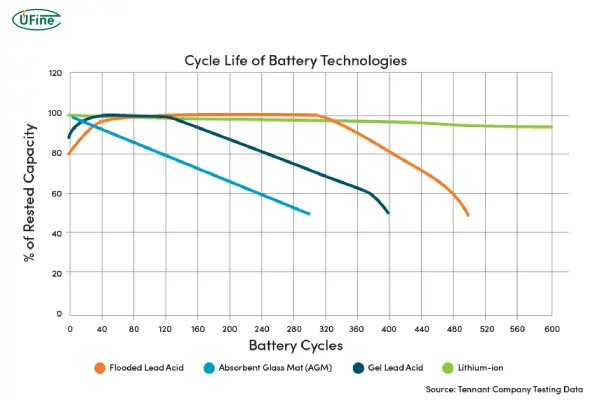
The shift toward lithium floor scrubber batteries is not simply a technology trend. It is largely driven by operational economics and labor efficiency.
Commercial cleaning companies increasingly operate under pressure to reduce labor costs while maximizing machine uptime. Because labor often represents the largest cleaning expense, downtime caused by battery charging or maintenance directly impacts profitability.
Lithium batteries improve operational efficiency in several important ways. Fast charging allows machines to return to service quickly instead of sitting idle overnight. Stable voltage output maintains cleaning consistency throughout the entire shift. Lower battery weight reduces strain on machine components and improves maneuverability. Maintenance-free operation eliminates the labor associated with watering, equalization charging, terminal cleaning, and corrosion management.
Multi-shift facilities such as airports, logistics warehouses, shopping centers, hospitals, and manufacturing plants particularly benefit from lithium battery systems because machines may operate nearly continuously throughout the day.
Another major advantage is lifespan. A high-quality LiFePO4 battery may last several thousand cycles, while lead-acid systems often require replacement after only a few hundred deep cycles. This significantly changes the long-term economics of commercial floor cleaning operations.
Part 6. Common floor scrubber battery problems
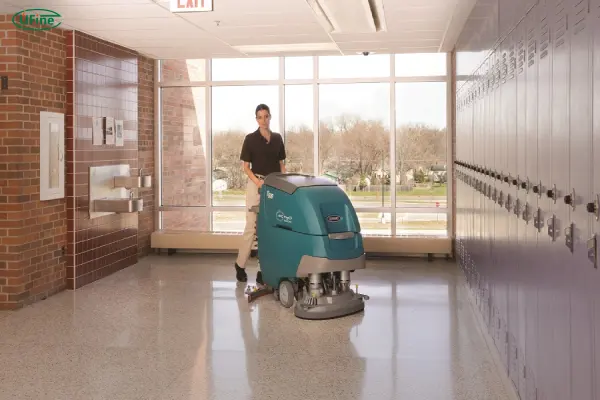
Battery-related problems are among the most common causes of floor scrubber downtime. Understanding these issues helps operators avoid expensive repairs and premature battery failure.
One of the most frequent complaints is reduced runtime. In lead-acid batteries, this often results from sulfation caused by incomplete charging or long-term storage in a discharged state. Sulfation gradually reduces battery capacity and charging efficiency. Lithium batteries are less vulnerable to sulfation but may still experience capacity loss if repeatedly exposed to excessive heat or improper charging equipment.
Another common issue is slow charging or charging failure. Faulty chargers, damaged connectors, loose terminals, incompatible charging profiles, or BMS protection shutdowns can all interrupt normal charging operation. In lithium systems, a protective shutdown may occur if voltage, temperature, or current exceeds safe operating limits.
Voltage sag under heavy load is another major performance issue. Operators may notice that the machine suddenly loses power when brushes engage or when climbing ramps. This can indicate aging battery cells, excessive internal resistance, undersized battery capacity, or poor cable connections.
Cold weather also affects battery performance. Although LiFePO4 chemistry performs better than many lithium chemistries in low temperatures, all batteries experience some reduction in available capacity during cold operation. Proper thermal management becomes increasingly important in refrigerated warehouses and winter cleaning applications.
Part 7. Choosing the right battery for different industries
Different cleaning environments place very different demands on floor scrubber batteries.
Hospitals often prioritize low maintenance, safety, quiet operation, and reliable runtime because cleaning operations occur continuously in sensitive indoor environments. Lithium batteries are particularly attractive in healthcare facilities because they eliminate acid spills, reduce maintenance labor, and support fast charging between cleaning shifts.
Warehouses and logistics centers require long runtime and high durability because machines frequently operate across massive floor areas. Lithium batteries provide strong advantages here due to their stable voltage output and ability to support multi-shift charging cycles.
Airports and shopping malls typically require nearly continuous machine availability. Fast charging becomes extremely valuable because machines can recharge during short downtime windows instead of remaining unavailable overnight.
Small retail stores or low-frequency cleaning operations may still find AGM or traditional lead-acid batteries acceptable when minimizing upfront costs is the primary objective.
Part 8. Can you upgrade a floor scrubber to lithium?

Many commercial floor scrubbers originally designed for lead-acid batteries can be upgraded to lithium battery systems. However, successful conversion requires careful evaluation of several technical factors.
Battery voltage must match the machine’s electrical system precisely. Charger compatibility is equally important because lithium batteries require different charging profiles than lead-acid systems. Connector types, cable sizing, current requirements, and battery tray dimensions must also be verified.
In some cases, lithium batteries reduce overall machine weight significantly enough to alter balance characteristics. Professional battery suppliers may adjust pack design or mounting systems to maintain proper equipment stability.
Advanced lithium systems may also include communication protocols, CAN bus integration, or smart BMS monitoring features depending on machine complexity.
Because of these technical considerations, many commercial operators prefer custom-designed lithium battery solutions rather than generic replacement batteries.
Part 9. Custom lithium battery solutions for floor machines
Commercial floor cleaning equipment varies widely in voltage requirements, battery compartment dimensions, discharge rates, and runtime expectations. Standard battery configurations do not always provide the best solution.
Custom lithium battery manufacturers can optimize battery design based on specific machine requirements, cleaning schedules, environmental conditions, and charging infrastructure.
Ufine Battery specializes in custom lithium battery solutions for commercial floor machines including LiFePO4 packs, high-capacity lithium systems, compact battery modules, and OEM battery replacement solutions. Customized battery systems can improve runtime, reduce machine weight, optimize space utilization, and support fast charging requirements for demanding commercial cleaning operations.
For companies operating large fleets of floor scrubbers, custom battery systems often provide better long-term operational efficiency than generic off-the-shelf batteries.
Part 10. FAQs
How much does a floor scrubber battery replacement cost?
The cost depends on battery type, voltage, and capacity. Traditional lead-acid floor scrubber batteries are usually cheaper upfront, while lithium batteries cost more initially but often reduce long-term replacement and maintenance expenses.
What is the best battery voltage for a commercial floor scrubber?
Smaller walk-behind scrubbers commonly use 24V systems, while larger ride-on machines may use 36V or 48V batteries for improved efficiency and higher power output.
How often should floor scrubber batteries be charged?
Lead-acid batteries should usually be recharged after each use to avoid sulfation. Lithium batteries are more flexible and can support opportunity charging during breaks or between shifts.
How do I know when my floor scrubber battery needs replacement?
Common signs include reduced runtime, slow charging, voltage drops under load, overheating, swollen battery cases, or inconsistent machine performance during operation.
Can cold weather affect floor scrubber battery performance?
Yes. Both lithium and lead-acid batteries lose some available capacity in cold environments. However, LiFePO4 batteries usually recover performance faster once temperatures rise.
Related Tags:

More Articles

Best 5 Riding Lawn Mower Battery Manufacturers
Looking for the best riding mower battery? Compare top battery brands by lifespan, maintenance, price, and performance.
All You Need to Know About CB Certification for Lithium Batteries
Learn what CB certification and the IECEE CB Scheme mean for lithium batteries. Explore requirements, testing, benefits, and global market access.
How to Choose the Right 3S LiPo Battery 5000mAh for Your RC Hobby Projects?
Learn how to choose the best 3S LiPo battery 5000mAh for RC cars, drones, boats, and planes. Compare C ratings, runtime, connectors, charging, and safety tips.
Comparing Semi Truck Batteries vs. Truck Batteries
Compare semi truck batteries and truck batteries by size, CCA, lifespan, and battery type. Learn how to choose the right truck battery for your vehicle.
Top 10 Flat Lithium Ion Battery Options for Compact Devices
Explore top flat lithium ion battery options, key specifications, and selection factors for compact electronics, medical devices, and energy storage systems.


