- Key Takeaways
- Part 1. Lead acid batteries
- Part 2. Lithium-ion batteries
- Part 3. Lead acid vs lithium-ion: key technical comparison
- Part 4. How lead acid batteries work?
- Part 5. How lithium-ion batteries work?
- Part 6. How to choose: lead acid vs lithium-ion
- Part 7. FAQs about lead acid vs lithium-ion
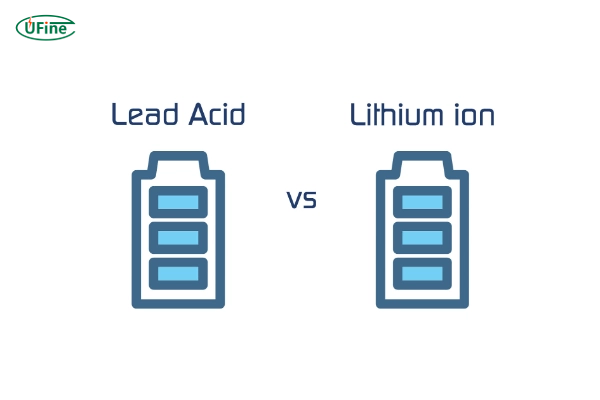
Lead acid and lithium-ion batteries are the two most widely used rechargeable battery technologies today. They differ fundamentally in chemistry, energy density, safety profile, cost structure, and long-term performance. This guide provides a clear, engineering-focused comparison to help you understand lead acid vs lithium-ion battery safety, price per kWh, size differences, and real-world application trade-offs, so you can make informed selection decisions for industrial, commercial, and energy storage systems.
Key Takeaways
- Lithium-ion batteries deliver 3–5× higher energy density than lead acid, enabling smaller and lighter systems.
- Lead acid batteries have a lower upfront price per kWh, but higher lifetime cost due to shorter cycle life and maintenance.
- Lithium-ion allows deeper depth of discharge (80–90%), while lead acid is typically limited to ~50% to avoid damage.
- Safety risks differ: lead acid involves corrosive acid and gas release; lithium-ion requires BMS control to prevent thermal runaway.
- For frequent cycling and space-constrained systems, lithium-ion is usually the better long-term choice.
- For low-budget, backup-only, or legacy systems, lead acid remains viable.
Part 1. Lead acid batteries
1 Chemistry and construction
Lead acid batteries use lead (Pb) and lead dioxide (PbO₂) plates immersed in a sulfuric acid electrolyte. Each cell produces about 2.0 V, and multiple cells are connected in series to form common system voltages such as 12 V, 24 V, or 48 V.
Common subtypes include:
- Flooded (vented) lead acid
- AGM (Absorbent Glass Mat)
- Gel lead acid
2 Advantages of lead acid batteries
- Low upfront cost: Typical lead acid battery price per kWh is lower than lithium-ion.
- Mature, proven technology: Used for over a century with predictable behavior.
- High recyclability: Over 95% of lead acid batteries are recycled globally.
- Good surge current capability: Suitable for engine starting and short-duration high current loads.
3 Limitations and drawbacks
- Low energy density: ~30–40 Wh/kg, resulting in large and heavy battery systems.
- Limited cycle life: Typically 300–500 cycles at 50% depth of discharge.
- Maintenance needs: Flooded types require electrolyte checks and ventilation.
- Poor performance under deep discharge: Frequent deep cycling accelerates sulfation and capacity loss.
4 Typical applications
- Automotive SLI (starting, lighting, ignition) batteries
- UPS and emergency backup power
- Telecom base stations
- Forklifts and industrial vehicles
- Off-grid solar systems with low cycling frequency
Part 2. Lithium-ion batteries
1 Chemistry and structure
Lithium-ion batteries store energy through the reversible movement of lithium ions between the anode (usually graphite) and cathode. Common lithium chemistries include:
- Lithium Iron Phosphate (LFP)
- Lithium Nickel Manganese Cobalt Oxide (NMC)
- Lithium Cobalt Oxide (LCO)
Each lithium-ion cell operates at 3.2–3.7 V nominal, enabling higher system efficiency.
Different lithium-ion chemistries such as LFP and NMC vary significantly in safety, lifespan, and cost structure. For a deeper technical breakdown, see our guide on: types of lithium-ion batteries and their applications
2 Advantages of lithium-ion batteries
- High energy density: Typically 150–250 Wh/kg, far exceeding lead acid.
- Compact and lightweight: Significant size and weight reduction for the same capacity.
- Long cycle life: 1,000–4,000+ cycles depending on chemistry and usage.
- Fast charging: Higher charge acceptance and efficiency.
- Maintenance-free: No electrolyte topping or equalization charging required.
3 Limitations and considerations
- Higher upfront price: Lithium-ion battery vs lead acid battery price is higher per kWh initially.
- Requires protection electronics: A Battery Management System (BMS) is mandatory.
- Thermal sensitivity: Poor thermal design or abuse can cause safety incidents, though modern designs mitigate this risk.
4 Typical applications
- Electric vehicles (EVs)
- Residential and commercial energy storage systems
- Medical and portable equipment
- Robotics and automation
- Aerospace and high-performance electronics
Part 3. Lead acid vs lithium-ion: key technical comparison
1 Energy density
- Lead acid: ~30–40 Wh/kg
- Lithium-ion: ~150–250 Wh/kg
This explains the difference between lithium and lead acid battery size—lithium systems are dramatically smaller for the same energy.
2 Cost per kWh (price perspective)
- Lead acid battery cost per kWh: Lower upfront, but higher replacement frequency
- Lithium-ion battery price per kWh: Higher upfront, lower total cost of ownership over time
When lifecycle cost is considered, lithium-ion often becomes more economical for daily cycling applications.
3 Depth of discharge (DoD)
- Lead acid: Recommended ≤50%
- Lithium-ion: Commonly 80–90% usable capacity
4 Cycle life and lifespan
- Lead acid: ~300–500 cycles (3–5 years typical)
- Lithium-ion: 1,000–10,000 cycles depending on chemistry (5–15 years typical)
5 Charging speed
- Lead acid: 8–10 hours, sensitive to overcharging
- Lithium-ion: 2–4 hours, high charge efficiency
6 Safety comparison
- Lead acid battery safety: Risks include acid leakage, hydrogen gas emission, and corrosion.
- Lithium-ion battery safety: Requires proper BMS to prevent overcharge, over-discharge, and thermal runaway.
Both technologies are safe when properly designed and used, but failure modes differ.
According to IEC battery safety standards, both battery types are considered safe when designed and operated within specified limits.
Part 4. How lead acid batteries work?
During discharge, lead and lead dioxide plates react with sulfuric acid to form lead sulfate, releasing electrical energy. Charging reverses this reaction. Repeated deep discharge accelerates sulfation, permanently reducing capacity.
Part 5. How lithium-ion batteries work?
Lithium ions shuttle between anode and cathode through the electrolyte. This intercalation process allows high efficiency, deep cycling, and long service life, provided voltage and temperature limits are maintained by a BMS.
Part 6. How to choose: lead acid vs lithium-ion
When selecting a battery system, evaluate:
- Application duty cycle: Backup-only vs daily cycling
- Space and weight constraints: Critical in mobile or compact systems
- Total lifecycle cost: Not just battery price per kWh
- Maintenance capability: On-site service vs sealed systems
- Safety and compliance requirements: Ventilation, standards, and monitoring
For modern energy storage, EVs, and industrial automation, lithium-ion is usually preferred. For low-cost backup and legacy infrastructure, lead acid remains relevant.
In applications requiring frequent cycling, limited installation space, or strict weight constraints, lithium-ion battery packs are often the preferred solution. If you need voltage, capacity, or form-factor customization, see our custom lithium battery pack solutions for industrial applications.
Part 7. FAQs about lead acid vs lithium-ion
Which is safer: lead acid or lithium-ion batteries?
Both are safe when used correctly. Lead acid involves chemical and gas risks, while lithium-ion requires electronic protection to prevent thermal events.
Why do many cars still use lead acid batteries?
Lead acid batteries are cost-effective and excellent for high starting current, making them suitable for traditional automotive SLI use.
What battery lasts longer, lead acid or lithium-ion?
Lithium-ion batteries typically last 2–5× longer in cycle life and calendar life.
Can I replace a lead acid battery with lithium-ion?
Yes, but voltage, charging profile, and system compatibility must be verified to avoid damage.
Is lithium-ion always better than lead acid?
Not always. For low-budget, infrequently cycled backup systems, lead acid can still be a practical choice.
Related Tags:

More Articles
Buck vs. Boost vs. Buck-Boost Converter: Which Is Best for Battery?
Not sure which converter your battery-powered device needs? Compare Buck, Boost, and Buck-Boost designs and discover what affects voltage stability and runtime.
How to Match 18650 Cells for a Reliable Battery Pack?
Building an 18650 battery pack? Learn how to compare cell capacity, voltage, and internal resistance to avoid mismatches and improve reliability.
Why Do 18650 Battery Packs Get Hot During Discharge?
Is your 18650 battery pack overheating under load? Learn what causes excess heat, how to spot dangerous symptoms, and what to do next.
18650 Battery BMS: How to Get the Specs Right
Learn how to choose a BMS for an 18650 battery pack. Compare voltage, current ratings, protection features, and balancing before you buy.
Why Does My Ring Camera Battery Drain So Fast or Stop Charging?
Is your Ring camera battery draining fast or not charging? Discover common causes, practical fixes, and when to replace the battery.