- Key Takeaways
- Part 1. What is a battery?
- Part 2. Types of batteries used in manufacturing
- Part 3. Materials used in battery manufacturing
- Part 4. Lithium-ion battery manufacturing process (Step-By-Step)
- Part 5. How to manufacture other battery types?
- Part 6. Quality control in battery manufacturing
- Part 7. Innovations in battery manufacturing
- Part 8. Application-based battery selection guide
- Part 9. FAQs: Battery manufacturing and design
Batteries power everything from IoT devices to electric vehicles. For manufacturers, understanding the battery manufacturing process, materials, and design trade-offs is critical for product performance, safety, and cost control.
This guide explains how batteries are made, with a focus on lithium-ion technology. It also covers other chemistries and practical production insights for engineering and procurement decisions.
Key Takeaways
- Lithium-ion battery manufacturing involves coating, drying, calendering, assembly, formation, and aging—each step directly impacts performance and cycle life.
- Material selection (e.g., NMC vs LFP, graphite vs silicon blends) determines energy density, safety, and cost.
- Process control (moisture, coating uniformity, formation conditions) is more critical than raw materials alone.
- Different battery chemistries (Li-ion, lead-acid, NiMH) follow similar structures but vary in materials and assembly methods.
- Quality testing and certification (e.g., UN38.3) are essential for safe commercialization and transport.
- Manufacturing scalability depends on automation, yield rate, and consistency—not just lab-level design.
Part 1. What is a battery?
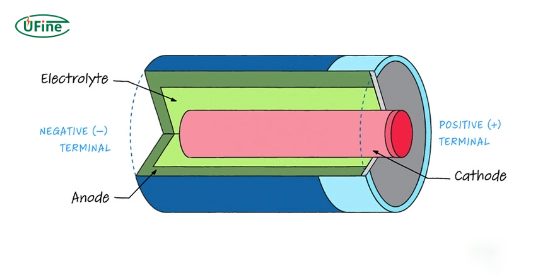
A battery is an electrochemical device that converts stored chemical energy into electrical energy.
Each cell includes:
- Anode (negative electrode): Releases electrons during discharge
- Cathode (positive electrode): Accepts electrons
- Electrolyte: Enables ion movement between electrodes
When connected to a circuit, ions move internally while electrons flow externally, generating usable power.
Batteries fall into two main categories:
- Primary batteries: Non-rechargeable (e.g., alkaline)
- Secondary batteries: Rechargeable (e.g., lithium-ion, NiMH)
Part 2. Types of batteries used in manufacturing
Understanding battery chemistry is key when deciding how to build a battery for specific applications.
1 Lithium-Ion Batteries
- High energy density and long cycle life
- Used in EVs, consumer electronics, medical devices
- Common chemistries: NMC, LFP, LCO
👉 For custom designs, see our li-ion 18650 battery solutions.
2 Lead-Acid Batteries
- Mature and low cost
- Used in automotive starters and backup systems
- Heavy but reliable
3 Nickel-Metal Hydride (Nimh)
- Moderate energy density
- Used in hybrid vehicles and consumer electronics
4 Sodium-Ion Batteries (Emerging)
- Lower cost potential
- Better raw material availability
- Still scaling commercially
Part 3. Materials used in battery manufacturing
Material selection defines performance, safety, and cost.
Key Materials In Lithium-Ion Batteries
- Lithium compounds: Lithium carbonate or hydroxide
- Cathode materials: NMC, LFP, LCO
- Anode materials: Graphite (natural or synthetic), silicon blends
- Electrolytes: Lithium salts (e.g., LiPF6) in organic solvents
- Binders: PVDF
- Conductive additives: Carbon black
👉 Material purity and particle size distribution directly affect cycle life and internal resistance.
For deeper insight into production stages, refer to our battery production process overview.
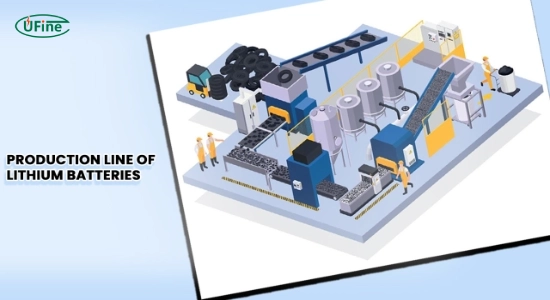
Part 4. Lithium-ion battery manufacturing process (Step-By-Step)
This section answers the core question: how are batteries made in industrial production?
Step 1: Raw Material Processing
Lithium, nickel, cobalt, and graphite are refined
Impurities must be tightly controlled (ppm level)
Step 2: Active Material Synthesis
Cathode materials (e.g., NMC) are synthesized via high-temperature reactions
Anode materials are processed for particle uniformity
Step 3: Electrode Manufacturing
This is the most critical step in how to make a Li-ion battery.
Slurry mixing: Active materials + binder + solvent
Coating: Applied to aluminum (cathode) or copper (anode) foil
Drying: Removes solvent and stabilizes coating
👉 Coating uniformity directly affects capacity consistency.
Step 4: Calendering
Roll pressing increases electrode density
Improves conductivity and energy density
Step 5: Slitting
Electrodes are cut into precise widths
Tight tolerance is required for automation
Step 6: Cell Assembly
Stacking or winding electrodes with separators
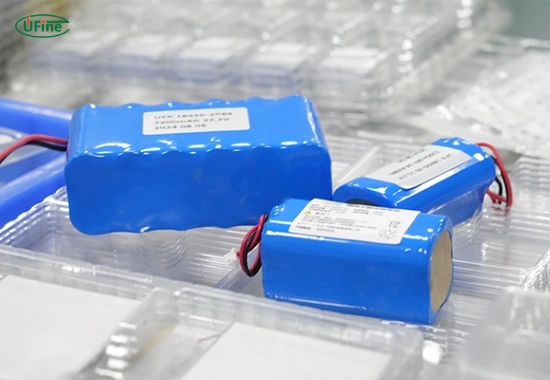
Formats: cylindrical, prismatic, pouch
Step 7: Electrolyte Filling & Sealing
Electrolyte is injected under vacuum
Cells are sealed to prevent contamination
Step 8: Formation (Initial Charging)
Controlled charging creates SEI layer
This step defines battery lifespan
Step 9: Aging & Testing
Cells rest under controlled conditions
Performance stabilizes before shipment
Part 5. How to manufacture other battery types?
1 Lead-Acid Battery Manufacturing Process
Materials:
- Lead dioxide (cathode)
- Sponge lead (anode)
- Sulfuric acid electrolyte
Steps:
- Plate grid casting
- Paste coating
- Plate curing
- Assembly with separators
- Electrolyte filling
- Formation charging
👉 Simpler than Li-ion, but heavier and lower energy density.
2 Nimh Battery Manufacturing Process
Materials:
- Nickel hydroxide
- Hydrogen storage alloy
- Potassium hydroxide electrolyte
Steps:
- Electrode coating
- Cell assembly
- Electrolyte filling
- Sealing
- Formation cycling
Part 6. Quality control in battery manufacturing
Quality control defines whether a battery is safe and scalable.
Key Tests
- Electrical tests: Capacity, voltage, internal resistance
- Cycle life testing: Charge/discharge durability
- Safety tests: Overcharge, short circuit, thermal stability
For transport compliance, manufacturers must meet standards such as UN38.3 testing requirements.
👉 Poor QC leads to swelling, capacity fade, or safety risks.
Part 7. Innovations in battery manufacturing
Solid-State Batteries
- Replace liquid electrolyte with solid
- Higher safety and energy density potential
Sodium-Ion Batteries
- Lower cost alternative to lithium
- Better resource availability
Battery Management Systems (Bms)
- Monitor voltage, temperature, and SOC
- Extend lifespan and improve safety
Part 8. Application-based battery selection guide
| Application | Recommended Chemistry | Key Requirement |
|---|---|---|
| Consumer electronics | Lithium-ion (LCO) | High energy density |
| EV / e-mobility | Lithium-ion (NMC/LFP) | Cycle life + safety |
| Backup power | Lead-acid / LFP | Low cost + reliability |
| Industrial tools | Lithium-ion (NMC) | High discharge rate |
| Medical devices | Lithium-ion / Li-primary | Stability + small size |
Part 9. FAQs: Battery manufacturing and design
How is a lithium-ion battery made step by step?
It involves electrode coating, drying, calendering, slitting, cell assembly, electrolyte filling, formation, and aging. Each step impacts performance and safety.
What are the most critical steps in battery production?
Electrode coating, moisture control, and formation are the most sensitive steps. Small defects here lead to major failures later.
How long does it take to manufacture a battery?
Typically several days to weeks, depending on aging time and testing requirements.
Can batteries be recycled after manufacturing?
Yes. Materials like lithium, nickel, and cobalt can be recovered through industrial recycling processes.
What determines battery performance the most?
Material selection, electrode design, and manufacturing precision all play key roles—not just chemistry alone.
Related Tags:

More Articles
Dead Battery or Device Failure? How to Find the Cause
Think your device is broken? Learn how to tell if the problem comes from battery aging or hardware failure before replacing your electronics.
Why iPhone Duo Uses Two Batteries: The Engineering Behind Foldable Phone Power
Why do foldable phones need two batteries? Explore the engineering challenges behind iPhone Duo’s dual-battery architecture and future battery trends.
Solid-State Batteries: 3 Myths You Need to Know
Solid-state batteries promise safer EVs and longer range, but the reality is more complex. Discover the challenges behind this next-gen technology.
Battery Capacity vs Discharge Rate: The Choice Engineers Face
Higher capacity or higher discharge rate? Learn how to choose the right LiPo battery for longer runtime, stable power output, and better device performance.
Battery Cable Size Guide: Choose the Right Wire Fast
Not sure what battery cable size you need? Learn how to select the right wire gauge, terminal size, and cable for safer, more efficient battery systems.