
How can you increase the life of an 18650 lithium ion battery?
These cells power laptops, EV packs, power tools, and industrial systems. But poor charging habits, high temperatures, and deep discharge can quickly reduce their lifespan.
This guide explains how to extend 18650 battery life, what affects performance, and how to estimate battery life cycle calculation in real use.
Key Takeaways
- Keeping an 18650 battery between 20%–80% charge can significantly extend cycle life.
- High temperature is the primary cause of capacity loss in lithium-ion batteries.
- Avoid deep discharge below 2.5–3.0V to protect long-term health.
- Typical 18650 rechargeable battery life is 300–500 cycles, but optimized use can exceed 800+ cycles.
- Battery quality and BMS design directly impact 18650 battery life stability.
Part 1. How to prolong 18650 battery life?
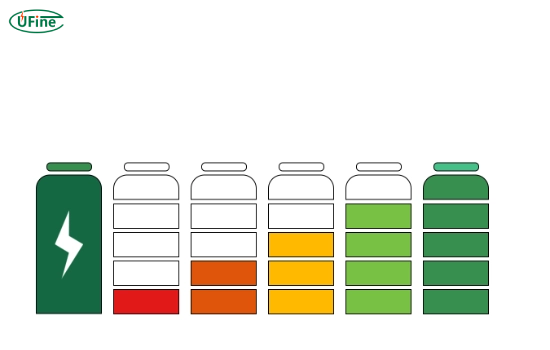
1. Optimize Charging Practices
- Use dedicated chargers designed for 18650 lithium-ion batteries
- Avoid charging to 100% all the time (ideal range: 4.1V instead of 4.2V)
- Do not leave batteries plugged in after full charge
- Use smart chargers with CC/CV control and protection
👉 For industrial packs, integrate a Battery Management System (BMS) for voltage and temperature control.
2. Control Storage Conditions
- Store at 20°C–25°C (68–77°F)
- Keep battery at 40%–60% charge for long-term storage
- Avoid humid or sealed hot environments
📌 According to Battery University, high storage voltage accelerates electrolyte degradation.
3. Improve Usage Habits
- Avoid deep discharge cycles (below 2.5V–3.0V)
- Reduce high current draw when possible
- Rotate batteries in multi-cell systems
- Optimize device settings (brightness, background apps)
4. Perform Regular Maintenance
- Clean battery contacts to reduce resistance
- Inspect for swelling, leakage, or damage
- Replace degraded or unsafe cells immediately
5. Avoid Extreme Conditions
- High heat (>45°C) → accelerates chemical aging
- Freezing (<0°C) → reduces capacity temporarily
- Mechanical stress → damages internal structure
Part 2. Factors affecting 18650 battery life
Temperature
- Heat increases internal side reactions → capacity loss
- Cold reduces performance but usually reversible
Charge Cycles
- One full cycle = 100% discharge equivalent
- Shallow cycles (e.g., 30% usage) extend lifespan
Depth of Discharge (DoD)
| DoD | Typical Cycle Life |
|---|---|
| 100% | 300–500 cycles |
| 80% | 400–700 cycles |
| 50% | 800–1200 cycles |
Manufacturing Quality
High-quality cells (consistent electrode coating, electrolyte purity) deliver:
- Better cycle stability
- Lower internal resistance
- Safer operation
👉 Learn more about cell quality differences in our internal guide: lithium battery technology insights
Application Load
- High-drain devices (power tools, EVs) → faster degradation
- Low-drain systems (IoT, backup power) → longer lifespan
Part 3. 18650 Battery life cycle calculation
What Is Cycle Life?
Cycle life refers to how many charge/discharge cycles a battery completes before dropping to ~80% of its original capacity.
Using Peukert’s Law (Simplified)

Key variables:
- Capacity (Ah)
- Discharge current (A)
- Peukert exponent (k ≈ 1.05–1.15 for lithium-ion)
Example
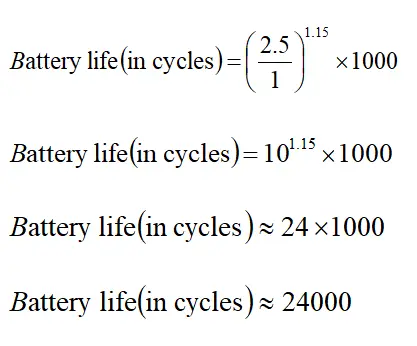
- Battery: 2500mAh (2.5Ah)
- Discharge: 1A
- Result: theoretical cycle estimate under ideal conditions
⚠️ In practice, real 18650 battery life cycle is much lower due to:
- Temperature variation
- Charging behavior
- Internal resistance growth
📌 For engineering design, refer to standards like IEC 61960 for testing methods.
Part 4. Real-world 18650 battery life
| Scenario | Expected Lifespan |
|---|---|
| Consumer electronics | 2–3 years |
| EV battery modules | 3–5 years |
| Industrial storage | 5–8 years |
👉 Proper management can extend 18650 lithium ion battery life by 30–80%.
Part 5. FAQs about 18650 battery life
How long does an 18650 battery last?
Most 18650 rechargeable batteries last 300–500 cycles, or about 2–5 years depending on usage and temperature.
How many times can an 18650 battery be recharged?
Typically 300–500 cycles, but optimized charging (20–80%) can increase this to 800+ cycles.
What shortens 18650 battery life the most?
High temperature, overcharging, and deep discharge are the main causes of early failure.
Can you overcharge a 18650 battery?
Yes. Overcharging can cause overheating and safety risks. Always use protected chargers or BMS systems.
When should I replace an 18650 battery?
Replace when:
- Capacity drops below 70–80%
- Runtime becomes unstable
- Physical damage appears
Related Tags:

More Articles

JST vs Molex: The Right Battery Connector Choice
JST or Molex for your battery? Learn how connector selection affects current, voltage drop, reliability, and device performance.
Custom Battery Pricing: Costs Manufacturers Don’t Mention
A low battery quote may not be the final cost. Discover common hidden expenses that affect custom lithium battery projects.
Battery Wire Length: Hidden Cause of Power Loss
A longer battery wire can cause voltage drop, power loss, and unstable operation. Learn how wire length affects battery performance.
How Device Sleep Modes Affect Battery Life
Think sleep mode extends battery life? Learn why devices still drain power and how firmware, hardware, and batteries affect runtime.
LiPo Battery and PCB Design: Clearance, Insulation, and Placement
Learn how to optimize LiPo battery PCB clearance, insulation, placement, wiring, and thermal design—and avoid common integration mistakes.


