
- Part 1. Smartwatch battery market size and industry overview
- Part 2. What determines smartwatch battery life?
- Part 3. Battery chemistry and structural design for smartwatches
- Part 4. Which smartwatch battery has the longest lifespan?
- Part 5. Cycle life vs. runtime: what’s the difference?
- Part 6. Smartwatch battery lifespan and run time comparison
- Part 7. Smartwatch battery life under different loads
- Part 8. What kills smartwatch batteries?
- Part 9. Why does lithium battery performance drops in cold environments
- Part 10. How to extend battery lifespan?
- Part 11. How to choose a long-lasting smart watch battery?
- Part 12. FAQS
Key takeaways
- Smartwatch battery life is governed by energy system design, not just battery capacity (mAh).
- Lithium polymer pouch cells dominate wearables due to volumetric efficiency, mechanical flexibility, and discharge stability.
- Real battery life is determined by average system current, including SoC idle power, display duty cycle, and sensor sampling architecture.
- Temperature affects lithium-ion electrochemistry at a diffusion level, directly changing usable capacity and voltage stability.
- Most smartwatch batteries degrade due to SEI layer growth, cycle stress, and elevated thermal exposure, not simply charge cycles.
Part 1. Smartwatch battery market size and industry overview
The smartwatch battery market has been expanding steadily alongside the rapid growth of the global wearable device industry. In 2024, the global smartwatch market itself is estimated to exceed USD 40–45 billion, and is projected to continue growing at a CAGR of around 8–12% through 2030, according to multiple industry research reports.
Within this ecosystem, the smartwatch battery segment—primarily dominated by lithium-ion and lithium polymer pouch cells—is also experiencing consistent growth. Although battery components are not always reported as a standalone market, the wearable lithium battery segment is generally estimated to be valued in the low single-digit billion USD range globally, with strong year-on-year growth driven by:
- Increasing demand for longer battery life in fitness and health tracking devices
- Higher energy consumption from GPS, AMOLED displays, and always-on sensors
- The shift toward ultra-thin and compact wearable designs requires custom lithium polymer batteries
- Expansion of mid-range and premium smartwatch brands globally
Among all battery chemistries, lithium polymer batteries account for the majority share in smartwatch applications due to their superior volumetric efficiency and ability to support flexible, space-constrained device architectures.
As smartwatches evolve toward more advanced health monitoring and always-connected functionality, the demand for high-efficiency, low-thickness, and high-stability battery solutions is expected to continue increasing, making battery engineering a critical competitive factor for wearable manufacturers.
Part 2. What determines smartwatch battery life?
Smartwatch battery life is not a “battery problem”—it is a system-level energy balance problem.
From an engineering perspective, battery life is determined by:
1. Average system current consumption (most important factor)
This is the dominant variable and includes:
- SoC idle leakage current (always-on baseline drain)
- Display power draw (OLED subpixel activation + refresh logic)
- Wireless stack consumption (Bluetooth LE / Wi-Fi bursts)
- Sensor polling architecture (PPG, accelerometer, GPS duty cycles)
Even small reductions in idle current (e.g., 2 mA → 1 mA) can extend standby time by 30–50%.
2. Duty cycle behavior of high-load components
Smartwatch power spikes are not continuous—they are burst-based.
Examples:
- GPS module: high current bursts every second
- Heart rate monitoring: periodic photodiode activation
- Screen wake: sudden peak current during UI transitions
Battery life depends heavily on how the firmware schedules these events.
3. Display power architecture
OLED displays behave differently from LCDs:
- OLED power depends on pixel brightness and UI design
- Black interfaces significantly reduce consumption
- Always-on display introduces continuous micro-load
Display alone can account for 20–40% of total energy consumption.
Part 3. Battery chemistry and structural design for smartwatches
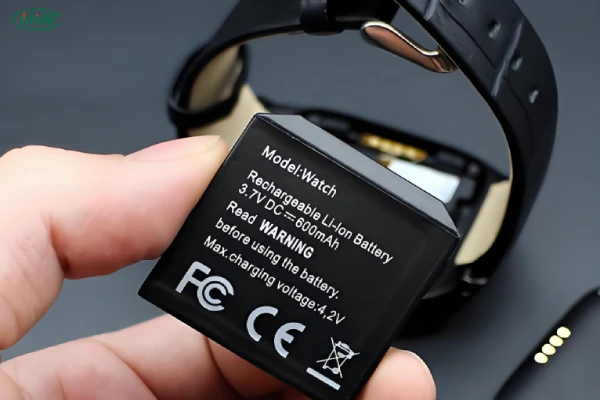
The battery is the heart of your smartwatch. Without it, your device is just a piece of metal and glass. But not all smartwatch batteries are the same. Some last longer, charge faster, and handle extreme temperatures better.
Most smartwatches use rechargeable lithium-based batteries due to their high energy density, lightweight structure, and ability to hold a charge for long periods. Let’s explore the most common types:
1 Lithium-Ion (Li-Ion) Batteries
The most widely used battery type in smartwatches.
Offers high energy density, making it ideal for compact devices.
Fast charging but has a limited lifespan (about 300-500 charge cycles).
May experience performance degradation after prolonged use.
2 Lithium-Polymer (LiPo) Batteries
More flexible and lightweight than Li-Ion batteries.
Better safety performance due to lower risk of leakage.
Can be molded into different shapes, allowing ultra-thin smartwatch designs.
Generally last longer than Li-Ion batteries with proper care.
3 Solid-State Batteries (Future Technology)
Expected to outperform Li-Ion and LiPo batteries in terms of lifespan and safety.
Higher energy density, meaning longer battery life in smaller sizes.
Currently in development and not yet common in consumer smartwatches.
| Battery type | Energy density | Mechanical form factor | Wearable suitability | Engineering limitation |
|---|---|---|---|---|
| Cylindrical lithium-ion | High | Rigid | Poor | wasted internal volume |
| Lithium polymer pouch | High | Flexible ultra-thin | Excellent | swelling management required |
| Solid-state (emerging) | Very high | ultra-thin potential | future use | manufacturing maturity |
At Ufine Battery, we specialize in custom lithium-ion and lithium-polymer batteries for smartwatches. Our batteries are designed for maximum longevity and efficiency. If you’re a smartwatch manufacturer looking for high-quality power solutions, contact us today!
Part 4. Which smartwatch battery has the longest lifespan?
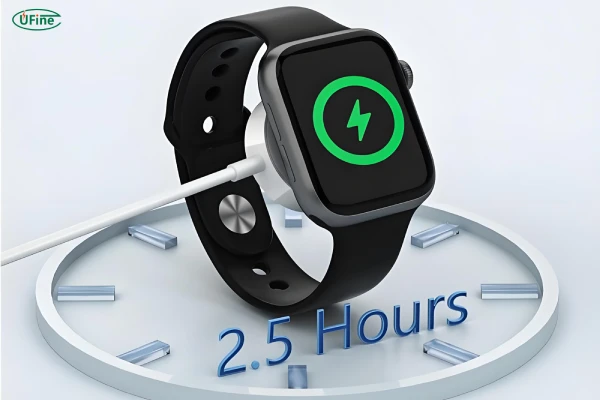
If you want a battery that lasts for years, not just months, you need to understand real-world degradation.
Battery Lifespan Comparison
| Battery Type | Cycle Life (Full Charges) | Degradation Rate | Best For |
|---|---|---|---|
| Li-ion | 300-500 cycles | Loses ~20% capacity after 500 cycles | Budget-friendly smartwatches |
| LiPo | 400-600 cycles | Loses ~15% capacity after 600 cycles | Premium, long-lasting wearables |
| Solid-State | 1,000+ cycles (estimated) | Minimal degradation | Future smartwatches |
Why LiPo Lasts Longer:
-
Stable chemistry (less prone to internal damage)
-
Better heat resistance (slower degradation in high temps)
-
Flexible structure (reduces wear from repeated charging)
Pro Tip: If your smartwatch allows battery replacement, upgrading to a high-quality LiPo battery (like those from Ufine Battery) can double its usable life.
Part 5. Cycle life vs. runtime: what’s the difference?
Many users confuse these two, but they’re not the same thing.
A. Cycle Life (Long-Term Durability)
-
Definition: The number of full charge cycles (0% to 100%) a battery can handle before losing significant capacity.
-
Example: A 500-cycle battery charged daily will last about 1.5 years before dropping to 80% capacity.
B. Runtime (Daily Usage Time)
-
Definition: How long a single charge lasts under normal use.
-
Example: An Apple Watch lasts 18-24 hours, while a Garmin can go 7+ days on one charge.
Key Insight:
-
A battery with high cycle life (like LiPo) will last longer over the years.
-
A battery with high runtime (like in Garmin watches) needs fewer charges, indirectly extending lifespan.
Part 6. Smartwatch battery lifespan and run time comparison
Here’s how popular smartwatches compare in real-world usage:
| Smartwatch Model | Battery Type | Avg. Runtime | Cycle Life | Years Until 80% Capacity |
|---|---|---|---|---|
| Apple Watch Series 9 | Li-ion | 18-36 hrs | 500 cycles | ~1.5 years (daily charging) |
| Samsung Galaxy Watch 6 | Li-ion | 30-40 hrs | 500 cycles | ~1.5 years |
| Garmin Venu 3 | LiPo | Up to 14 days | 600 cycles | ~3 years (weekly charging) |
| Fitbit Sense 2 | LiPo | 6+ days | 600 cycles | ~3 years |
Takeaway:
-
Frequent chargers (like Apple/Samsung users) wear out batteries faster.
-
Long-runtime watches (Garmin/Fitbit) last longer because they charge less often.
Part 7. Smartwatch battery life under different loads
In engineering validation tests, usage profiles are typically divided into energy states:
| Operational profile | System behavior | Estimated battery life |
|---|---|---|
| Ultra-low power standby | minimal sensor + BLE sleep | 7–20 days |
| Balanced fitness mode | periodic HR + notifications | 3–7 days |
| High-frequency tracking | continuous HR + frequent sync | 1–3 days |
| GPS intensive mode | continuous GNSS + display active | 8–36 hours |
The key insight is that smartwatch “battery life” is actually a weighted state machine problem, not a static specification.
Part 8. What kills smartwatch batteries?
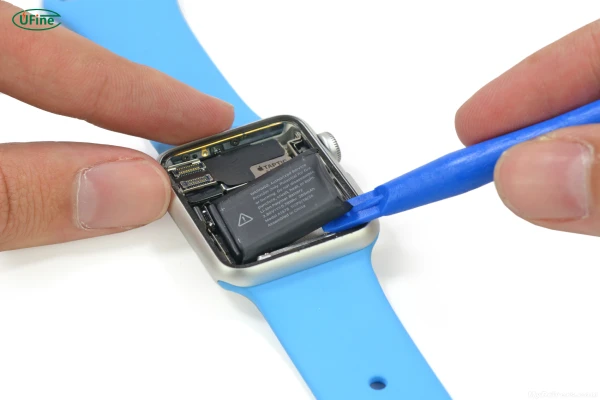
Even the best battery won’t last if mistreated. Here’s what destroys battery health:
🔋1. Heat
-
Why? High temps accelerate chemical degradation.
-
Fix: Avoid leaving your watch in hot cars or direct sunlight.
🔋 2. Deep Discharges (0% Battery)
-
Why? Draining to 0% strains the battery.
-
Fix: Charge before it drops below 20%.
🔋 3. Fast Charging Every Day
-
Why? High-voltage charging generates heat and stress.
-
Fix: Use slow charging when possible.
🔋 4. Always-On Display & GPS
-
Why? These features drain power constantly.
-
Fix: Disable when not needed
Part 9. Why does lithium battery performance drops in cold environments
Temperature impacts lithium-ion batteries at a diffusion and kinetic level, not just a “capacity reduction” level.
At low temperatures, three physical effects occur:
1. Reduced lithium-ion diffusion rate
Lithium ions move more slowly through the electrolyte, reducing reaction efficiency.
2. Increased internal impedance
Electrochemical resistance rises, causing a voltage sag under load.
3. Early cutoff voltage trigger
Devices shut down earlier because voltage drops below operational thresholds, even if capacity remains.
This is why a smartwatch may shut down at 20–30% battery in cold weather.
Importantly, this is not actual energy loss—it is usable energy limitation caused by electrochemical constraints.
Part 10. How to extend battery lifespan?
Want your battery to last years, not months? Follow these science-backed tips:
Daily Use Tips
- Lower screen brightness and reduce Always-On Display usage.
- Turn off unnecessary features like LTE, Wi-Fi, and Bluetooth when not in use.
- Close background apps to minimize power consumption.
Long-Term Battery Health Tips
- Avoid charging to 100% all the time; aim for 80-90% instead.
- Don’t let the battery drop below 20% frequently.
- Use the original charger to avoid voltage fluctuations.
- Keep the watch at room temperature; avoid extreme heat or cold.
Part 11. How to choose a long-lasting smart watch battery?
When selecting a smartwatch, battery performance should be a priority. Here’s what to consider:
✔ Battery Type – LiPo batteries generally last longer than Li-Ion batteries.
✔ Brand Reputation – Brands like Garmin and Amazfit focus on battery longevity.
✔ Software Optimization – WatchOS and Wear OS impact power efficiency.
✔ Battery Capacity – A larger battery doesn’t always mean better life if the smartwatch has power-hungry features.
If you’re looking for a smartwatch with a long battery life, consider models with LiPo batteries, efficient processors, and power-saving software.
Part 12. FAQS
How much battery capacity does a typical smartwatch have?
Most smartwatches use batteries ranging from 150 mAh to 500 mAh. Compact fitness trackers may use smaller batteries, while GPS-focused sports watches often require larger capacities to support extended tracking sessions.
Is it safe to leave a smartwatch charging overnight?
Modern smartwatches include battery management systems that stop charging when the battery reaches full capacity. While occasional overnight charging is generally safe, keeping a battery at 100% charge for extended periods may accelerate long-term capacity degradation.
Can smartwatch batteries be replaced?
In many smartwatches, the battery can technically be replaced, but the process often requires specialized tools because the device is sealed for water resistance. Some manufacturers offer official battery replacement services.
Why does battery life decrease after software updates?
Software updates sometimes introduce new features, background processes, or sensor functions that increase power consumption. In many cases, battery performance stabilizes after the system completes indexing, synchronization, and optimization tasks following the update.
Do faster charging speeds shorten smartwatch battery lifespan?
Frequent fast charging can generate additional heat and place more stress on battery materials. While modern battery management systems reduce this risk, slower charging generally produces less thermal stress and may help preserve battery health over the long term.
Related Tags:

More Articles

JST vs Molex: The Right Battery Connector Choice
JST or Molex for your battery? Learn how connector selection affects current, voltage drop, reliability, and device performance.
Custom Battery Pricing: Costs Manufacturers Don’t Mention
A low battery quote may not be the final cost. Discover common hidden expenses that affect custom lithium battery projects.
Battery Wire Length: Hidden Cause of Power Loss
A longer battery wire can cause voltage drop, power loss, and unstable operation. Learn how wire length affects battery performance.
How Device Sleep Modes Affect Battery Life
Think sleep mode extends battery life? Learn why devices still drain power and how firmware, hardware, and batteries affect runtime.
LiPo Battery and PCB Design: Clearance, Insulation, and Placement
Learn how to optimize LiPo battery PCB clearance, insulation, placement, wiring, and thermal design—and avoid common integration mistakes.


