
- Key takeaways
- Part 1. What is a d battery?
- Part 2. What is a c battery?
- Part 3. D battery vs c battery: size and dimensions
- Part 4. Difference between c and d batteries: capacity and runtime
- Part 5. D battery vs c battery applications
- Part 6. Can you use a c battery instead of a d battery?
- Part 7. Are c and d batteries interchangeable?
- Part 8. Rechargeable d battery vs rechargeable c battery
- Part 9. Cost comparison: c battery vs d battery
- Part 10. How to choose between a d battery and a c battery?
- Part 11. D battery vs c battery FAQs
Choosing between a D battery and a C battery can affect device performance, runtime, and operating costs.
While both batteries provide similar voltage, they differ in size, capacity, weight, and intended applications. D batteries offer longer runtime and higher energy storage, while C batteries provide a smaller, lighter option for medium-drain devices.
This guide compares D battery vs C battery dimensions, capacity, applications, lifespan, and interchangeability to help you select the right battery for your needs.
Key takeaways
- D batteries are physically larger than C batteries and store significantly more energy.
- Standard D battery dimensions are 61.5 mm × 33.2 mm, while C battery dimensions are 50 mm × 26.2 mm.
- Typical alkaline D battery capacity ranges from 12,000–20,000 mAh.
- Typical alkaline C battery capacity ranges from 6,000–8,000 mAh.
- D batteries generally provide longer runtime in high-drain devices.
- C batteries are lighter and better suited for medium-power portable equipment.
- C and D batteries are not directly interchangeable due to size differences.
- Rechargeable versions are available in both NiMH and lithium-based chemistries.
Part 1. What is a d battery?
A D battery is a large cylindrical battery designed for devices that require sustained power over extended periods.
For decades, D cells have been widely used in industrial equipment, emergency lighting, large flashlights, radios, medical devices, and portable instruments.
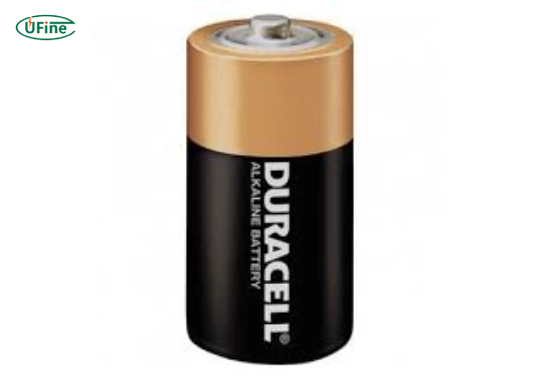
D battery specifications
| Specification | D Battery |
|---|---|
| IEC Size | R20 |
| Diameter | 33.2 mm |
| Height | 61.5 mm |
| Voltage | 1.5V (alkaline), 1.2V (NiMH) |
| Typical Capacity | 12,000–20,000 mAh |
| Weight | 140–160 g |
| Typical Applications | Flashlights, radios, medical devices |
Types of d batteries
Alkaline D Batteries
The most common disposable D cell. They provide good shelf life and low cost.
Rechargeable NiMH D Batteries
Suitable for frequently used equipment. They can be recharged hundreds of times.
Lithium D Batteries
Offer longer runtime, lower self-discharge, and better cold-weather performance.
For a detailed breakdown, see our guide on D battery types and applications.
Part 2. What is a c battery?
A C battery is a medium-sized cylindrical battery that balances capacity, weight, and portability.
C batteries are often found in portable radios, toys, musical instruments, lanterns, and medium-drain electronic devices.
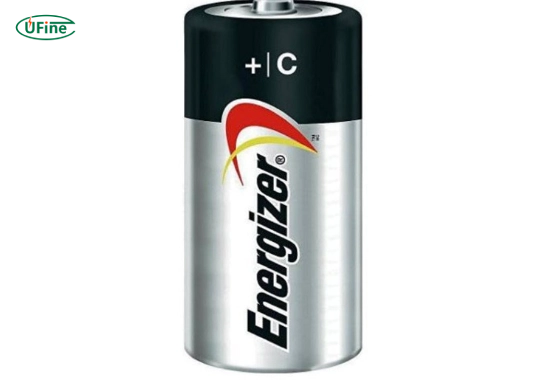
C battery specifications
| Specification | C Battery |
|---|---|
| IEC Size | R14 |
| Diameter | 26.2 mm |
| Height | 50 mm |
| Voltage | 1.5V (alkaline), 1.2V (NiMH) |
| Typical Capacity | 6,000–8,000 mAh |
| Weight | 65–75 g |
| Typical Applications | Toys, radios, instruments |
Types of c batteries
Alkaline C Batteries
The most widely available disposable option.
Rechargeable NiMH C Batteries
Ideal for devices with regular battery replacement needs.
Lithium C Batteries
Offer longer shelf life and improved performance under extreme temperatures.
You can also read our complete guide to C batteries and their applications.
Part 3. D battery vs c battery: size and dimensions
One of the most searched questions is: “What are the dimensions of a C battery compared with a D battery?”
Battery size comparison
| Battery Type | Height | Diameter |
|---|---|---|
| C Battery | 50 mm | 26.2 mm |
| D Battery | 61.5 mm | 33.2 mm |
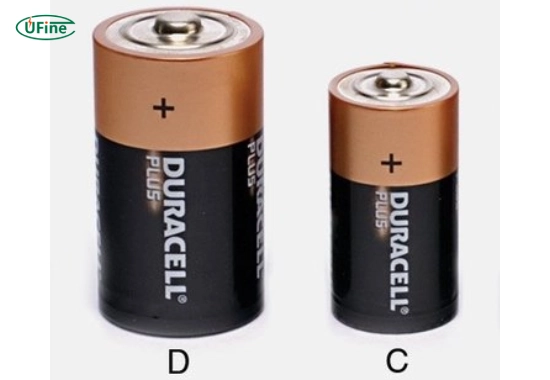
What do d batteries look like?
A D battery looks like a larger version of a C battery. Both are cylindrical, but the D cell is noticeably wider and taller.
Many users searching for “what do D batteries look like” are surprised by the substantial size difference when placed side by side.
Part 4. Difference between c and d batteries: capacity and runtime
The biggest functional difference between C and D batteries is energy storage.
Typical capacity comparison
| Battery Type | Typical Capacity |
|---|---|
| C Battery | 6,000–8,000 mAh |
| D Battery | 12,000–20,000 mAh |
A D battery may provide more than twice the usable energy of a C battery.
Runtime example
For a high-power flashlight:
| Battery Type | Typical Runtime |
|---|---|
| C Battery | 10–12 Hours |
| D Battery | 20+ Hours |
Actual performance depends on battery chemistry, discharge rate, and device efficiency.
Part 5. D battery vs c battery applications
Choosing the correct battery depends largely on power requirements.
Best uses for d batteries
- Large flashlights
- Emergency lighting systems
- Portable medical equipment
- Industrial instruments
- Boomboxes and radios
- Camping equipment
Best uses for c batteries
- Children’s toys
- Portable lanterns
- Musical instruments
- Small flashlights
- Portable audio devices
- Household electronics
Application selection table
| Device Type | Recommended Battery |
|---|---|
| Emergency Radio | D Battery |
| High-Power Flashlight | D Battery |
| Children’s Toy | C Battery |
| Portable Speaker | C Battery |
| Medical Equipment | D Battery |
| Portable Lantern | C Battery or D Battery |
Part 6. Can you use a c battery instead of a d battery?
Technically, yes.
Battery adapters are available that allow a C battery to fit inside a D battery compartment.
However, there are important limitations:
- Runtime will be significantly shorter.
- Voltage remains the same, but available energy decreases.
- High-drain devices may experience reduced performance.
- More frequent battery replacement is required.
For mission-critical equipment, manufacturers generally recommend using the specified battery size.
Part 7. Are c and d batteries interchangeable?
In most cases, no.
Why They Are Not Interchangeable
Physical Size Difference: A D battery cannot fit into a C battery compartment.
Capacity Difference: Even with an adapter, a C battery cannot match the runtime of a D battery.
Device Performance: Some equipment is designed around the larger energy reserve provided by D cells.
Always follow the battery specifications listed by the equipment manufacturer.
Part 8. Rechargeable d battery vs rechargeable c battery
Rechargeable batteries can significantly reduce operating costs.
Benefits of Rechargeable Batteries
- Hundreds of charge cycles
- Lower long-term cost
- Reduced environmental waste
- Stable voltage output
- Better performance under repeated use
For industrial projects requiring custom rechargeable solutions, many manufacturers are moving toward lithium battery packs instead of traditional C and D cells because of higher energy density and lower weight.
Learn more about Lithium-ion vs NiMH batteries when evaluating rechargeable alternatives.
Part 9. Cost comparison: c battery vs d battery
| Battery Type | Average Price Per Cell | Typical Runtime |
|---|---|---|
| C Battery | $1.50–$3.50 | Medium |
| D Battery | $2.50–$5.00 | Long |
| Rechargeable C | Higher Initial Cost | Hundreds of Cycles |
| Rechargeable D | Higher Initial Cost | Hundreds of Cycles |
Although D batteries cost more, they often deliver a lower cost per operating hour due to their longer runtime.
Part 10. How to choose between a d battery and a c battery?
Choose a D battery if:
- Long runtime is critical
- Your device has high current demands
- Reliability matters during emergencies
- Battery replacement is inconvenient
Choose a C battery if:
- Portability is important
- Space is limited
- Your device has moderate power requirements
- Weight reduction is a priority
For modern industrial and portable equipment, engineers increasingly evaluate custom lithium battery packs as replacements for traditional primary cells because they provide higher energy density and longer service life.
Part 11. D battery vs c battery FAQs
What is the difference between a D battery and a C battery?
The main difference is size and capacity. D batteries are larger and typically provide 12,000–20,000 mAh, while C batteries usually provide 6,000–8,000 mAh.
Which lasts longer, a D battery or a C battery?
A D battery lasts significantly longer because it contains more active material and stores more energy.
Can I replace a D battery with a C battery?
Only with an adapter, and runtime will be reduced. For high-drain applications, using the correct D battery is recommended.
What are standard C battery dimensions?
A standard C battery measures approximately 50 mm in height and 26.2 mm in diameter.
Are rechargeable D and C batteries worth buying?
Yes. If batteries are replaced frequently, rechargeable versions usually provide substantial long-term cost savings and reduce waste.
Related Tags:

More Articles

JST vs Molex: The Right Battery Connector Choice
JST or Molex for your battery? Learn how connector selection affects current, voltage drop, reliability, and device performance.
Custom Battery Pricing: Costs Manufacturers Don’t Mention
A low battery quote may not be the final cost. Discover common hidden expenses that affect custom lithium battery projects.
Battery Wire Length: Hidden Cause of Power Loss
A longer battery wire can cause voltage drop, power loss, and unstable operation. Learn how wire length affects battery performance.
How Device Sleep Modes Affect Battery Life
Think sleep mode extends battery life? Learn why devices still drain power and how firmware, hardware, and batteries affect runtime.
LiPo Battery and PCB Design: Clearance, Insulation, and Placement
Learn how to optimize LiPo battery PCB clearance, insulation, placement, wiring, and thermal design—and avoid common integration mistakes.


